Hazard Communication
Updated 2026-07-28
In this bundle Jobsite Fundamentals & Compliance
Print-ready PDF
Download this talk as a print-ready PDF, available in 4 languages.
Hazard communication is the most cited standard almost every year, and the reason is not that chemicals are hard. It is that HazCom is a system with four moving parts, and a site can do three of them well and still fail. The chemicals are labelled but nobody has the data sheets; the data sheets are in a binder in a locked office; the training happened but only for the people who were there in March. This Hazard Communication Toolbox Talk (Safety Talk / Tailgate Talk) is about the system rather than the substances.
Here is the distinction that carries this whole talk: the right to know is worthless without the ability to find out. The standard exists so that a worker holding an unfamiliar container can establish, within a couple of minutes, what it is and what it will do to them. Every requirement in it — labels, data sheets, the written programme, the training — is a step in that one chain. Break any link and the whole chain fails, no matter how good the other three are.
Construction's standard is one sentence#
29 CFR 1926.59 is a pointer: the requirements applicable to construction work are identical to those set forth at 29 CFR 1910.1200. Construction does not have its own HazCom rule — it has the general industry rule, incorporated whole.
That matters practically, because it means every reference, every appendix and every update to 1910.1200 applies on your site directly. When somebody says "that's a general industry thing," on HazCom they are wrong.
The four parts#
1. Hazard classification. Chemical manufacturers and importers evaluate the hazards of their products and assign them to classes and categories. That happens upstream of you — but it is why the information arriving on labels and data sheets is standardised rather than each supplier's own invention.
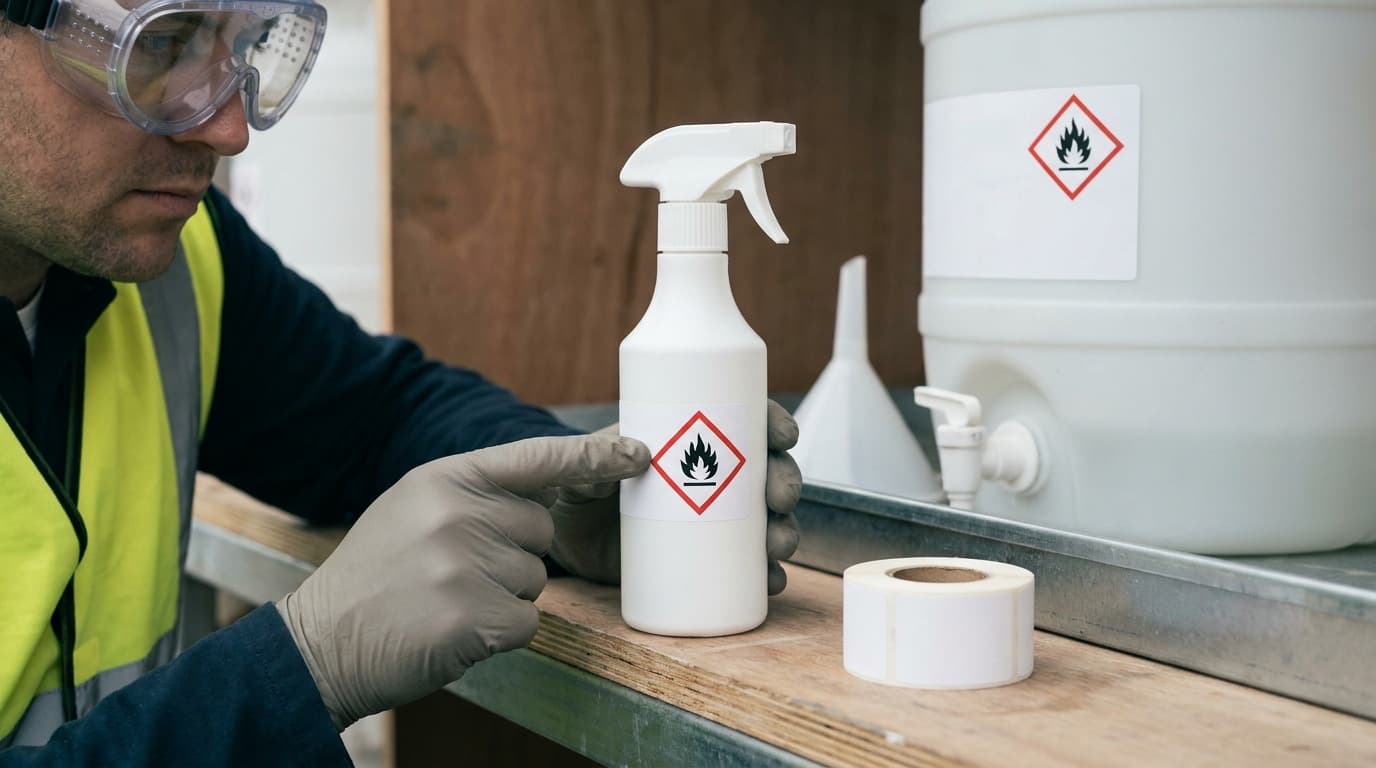
2. Labels. Every container of a hazardous chemical needs a label communicating the hazard, both as shipped and as used in your workplace. The elements, signal words and pictograms are covered in the chemical labelling talk.
3. Safety data sheets. A standardised 16-section document for each hazardous chemical, which must be readily accessible to employees. The format and what each section is for are covered in the safety data sheets talk.
4. Training. Employees must be trained on the hazards and on how the system works — including how to read the labels and the data sheets — so the information can actually be used.

Behind all four sits 1910.1200(e), the written hazard communication programme. It must address container labelling, data sheet availability and training, identify who is responsible for each element, and be available to employees. On a construction site with multiple employers it also has to explain how information reaches the other contractors working alongside you — which is the part most often missing.
Training is due before initial assignment to work with a hazardous chemical, and again whenever a new hazard is introduced. That is what makes the "we did HazCom in March" answer inadequate: on construction sites, new people and new products arrive continuously.
What changed in 2024 — and the dates now running#
This is the part most training material has not caught up with.
On 20 May 2024, OSHA published a final rule (89 FR 44144) amending the Hazard Communication Standard to align it with Revision 7 of the UN Globally Harmonized System. It revised hazard classification criteria, labelling provisions and rules on concentrations claimed as trade secrets. The section became effective 19 July 2024.
Compliance is staged, not immediate. During the transition, manufacturers, importers, distributors and employers may comply with either the amended section or 1910.1200 as revised on 1 July 2023, or both. Manufacturers, importers and distributors evaluating substances were required to comply with all modified provisions no later than 19 May 2026, with the remaining dates running to January 2028.
The practical consequence on site today: you will be receiving labels and data sheets in both the old and the new format at the same time, legitimately. A document that does not look like the last one is not necessarily wrong. What matters is that the information is present, current and reachable — not that everything matches.
One more change worth knowing: where a DOT pictogram required under 49 CFR appears on a shipped container, the HCS pictogram for the same hazard is not required on that label. That resolves the double-pictogram question that used to come up on deliveries.
And note the boundary of the system itself — OSHA's HCS, unlike the GHS it is built on, does not cover environmental hazards, and eight pictograms are designated under the standard rather than the nine in the GHS.
What HazCom does not cover#
1910.1200(b)(6) carries blanket exemptions, and two matter on construction sites: consumer products used as intended, for the same duration and frequency a consumer would use them, and biological hazards. The first one is narrower than people assume — using a consumer product all day, every day, is not "as a consumer would use it," and the exemption stops applying.
What can go wrong?#
The written programme exists but nobody has read it. A folder in the office is not a communication system.
Data sheets locked away. In a cabinet, on a laptop nobody can access, or behind a login the crew does not have.
Training done once, for whoever was present. New starters and new products arrive continuously, and training is due before assignment.
Secondary containers unlabelled. Decanted solvent in an unmarked bottle is the classic HazCom citation.

Other contractors not informed. Multi-employer sites need the information to travel between employers, and the written programme has to say how.
Old and new format documents treated as an error. During the transition, both are legitimate.
Nobody knows who owns it. The programme has to identify the person responsible for each element.
"It's just paint." Familiarity, not information, deciding how a product is handled.
How do we make this work?#
Make the chemical inventory match reality. What is actually on site today, not what was ordered.
Put the data sheets where the work is, reachable during each work shift without asking permission, on paper or by a device everyone can actually use.
Train before assignment, not after. And treat a new product as a new training trigger.
Label every secondary container the moment anything is decanted.
Name the owner of each element in the written programme — labelling, data sheets, training, contractor coordination.
Brief the other trades. Their exposure to your chemicals is your communication duty.
Expect mixed formats through the transition and check content rather than appearance.
Ask the question the standard is built for: what is it, what will it do to me, and what do I do if it goes wrong?
Before you start#
- Confirm every hazardous chemical you will use today is on the inventory.
- Confirm you can reach its safety data sheet right now, from where you are working.
- Confirm the container in front of you is labelled — including any secondary container.
- Confirm you have been trained on this product, not just on HazCom generally.
- Confirm who else on site is exposed to what you are using, and that they know.
- Confirm the written programme names who is responsible for each element.
- Confirm anything new on site has triggered a training and inventory update.
- Confirm you know what to do if it spills, or gets on skin or in eyes.
Talk it over#
- Pick up the nearest container — can you find its data sheet in two minutes?
- What is in that unmarked bottle, and who decanted it?
- Which trade working near you is using something you know nothing about?
- Who on this site owns the hazard communication programme?
The bottom line#
1926.59 makes construction's requirements identical to 29 CFR 1910.1200, so the general industry standard applies here whole. It is a four-part system: hazard classification, labels, safety data sheets and training, held together by the written hazard communication programme under (e), which must cover labelling, data sheet availability and training and identify who is responsible for each element. Training is due before initial assignment and whenever a new hazard appears. OSHA's 20 May 2024 final rule (89 FR 44144) aligned the standard with GHS Revision 7, effective 19 July 2024, with staged compliance — substances by 19 May 2026 and remaining dates running to January 2028 — so mixed old-format and new-format documents are legitimate right now. Note also that OSHA's HCS designates eight pictograms and, unlike the GHS, does not cover environmental hazards.
Frequently asked questions about hazard communication#
Does the HazCom standard apply to construction?
Directly. 29 CFR 1926.59 provides that the requirements applicable to construction work are identical to those set forth at 29 CFR 1910.1200. Construction has no separate HazCom rule — the general industry standard is incorporated in full, including its appendices and updates.
What are the four parts of HazCom?
Hazard classification by manufacturers and importers; labels on every container of a hazardous chemical; safety data sheets in a standardised 16-section format; and employee training. All four are tied together by the written hazard communication programme required under 1910.1200(e).
When does HazCom training have to happen?
Before initial assignment to work with a hazardous chemical, and again whenever a new chemical hazard is introduced into the work area. On construction sites that means training is a continuous obligation rather than an annual event, because both people and products change constantly.
What did the 2024 update change?
OSHA's final rule of 20 May 2024 (89 FR 44144) aligned the HCS with Revision 7 of the GHS, revising hazard classification criteria, labelling provisions and trade secret rules. The section became effective 19 July 2024, with compliance staged — manufacturers, importers and distributors evaluating substances by 19 May 2026, and remaining dates running into January 2028.
Why are we getting labels in two different formats?
Because the transition permits it. Between 20 May 2024 and the applicable compliance dates, manufacturers, importers, distributors and employers may comply with either the amended section or 1910.1200 as revised on 1 July 2023, or both. Documents that look different from each other are not automatically wrong during this period — check that the information is present and current.
Does a DOT label mean we still need the HazCom pictogram?
Not for the same hazard. Under the updated standard, where a pictogram required by the Department of Transportation appears on a shipped container, the HCS pictogram for that same hazard is not required on the label.
Are any chemicals exempt?
Some. 1910.1200(b)(6) contains blanket exemptions including consumer products used as intended for the same duration and frequency that a consumer would use them, and biological hazards. The consumer product exemption is narrower than it sounds — sustained, repeated occupational use is not consumer use, and the exemption then does not apply.
Download the hazard communication toolbox talk PDF#
Get this hazard communication toolbox talk as a print-ready PDF — available in English, Spanish, Portuguese, and Turkish. Print it, hand it to the crew, and collect signatures on the included attendance sheet.
Download the PDF — free account required. New members get 3 free downloads.
Related toolbox talks#
Sources#
- OSHA, 29 CFR 1910.1200 — Hazard Communication: https://www.osha.gov/laws-regs/regulations/standardnumber/1910/1910.1200
- OSHA, 29 CFR 1926.59 — Hazard Communication: https://www.osha.gov/laws-regs/regulations/standardnumber/1926/1926.59
- OSHA, Hazard Communication Standard: Labels and Pictograms (OSHA 3636): https://www.osha.gov/sites/default/files/publications/OSHA3636.pdf
Written by FieldSafetyTalk's safety professional — a CSP, ASP, CHST and OSHA Authorized Outreach Trainer with 14+ years of international construction safety experience across federal, heavy civil, and industrial projects.