Back Injuries
Updated 2026-07-24
In this bundle Manual Handling & Body Mechanics
Print-ready PDF
Download this talk as a print-ready PDF, available in 4 languages.
Most people can tell you the exact moment they hurt their back. The box, the day, the twist, the feeling of something going. What almost nobody can tell you is when the damage happened — because it was not that day. It was the eighteen months before it, one unremarkable lift at a time. This Back Injuries Toolbox Talk (Safety Talk / Tailgate Talk) is about an injury that arrives long after it was caused, and about the piece of equipment most sites hand out to prevent it, which has never been shown to work.
Here is the distinction that carries this whole talk: nearly every other hazard on this site is an event. Something falls, something closes, something energises. A back injury is usually a process — a slow accumulation of small insults to discs and soft tissue that stays silent until one ordinary lift finds the limit. That is why "what were you lifting when it happened" is almost always the wrong question, and why the fix is never about being more careful on the day.
The belt that does not do what it says#
This is the most useful thing you can tell a crew about backs, and it comes straight from the agency that studied it.
NIOSH Publication No. 94-127, Back Belts — Do They Prevent Injury? sets out the conclusion plainly. NIOSH systematically reviewed the published peer-reviewed literature and found that although back belts are bought and sold on the premise that they reduce the risk of back injury, there is insufficient scientific evidence that they actually deliver what is promised. Its recommendation follows directly: NIOSH does not recommend the use of back belts to prevent injuries among workers who have never been injured, and employers relying on them should be aware of the lack of scientific evidence supporting their use.
NIOSH examined the specific claims made for belts — that they reduce internal forces on the spine, that they raise intra-abdominal pressure to counter spinal forces, that they stiffen the spine, that they restrict bending, that they remind the wearer to lift properly, and that they have reduced injuries in particular workplaces. Its finding was that all of these remain unproven, and that even where a biomechanical effect might exist, there is no proven link to injury prevention.
Then NIOSH went and tested it at scale. In the largest study of its kind ever conducted — 9,377 employees across 160 retail stores, followed over two years and published in the Journal of the American Medical Association on 6 December 2000 (Wassell and colleagues) — researchers compared workers' compensation claims for back injuries between employees who reported wearing a back belt usually every day and those who did not. They found no statistically significant difference between the two groups. The result was consistent with the 1994 conclusion.
One honest qualification, because it matters. NIOSH's focus was injury prevention. It explicitly did not address the use of back belts as medical treatment during rehabilitation from an existing injury. So if a clinician has prescribed a belt as part of someone's recovery, that is a different question with a different evidence base — follow the medical advice.
What NIOSH recommends instead is unambiguous: the most effective way to prevent back injury is an ergonomics programme that redesigns the work environment and work tasks to reduce the hazards of lifting. Change the job, not the person.
Why the damage is invisible until it is not#
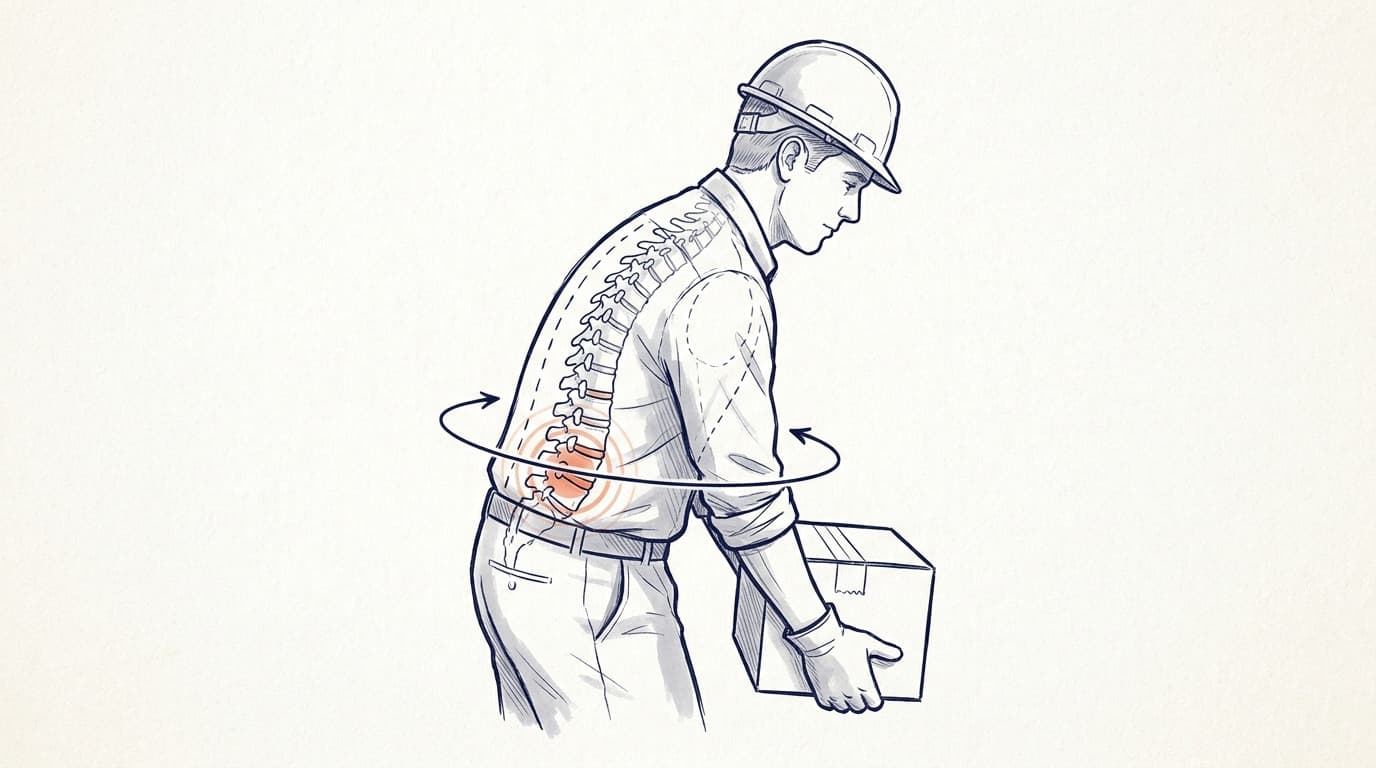
Spinal discs have a poor blood supply and limited capacity to repair. Loading them repeatedly — particularly in flexion, under compression, with rotation — produces small changes that do not register as pain and do not generate an incident report. The tissue tolerates it. Then it tolerates a little less. Then one day a movement no different from a thousand before it exceeds what is left.
Three consequences follow for how a crew should think about this:
The reported cause is usually not the cause. A worker lifting a light object, or bending to pick up a tool, or simply straightening up, is the classic presentation. That lift did not do the damage. It found it.
Absence of pain is not absence of harm. Between the damage and the symptom there is often a long silent period, which is why "my back's fine" is not evidence that a task is safe.
By the time it hurts, the options have narrowed. Early intervention on a nagging ache is a task redesign conversation. Late intervention is a medical one.
This is also why back injuries are the topic most likely to follow someone out of construction. The event is unremarkable; the consequence is often not.
What actually accumulates#
The exposures that build the damage are the ones the lifting talk quantifies, and they are worth naming again from the injury side:
- Repetition. The same movement hundreds of times a shift. Frequency is the variable most often ignored because no single instance looks hazardous.
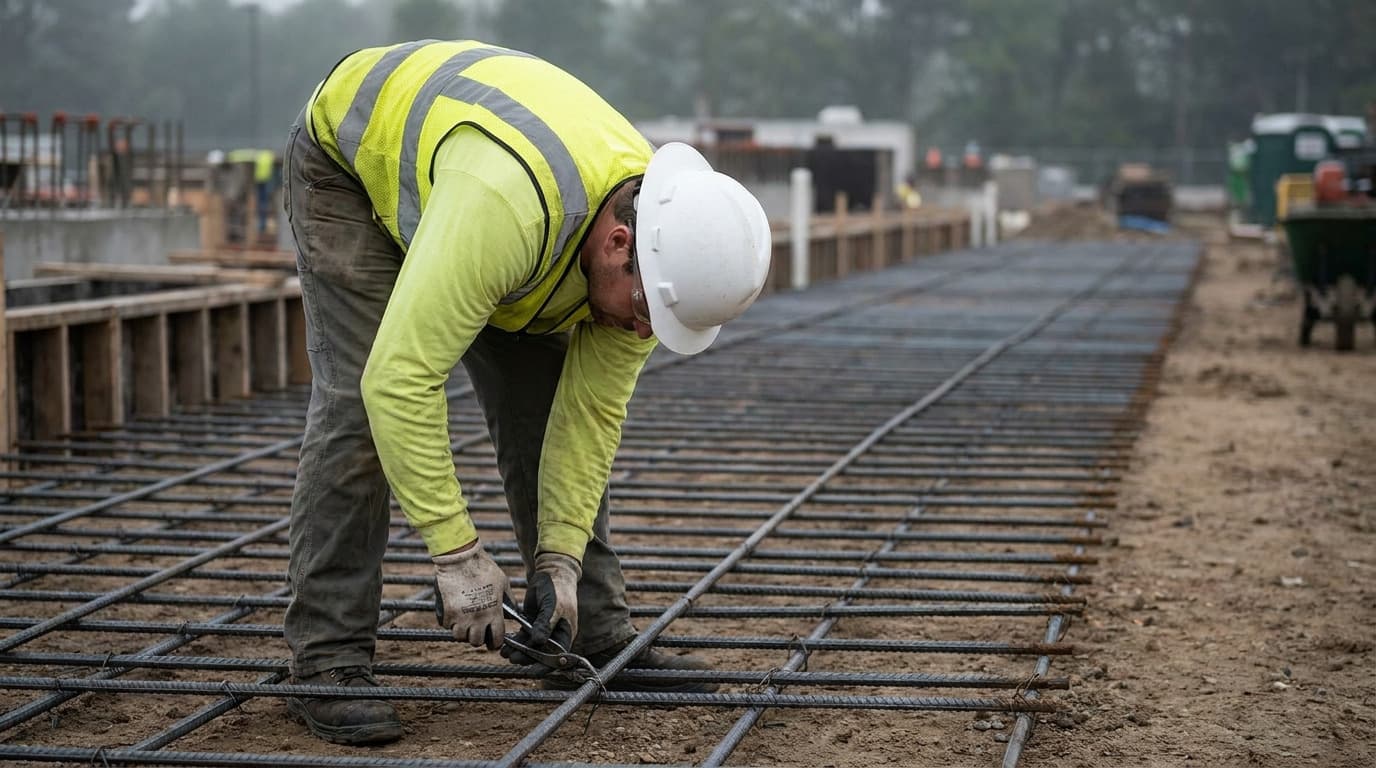
- Sustained flexion. Bending forward and staying there — kneeling to fix, bending over formwork, working at low level. Static loading fatigues supporting muscle and transfers load to passive structures.
- Twisting under load. Rotation while compressed is the mechanism most consistently associated with disc injury.
- Whole-body vibration. Long hours in equipment, plant, and vehicles. This is a genuinely underappreciated construction exposure, and it fatigues the same structures before any manual handling starts.
- Awkward and constrained postures. Working overhead, in trenches, in ceiling voids, and under equipment.
- Fatigue and dehydration, both of which reduce the muscular support the spine relies on.
- Cold. Working cold reduces tissue tolerance, which is why the first lift of a winter morning is a common presentation.
Notice what is not on that list: how heavy the object was.
What can go wrong#
Waiting for it to become an incident. The ache that resolves overnight is the warning stage, and it is the only stage where the fix is cheap.
Treating the belt as the control. Issuing belts and considering the hazard managed — while the task, the height, the reach, and the frequency all stay exactly as they were.
"I'm fine, I've done this for twenty years." Twenty years of exposure is the risk factor, not a defence against it.
Working through it. Continuing the same task with an aggravated back is how a strain becomes a chronic problem.
Only assessing the heavy jobs. The light, repetitive, awkward tasks accumulate more damage than the occasional heavy lift, and they are never on the risk assessment.
Ignoring vibration exposure. Operators and drivers are assessed for everything except the hours they spend being shaken.
Nobody reports early symptoms because reporting feels like admitting weakness or risking the job.
Return to work with no task change. The same body goes back to the same job that hurt it, and the cycle restarts with less tissue tolerance than before.
How do we actually prevent back injuries?#
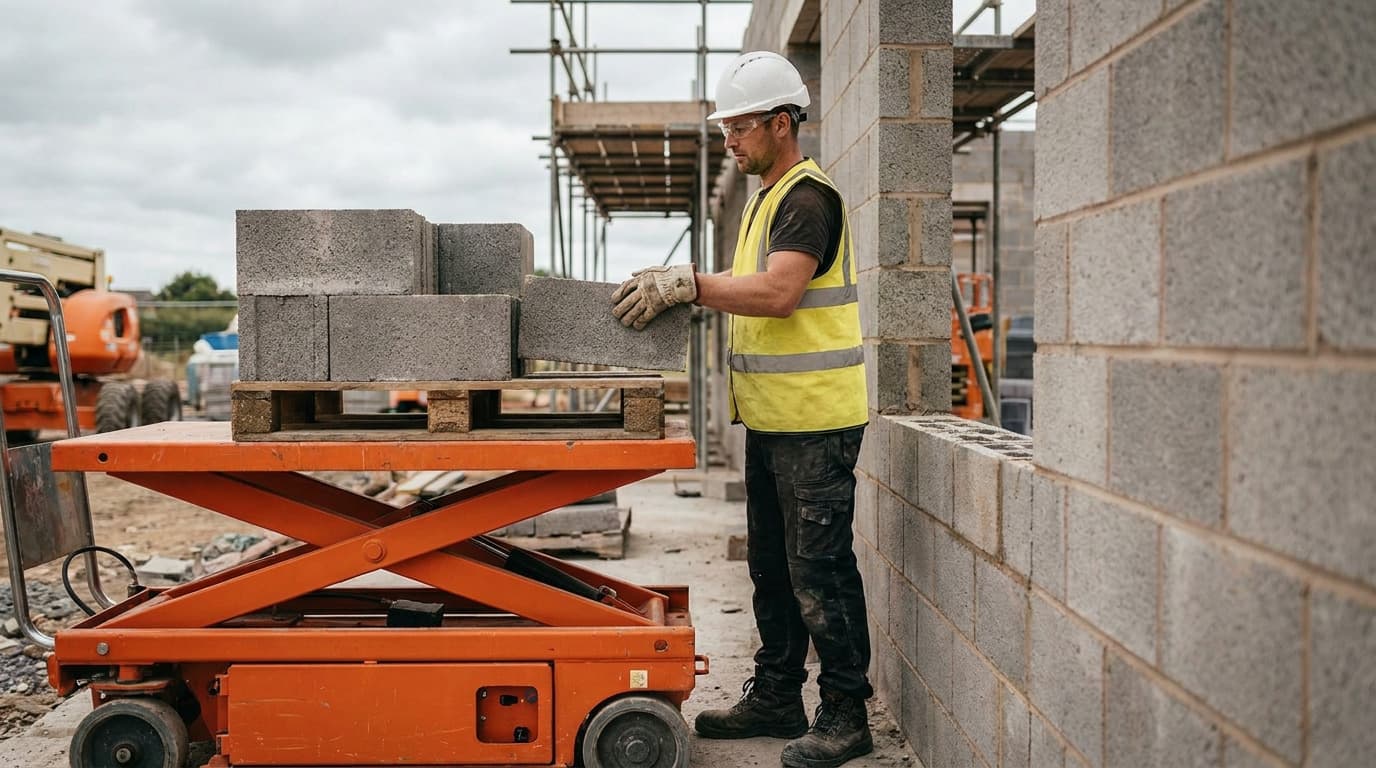
Redesign the task, because that is what the evidence supports. NIOSH's own recommendation is an ergonomics programme aimed at the work environment and the work tasks. Raise the working height, cut the reach, remove the twist, reduce the repetition, shorten the carry, and use a mechanical aid.
Attack frequency, not just weight. Rotate people through repetitive tasks, build recovery into the sequence, and look hard at anything that happens hundreds of times a shift.
Break up sustained postures. Anything held for long periods needs a change of position on a schedule, not when it starts to hurt.
Manage vibration exposure as a real hazard — seat condition and adjustment, ground conditions, speed, and time in the machine.
Do not rely on a back belt as protection. If your site issues them, that is a decision to revisit against NIOSH's position. If a worker has been prescribed one clinically after an injury, that is different and should be followed.
Make reporting an ache normal and consequence-free. This is the single highest-value control in the topic. Early symptoms are the only chance to fix the job before it becomes a claim, and people will only report if reporting is safe.
Change the task on return to work, not just the duties for a fortnight. Sending someone back to the job that injured them is how a first back injury becomes a career-limiting one.
Warm up in cold conditions and treat the first hour of a winter shift as the highest-risk hour.
Ask about the job, not the person. When someone hurts their back, the productive question is not "were you lifting properly" but "what about this task made that possible."
On USACE and NAVFAC projects, EM 385-1-1 applies and carries its own ergonomics and manual handling requirements.
Before you start#
- Identify the tasks today that involve repetition, sustained bending, or twisting — not just the heavy ones.
- Ask whether the working height can be raised or the reach shortened before anyone starts.
- Confirm mechanical aids are available and actually accessible, not locked away.
- Plan rotation for anything highly repetitive.
- Plan position changes for anything sustained.
- Check seat condition and adjustment if the task involves hours in a machine.
- Confirm the crew knows that reporting an ache today is expected, not penalised.
- Confirm anyone returning from a back injury has a changed task, not just a changed duty list.
- In cold conditions, allow for warm-up before the first heavy work.
- Confirm nobody is relying on a back belt as their protection.
Talk it over#
- Which task on this job would you still be doing in ten years — and what would your back look like by then?
- Has anyone here got a back that talks to them at the end of the week? What task does it talk about?
- If we could change one thing about the layout of this work to save people's backs, what would it be?
The bottom line#
A back injury is a process, not an event — the lift that puts someone out is rarely the one that caused the damage, which is why the useful question is about the task rather than the day. And the equipment most sites issue against it does not have the evidence behind it: NIOSH Publication 94-127 concluded there is insufficient scientific evidence that back belts deliver what is promised, and does not recommend them to prevent injury in workers who have never been injured — a finding its own study of 9,377 workers across 160 stores, published in JAMA in December 2000, then confirmed with no statistically significant difference in back injury claims between daily wearers and non-wearers. What NIOSH does recommend is redesigning the work: raise the height, cut the reach, remove the twist, reduce the frequency, manage vibration. And make it safe to report an ache, because that is the only point at which this is still cheap to fix.
Frequently asked questions about back injuries#
Do back belts prevent back injuries?
The evidence does not support it. NIOSH Publication No. 94-127 states that although back belts are sold on the premise that they reduce the risk of back injury, there is insufficient scientific evidence that they actually deliver what is promised, and NIOSH does not recommend their use to prevent injuries among workers who have never been injured. NIOSH's own large prospective study — 9,377 employees at 160 stores, published in JAMA on 6 December 2000 — found no statistically significant difference in back injury claims between workers who wore belts daily and those who did not.
So should we stop issuing back belts?
That is a decision for your organisation, but it should be made knowing NIOSH's position rather than by default. The important point is not to treat a belt as the control — if belts are issued while the task height, reach, twist, and frequency remain unchanged, the hazard has not been managed. Note also that NIOSH's conclusion concerns injury prevention; it explicitly did not address back belts used as medical treatment during rehabilitation, so a clinically prescribed belt after an injury is a separate matter and medical advice should be followed.
Why do backs get injured on light lifts?
Because the damage is usually cumulative. Spinal discs have limited repair capacity, and repeated loading — especially bending, compression, and twisting — produces changes that are painless for a long time. Eventually a movement no different from thousands before it exceeds what remains. The light lift did not cause the injury; it found it.
What causes cumulative back damage?
Repetition, sustained forward bending, twisting under load, whole-body vibration from hours in plant and vehicles, awkward or constrained postures, fatigue, dehydration, and cold. Notably, the weight of any individual object is only one factor among these — and often not the dominant one.
What is the single most effective control?
Redesigning the work. NIOSH states that the most effective way to prevent back injury is to implement an ergonomics programme that focuses on redesigning the work environment and work tasks to reduce the hazards of lifting. In practice that means changing working height, reach distance, twist, repetition, and carry distance — and using mechanical aids in place of manual handling.
Why does early reporting matter so much?
Because it is the only stage at which the problem is cheap to solve. An ache reported early is a task-redesign conversation; the same problem reported late is a medical and compensation one. Early symptoms are also the best available indicator of which specific tasks are causing harm, which makes reporting a source of prevention data rather than just a record of damage.
Should someone return to the same job after a back injury?
Not to the same job unchanged. Returning a worker to the task that caused the injury — with less tissue tolerance than they had before — is how a first back injury becomes a recurring or career-ending one. The task itself needs to change, not merely the duty list for a couple of weeks, and any return should follow medical guidance.
Download the back injuries toolbox talk PDF#
Get this back injuries toolbox talk as a print-ready PDF — available in English, Spanish, Portuguese, and Turkish. Print it, hand it to the crew, and collect signatures on the included attendance sheet.
Download the PDF — free account required. New members get 3 free downloads.
Related toolbox talks#
Sources#
- NIOSH, Back Belts — Do They Prevent Injury?, DHHS (NIOSH) Publication No. 94-127: https://www.cdc.gov/niosh/docs/94-127
- NIOSH, Workplace Use of Back Belts: Review and Recommendations, DHHS (NIOSH) Publication No. 94-122
- Wassell JT, Gardner LI, Landsittel DP, et al., A prospective study of back belts for prevention of back pain and injury, JAMA, 6 December 2000; 284(21)
- NIOSH, Summary of NIOSH Back Belt Studies
Written by FieldSafetyTalk's safety professional — a CSP, ASP, CHST and OSHA Authorized Outreach Trainer with 14+ years of international construction safety experience across federal, heavy civil, and industrial projects.
This talk summarises published research and regulatory guidance. It is not medical advice. Workers with back symptoms should be assessed by a qualified healthcare professional, and any individual treatment or return-to-work plan should follow medical direction.