Hearing Conservation
Updated 2026-07-28
In this bundle Health & Environmental Exposure
Working in Washington? See the WA DOSH edition → Washington (WA DOSH)
Print-ready PDF
Download this talk as a print-ready PDF, available in 4 languages.
Ask what a hearing conservation programme is and most people will describe audiograms, annual testing, a baseline and a standard threshold shift. All of that is real — and almost none of it appears in the construction standard. What construction has is one sentence saying a programme is required, three sentences about ear protection, and nothing at all about what the programme contains. This Hearing Conservation Toolbox Talk (Safety Talk / Tailgate Talk) is about working honestly inside that gap.
Here is the distinction that carries this whole talk: protection that is worn incorrectly is not partial protection — it is closer to none. A hearing protector's rating is achieved with a proper seal. Break the seal — a plug half inserted, a muff over a hood or spectacle arms, a cable running under a cushion — and the attenuation collapses, while everyone involved carries on believing the ear is covered. Hearing protection is the one PPE where looking right and working right come apart most easily.
The programme requirement is one sentence long#
29 CFR 1926.52(d)(1):
In all cases where the sound levels exceed the values shown herein, a continuing, effective hearing conservation program shall be administered.
That is the entire construction requirement. It is mandatory, and it never defines a single element. No audiometric testing. No baseline audiogram. No annual review. No 85 dBA action level. No standard threshold shift. Nothing about training frequency or record retention.
Those elements exist — in 29 CFR 1910.95, the general industry noise standard, which was updated over the years while the construction standard was not. The National Academies' review Technology for a Quieter America puts it plainly: subparts of the construction rule may be a slight improvement on general industry in places, but overall the construction standard became much weaker because it was never updated as the general industry standard was.
So the honest position for a construction employer is this. The obligation to run a continuing, effective programme is real and enforceable. What "effective" contains is not spelled out — which means the recognised practice fills it, and the nearest recognised practice is 1910.95: exposure monitoring, audiometric testing with a baseline and annual follow-up, protector selection with adequate attenuation, training, and records. Many contracts and owner requirements simply import it.
Two words in that sentence do a lot of work. Continuing means it is not a one-off induction or a single set of earplugs handed out in March. Effective means it has to actually reduce exposure — which is a results test, not a paperwork test.
Three sentences on ear protection — 1926.101#
The whole of the construction hearing-protection standard:
(a) Wherever it is not feasible to reduce the noise levels or duration of exposures to those specified in Table D-2, Permissible Noise Exposures, in §1926.52, ear protective devices shall be provided and used.
(b) Ear protective devices inserted in the ear shall be fitted or determined individually by competent persons.
(c) Plain cotton is not an acceptable protective device.
Each line is worth reading closely.
"Provided and used" — not made available. The employer owes both the equipment and the enforcement. A box of plugs in the site office satisfies half of a two-part duty.
"Fitted or determined individually by competent persons" — this applies to anything inserted in the ear, and it is the requirement most often skipped entirely. Ear canals differ in size and shape between people and between a person's own two ears. Individual fitting or determination by a competent person is what turns a nominal rating into real attenuation, and self-service from a dispenser is not that.
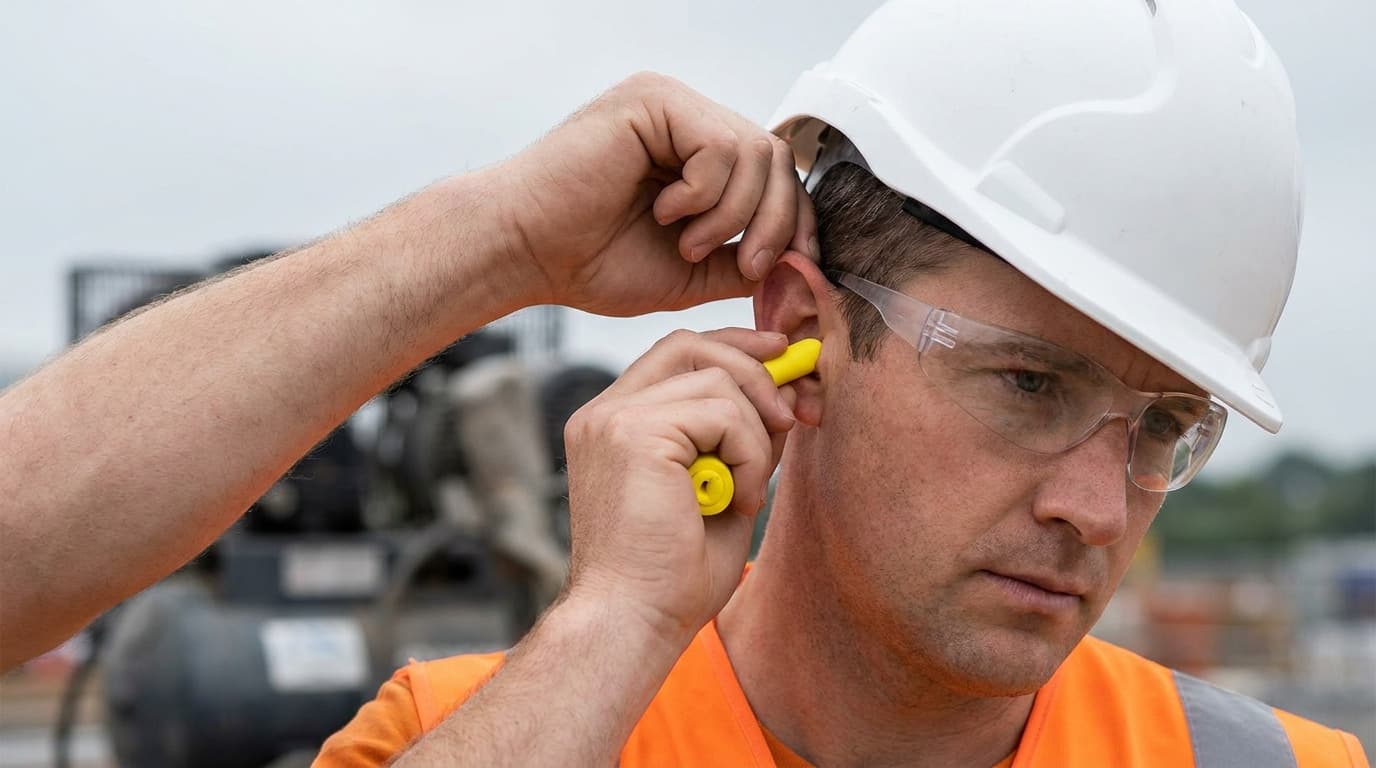
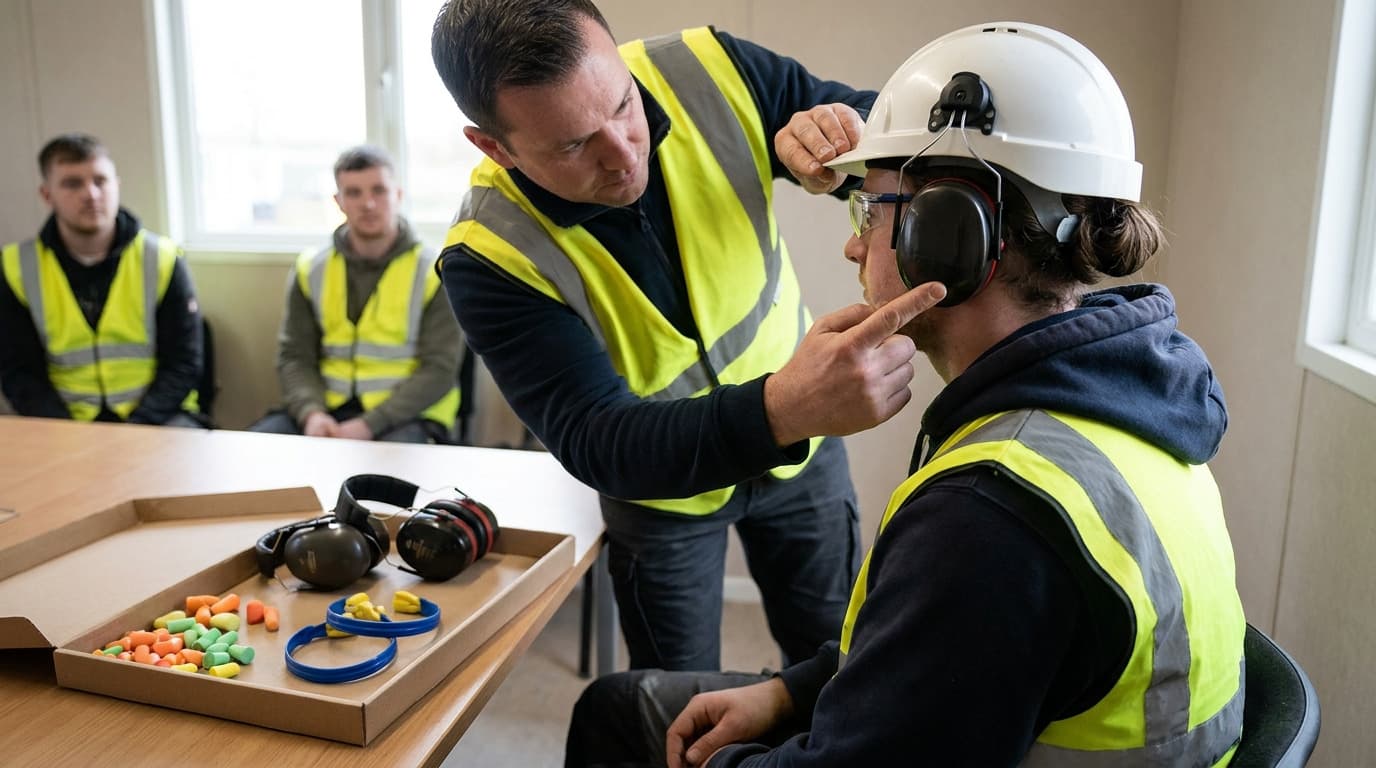
"Plain cotton is not an acceptable protective device" — a strange sentence to find in a modern regulation, and it survives because the point behind it has not aged. Cotton wool, tissue, a piece of rag, foam offcuts, cigarette filters: things that block sound subjectively without providing measured attenuation are not hearing protection. The standard names one example; the principle covers all the improvised ones.
What "effective" looks like in practice#
Since the standard does not define the programme, this is what a defensible one contains:
Know the exposures. Measure sound levels and durations, because Table D-2 cannot be applied without both — covered in the noise talk.
Select for the exposure, not the maximum. A protector's rating is a laboratory figure, and real-world attenuation is consistently lower. Over-protection is a genuine problem too: a worker who cannot hear reversing alarms, verbal warnings or the change in a machine's sound will remove the protector, or miss the thing that would have warned them.
Fit properly, and check. Roll-down foam plugs must be rolled thin, inserted deeply while the ear is pulled up and back, and held while they expand. Muff cushions must seal on skin — nothing between the cushion and the head. Both are checkable in ten seconds.
Offer choice. Comfort determines wear time more than any specification. Plugs, banded plugs, muffs, and combinations for the highest exposures — a protector that comes off after twenty minutes attenuates nothing for the rest of the shift.
Support audiometric testing. It is not required by the construction standard, but it is the only way to know whether the programme is effective rather than merely present — it detects loss while there is still something to protect.
Train on the failure modes, not the rating. Where the seal breaks, why hair, glasses and hood straps matter, and how to check.
Watch the whole shift. Protection removed for a "quick" conversation in a loud area costs a disproportionate share of the day's benefit.
What can go wrong?#
Plugs are inserted, not seated. Sitting in the outer ear like a cork, visible from the front, doing a fraction of their job.
Muffs are worn over something. Hood, cap peak, spectacle arms, hair, or a cable — any of which breaks the cushion seal.
One size for everyone. No individual fitting, so the standard's own requirement in 1926.101(b) is unmet and the fit is a coincidence.
Improvised protection. Cotton wool, tissue or foam offcuts — the exact practice 1926.101(c) singles out.
Over-protection. So much attenuation that alarms and speech vanish, so the protector comes off in the noisiest place.
The programme is a box of plugs. No monitoring, no fitting, no training, no review — none of which is "continuing" or "effective."
Nobody tests hearing. Loss accumulates silently, and the first evidence is a worker struggling at home years later.
Damaged or dirty protectors. Hardened cushions, torn foam, plugs reused past their life.
Before you start#
- Confirm the exposure for this task and whether protection is required at all.
- Confirm the protector suits the exposure — enough attenuation, not so much that alarms disappear.
- Confirm anything inserted in the ear has been individually fitted or determined by a competent person.
- Confirm nothing is between muff cushions and the head — no hood, cap peak, glasses arms or hair.
- Confirm plugs are rolled thin, inserted deeply and allowed to expand.
- Confirm no improvised protection is in use — cotton, tissue or offcuts are not protectors.
- Confirm protection will stay on for the whole time in the noise, including short conversations.
- Confirm anyone with ringing, muffled hearing or discomfort knows where to raise it.
Talk it over#
- Can you see your own plugs in a mirror? If so, how far in are they really?
- Who is wearing muffs over a hood or over glasses right now?
- Who fitted your plugs — or did you take them from a box?
- Has anyone here had a hearing test? Would you want one?
The bottom line#
Construction's hearing conservation requirement is one sentence: under 1926.52(d)(1), where sound levels exceed Table D-2, a continuing, effective hearing conservation program shall be administered — and the standard never says what is in it. The detailed apparatus of audiometric testing, baselines and action levels lives in 1910.95, which covers general industry rather than construction, and the National Academies has noted the construction standard became much weaker because it was never updated. Protection itself is three lines: 1926.101(a) requires ear protective devices to be provided and used where noise cannot feasibly be reduced to Table D-2; (b) requires devices inserted in the ear to be fitted or determined individually by competent persons; and (c) states that plain cotton is not an acceptable protective device. Everything that makes a programme effective — monitoring, fitting, selection, training, audiometry — is recognised practice rather than construction text, and it is worth doing precisely because the standard leaves it to you.
Frequently asked questions about hearing conservation#
What does OSHA require for hearing conservation in construction?
One thing, in one sentence. 1926.52(d)(1) provides that in all cases where sound levels exceed the values in Table D-2, a continuing, effective hearing conservation program shall be administered. The construction standard does not specify the programme's contents.
Is audiometric testing required in construction?
Not by the construction standard. Audiometric testing, baseline and annual audiograms, the 85 dBA action level and standard threshold shift provisions are in 29 CFR 1910.95, the general industry noise standard. Many employers, contracts and owner requirements apply that framework to construction anyway, and it is the most direct way to demonstrate a programme is effective rather than merely in place.
Why is the construction noise standard weaker than general industry's?
Because it was not updated. As the National Academies' Technology for a Quieter America records, some subparts of the construction rule are a slight improvement on general industry, but overall the construction standard became much weaker because it was never updated as the general industry standard was.
Does providing earplugs satisfy the standard?
No. 1926.101(a) requires ear protective devices to be provided and used — two obligations. Supplying protection without ensuring it is worn correctly, for the whole exposure, meets only half of the requirement.
Do earplugs have to be individually fitted?
Yes, where they are inserted in the ear. 1926.101(b) requires that ear protective devices inserted in the ear be fitted or determined individually by competent persons. Ear canals vary between people and between a person's own two ears, so individual fitting or determination is what converts a nominal rating into actual attenuation.
Why does the standard mention plain cotton?
Because improvised protection was, and still is, common. 1926.101(c) states that plain cotton is not an acceptable protective device. The named example is cotton, but the principle covers anything that muffles sound subjectively without providing measured attenuation — tissue, rag, foam offcuts and similar.
Can hearing protection be too strong?
Yes, and it is a real failure mode. A protector that removes too much sound can make reversing alarms, shouted warnings and changes in machine noise inaudible, and workers respond by removing it — usually in the loudest place. Selection should match the exposure rather than maximise attenuation.
Download the hearing conservation toolbox talk PDF#
Get this hearing conservation toolbox talk as a print-ready PDF — available in English, Spanish, Portuguese, and Turkish. Print it, hand it to the crew, and collect signatures on the included attendance sheet.
Download the PDF — free account required. New members get 3 free downloads.
Related toolbox talks#
Sources#
- OSHA, 29 CFR 1926.101 — Hearing protection: https://www.osha.gov/laws-regs/regulations/standardnumber/1926/1926.101
- OSHA, 29 CFR 1926.52 — Occupational noise exposure: https://www.osha.gov/laws-regs/regulations/standardnumber/1926/1926.52
- National Academies, Technology for a Quieter America: https://www.nationalacademies.org/read/12928/chapter/21
This talk summarises published regulatory guidance. It is not medical advice. Audiometric testing and the interpretation of any hearing loss are matters for a qualified health professional — noise-induced hearing loss is permanent and cannot be restored.
Written by FieldSafetyTalk's safety professional — a CSP, ASP, CHST and OSHA Authorized Outreach Trainer with 14+ years of international construction safety experience across federal, heavy civil, and industrial projects.