Confined Space
Updated 2026-07-23
In this bundle Health & Environmental Exposure
Print-ready PDF
Download this talk as a print-ready PDF, available in 4 languages.
A confined space does not look like a hazard. A manhole, a tank, a crawl space, a vault — they look like inconvenient places to work, not lethal ones. There is no visible edge, no exposed conductor, no moving machinery. The atmosphere that will kill you in three minutes looks exactly like the atmosphere you are breathing right now. This Confined Space Toolbox Talk (Safety Talk / Tailgate Talk) is about the hazard that gives no warning at all before it takes you.
Here is the distinction that carries this whole talk: with every other hazard on this site, the danger is something you could in principle see, hear, or feel coming. A confined space kills by removing the one thing you cannot function without and cannot detect the absence of. Oxygen deficiency produces no sensation of suffocation — you do not gasp, you do not struggle, you simply lose consciousness, often within a breath or two. That is why the entire standard is built around testing and monitoring rather than judgement. You cannot assess a confined space atmosphere by standing in it, because by then you have already made the only mistake that matters.
How dangerous are confined spaces?#
The fatality data shows a hazard that is rare in exposure but extraordinarily lethal when it occurs. According to the Bureau of Labor Statistics Census of Fatal Occupational Injuries, cited by OSHA, 1,030 workers in the United States died from occupational injuries involving a confined space between 2011 and 2018 — with annual figures ranging from a low of 88 in 2012 to a high of 166 in 2017 (BLS CFOI, via OSHA).
The pattern behind those deaths matters more than the total:
- Confined space fatalities frequently involve multiple victims in a single incident. OSHA has repeatedly documented cases where a worker collapsed inside a space and a second worker died attempting rescue.
- Trench collapse, falls to a lower level, inhalation of a harmful substance, and engulfment are the leading mechanisms in BLS's analysis of confined space deaths from 2011 to 2018.
- Construction laborers were the occupation with the highest number of confined space fatalities in that period, followed by farmers and first-line construction supervisors (BLS Fact Sheet, July 2020).
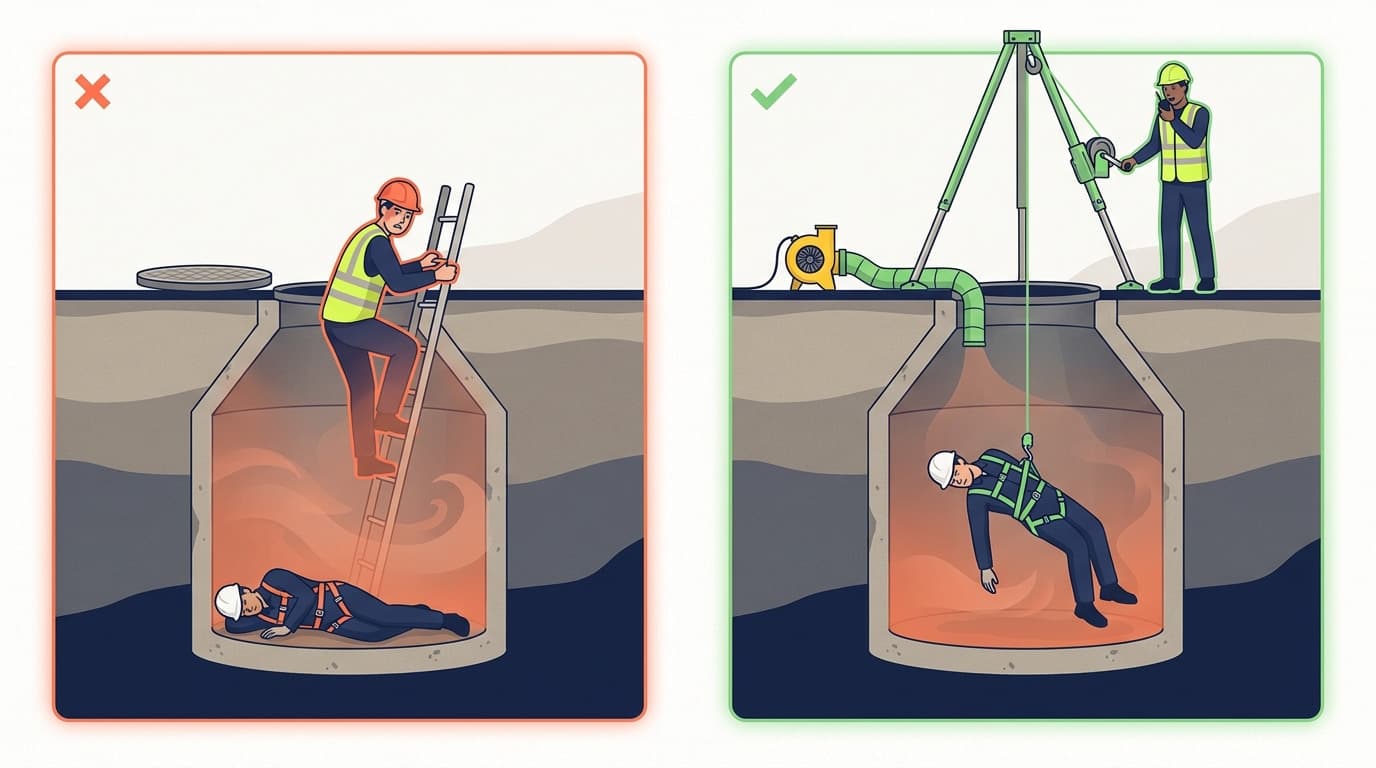
Multiple-fatality incidents are the signature of this hazard. In one OSHA investigation, a worker entered a newly installed sewer manhole to conduct testing and lost consciousness; a second worker followed to rescue him and also lost consciousness. Both died. The employer had not tested the oxygen level before entry and had not provided rescue equipment.
OSHA confined space requirements (29 CFR 1926 Subpart AA)#
Construction confined spaces are governed by 29 CFR 1926 Subpart AA, sections 1926.1200 through 1926.1213, which took effect in August 2015. Before that, construction had no equivalent to the general industry standard.
A confined space is a space that meets all three criteria:
- Is large enough and so configured that an employee can bodily enter it
- Has limited or restricted means for entry or exit
- Is not designed for continuous employee occupancy
A permit-required confined space is a confined space that has one or more of:
- Contains or has the potential to contain a hazardous atmosphere
- Contains material with the potential to engulf an entrant
- Has an internal configuration — converging walls or a sloping, tapering floor — that could trap or asphyxiate an entrant
- Contains any other recognized serious safety or health hazard
Key requirements:
- Identification — 1926.1203(a). Before beginning work, each employer must ensure a competent person identifies all confined spaces in which its employees may work, and identifies each space that is a permit space, including testing as necessary.
- Signage — 1926.1203(b)(1). Exposed employees must be informed by danger signs or other equally effective means. A sign reading "DANGER — PERMIT-REQUIRED CONFINED SPACE, DO NOT ENTER" satisfies this.
- Written program — 1926.1204. If employees will enter a permit space, the employer must have a written permit space program at the construction site.
- Entry permit — 1926.1206. A permit documenting the space, the purpose, the duration, the hazards, the control measures, the acceptable entry conditions, the test results, the attendant, and the rescue services — signed by the entry supervisor before entry.
- Attendant — 1926.1209. An attendant is stationed outside the space, monitors entrants and conditions, maintains communication, orders evacuation when required, and must not enter to perform a rescue.
- Rescue services — 1926.1211. The employer must ensure rescue and emergency services are available, evaluated for capability, and able to respond in a timely manner.
- Training — 1926.1207. Training in the duties of the role, provided before first assignment and whenever there is a change in duties or hazards.
- Coordination — 1926.1203(h). Host employers, controlling contractors, and entry employers must share confined space information and coordinate entry operations.
On USACE and NAVFAC projects, EM 385-1-1 applies and is more prescriptive on entry procedures and rescue capability.
What can go wrong in a confined space?#
Oxygen deficiency, which produces no warning. Normal air is about 20.9 percent oxygen. Below 19.5 percent the atmosphere is oxygen-deficient. Below roughly 16 percent, judgement and coordination fail. Below 10 percent, unconsciousness can occur within seconds and death follows in minutes. The worker feels nothing that resembles suffocation.
Oxygen displacement by other gases. Purging with nitrogen or argon, welding gases, sewer gas, and vapours from adjacent processes all displace oxygen without any smell or visible sign.
Toxic atmospheres. Hydrogen sulphide in sewers and wastewater — which deadens the sense of smell at exactly the concentrations that become lethal. Carbon monoxide from any combustion source, including a generator or a petrol-driven pump running nearby. Solvent vapours from coatings applied in the space.
Flammable atmospheres. Vapours accumulating below the point where a meter placed at the opening would find them, ignited by a tool, a light, or static.
Engulfment. Grain, sand, aggregate, sludge, and water can flow and bury an entrant faster than anyone can respond.
Physical hazards inside the space. Unguarded machinery, exposed live conductors, residual energy, converging walls, and internal configurations that trap.
Then the process failures that turn hazards into fatalities:
- Entering without testing, because the space "was fine last time"
- Testing at the opening only, missing stratified gases at depth
- No continuous monitoring, so conditions change after entry
- No attendant, or an attendant who left, or an attendant given other duties
- No rescue plan beyond calling emergency services
- Reclassifying a permit space without meeting the requirements
- Untrained workers entering because they were available
How do we prevent confined space fatalities?#
Ask whether entry is necessary at all. Many tasks can be done from outside with cameras, extension tools, or remote equipment. The safest confined space entry is the one that does not happen.
Identify and evaluate before anyone approaches. A competent person identifies every confined space, determines whether it is a permit space, and documents it. Signs go up before work starts, not after someone asks.
Test the atmosphere before entry, in the correct order:
- Oxygen first, because the other readings depend on it
- Flammable gases and vapours second
- Toxic contaminants third
- Test at multiple depths — top, middle, and bottom — because gases stratify by density
- Test with a calibrated, bump-tested instrument, and know when it was last calibrated
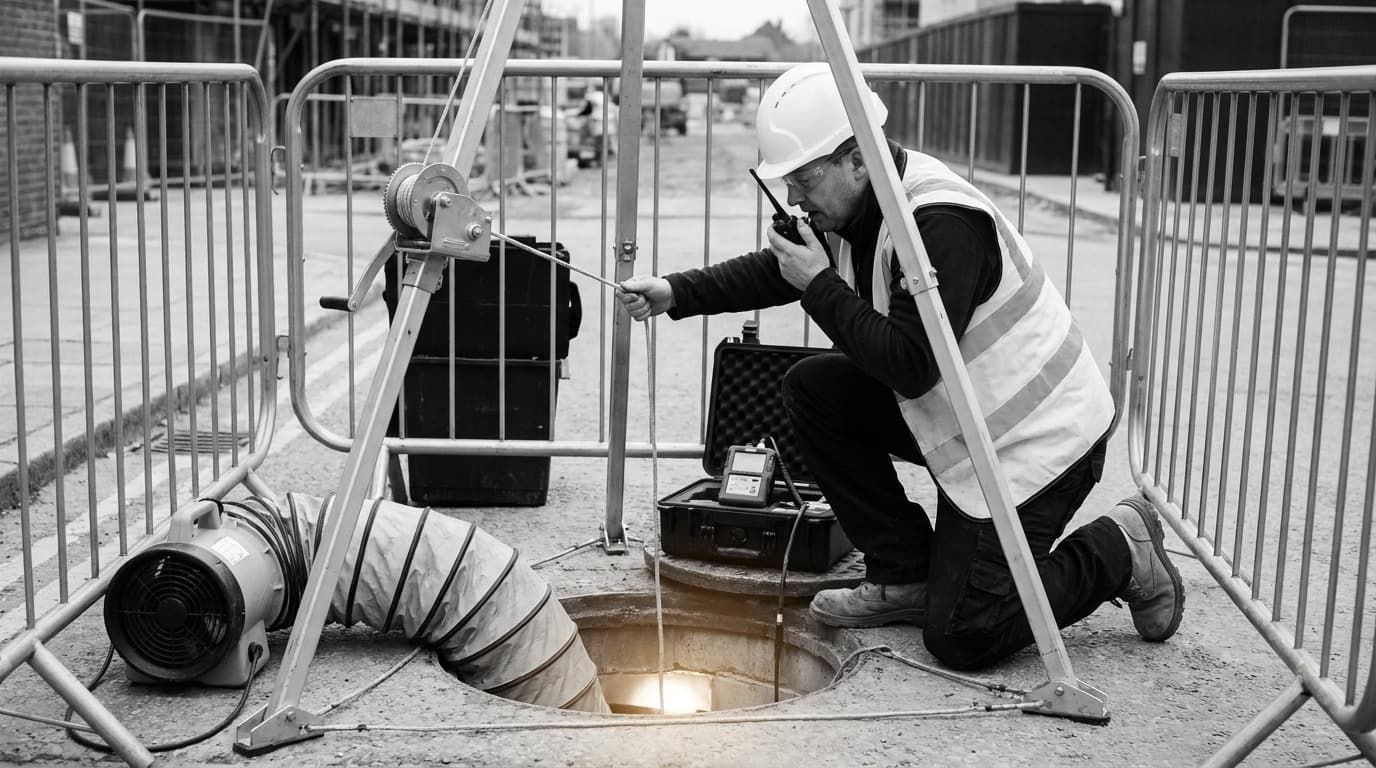
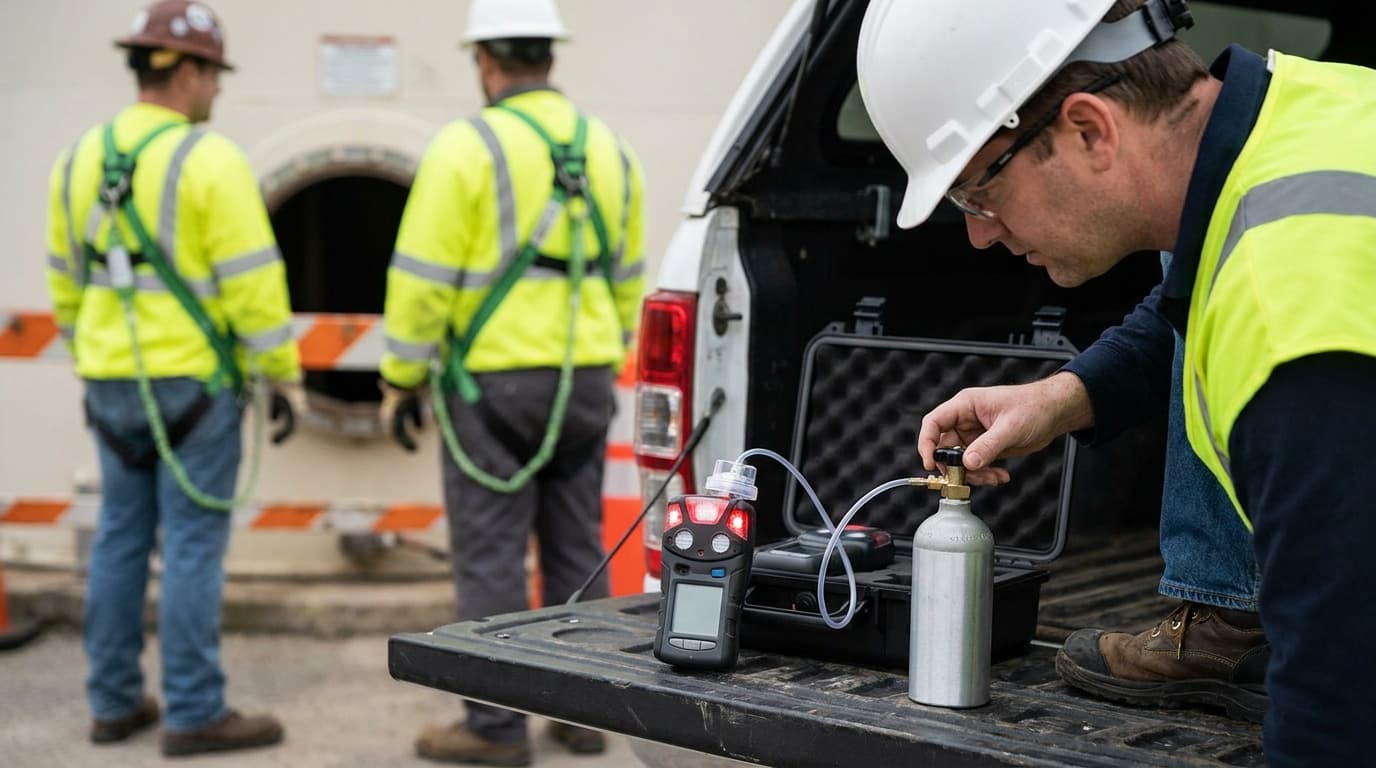
Monitor continuously during entry. Conditions change: work generates gases, ventilation fails, adjacent processes vent, and the atmosphere that tested clean at 9 a.m. is not the same atmosphere at 11 a.m.
Ventilate before and during. Forced-air ventilation to establish and maintain acceptable conditions. Never ventilate with pure oxygen — an oxygen-enriched atmosphere is a severe fire and explosion hazard.
Isolate every energy source. Lock out mechanical and electrical energy, blank or blind piping, and control residual and stored energy before entry, not as the entrant is climbing in.
Complete the permit, and mean it. The permit is the record that the checks actually happened. An entry supervisor signing a permit without verifying the tests is documenting a fiction.
Post an attendant who does nothing else. The attendant stays outside, maintains continuous communication, monitors conditions, keeps unauthorized people out, and orders evacuation the moment anything changes. The attendant does not run errands, does not do paperwork, and — critically — does not enter the space.
Plan non-entry rescue first. Retrieval line and full-body harness attached before entry, with a tripod and winch where the configuration allows, so an entrant can be extracted without anyone going in. Confirm that rescue services are available and capable before entry begins, not after an incident.
Train the response, including the instinct to resist. The reason multiple-fatality confined space incidents keep happening is that a colleague collapses and a coworker goes in after them. The rescue plan has to be practised precisely because the instinct to enter is overwhelming and lethal.
Before you start#
- Ask whether this work can be done without entering the space at all.
- Confirm a competent person has identified the space and classified it, and that signage is posted.
- Confirm a written permit space program exists and an entry permit is issued and signed.
- Test the atmosphere in order — oxygen, then flammables, then toxics — at multiple depths.
- Check the instrument's calibration and bump test dates before you trust a reading.
- Confirm continuous monitoring is in place for the duration of the entry.
- Confirm ventilation is running, and that it is air, never pure oxygen.
- Confirm every energy source is isolated, locked out, and verified.
- Confirm the attendant is posted, has no other duties, and knows they do not enter.
- Confirm non-entry rescue equipment is rigged and rescue services are confirmed available.
Talk it over#
- Is there a way to do this job without anyone going inside? Walk me through it.
- If the person inside stopped answering right now, what exactly would you do — and what would you not do?
- When was that gas meter last calibrated and bump tested, and who checked?
The bottom line#
A confined space kills by removing something you cannot see, smell, or feel disappearing — oxygen deficiency causes no sensation of suffocation, just unconsciousness. That is why everything in Subpart AA is built on testing and monitoring rather than judgement. Test before entry in the right order and at multiple depths, monitor continuously, ventilate with air, isolate every energy source, and post an attendant who does nothing else. Above all, rig non-entry rescue before anyone goes in — because the second person through that opening is the one this hazard is most likely to kill.
Frequently asked questions about confined spaces#
What makes a space a confined space?
Under 29 CFR 1926 Subpart AA, a space is confined if it meets all three criteria: it is large enough for an employee to bodily enter, has limited or restricted means of entry or exit, and is not designed for continuous employee occupancy. Manholes, tanks, vaults, silos, sewers, pits, and crawl spaces commonly qualify.
What makes a confined space permit-required?
A confined space becomes a permit-required confined space if it contains or could contain a hazardous atmosphere, contains material that could engulf an entrant, has converging walls or a sloping tapered floor that could trap or asphyxiate, or contains any other recognized serious safety or health hazard.
How many workers die in confined spaces?
1,030 workers in the United States died from occupational injuries involving a confined space between 2011 and 2018, with annual figures ranging from 88 in 2012 to 166 in 2017 (BLS Census of Fatal Occupational Injuries, via OSHA). Construction laborers were the occupation with the highest number of these fatalities.
In what order should a confined space atmosphere be tested?
Oxygen first, because other sensor readings depend on oxygen concentration. Then flammable gases and vapours, then toxic contaminants. Test at multiple depths — top, middle, and bottom — because gases stratify by density, and a reading taken at the opening can miss a lethal layer at the floor.
Can an attendant enter the space to perform a rescue?
No. Under 29 CFR 1926.1209, the attendant remains outside the permit space. Multiple-fatality confined space incidents overwhelmingly follow the same pattern: an entrant collapses and a coworker enters to help. Rescue must be by non-entry retrieval or by trained rescue services with appropriate respiratory protection.
Why is oxygen deficiency so dangerous if you can just leave?
Because it produces no sensation of suffocation. The urge to breathe is triggered by carbon dioxide build-up, not oxygen absence, so a worker in an oxygen-deficient atmosphere feels no alarm. Below roughly 10 percent oxygen, unconsciousness can occur within seconds — before the worker recognizes anything is wrong.
Download the confined space toolbox talk PDF#
Get this confined space toolbox talk as a print-ready PDF — available in English, Spanish, Portuguese, and Turkish. Print it, hand it to the crew, and collect signatures on the included attendance sheet.
Download the PDF — free account required. New members get 3 free downloads.
Related toolbox talks#
Sources#
- OSHA, 29 CFR 1926 Subpart AA — Confined Spaces in Construction: https://www.osha.gov/laws-regs/regulations/standardnumber/1926/1926SubpartAA
- OSHA, 29 CFR 1926.1203 — General requirements: https://www.osha.gov/laws-regs/regulations/standardnumber/1926/1926.1203
- OSHA, Confined Spaces in Construction — Frequently Asked Questions: https://www.osha.gov/confined-spaces-construction/faq
- Bureau of Labor Statistics, Census of Fatal Occupational Injuries: https://www.bls.gov/iif/
Written by FieldSafetyTalk's safety professional — a CSP, ASP, CHST and OSHA Authorized Outreach Trainer with 14+ years of international construction safety experience across federal, heavy civil, and industrial projects.