Temporary Power Safety
Updated 2026-07-28
In this bundle Electrical Safety
Print-ready PDF
Download this talk as a print-ready PDF, available in 4 languages.
Temporary power is the installation nobody owns. It appears in week two, grows every month, gets modified by four trades who never speak to each other, and is still feeding tools the week before handover. OSHA saw that coming and wrote one short paragraph about it. This Temporary Power Safety Toolbox Talk (Safety Talk / Tailgate Talk) is about what that paragraph actually concedes — which is far less than most people assume.
Here is the distinction that carries this whole talk: "temporary" is a permission about the class of the installation, not about the standard of the work. The scope paragraph allows temporary wiring to be of a lower class than a permanent installation. It then requires everything else in Subpart K to apply anyway. Temporary is a description of how long the wiring stays; it is not a description of how well it is done.
Read the scope paragraph — it gives one thing away and takes the rest back#
29 CFR 1926.405(a)(2)(i) is three sentences long and does all the work:
The provisions of paragraph (a)(2) apply to temporary electrical power and lighting wiring methods which may be of a class less than would be required for a permanent installation. Except as specifically modified in paragraph (a)(2), all other requirements of this subpart for permanent wiring shall apply to temporary wiring installations. Temporary wiring shall be removed immediately upon completion of construction or the purpose for which the wiring was installed.
Three things follow, and they settle most site arguments:
- The concession is about wiring method and class — cord and cable assemblies, open conductors on insulators, a lower grade of installation. That is all.
- Everything else in Subpart K still applies: grounding, overcurrent protection, boxes and covers, enclosures suitable for wet locations, conductor identification. There is no lower standard for any of that because the job is temporary.
- The clock is not a date, it is an event. Removal is due immediately on completion of the purpose the wiring was installed for. Wiring that outlives its purpose is not temporary wiring; it is non-compliant permanent wiring.
The 90-day limit is not in the construction standard#
Nearly every site has someone who will tell you temporary power is good for 90 days. That figure is real, but it comes from somewhere else. 1910.305(a)(2)(i)(B), the general industry rule, applies 90 days to temporary wiring for Christmas decorative lighting, carnivals and similar purposes. The National Electrical Code carries the same 90 days in Article 590 for holiday decorative lighting.
Construction has no such number. Search 1926.405(a)(2) and there is no day count at all — only "removed immediately upon completion." So a temp installation feeding a two-year project is not automatically a violation at day 91, and one left up for a week after the trade finished is a problem on day one. The test is purpose, not duration.
The rules people break without noticing#
Nothing on the floor. Under (a)(2)(ii)(B), branch circuits must originate in a power outlet or panelboard, all conductors must be protected by overcurrent devices at their ampacity, open runs must be located where they will not be subject to physical damage and fastened at intervals not exceeding 10 feet (3.05 m) — and no branch-circuit conductors shall be laid on the floor. Not coiled on the slab, not run along the wall base, not lying across a walkway.
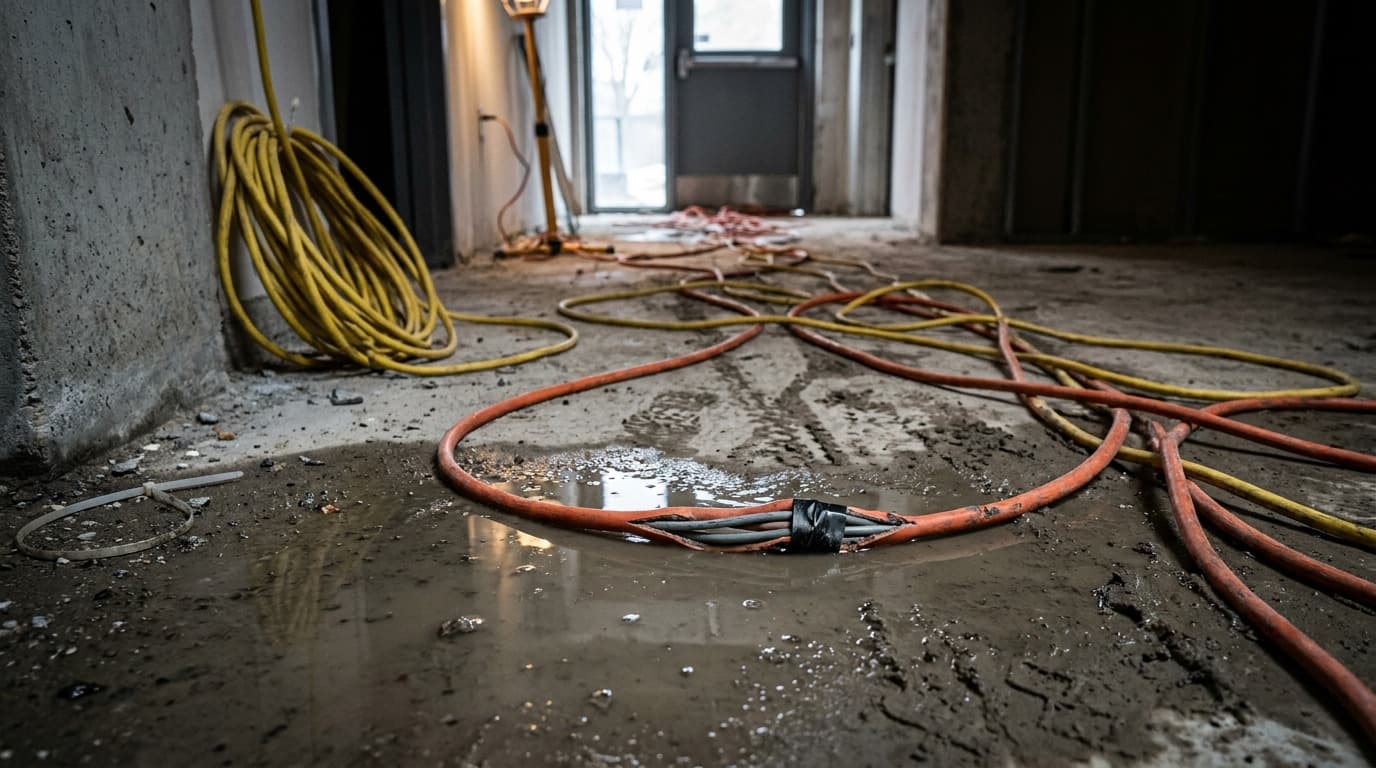
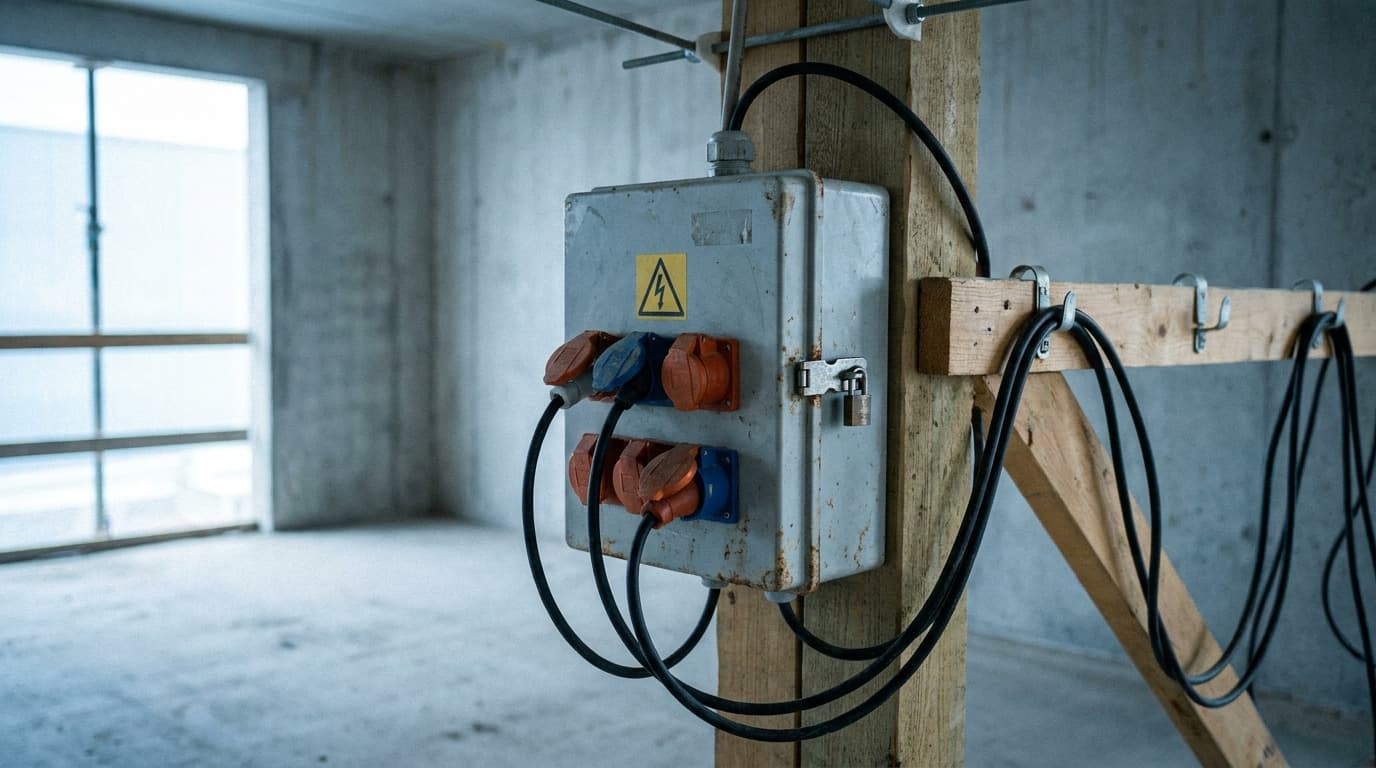
Feeders start at a distribution centre. Under (a)(2)(ii)(A), feeders originate in a distribution centre and run as cord or cable assemblies or in raceways; open conductors on insulators are allowed only where not subject to physical damage, spaced no more than 10 feet (3.05 m) apart.
Lighting circuits are not receptacle circuits. (a)(2)(ii)(C) requires receptacles to be of the grounding type and — this is the one everybody misses — receptacles for uses other than temporary lighting must not be installed on branch circuits which supply temporary lighting, and must not be connected to the same ungrounded conductor of a multiwire circuit supplying temporary lighting. Plugging a grinder into the string-light circuit is a written violation, not just bad practice.
Every temporary circuit needs a way to kill it. (a)(2)(ii)(D) requires disconnecting switches or plug connectors that disconnect all ungrounded conductors of each temporary circuit.
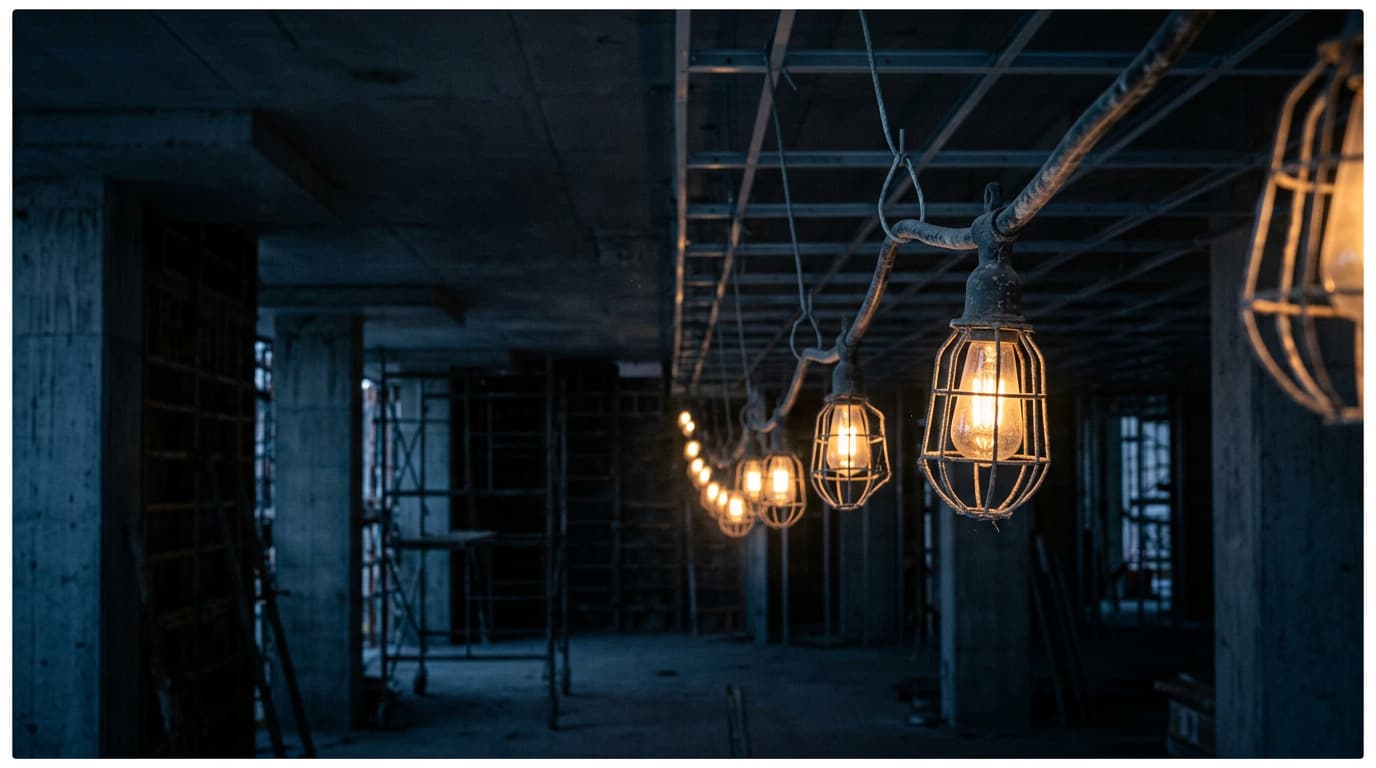
Lamps must be guarded, and must not hang by their cords. (a)(2)(ii)(E) requires all lamps for general illumination to be protected from accidental contact or breakage, and metal-case sockets to be grounded. (a)(2)(ii)(F) prohibits suspending temporary lights by their electric cords unless the cords and lights are designed for it. The bare bulb on a nail is two violations in one.
Cords through doorways need protection. (a)(2)(ii)(I) requires flexible cords and cables to be protected from damage, sharp corners and projections avoided, and allows them through doorways and other pinch points only where protection is provided.
Cord sets have a specification. (a)(2)(ii)(J) requires extension cord sets used with portable electric tools and appliances to be of the three-wire type and designed for hard or extra-hard usage — the S, ST, SO, STO and SJ family named in the Note. A light-duty household cord is not a jobsite cord.
Over 600 volts gets a barrier. (a)(2)(iii) requires fencing, barriers or other effective means to prevent access by anyone other than authorised and qualified personnel.
The 12-volt rule almost nobody knows#
(a)(2)(ii)(G) is the sharpest requirement in the paragraph:
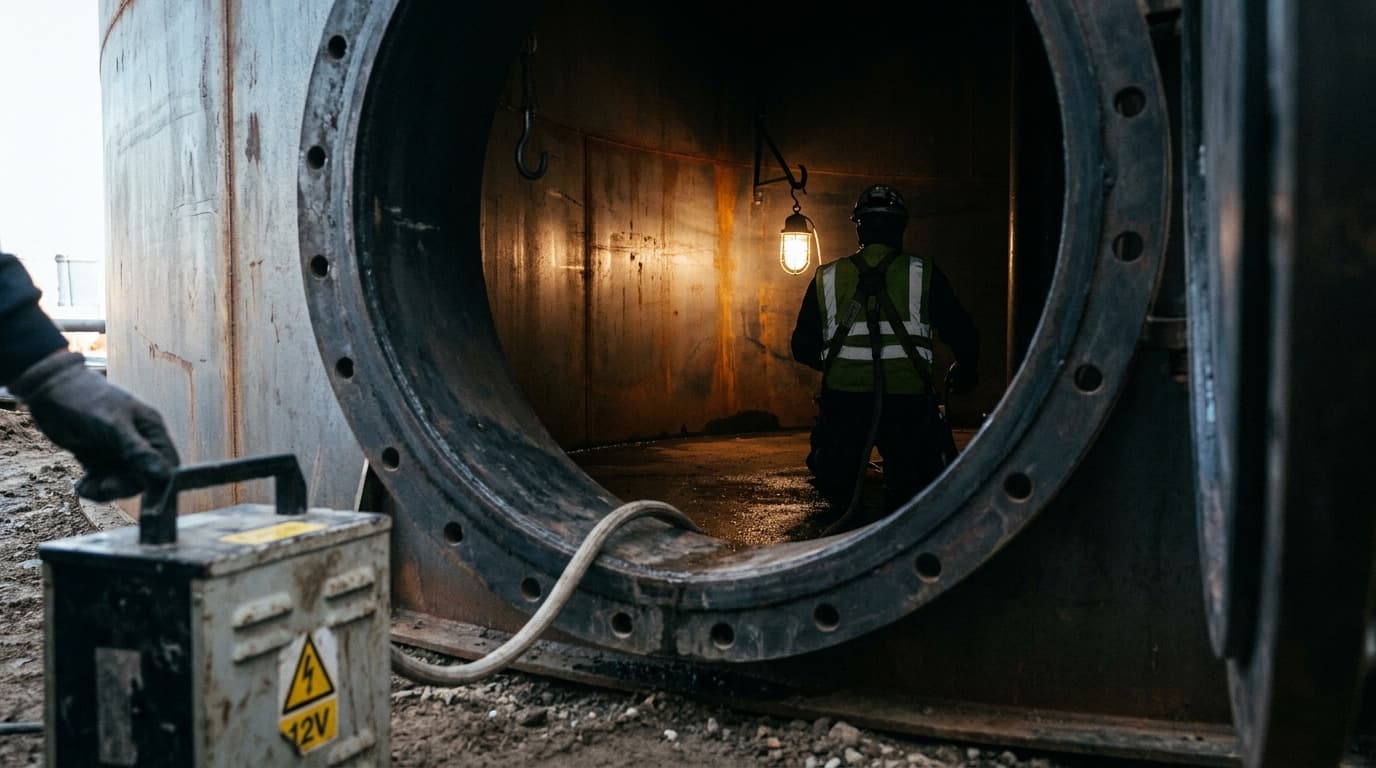
Portable electric lighting used in wet and/or other conductive locations, as for example, drums, tanks, and vessels, shall be operated at 12 volts or less. However, 120-volt lights may be used if protected by a ground-fault circuit interrupter.
Inside a tank, a drum, a wet vault or a confined metal space, the standard's first answer is not "use a GFCI" — it is 12 volts or less. The 120-volt option is the exception, and it is conditional on ground-fault protection. If you are sending someone into a metal vessel with a 120-volt handlamp and no GFCI, that is not a judgement call; it is outside the rule.
Ground-fault protection itself — the choice between GFCIs and an assured equipment grounding conductor program under 1926.404(b)(1) — is covered in its own talk and applies to this whole installation.
What can go wrong?#
The temp panel becomes permanent. Fed by a generator, extended by three trades, feeding loads nobody sized, with a schedule that stopped being accurate in month two.
Cords on the ground get damaged, then buried. Run over, pinched under a door, covered in mud, spliced with tape. Damaged insulation on a floor-level conductor puts fault current wherever the water goes.
String lighting doubles as a power circuit. Tools plugged into the lighting circuit trip it, so somebody upsizes the breaker — and now the lighting conductors are protected above their ampacity.
Broken lamps. Unguarded bulbs break, leaving an energised socket at head height in a dark area.
Weather. A temporary installation that was fine in the dry season sits in standing water in the wet one. Enclosures in wet locations have to be weatherproof — that requirement never became temporary.
Nobody removes it. The wiring outlives its purpose, and the last person who knew how it was built left the project.
How do we do this properly?#
Give it an owner. One competent person responsible for the temporary installation, its distribution and every modification to it. Unowned installations are the ones that fail.
Get it off the floor. Support conductors, keep runs out of traffic and water, protect anything crossing a doorway or a pinch point, and never leave a branch-circuit conductor lying on a slab.
Keep lighting and receptacle circuits apart, as (a)(2)(ii)(C) requires — separate circuits, separate purposes.
Guard the lamps and hang them properly — a fitting designed for suspension, never the cord, and a guard on every general-illumination lamp.
Use 12 volts or less inside tanks, drums and vessels, or a 120-volt lamp behind ground-fault protection. Decide that before anyone enters.
Inspect it like an installation, not like a cord. Walk the temp system weekly: enclosures closed, covers on, no exposed conductors, overcurrent devices matched to conductors, disconnects labelled and reachable.
Remove it when its purpose ends. That is the actual legal test, and it is the easiest one to fail.
Before you start#
- Confirm which panel or distribution centre feeds the circuit you are about to use, and that you can disconnect it.
- Confirm no conductor on your work route is lying on the floor or crossing a doorway unprotected.
- Confirm the cord sets you will use are three-wire and rated for hard or extra-hard usage.
- Confirm the lighting circuit is not being used as a power circuit.
- Confirm lamps are guarded and none is suspended by its cord.
- If work is inside a tank, drum or vessel, confirm the lighting is 12 volts or less, or 120 volts behind ground-fault protection.
Talk it over#
- Who owns the temporary power on this site, and who is allowed to modify it?
- Where is the nearest place you could shut off the circuit you are working on?
- What is plugged into the lighting circuit right now?
- Which parts of this temp installation have already outlived the work they were installed for?
The bottom line#
1926.405(a)(2)(i) grants temporary wiring one concession — it may be of a class less than would be required for a permanent installation — and then requires all other Subpart K requirements for permanent wiring to apply anyway. There is no 90-day allowance in construction; that number belongs to general industry and the NEC for decorative lighting. What the construction rule requires is removal immediately upon completion of the purpose the wiring was installed for. In between, the specifics are unglamorous and enforceable: nothing on the floor, feeders from a distribution centre, lighting circuits kept separate from receptacles, guarded lamps never hung by their cords, hard-usage three-wire cord sets, barriers above 600 volts, and 12 volts or less for portable lighting inside drums, tanks and vessels.
Frequently asked questions about temporary power on construction sites#
Is there a 90-day limit on temporary wiring?
Not in construction. The 90-day figure comes from 1910.305(a)(2)(i)(B) in general industry and from NEC Article 590, and in both it applies to holiday or decorative lighting and similar purposes. 1926.405(a)(2)(i) sets no day count. Its rule is that temporary wiring must be removed immediately upon completion of construction or the purpose for which it was installed.
Does temporary wiring have to meet the same standard as permanent wiring?
Almost. 1926.405(a)(2)(i) allows temporary wiring methods of a class less than would be required for a permanent installation, but states that except as specifically modified in that paragraph, all other requirements of Subpart K for permanent wiring apply. The concession is about wiring method, not about grounding, overcurrent protection, enclosures or workmanship.
Can extension cords or branch-circuit conductors lie on the floor?
No. 1926.405(a)(2)(ii)(B) states plainly that no branch-circuit conductors shall be laid on the floor, and requires open runs to be located where they will not be subject to physical damage and fastened at intervals not exceeding 10 feet (3.05 m). Cords passing through doorways or other pinch points are permitted only where protection against damage is provided.
What voltage can I use for lighting inside a tank or a drum?
1926.405(a)(2)(ii)(G) requires portable electric lighting used in wet or otherwise conductive locations — the standard names drums, tanks and vessels — to be operated at 12 volts or less. A 120-volt light may be used only if it is protected by a ground-fault circuit interrupter.
Can I plug a tool into the temporary lighting circuit?
No. 1926.405(a)(2)(ii)(C) provides that receptacles for uses other than temporary lighting shall not be installed on branch circuits which supply temporary lighting, and shall not be connected to the same ungrounded conductor of multiwire circuits supplying temporary lighting.
Can temporary lights be hung by their cords?
Only if they are built for it. 1926.405(a)(2)(ii)(F) prohibits suspending temporary lights by their electric cords unless the cords and lights are designed for that means of suspension. Separately, (a)(2)(ii)(E) requires every lamp for general illumination to be protected from accidental contact or breakage, and metal-case sockets to be grounded.
What kind of extension cord is allowed on a construction site?
1926.405(a)(2)(ii)(J) requires extension cord sets used with portable electric tools and appliances to be of the three-wire type and designed for hard or extra-hard usage. The Note to the paragraph points to the flexible cord types listed in the National Electrical Code — hard service cords such as S, ST, SO and STO, and junior hard service cords such as SJ, SJO, SJT and SJTO.
Download the temporary power toolbox talk PDF#
Get this temporary power safety toolbox talk as a print-ready PDF — available in English, Spanish, Portuguese, and Turkish. Print it, hand it to the crew, and collect signatures on the included attendance sheet.
Download the PDF — free account required. New members get 3 free downloads.
Related toolbox talks#
Sources#
- OSHA, 29 CFR 1926.405 — Wiring methods, components, and equipment for general use: https://www.osha.gov/laws-regs/regulations/standardnumber/1926/1926.405
- OSHA, 29 CFR 1926.404 — Wiring design and protection: https://www.osha.gov/laws-regs/regulations/standardnumber/1926/1926.404
- OSHA, 29 CFR 1910.305 — Wiring methods, components, and equipment for general use (general industry): https://www.osha.gov/laws-regs/regulations/standardnumber/1910/1910.305
Written by FieldSafetyTalk's safety professional — a CSP, ASP, CHST and OSHA Authorized Outreach Trainer with 14+ years of international construction safety experience across federal, heavy civil, and industrial projects.