Common Unsafe Behaviors
Updated 2026-07-28
In this bundle Jobsite Fundamentals & Compliance
Print-ready PDF
Download this talk as a print-ready PDF, available in 4 languages.
Every site has a list of unsafe behaviours, and every list is roughly the same: not wearing the harness, standing on the guardrail, removing the guard, taking the shortcut, working without the permit. What the lists never contain is why. And without that, the list is just a description of what happened followed by an instruction not to do it again — which is the least effective safety intervention there is. This Common Unsafe Behaviors Toolbox Talk (Safety Talk / Tailgate Talk) goes after the why.
Here is the distinction that carries this whole talk, and it is one question: how many people do it? If one person on the crew does something unsafe, that is a training, supervision or individual problem, and it is dealt with as one. If most of the crew does it, it is not a behaviour problem — it is a design problem wearing a behaviour costume. Twelve people do not independently decide to be reckless in the same way on the same task. They are all responding to the same thing, and that thing is fixable.
Where the duty actually sits#
It is worth being clear about this, because "unsafe behaviour" is the phrase most often used to move responsibility onto the person who got hurt.
1926.21(b)(2) — the employer shall instruct each employee in the recognition and avoidance of unsafe conditions and the regulations applicable to their work environment. The duty to make sure someone knows is the employer's.
1926.20(b)(4) — the employer shall permit only those employees qualified by training or experience to operate equipment and machinery. Again, the duty to prevent an unqualified person from operating is placed on the employer, not the operator.
1926.32(f) — the competent person must be capable of identifying hazards and have authorization to take prompt corrective measures. Where a hazard is left in place, the question is partly whether anyone present was empowered to correct it.
Section 5(a)(1) — the General Duty Clause turns on recognised hazards. A behaviour that everyone on site knows about is recognised.
None of this means individual choices do not matter. They plainly do. But the standards consistently place the duty to train, to authorise, to supervise and to correct on the employer — and a safety programme that treats behaviour as the endpoint of an investigation rather than the beginning of one is not using the framework it operates in.
The behaviours, and what is actually behind them#
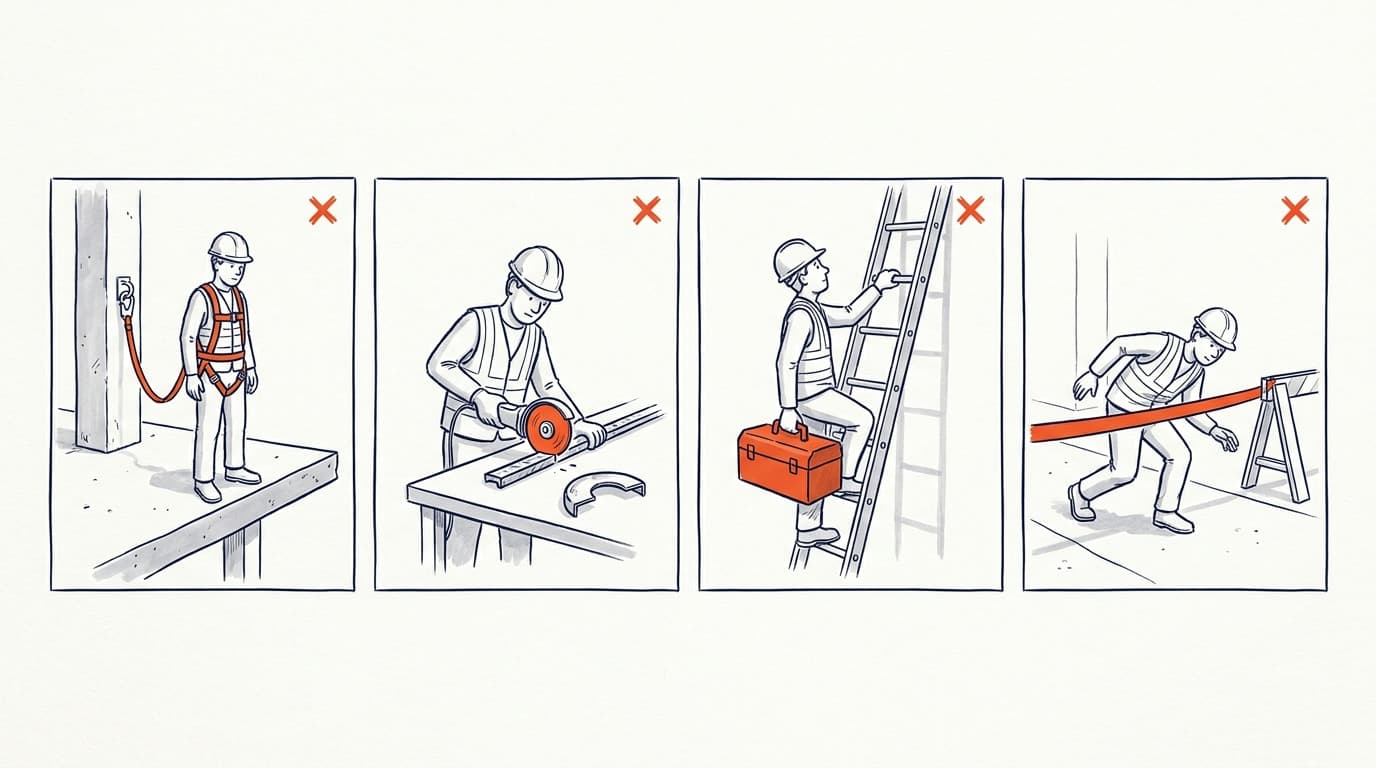
Taking the shortcut. Almost always because the safe route is longer, blocked, or does not exist. Shortcuts are worn into sites like footpaths across grass — and they map exactly onto where the route should have been.
Not using fall protection. Frequently because there is nowhere adequate to anchor, the harness does not fit, or the task takes ninety seconds and the setup takes twenty minutes.
Removing a guard. Usually because the machine cannot be adjusted, cleared or fed with it in place. That is a machine or method problem expressed as an act.
Using the wrong tool. The right one is three floors down, in the store, on another crew's truck, or has been broken for a fortnight.
Working without the permit or isolation. Because the process takes longer than the job, or the authorised person is unavailable.
Not reporting. Because reporting has cost someone something, visibly, in living memory.
Rushing at the end of a shift or before weather. Production pressure that nobody stated out loud but everybody understood.
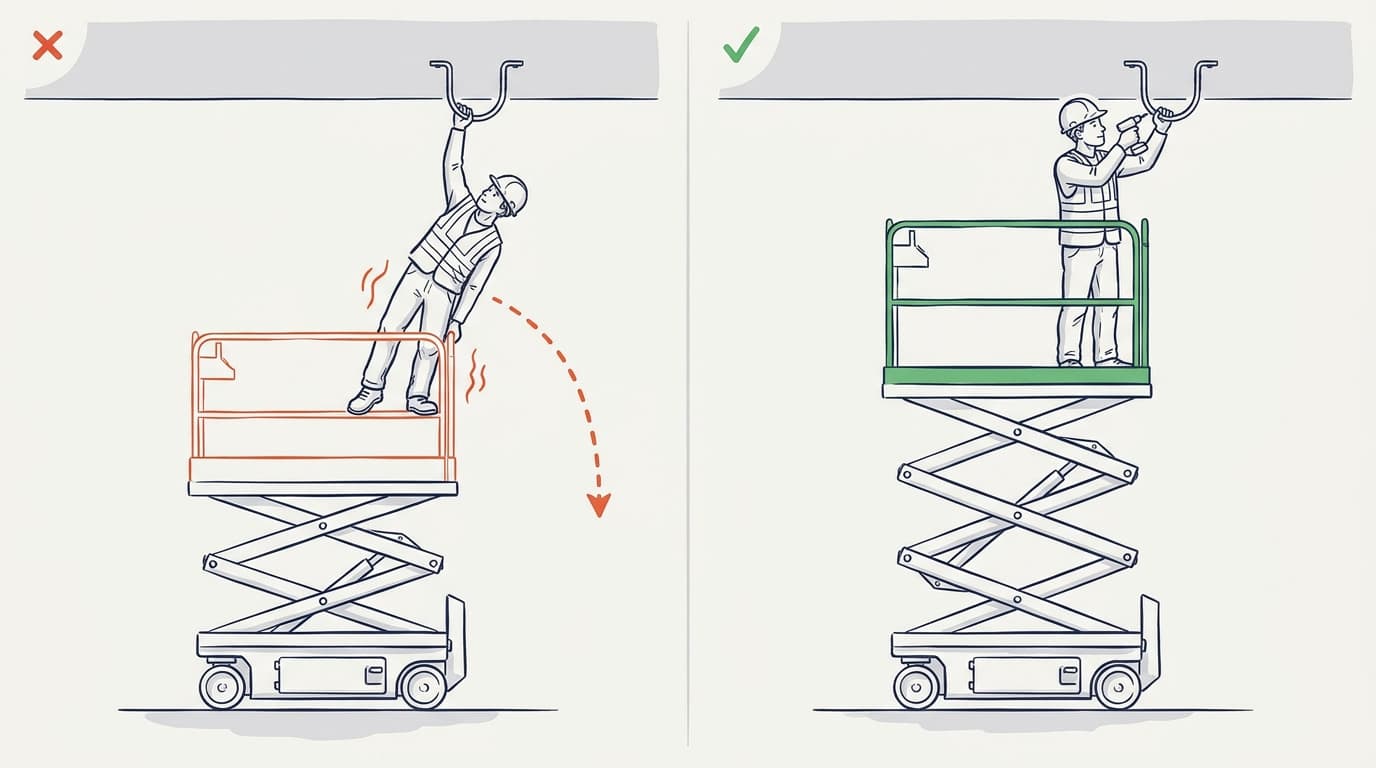
Standing on the guardrail, the bucket, the drum. Because access was not planned for the last two metres of the task.
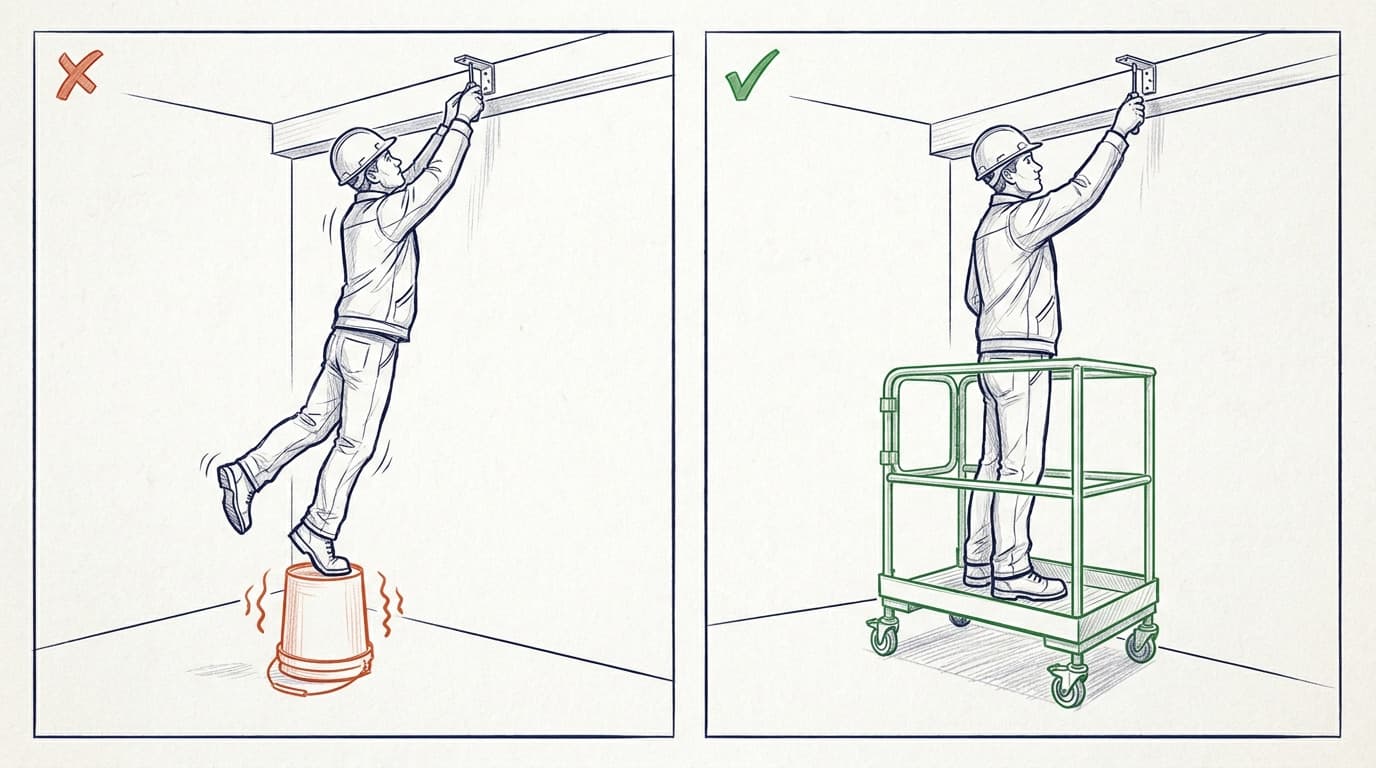
In every one of those, the behaviour is the cheapest available solution to a real problem the worker has been handed. Change the problem and the behaviour changes with it. Leave the problem and no amount of instruction will hold.
How deviance becomes normal#
The most dangerous behaviours are not the ones people know are wrong. They are the ones that stopped feeling wrong.
It happens in a predictable sequence. Someone deviates once, under pressure, and nothing bad happens. Others see it work. The deviation becomes the informal method. New starters learn it as the way the job is done — they never see the original rule at all. Eventually the written method and the actual method are two different things, and only one of them is on paper.
Two consequences follow.
The people doing it are not being reckless. They are doing what they were taught by watching. Discipline aimed at them treats the last person in a long chain as the cause.
Nothing bad happening is not evidence of safety. The outcome of an unsafe act is mostly determined by circumstance — where someone happened to be standing, whether the load happened to swing. A deviation that has worked two hundred times has been lucky two hundred times.
The practical test: when did we last check that the written method and the real method are the same? If nobody can answer, they are not.
What can go wrong?#
Behaviour treated as the cause, so the investigation stops at the person and the condition survives to catch the next one.
Discipline used where design was needed, producing compliance while supervised and nothing else.
Observation programmes that count acts without ever asking why the act was the sensible option.
New starters learning the informal method because that is what they see, not what they are told.
Supervisors modelling the shortcut — the single strongest determinant of what a crew does.
Silence as consent. Walking past something is a decision that teaches everyone watching.
Unstated production pressure, which everyone hears and nobody can point to.
Rules that cannot be followed as written, so following them becomes optional and the whole rulebook loses authority.
How do we manage this properly?#
Ask the diagnostic question first: how many people do this? One is a conversation. Most of the crew is a design review.
Then ask why it made sense. Not to excuse it, but because the answer is where the fix is. Nobody takes a risk for no reason.
Fix the reason. Provide the anchor, plan the last two metres of access, put the tool where the work is, shorten the permit process, unblock the safe route.
Make the safe way the easy way. Where the safe method is also the quickest, behaviour changes without any persuasion at all.
Supervisors go first. A supervisor who takes the shortcut has authorised it for everybody, permanently.
Speak up in the moment, and make it normal in both directions — including upward. A site where a labourer can stop a foreman has a real safety culture; one where they cannot has a poster.
Protect people who report their own deviations, because those reports contain the most information you will ever get.
Re-check the written method against the real one periodically, and correct whichever is wrong — sometimes it is the paperwork.
Before you start#
- Confirm you can do this task the safe way with what is on site right now.
- Confirm the anchor point, access and tools exist for the whole task, including the last part.
- Confirm nothing in today's plan requires a shortcut to achieve.
- Confirm the written method matches how the job is actually done.
- Confirm anyone new has been shown the correct method, not just left to copy.
- Confirm you would be comfortable stopping anyone here, at any level.
- Confirm there is no unstated pressure about finishing today.
- Confirm what you would do if the safe method turned out to be impossible.
Talk it over#
- What do we all do here that we know is not the written method?
- What is the safe way that nobody uses, and why doesn't anyone use it?
- Who taught you how this job is done — and were they following the method?
- When did you last stop someone senior to you?
The bottom line#
The diagnostic question is how many people do it. One person is a training or supervision matter; most of the crew is a design problem, because twelve people do not independently choose the same risk — they are responding to the same thing, and that thing is fixable. The standards place the duty accordingly: 1926.21(b)(2) requires the employer to instruct each employee in recognising and avoiding unsafe conditions; 1926.20(b)(4) requires the employer to permit only employees qualified by training or experience to operate equipment and machinery; 1926.32(f) requires a competent person to hold authorization to take prompt corrective measures; and Section 5(a)(1) turns on recognised hazards — which a behaviour everyone knows about certainly is. Behind almost every unsafe act is a real problem handed to the worker, with the unsafe act as the cheapest available solution. And remember what deviance does: nothing bad happening is not evidence of safety, it is evidence of luck that has held so far.
Frequently asked questions about unsafe behaviours#
Is unsafe behaviour the worker's fault?
Sometimes, and the honest answer is that individual choices matter. But the standards place the duties to train, authorise, supervise and correct on the employer — 1926.21(b)(2) on instruction, 1926.20(b)(4) on permitting only qualified employees to operate equipment, and 1926.32(f) on the competent person's authority. An investigation that stops at the behaviour has stopped one step before the thing that could be fixed.
What is the quickest way to tell a training problem from a design problem?
Count. If one person does it, it is a training, supervision or individual matter. If most of the crew does it, it is a design problem. People do not independently arrive at the same unsafe method by coincidence — they are all responding to the same constraint, and that constraint is what needs changing.
Why do experienced workers take more shortcuts?
Because experience includes a long record of shortcuts that worked. Every deviation that produced no injury reinforces the belief that it is safe, when the outcome was mostly determined by circumstance. Nothing bad happening is not evidence of safety — it is evidence that luck has held so far.
What is normalisation of deviance?
The process by which a one-off deviation becomes the standard method. Someone deviates under pressure, nothing goes wrong, others copy it, and new starters learn it as simply how the job is done — often never seeing the original rule. Eventually the written method and the real method are different, and only one of them is on paper.
Does discipline change behaviour?
It changes behaviour while people are being watched, which is not the same thing. Where the unsafe act is the cheapest available solution to a real problem — no anchor point, no access, wrong tool, blocked route — discipline removes the solution without removing the problem, and the behaviour returns as soon as supervision moves on.
What is the single most effective thing a supervisor can do?
Follow the method themselves. A supervisor taking a shortcut has authorised it for the entire crew, permanently, and no amount of subsequent instruction will undo it. The reverse is equally powerful: crews follow what they see far more reliably than what they are told.
How do we make speaking up normal?
Make it work in both directions. A site where a labourer can stop a foreman has a functioning safety culture; a site where that would be career-limiting has a poster. It also means protecting people who report their own deviations, because those reports contain more information about how work actually happens than any observation programme will produce.
Download the unsafe behaviours toolbox talk PDF#
Get this common unsafe behaviours toolbox talk as a print-ready PDF — available in English, Spanish, Portuguese, and Turkish. Print it, hand it to the crew, and collect signatures on the included attendance sheet.
Download the PDF — free account required. New members get 3 free downloads.
Related toolbox talks#
Sources#
- OSHA, 29 CFR 1926.20 — General safety and health provisions: https://www.osha.gov/laws-regs/regulations/standardnumber/1926/1926.20
- OSHA, 29 CFR 1926.21 — Safety training and education: https://www.osha.gov/laws-regs/regulations/standardnumber/1926/1926.21
- OSHA, 29 CFR 1926.32 — Definitions: https://www.osha.gov/laws-regs/regulations/standardnumber/1926/1926.32
Written by FieldSafetyTalk's safety professional — a CSP, ASP, CHST and OSHA Authorized Outreach Trainer with 14+ years of international construction safety experience across federal, heavy civil, and industrial projects.