Steel Erection
Updated 2026-08-05
In this bundle Fall Protection & Heights
Print-ready PDF
Download this talk as a print-ready PDF, available in 4 languages.
Every crew that comes onto a steel job already knows the fall protection rule, because every other trade on site works to it: six feet, tie off. Then they meet Subpart R, where the number is fifteen, and the usual conclusion is that steel erection has a weaker rule than everybody else. That conclusion is wrong, and understanding why changes what you check before the shift starts. This Steel Erection Toolbox Talk (Safety Talk / Tailgate Talk) is about the trade.
Here is the distinction that carries this whole talk: most of Subpart R is not about your harness — it is about whether the thing you are standing on will stay up. The fall protection trigger really is higher: 1926.760(a)(1) requires protection for an employee on a walking/working surface with an unprotected side or edge more than 15 feet (4.6 m) above a lower level, against the 6-foot trigger that governs most construction under Subpart M. OSHA did not simply relax the rule. It paid for that height with a set of structural stability requirements that other trades do not have — anchor rods, concrete strength, bolted connections — because in steel erection the most reliable way to stop a fall is to stop the steel from moving.
Where the boundary of this talk sits#
General fall protection duties and the 6-foot trigger belong to the fall protection talk. Fall clearance arithmetic — free fall, deceleration, harness stretch — belongs to the fall clearance talk. Crane capacity, load charts and signalling belong to the crane talk; sling and hardware inspection to the rigging inspections talk. Securing tools and materials aloft under 1926.759(a) belongs to the dropped objects talk. This talk owns Subpart R: the trigger, the connectors, and the structural rules that justify them.
The trade OSHA made#
Read the three numbers together and the logic appears.
1926.760(a)(1) — 15 feet. Conventional fall protection is required above that height for employees engaged in a steel erection activity.
1926.760(b) — connectors. A connector must be protected from fall hazards of more than two stories or 30 feet (9.1 m) above a lower level, whichever is less. Connectors are the workers receiving and bolting the steel as the crane holds it, and they are the reason the subpart exists in its current form: they cannot be conventionally protected while doing the work, so OSHA set a different threshold for them specifically.
1926.760(c) — controlled decking zone. A CDZ may extend no more than 90 feet from a leading edge, and inside it deckers work to controlled-access rules rather than conventional protection.
Those three are the concessions. What follows are the conditions attached to them.
The concrete decides when you start#
This is the provision most crews have never read, and it is the one that turns a collapse from bad luck into a documented failure.
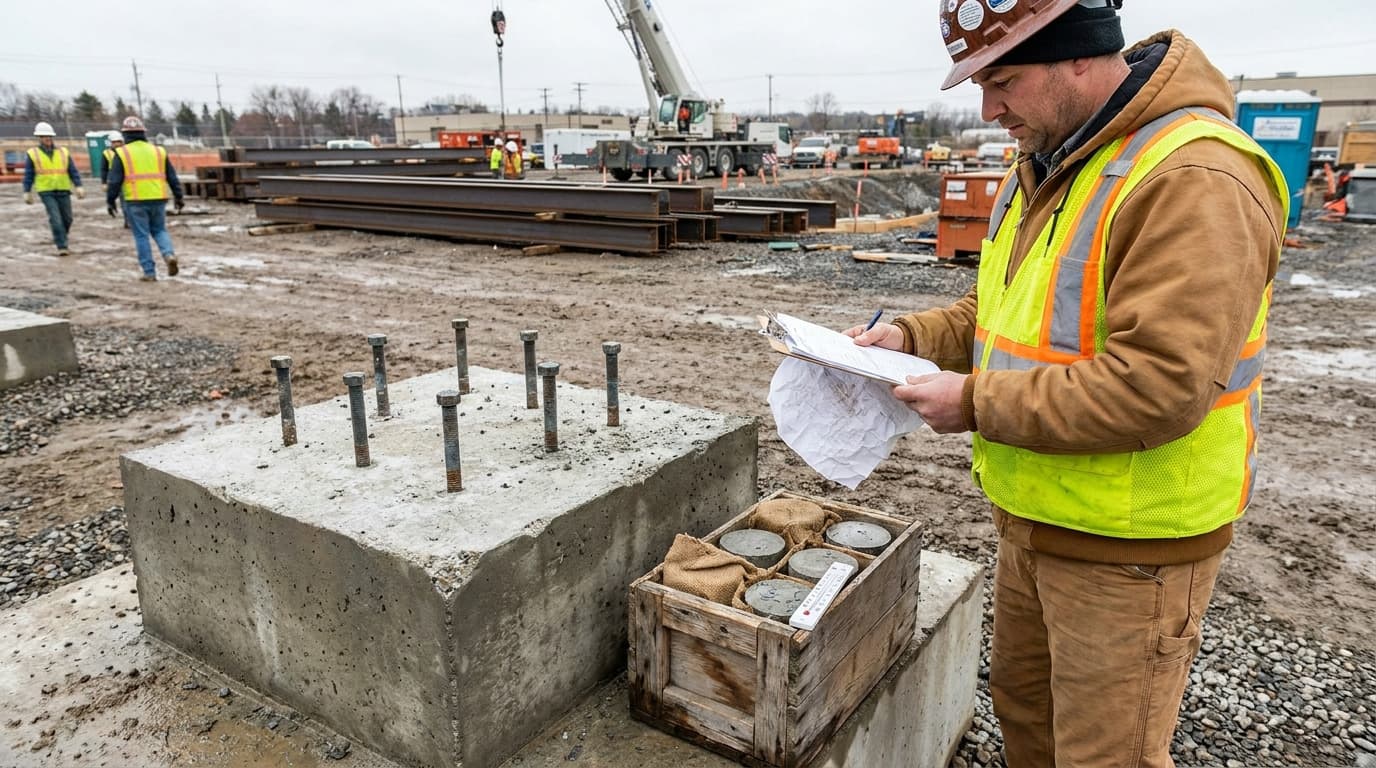
1926.752(a)(1): a steel erection contractor shall not erect steel unless it has received written notification that the concrete in the footings, piers and walls, or the mortar in the masonry piers and walls, has attained — on the basis of an appropriate ASTM standard test method of field-cured samples — either 75 percent of the intended minimum compressive design strength, or sufficient strength to support the loads imposed during steel erection.
1926.752(a)(2) adds the second half: written notification that any repairs, replacements and modifications to the anchor bolts were conducted in accordance with 1926.755(b).
Read what that requires. Not an opinion that the concrete looks ready. A field-cured sample, an ASTM test method, a percentage, and a piece of paper from the controlling contractor. The chain of custody is the control.
What holds a column up before it is connected#
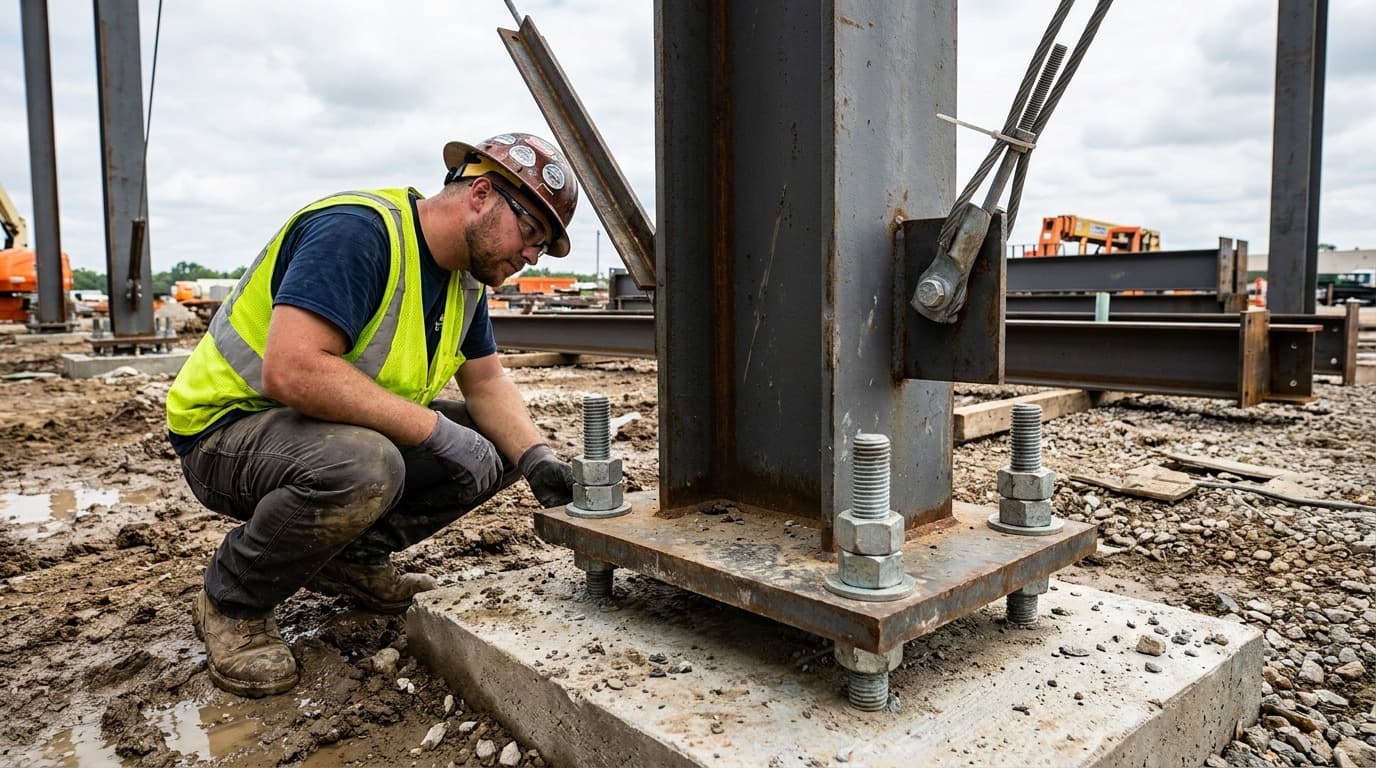
1926.755(a)(1): each column shall be anchored by a minimum of four anchor rods (anchor bolts).
1926.755(a)(2): each column-anchorage connection shall be designed to resist a minimum eccentric gravity load of 300 pounds located 18 inches from the extreme outer face of the column in each direction at the top of the column shaft.
That second number is the interesting one, because it describes a person. Three hundred pounds acting a foot and a half off the face of the column, at the top — that is a worker with tools hanging on the column, or landing against it. OSHA wrote a structural requirement whose load case is a human being.
The reason is in the record. In the preamble to the final rule, OSHA describes a fatality: a column displaced from the foundation bolts during the connecting process, knocking the worker from the ladder and fatally injuring him — and states that compliance with the column anchorage requirements could have prevented that accident.
Four rods and a 300-pound eccentric load are fall protection. They just do not look like it.
Do not release the hoist too early#
The same logic governs when the crane can let go, and the clearest verified example sits in the systems-engineered metal buildings section.
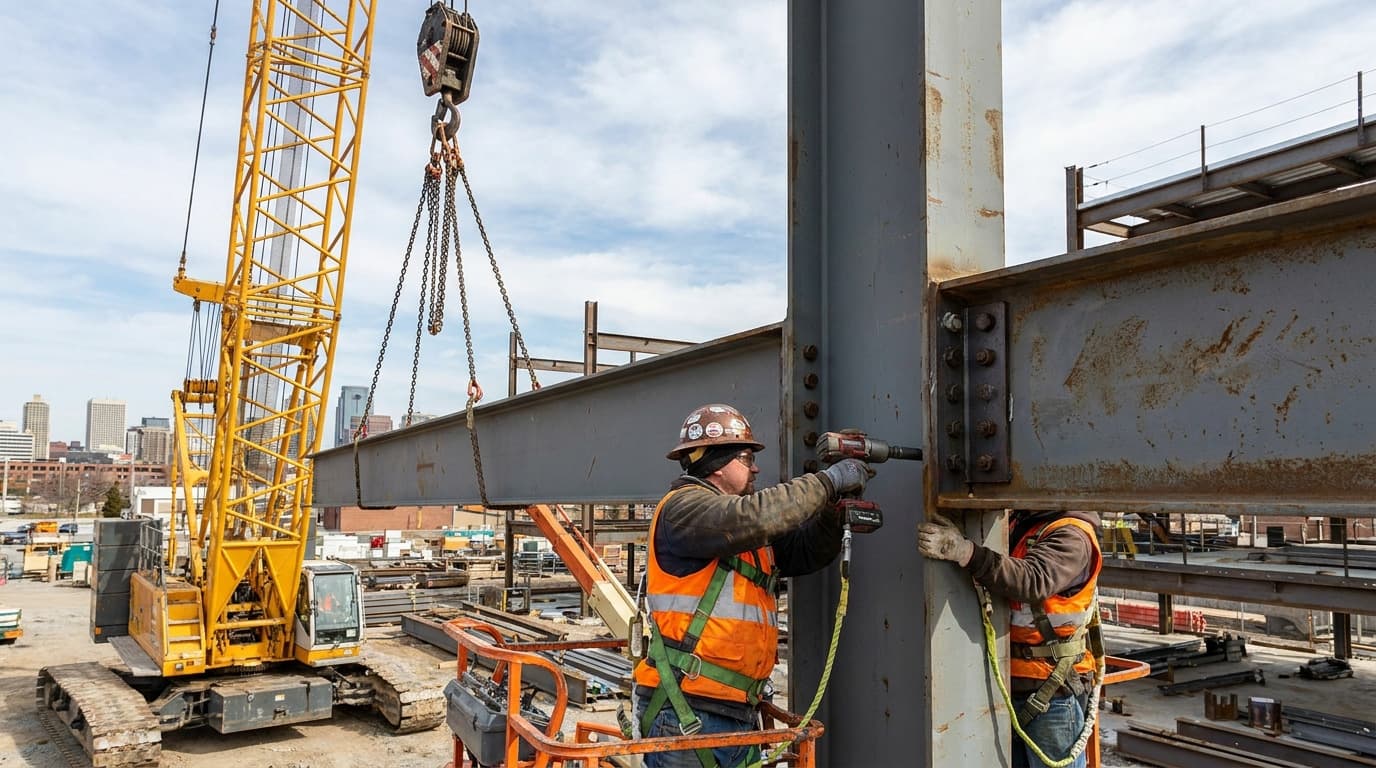
1926.758(c): rigid frames shall have 50 percent of their bolts, or the number of bolts specified by the manufacturer, whichever is greater, installed and tightened on both sides of the web adjacent to each flange before the hoisting equipment is released.
Note the structure of that sentence: the connection must carry itself before the crane stops carrying it. Structural steel assembly under 1926.756 applies the same principle to conventional framing, with its own minimum connection requirements before a member is released from the hoisting line — check the section and the erection drawings for the job in front of you rather than working from memory.
Note also 1926.758(a): for systems-engineered metal buildings, all of Subpart R applies except 1926.755 (column anchorage) and 1926.757 (open web steel joists) — so a metal building job is not simply "steel erection with fewer rules", it is a different subset.
The rest of the frame#
Perimeter safety cables — 1926.760(a)(2). On multi-story structures, perimeter safety cables shall be installed at the final interior and exterior perimeters of the floors as soon as the metal decking has been installed, and they must meet the guardrail criteria in 1926.502 via Appendix G.
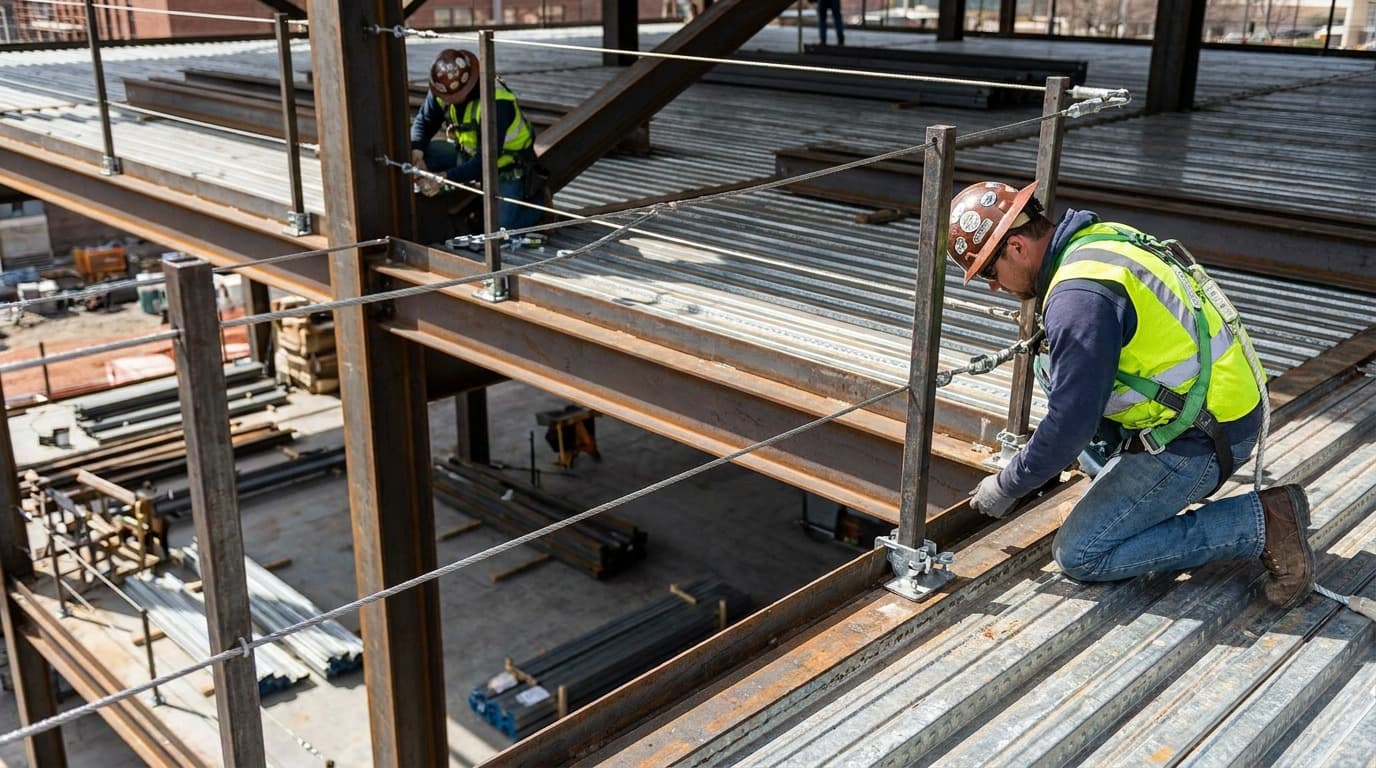
Custody of fall protection — 1926.760(e). Fall protection provided by the steel erector remains in the completed area for other trades to use only if the controlling contractor or its authorised representative agrees — and takes on the inspection and maintenance obligations. Otherwise it comes down with the erector. If your trade is following steel, do not assume the cables you can see belong to you.
Open web steel joists — 1926.757. Joists are the members in the fatality record that twist and drop; bridging, terminus points and the sequence of attachment are governed here.
Training — 1926.761. The subpart requires training by a qualified person, with specialised training for connectors, employees working in CDZs, and multiple lift rigging where those are used.
Multiple lift rigging — "Christmas treeing" — is permitted under 1926.753 only under defined conditions with a specific rigging assembly, and it is one of the practices the training requirement calls out by name.
Where the duty sits#
Subpart R, 1926.750 to 1926.761, is the standard, and it is unusually self-contained: scope, site layout, hoisting and rigging, structural assembly, column anchorage, beams and columns, joists, systems-engineered buildings, falling object protection, fall protection and training.
Two provisions decide who does what. 1926.752(a) puts the written notification duty on the controlling contractor before erection may begin. 1926.760(e) puts the custody decision for fall protection on the controlling contractor as well. Steel erection is a trade where the general contractor's paperwork is part of the physical safety system, not an administrative afterthought.
Around it: 1926.502 supplies the fall protection system criteria through Appendix G. 1926.759(a) covers securing materials and tools aloft. 1926.21(b)(2) covers instruction. And Section 5(a)(1) applies to recognised hazards not otherwise addressed.
What can go wrong?#
Reading the 15-foot trigger as a relaxation and ignoring the structural conditions that came with it.
Starting erection without the written notification on concrete strength and anchor bolt modifications.
Accepting a visual judgement that the concrete is ready, when the standard requires a field-cured sample and an ASTM test method.
Field-modifying anchor bolts without the structural engineer of record's approval.
Releasing the hoisting equipment before the connection can carry itself.
Assuming a systems-engineered metal building follows the same rules, when 1926.755 and 1926.757 do not apply to it.
Using perimeter cables left by the steel erector without knowing whether custody was actually transferred.
Treating connector work as ordinary work at height, when it has its own threshold and its own required training.
How do we manage this properly?#
Get the written notification before anybody erects anything — concrete or mortar strength on field-cured samples to an ASTM method, and the anchor bolt statement.
Check that every column has four anchor rods, and that nothing was repaired, replaced or field-modified without the structural engineer of record.
Treat the 300-pound eccentric load as what it is — the standard's model of a person on the column — and do not add loads to an unbraced column.
Confirm the release criteria for each connection type from the section and the erection drawings, and do not free the crane early to keep the pick rate up.
Establish which employees are connectors and which are working in a CDZ, and confirm they have the specialised training 1926.761 requires.
Install perimeter safety cables as soon as the decking is in, not at the end of the floor.
Settle custody of fall protection in writing with the controlling contractor before the steel crew leaves the area.
Check whether the job is a systems-engineered metal building, because the applicable subset of Subpart R changes.
Secure everything aloft — tools, bolts, offcuts — under 1926.759(a).
Before you start#
- Confirm the written notification under 1926.752(a) has been received and is on site.
- Confirm concrete or mortar strength was established from field-cured samples by an ASTM method.
- Confirm no anchor bolts were repaired, replaced or field-modified without engineer approval.
- Confirm every column has a minimum of four anchor rods.
- Confirm who today's connectors are and that their training is current.
- Confirm whether a controlled decking zone is in use and where its control lines are.
- Confirm the release criteria before the crane is freed from any member.
- Confirm who owns the perimeter cables once this floor is complete.
Talk it over#
- Has anyone actually seen the written notification for the concrete on this job?
- Who is connecting today, and what height are they protected from?
- What is holding the column you are about to climb, and how many rods are in it?
- When this floor is done, do the perimeter cables stay or go?
The bottom line#
Most of Subpart R is not about your harness — it is about whether the thing you are standing on will stay up. The trigger genuinely is higher: 1926.760(a)(1) requires protection above 15 feet (4.6 m) against the 6-foot trigger elsewhere in construction, with connectors protected from falls of more than two stories or 30 feet (9.1 m), whichever is less under (b), and a controlled decking zone extending no more than 90 feet from a leading edge under (c). Those are the concessions; the structural rules are the price. 1926.752(a)(1): a steel erection contractor shall not erect steel without written notification that concrete or mortar has attained, on the basis of an appropriate ASTM standard test method of field-cured samples, either 75 percent of the intended minimum compressive design strength or sufficient strength for the erection loads — with (a)(2) adding written confirmation that anchor bolt repairs, replacements and modifications complied with 1926.755(b). 1926.755(a)(1) requires each column to be anchored by a minimum of four anchor rods, and (a)(2) requires the column-anchorage connection to resist a minimum eccentric gravity load of 300 pounds located 18 inches from the extreme outer face of the column — a load case that describes a person, which is why OSHA's preamble records a fatality in which a column displaced from the foundation bolts during connecting, knocking the worker from the ladder, and states the anchorage requirements could have prevented it. On releasing the hoist, 1926.758(c) requires rigid frames to have 50 percent of their bolts, or the manufacturer's number, whichever is greater, installed and tightened before the hoisting equipment is released — the connection carries itself before the crane stops carrying it — with 1926.756 applying the same principle to conventional structural assembly. Note that for systems-engineered metal buildings, 1926.758(a) disapplies 1926.755 and 1926.757. Around these: perimeter safety cables under 1926.760(a)(2) installed as soon as the metal decking has been installed; custody of fall protection under (e), which stays for other trades only if the controlling contractor agrees; 1926.757 for open web steel joists; 1926.753 for hoisting and rigging including multiple lift rigging; and 1926.761 training, with specialised training for connectors, CDZ work and multiple lift rigging. Four rods and a 300-pound eccentric load are fall protection — they just do not look like it.
Frequently asked questions about steel erection#
Why is the fall protection trigger 15 feet instead of 6?
Because Subpart R buys that height back with structural requirements. 1926.760(a)(1) requires protection above 15 feet (4.6 m) for employees engaged in a steel erection activity, against the 6-foot trigger governing most construction. It is not a relaxation on its own — the subpart pairs it with rules that keep the steel from moving in the first place: four anchor rods per column, a 300-pound eccentric load design case, and written notification on concrete strength before erection may begin.
What has to happen before steel erection can start?
1926.752(a)(1): the steel erection contractor shall not erect steel without written notification that concrete in the footings, piers and walls, or mortar in masonry piers and walls, has attained — on the basis of an appropriate ASTM standard test method of field-cured samples — either 75 percent of the intended minimum compressive design strength or sufficient strength to support the erection loads. (a)(2) adds written confirmation that any anchor bolt repairs, replacements or modifications complied with 1926.755(b).
What are the column anchorage rules?
1926.755(a)(1): each column shall be anchored by a minimum of four anchor rods (anchor bolts). (a)(2): each column-anchorage connection shall resist a minimum eccentric gravity load of 300 pounds located 18 inches from the extreme outer face of the column in each direction at the top of the shaft. That load case is a person. OSHA's preamble to the final rule records a fatality where a column displaced from the foundation bolts during connecting, knocking the worker from the ladder, and says the anchorage requirements could have prevented it.
What protection do connectors get?
A different threshold and specific training. 1926.760(b) requires each connector to be protected from fall hazards of more than two stories or 30 feet (9.1 m) above a lower level, whichever is less. Connectors receive and bolt steel while the crane holds it, which is why conventional protection is difficult during the work itself — and why 1926.761 requires specialised training for connectors, for employees working in controlled decking zones, and for multiple lift rigging.
When can the crane be released from a member?
Only once the connection can carry itself. The clearest expression is 1926.758(c) for systems-engineered metal buildings: rigid frames shall have 50 percent of their bolts, or the number specified by the manufacturer, whichever is greater, installed and tightened on both sides of the web adjacent to each flange before the hoisting equipment is released. Conventional structural assembly under 1926.756 applies the same principle — check the section and the erection drawings for the specific job.
Do the same rules apply to a metal building?
Not entirely, and this catches people out. 1926.758(a) states that all of the requirements of Subpart R apply to the erection of systems-engineered metal buildings except 1926.755 (column anchorage) and 1926.757 (open web steel joists). So a metal building job is not "steel erection with fewer rules" — it is a different applicable subset, with 1926.758(b) still requiring each structural column to be anchored by a minimum of four anchor rods.
Who owns the perimeter cables after the steel crew leaves?
Whoever the controlling contractor says, in writing. 1926.760(a)(2) requires perimeter safety cables at the final interior and exterior perimeters of floors on multi-story structures as soon as the metal decking has been installed, meeting the 1926.502 guardrail criteria via Appendix G. 1926.760(e) then provides that fall protection left by the steel erector remains for other trades only if the controlling contractor or its authorised representative agrees and takes on inspection and maintenance. Following trades should not assume.
Download the steel erection toolbox talk PDF#
Get this steel erection toolbox talk as a print-ready PDF — available in English, Spanish, Portuguese, and Turkish. Print it, hand it to the crew, and collect signatures on the included attendance sheet.
Download the PDF — free account required. New members get 3 free downloads.
Related toolbox talks#
Sources#
- OSHA, 29 CFR 1926.760 — Fall protection: https://www.osha.gov/laws-regs/regulations/standardnumber/1926/1926.760
- eCFR, 29 CFR Part 1926 Subpart R — Steel Erection: https://www.ecfr.gov/current/title-29/subtitle-B/chapter-XVII/part-1926/subpart-R
- Federal Register, Safety Standards for Steel Erection, 18 January 2001: https://www.federalregister.gov/documents/2001/01/18/01-979/safety-standards-for-steel-erection
This talk is general awareness guidance for training purposes. It does not qualify anyone to erect steel, connect, deck, or determine when a member may be released from the hoisting line. Subpart R requires training by a qualified person, with specialised training for connectors, controlled decking zone work and multiple lift rigging.
Written by FieldSafetyTalk's safety professional — a CSP, ASP, CHST and OSHA Authorized Outreach Trainer with 14+ years of international construction safety experience across federal, heavy civil, and industrial projects.