Loading Dock Safety
Updated 2026-08-06
In this bundle Vehicle Safety
Print-ready PDF
Download this talk as a print-ready PDF, available in 4 languages.
A loading dock looks like a solid, finished place to work — a level floor, a doorway, a truck backed up flush against it. But that flush surface is a trick. The floor you drive a forklift across does not end at the building; it continues onto the trailer, and the trailer is not part of the building. It is a vehicle, sitting on tires and suspension, held in place by nothing more than its own brakes and whatever you did to secure it. This Loading Dock Safety Toolbox Talk (Safety Talk / Tailgate Talk) is about the hazard that defines a dock: not the fall off the edge, but the fact that the surface you drive onto can move or leave.
Here is the distinction that carries this whole talk: the most dangerous thing at a loading dock is that the surface you drive onto isn't part of the building — it's a truck, and a truck can move; the gap only exists because two separate structures are pretending to be one continuous floor. When a forklift crosses a dock plate onto a trailer, it is driving from a fixed concrete structure onto a vehicle. The dock plate bridging the two is only doing its job as long as the two ends stay where they are. If the trailer rolls forward, creeps sideways, or pulls away entirely, that bridge drops — and the forklift, the operator, and the load go into the gap. Everything about dock safety is about holding those two separate structures together long enough, and reliably enough, to treat them as one floor: the restraint that keeps the trailer against the dock, the communication that keeps the driver from leaving, and the plate seated properly between them.
Where the boundary of this talk sits#
The fall protection talks own the fall off an unprotected edge in general. The unprotected-edges and leading-edge talks own working near open sides. The pallet jack talk owns the material-handling equipment. This talk owns what is specific to the dock — the trailer as a moving surface, trailer creep and pull-away, the dock plate as a bridge between two structures, and the dock-edge drop-off when no trailer is there. Where the question is fall arrest for edge work generally, that is the fall protection talks; this one owns the loading dock as a place where a truck becomes your floor.
Trailer creep — the gap that opens slowly and silently#
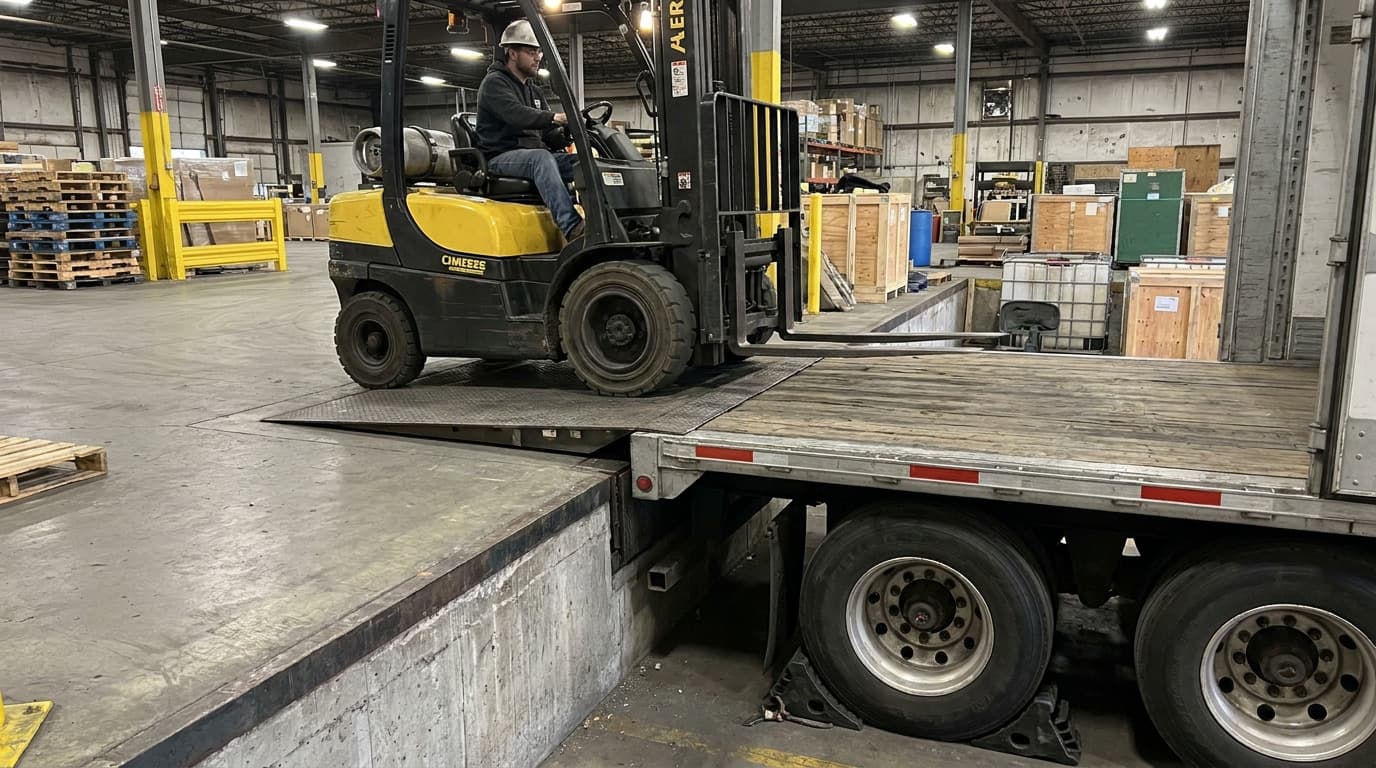
Trailer creep is the dock hazard that gets people because it is invisible while it happens. As forklifts drive in and out of a trailer, each pass nudges the trailer a little — the whole rig inches horizontally away from the dock face, a bit at a time. Nothing looks wrong. The trailer is still there, the plate is still down, the operator is still driving the same path. But the gap between the trailer and the dock is slowly widening, and at some point the dock plate no longer has enough purchase on both ends. Then a forklift crosses it and the plate drops into the gap. Trailers with air-ride suspension add a second version of the same problem — the trailer rises and falls as weight moves on and off, so the dock plate angle shifts under the forklift. The point is that creep is gradual and quiet, so you cannot rely on noticing it. You control it before it starts, with a restraint that physically holds the trailer to the dock, not by watching for it.
Trailer pull-away — the driver who leaves too early#
The other version is sudden: the truck driver, believing loading is done or simply mistaken, pulls away from the dock while a forklift is still on or entering the trailer. This is why a dock needs more than equipment — it needs a communication system that makes it impossible for the driver to leave at the wrong moment. That is what dock locks, traffic lights, and communication signals are for: a red light or an engaged restraint tells the driver "do not move," and a system of keys, signs, or procedures ensures the driver knows loading is not finished. Employers are required to have some system to make sure truck drivers do not pull away while powered industrial trucks are loading or unloading. Equipment and a rule together — the restraint holds the trailer, the signal holds the driver.
Chock it or restrain it — every time#
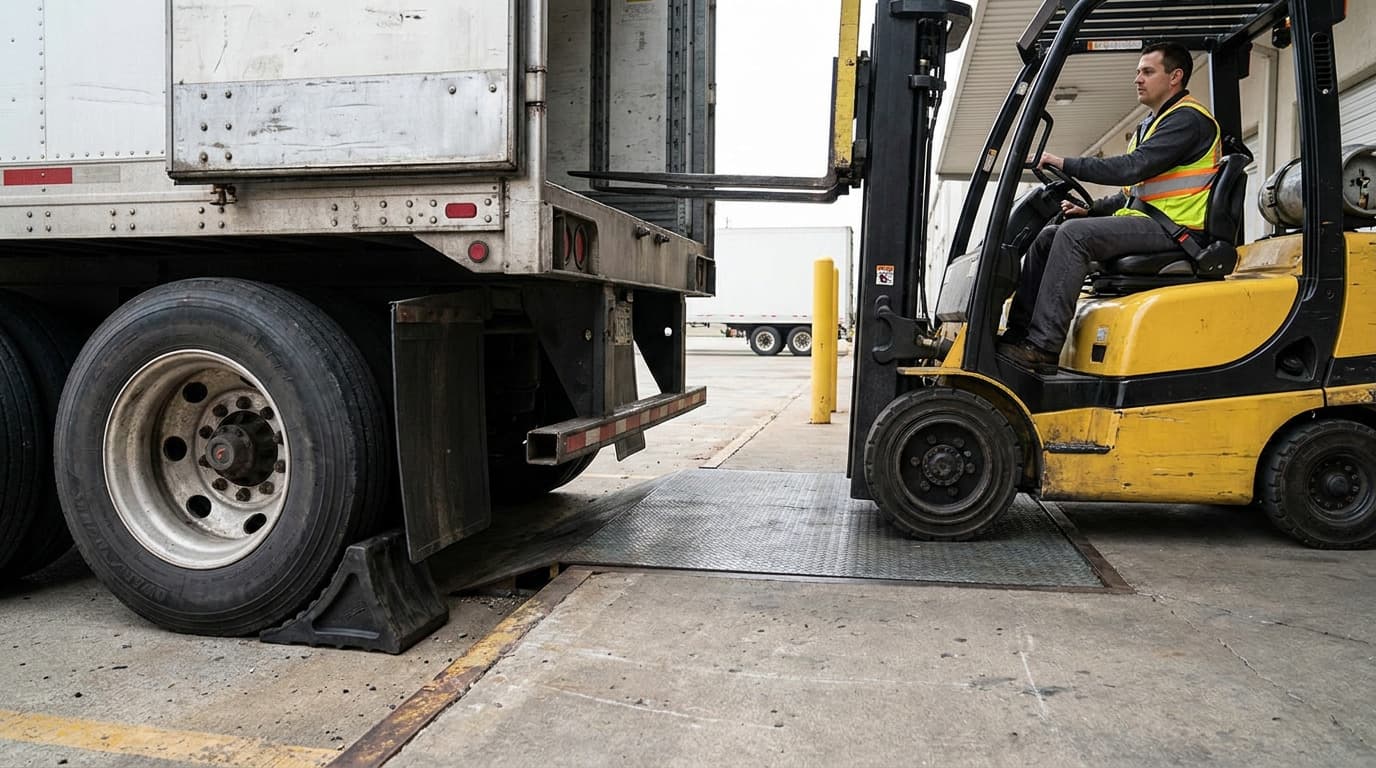
The control for both creep and pull-away is the same in principle: physically secure the trailer to the dock before anyone drives onto it. Wheel chocks placed against the rear wheels are the baseline requirement, and a positive mechanical vehicle restraint — a dock lock that hooks the trailer's rear impact guard — is the accepted equivalent and is more reliable because it cannot be forgotten or kicked loose the way a chock can. Whichever the site uses, the rule is the same: the trailer is secured before a forklift crosses the plate, and it stays secured until loading is complete and the operator is clear. A chock that is "usually" placed is a chock that will eventually be missing on the day it matters. Trailer secured, plate seated, driver signaled — then you drive.
The dock edge when there's no trailer#
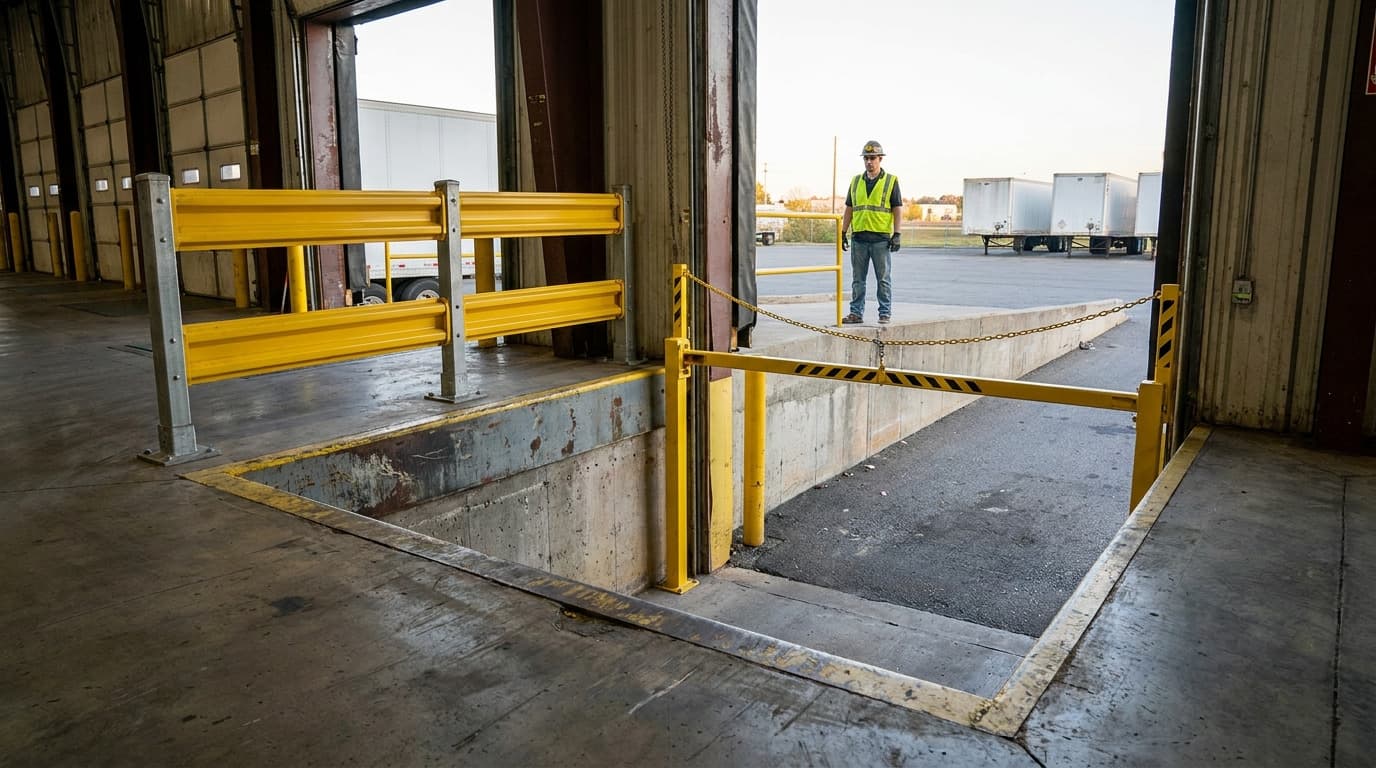
The other dock hazard is the plain one: an open dock edge with a four-foot-or-greater drop and no trailer there is a fall hazard, and a forklift or a walking worker can go over it. The rule here has a nuance worth getting right. The open face of the dock — the working edge where trucks back in for loading and unloading — is treated differently from an ordinary unprotected edge, and standard guardrails are not required across that active loading face. But open-sided dock areas away from that working face, four feet or more above the lower level, must be guarded like any other edge. So the working face is managed with the trailer, the restraint, and the plate; the rest of the dock edge gets edge protection, dock-edge barriers, or a chained-off opening when no trailer is present. An empty dock door standing open over a four-foot drop is not a doorway — it is a hole.
Where the duty sits#
There is no single OSHA "loading dock" standard; the requirements are assembled from several. 1910.176 covers materials handling and storage and is the general anchor. 1910.178 governs powered industrial trucks — forklift operation, training, and the securing requirement: 1910.178(k)(1) and (m)(7) require wheel chocks under the rear wheels (or an equivalent restraint) to prevent trailer movement during loading, and OSHA guidance confirms a positive mechanical restraint is an accepted equivalent. On a construction site, 1926.600 and 1926.602 govern the vehicles and equipment. 1910.28 sets fall protection at unprotected edges four feet or more above a lower level, with a specific provision for the loading-dock face. 1910.26 covers dockboards, and 1910.22 the walking-working surfaces. Behind all of these, 1926.21(b)(2) requires training and the General Duty Clause, Section 5(a)(1) covers recognized hazards — including that employers must ensure drivers do not pull away during loading. Where a site procedure or the equipment manufacturer sets specific requirements, those govern.
What can go wrong?#
- A forklift crosses onto a trailer that was never chocked or restrained, and it creeps or pulls away.
- Trailer creep widens the gap until the dock plate drops a forklift into it.
- A truck driver pulls away while a forklift is still on or entering the trailer.
- A dock plate is not seated properly on both ends and shifts under the load.
- An air-ride trailer rises or falls as weight shifts and the plate angle changes.
- A forklift or worker goes over an open dock edge with no trailer present.
- A chock is "usually" placed but missing on the day it matters.
- The driver has no signal telling them loading is not finished.
How do we manage this properly?#
- Treat the trailer as a moving surface, not part of the building — secure it before you drive on.
- Chock or restrain the trailer every time, before the forklift crosses, until loading is complete.
- Prefer a positive mechanical restraint (dock lock) — it can't be forgotten like a chock.
- Use a communication system — lights, locks, signals — so the driver can't pull away early.
- Seat the dock plate properly on both ends; watch for air-ride trailer movement.
- Guard the dock edge away from the working face; barrier or chain an open dock door.
- Never treat an open dock door over a drop as a doorway — it's a fall hazard.
- Train operators on dock-specific hazards, not just general forklift operation.
Before you start#
- Confirm the trailer is chocked or restrained before any forklift crosses the plate.
- Confirm the restraint stays engaged until loading is done and the operator is clear.
- Confirm a signal or lock keeps the driver from pulling away during loading.
- Confirm the dock plate is rated for the load and seated on both ends.
- Confirm open dock edges away from the working face are guarded or barriered.
- Confirm open dock doors over a drop are chained or gated when no trailer is present.
- Confirm forklift operators are trained on the dock-specific hazards.
- On a construction site, confirm 1926.600/602 vehicle provisions apply.
Talk it over#
- On this dock, what physically stops a trailer from creeping or pulling away?
- How does the driver know loading isn't finished — what's the signal?
- Where are the open dock edges here that need edge protection when there's no trailer?
- Who confirms the trailer is secured before the first forklift crosses?
The bottom line#
The most dangerous thing at a loading dock is that the surface you drive onto isn't part of the building — it's a truck, and a truck can move; the gap only exists because two separate structures are pretending to be one continuous floor. A forklift crossing a dock plate is driving from fixed concrete onto a vehicle, and the bridge only holds while both ends stay put. Trailer creep opens the gap slowly and silently as forklifts drive in and out, so you cannot rely on noticing it — you control it before it starts. Trailer pull-away is the sudden version, the driver leaving too early, which is why a dock needs a communication system that keeps the driver from moving, not just equipment. The control for both is to chock or restrain the trailer every time, before the forklift crosses and until loading is complete — with a positive mechanical restraint preferred because it can't be forgotten like a chock. And the plain dock edge, four feet or more above the lower level away from the working loading face, is a fall hazard that needs edge protection: an open dock door over a drop is a hole, not a doorway. The duty is assembled — 1910.176 materials handling, 1910.178(k)(1)/(m)(7) chocks and restraint, 1910.28 the dock edge, 1926.600/602 on construction sites — with 5(a)(1) behind, including the employer's duty to keep drivers from pulling away. The test for anyone at a dock is one question: before that forklift crosses onto the trailer, what is physically holding the trailer to the dock — and how do you know the driver won't leave?
Frequently asked questions about loading dock safety#
What is trailer creep?
Trailer creep is the slow horizontal movement of a trailer away from the dock face as forklifts drive in and out of it. Each pass nudges the trailer a little, and over time the gap between the trailer and the dock widens until the dock plate no longer has enough purchase on both ends — at which point a forklift crossing it can drop the plate, and itself, into the gap. It is dangerous precisely because it is gradual and quiet: nothing looks wrong while it is happening. That is why you control it with a physical restraint before it starts, rather than trying to watch for it.
What's the difference between a wheel chock and a dock lock?
Both secure the trailer to the dock so it can't creep or pull away. A wheel chock is a wedge placed against the rear wheels — the baseline requirement, but it can be placed wrong, forgotten, or kicked loose. A dock lock (positive mechanical restraint) hooks the trailer's rear impact guard and physically holds it to the dock; OSHA accepts it as the equivalent of chocks, and it is more reliable because it can't be forgotten the way a chock can. Whichever your site uses, the trailer must be secured before a forklift crosses the plate and stay secured until loading is complete.
Why does the driver need a signal system?
Because trailer pull-away — the driver leaving while a forklift is still on or entering the trailer — is one of the deadliest dock events, and it happens when the driver believes loading is finished or is simply mistaken. Equipment alone doesn't prevent it; you need a system that tells the driver "do not move," such as dock lights (red for the driver while loading), an engaged restraint, or a key or sign procedure. Employers are required to have a system that keeps drivers from pulling away during loading. The restraint holds the trailer; the signal holds the driver.
Do loading docks need fall protection at the edge?
The dock edge four feet or more above the lower level is a fall hazard, but the rule has a nuance. The open working face of the dock — where trucks back in for loading and unloading — is treated differently, and standard guardrails are not required across that active loading face. But open-sided dock areas away from the working face, four feet or more up, must be guarded like any other edge. So the working face is managed with the trailer, restraint, and plate, while the rest of the dock edge needs edge protection or barriers, and an open dock door over a drop with no trailer present must be gated or chained.
Isn't a dock plate strong enough to be safe on its own?
No — a dock plate is only a bridge, and a bridge is only safe while both ends stay put. It must be rated for the load and seated properly on both the dock and the trailer, but even a good plate fails if the trailer moves out from under it through creep or pull-away, or if an air-ride trailer rises and falls as weight shifts and changes the plate angle. The plate is one part of a system; the trailer restraint and the driver signal are what keep the two ends where the plate needs them. Never treat the plate as the whole safeguard.
Are loading docks a general industry or a construction issue?
Mostly general industry — the core dock requirements live in the 1910 standards (1910.176, 1910.178, 1910.28, 1910.26, 1910.22), because docks are typically warehouse and distribution environments. On a construction site, the vehicles and mobile equipment are governed by the construction standards 1926.600 and 1926.602, and the forklift operating principles carry across. Either way, the hazards are the same — trailer creep, pull-away, the dock edge — and so are the controls: secure the trailer, signal the driver, guard the edge, train the operator.
Download the loading dock safety toolbox talk PDF#
Get this loading dock safety toolbox talk as a print-ready PDF — available in English, Spanish, Portuguese, and Turkish. Print it, hand it to the crew, and collect signatures on the included attendance sheet.
Download the PDF — free account required. New members get 3 free downloads.
Related toolbox talks#
Sources#
- OSHA, Powered Industrial Trucks — 1910.178(k)(1) and (m)(7) (wheel chocks or equivalent restraint to prevent trailer movement during loading): https://www.osha.gov/laws-regs/regulations/standardnumber/1910/1910.178
- OSHA, Standard Interpretation — trailer creep and pull-away (employers must ensure drivers do not pull away while forklifts are loading; chocks or restraints required): https://www.osha.gov/laws-regs/standardinterpretations/1998-03-04
- OSHA, Walking-Working Surfaces, Fall Protection — 1910.28 (protection at unprotected edges four feet or more above a lower level; loading-dock face provision): https://www.osha.gov/laws-regs/regulations/standardnumber/1910/1910.28
This talk is general awareness guidance for training purposes. It does not replace your employer's dock or powered-industrial-truck program, the OSHA materials-handling, forklift, and walking-working-surface standards, the OSH Act General Duty Clause, the equipment manufacturer's instructions, or a competent person's duties, and it is not legal advice. Where a site procedure or manufacturer's manual sets a stricter requirement, that requirement governs.
Written by FieldSafetyTalk's safety professional — a CSP, ASP, CHST and OSHA Authorized Outreach Trainer with 14+ years of international construction safety experience across federal, heavy civil, and industrial projects.