Buddy System
Updated 2026-08-06
In this bundle Jobsite Fundamentals & Compliance
Print-ready PDF
Download this talk as a print-ready PDF, available in 4 languages.
"Buddy up" is one of the most-used phrases on a jobsite and one of the least understood. Most crews hear it as a soft instruction — stay near someone, keep half an eye out, do not wander off alone. Understood that way it does almost nothing, because "keep an eye out" has no trigger, no job and no failure you can point to. This Buddy System Toolbox Talk (Safety Talk / Tailgate Talk) is about what the phrase means where it is a legal requirement, and why the real thing is far more specific — and more useful — than the version most sites run.
Here is the distinction that carries this whole talk: a buddy is not someone who keeps you company. A buddy is a designated rescuer whose one job is to notice, in time, that you are in trouble and to get you help. OSHA defines the buddy system in writing, and the definition is precise: a system of organizing employees into work groups in such a manner that each employee is designated to be observed by at least one other employee in the work group, for the purpose of providing rapid assistance in the event of an emergency. Read that closely. Not "watch out for each other" in general — designated to be observed, rapid assistance, emergency. The buddy exists for the moment you cannot help yourself, and everything else about the practice follows from that one purpose.
Where the boundary of this talk sits#
The confined space talk owns permit-required entry, the attendant's full duty set and the atmospheric testing before anyone goes in. The first aid and AED talk owns the treatment after the buddy raises the alarm. The asking for help talk owns the personal, off-the-tools conversation about how someone is doing. The isolation and remote work talk owns lone working as a mental-health and check-in problem. The situational awareness talk owns what one person perceives about their own surroundings. This talk owns the buddy relationship itself: what a buddy is for, what makes the pairing real or fake, and where the law requires it rather than merely suggesting it.
What OSHA actually says — it is a defined term, not a slogan#
The buddy system is not folklore. It is a defined term in a federal standard with a fixed meaning, and reading that meaning changes what you ask of it. The definition sits in the HAZWOPER standard, 29 CFR 1910.120(q)(3) — identical for construction at 1926.65 — and is worth having in front of the crew word for word. "Buddy system means a system of organizing employees into work groups in such a manner that each employee of the work group is designated to be observed by at least one other employee in the work group. The purpose of the buddy system is to provide rapid assistance to employees in the event of an emergency."
Three words do all the work. Designated — the pairing is assigned, not assumed; each person knows who is watching them and who they watch, by name, before the work starts. Observed — the function is to watch continuously, not to work alongside you and glance over now and then. Rapid assistance in an emergency — the buddy is measured on one thing: whether they notice you are in trouble fast enough to get help while it still matters. A pairing that satisfies "we buddied up" but fails any of the three is not a buddy system; it is two people near each other.
The rule that shows what "real" looks like: two-in, two-out#
The clearest illustration is the firefighting rule, because OSHA wrote out exactly how tight the contact has to be. Under the respiratory protection standard, 29 CFR 1910.134(g)(4), interior structural firefighting requires that at least two employees enter the IDLH atmosphere and remain in visual or voice contact with one another at all times, and that at least two employees are located outside ready to perform rescue. That is "two-in, two-out," and "at all times" is the part sites usually lose.
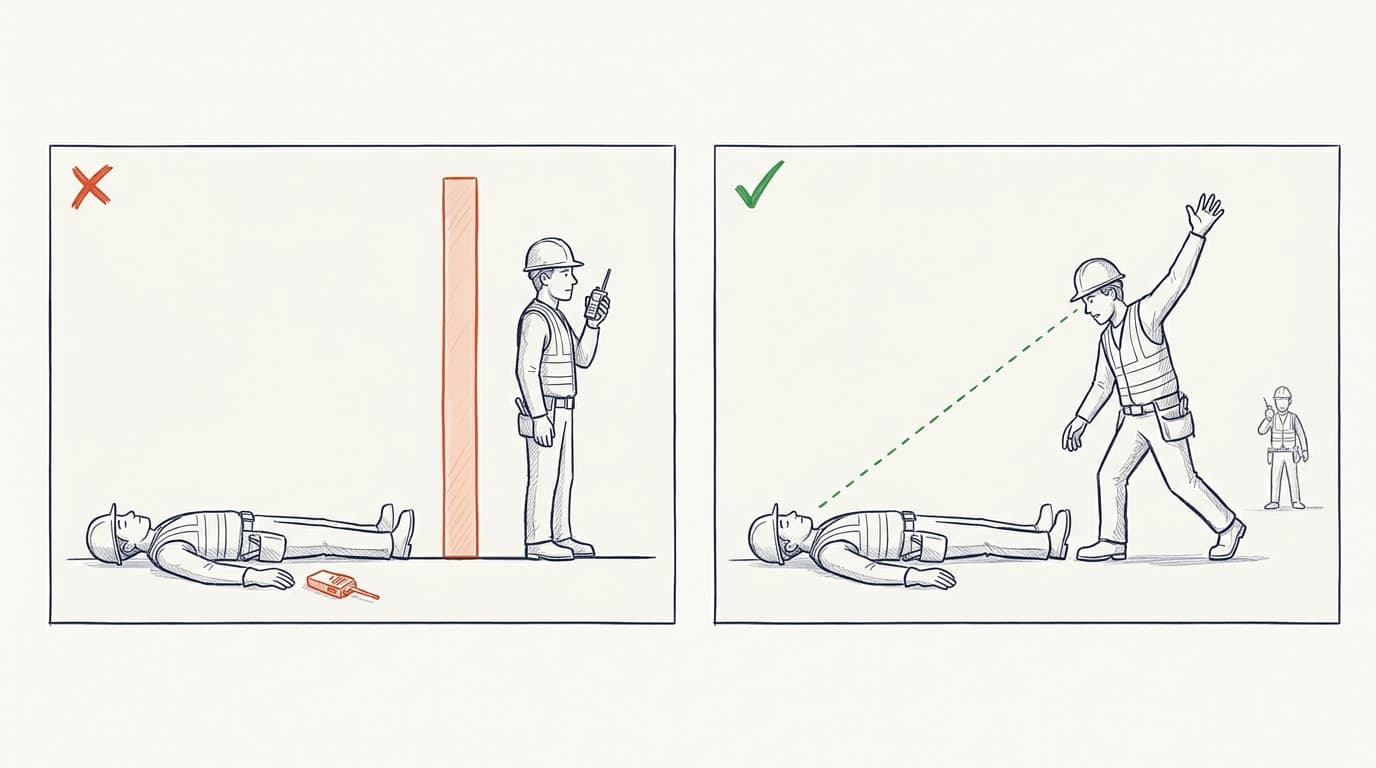
One OSHA clarification on that rule is the most useful thing in this talk, because it kills the most common shortcut. Radios and other electronic contact cannot substitute for visual or voice contact between buddies. The reasoning generalizes far beyond firefighting: devices can fail or lose reception, and — the deciding point — the person who needs rescue may be physically unable to operate the device to call for help. A worker who is unconscious, trapped or overcome cannot key a radio. That is exactly the moment the buddy system exists for, and exactly the moment a radio-based version fails. So the contact that counts is the kind that works when the watched person can do nothing: direct line of sight, or close enough to hear. If you can only reach your buddy by calling them, they are not your buddy at that moment.
Where a buddy is legally required, not optional#
The buddy system is not a general jobsite rule. It is mandatory in specific, high-consequence situations, and vague where it is not — so the useful thing is to know which is which.
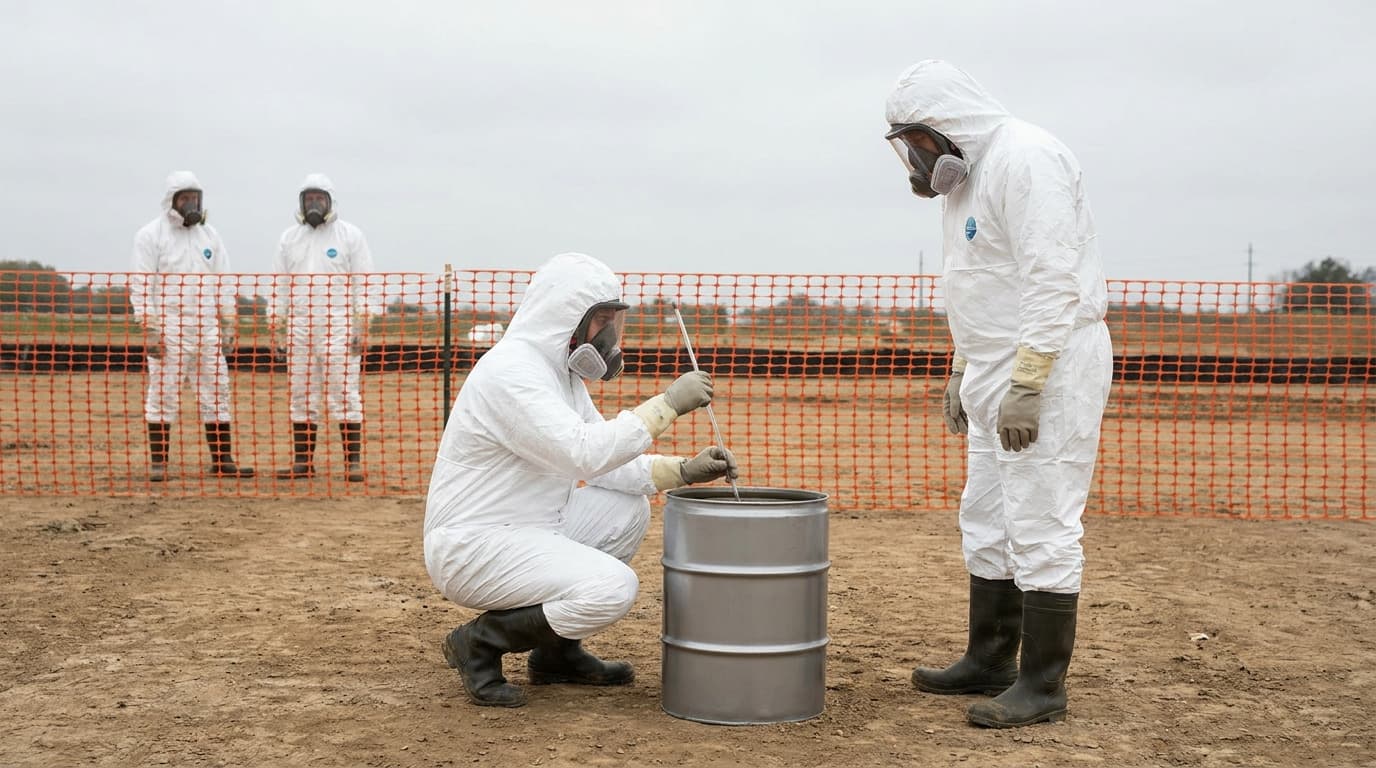
It is required in HAZWOPER operations: 1910.120(q)(3)(v) requires operations in hazardous areas to be performed using the buddy system in groups of two or more, with backup personnel outside the hazard area. It is required, as two-in/two-out, for interior structural firefighting under 1910.134(g)(4). And the confined space standard builds the same logic into the attendant — stationed outside a permit space to monitor the entrants and initiate rescue, the buddy relationship formalized into a role (developed in full in the confined space talk).
Where no specific standard names it, the duty is general but real. 1926.50(c) requires that where no infirmary, clinic, hospital or physician is reasonably accessible in time and distance, a person trained in first aid shall be available at the worksite — for a small or remote crew, functionally a buddy requirement, since the trained person only helps if present and aware when something happens. 1926.21(b)(2) requires instruction in recognizing and avoiding hazards, and 5(a)(1) turns on recognized hazards — a task known to be dangerous alone is a recognized hazard whether or not a numbered standard names the buddy. The honest line: outside HAZWOPER, confined space and hot work, no standard will hand you a buddy — so the decision to pair up on a genuinely dangerous solo task is usually the employer's and crew's to make, and making it is the point of this talk.
What makes a pairing fake#
If the buddy is a designated rescuer, then the ways a buddy system fails are all ways the rescue function quietly disappears while the label stays.
The most common is drift: two assigned buddies who get absorbed in separate tasks, back to back, each assuming the other is watching, until neither is — the label survived, the observation did not. The second is the radio buddy already covered: contact that depends on the endangered person being able to act. The third is the unbalanced pair, where one worker can raise the alarm and get help and the other, through inexperience, language or unfamiliarity, cannot — so the system works in one direction only. The fourth is the buddy who cannot leave — whose own task, anchor or PPE means that if they see trouble they cannot reach it or get help without endangering themselves. A buddy who would have to become a second casualty is not a rescuer. Naming these four out loud beats any policy, because every crew has run at least one under the honest belief that they had "buddied up."
Where the duty sits#
There is no single OSHA standard titled "buddy system" that covers all construction work; the duty is defined in some standards and general in others.
1910.120(q)(3) defines the term and, at (q)(3)(v), requires it in groups of two or more for hazardous-area operations, with backup personnel outside — applied to construction through 1926.65. 1910.134(g)(4) sets two-in/two-out with visual-or-voice contact at all times for interior structural firefighting. The permit-required confined space standard formalizes the same relationship in the attendant. 1926.50(c) requires a trained first-aid person on site where medical help is not reasonably accessible. And 1926.21(b)(2) and Section 5(a)(1) carry the general duty to recognize and control hazards — under which a task genuinely unsafe to perform alone is a hazard the employer must address, buddy or otherwise.
On federal contract work, EM 385-1-1 goes further than the OSHA baseline for lone and isolated work: it requires that employees working alone in a remote location or away from other workers be provided an effective means of emergency communication, readily available and tested before work starts, together with a check-in/check-out procedure — the systemic version of a buddy for situations where a physical one is not present.
What can go wrong?#
- "Buddy up" is issued as a mood, with no assigned pairs, so nobody actually knows who is watching whom.
- Two assigned buddies drift into separate tasks and each assumes the other is watching.
- Contact between buddies depends on a radio, and the person who needs help cannot operate it.
- The pairing is one-directional — one buddy could get help, the other could not.
- A buddy sees trouble but cannot reach it without abandoning their own anchor, task or air, and becomes a second casualty.
- A dangerous solo task is done alone because no numbered standard demanded a buddy, and nobody made the call.
- The buddy is present but has no idea what the emergency signal or the rescue plan is.
How do we manage this properly?#
- Assign buddies by name before the work starts; each person knows who watches them and who they watch.
- Make the contact visual or voice, not radio — close enough to see or hear, because the endangered person may not be able to call.
- Give the buddy the authority and the freedom to act — they must be able to get help without endangering themselves.
- Check the pairing is balanced — both can actually raise the alarm and get assistance; fix it if one cannot.
- Brief the emergency signal and the rescue plan so the buddy knows what to do the moment they notice trouble.
- For genuinely dangerous solo tasks with no specific standard, make the call to pair up rather than waiting for a rule to require it.
- On remote or lone work, set up the check-in/check-out and tested communications EM 385-1-1 describes.
- Re-pair whenever the crew changes, so nobody is left buddyless mid-shift.
Before you start#
- Confirm who is buddied with whom today, by name, and that each person knows it.
- Confirm the contact between each pair is visual or voice, not dependent on a device.
- Confirm each buddy can reach the other, or get help, without endangering themselves.
- Confirm both members of each pair could actually raise the alarm.
- Confirm everyone knows the emergency signal and the rescue plan.
- Confirm whether this work legally requires a buddy — HAZWOPER, confined space, hot work in an IDLH area.
- Confirm lone or remote workers have tested communications and a check-in schedule.
- Confirm the pairing will be reset if the crew changes during the shift.
Talk it over#
- Right now, who is your buddy — and do they know they are yours?
- If you went down and could not call out, how long before your buddy would notice?
- Is there a task on this job we are about to do alone that we should not?
- If your buddy got in trouble, could you reach them without putting yourself in the same trouble?
The bottom line#
A buddy is not company; a buddy is a designated rescuer whose one job is to notice you are in trouble in time to get help. OSHA defines the buddy system in writing at 1910.120(q)(3) — and identically for construction at 1926.65 — as employees organized so that each is designated to be observed by at least one other, for the purpose of rapid assistance in an emergency. The three load-bearing words are designated, observed and emergency: the pairing is assigned by name, the function is to watch continuously, and the measure is whether help arrives while it still matters. The firefighting rule shows what "real" looks like — 1910.134(g)(4) two-in/two-out, with visual or voice contact at all times — and OSHA's own clarification supplies the most useful rule in the talk: radios cannot substitute for visual or voice contact, because devices fail and, decisively, the person who needs rescue may be unable to operate one. So if you can only reach your buddy by calling them, they are not your buddy at that moment. The system is legally required in HAZWOPER hazardous-area operations (1910.120(q)(3)(v), groups of two or more plus backup outside), in interior structural firefighting, and — as the attendant — in permit-required confined spaces; where no standard names it, 1926.50(c) (a trained first-aid person available where help is not reasonably accessible), 1926.21(b)(2) and 5(a)(1) carry a general duty, which means the choice to pair up on a dangerous solo task is usually yours to make. Watch the four fake pairings: drift (both absorbed, neither watching), the radio buddy, the one-directional pair, and the buddy who cannot leave without becoming a second casualty. On remote or lone work, EM 385-1-1 requires tested emergency communications and a check-in/check-out procedure. The test for any pairing is one question: if you went down and could not call out, how long before your buddy would notice — and could they help without joining you?
Frequently asked questions about the buddy system#
Is the buddy system actually an OSHA requirement?
Yes, in specific situations. It is a defined term at 1910.120(q)(3) and required for HAZWOPER hazardous-area operations, it is required in the two-in/two-out form for interior structural firefighting under 1910.134(g)(4), and the same relationship is formalized as the attendant in permit-required confined spaces. Outside those, no standard names it, but 1926.50(c), 1926.21(b)(2) and Section 5(a)(1) can still make pairing up the required response to a recognized hazard.
Can we use radios instead of staying within sight or earshot?
No, not where the buddy system is doing its real job. OSHA has clarified that radios and other electronic contact cannot substitute for visual or voice contact, because the device can fail and the person needing rescue may be physically unable to operate it. Direct line of sight or close enough to hear is the contact that still works when the endangered person can do nothing.
What exactly is a buddy supposed to do?
Observe you continuously and get you rapid assistance if you are in trouble. That is the entire purpose in OSHA's definition. A buddy is not there to help with the task, keep you company, or supervise your work — they are there for the moment you cannot help yourself.
Isn't "buddy up" just about not being alone?
That is the version that does almost nothing. Being near someone is not the same as being observed by someone who is designated, free to act, and reachable without a device. The difference between the two is the difference between a system and a slogan.
What makes a buddy pairing fail?
Four common ways: drift, where both get absorbed in tasks and neither watches; the radio buddy, where contact depends on the endangered person acting; the one-directional pair, where only one member could actually raise the alarm; and the buddy who cannot leave their own task, anchor or air without becoming a second casualty. Naming these before the work is more useful than any written policy.
Do we need a buddy for a task with no specific standard?
Sometimes the honest answer is yes, even though no numbered rule demands it. Where a task is genuinely dangerous to do alone, 1926.21(b)(2) and Section 5(a)(1) make it a recognized hazard, and the decision to pair up is the employer's and the crew's to make. Waiting for a rule to require it is how people end up alone on jobs they should not be.
What about someone working alone on a remote part of the site?
That is where EM 385-1-1 applies on federal work: a lone or remote worker must have an effective means of emergency communication, readily available and tested before work, plus a check-in/check-out procedure. It is the systemic substitute for a physical buddy when one cannot be present.
Download the buddy system toolbox talk PDF#
Get this buddy system toolbox talk as a print-ready PDF — available in English, Spanish, Portuguese, and Turkish. Print it, hand it to the crew, and collect signatures on the included attendance sheet.
Download the PDF — free account required. New members get 3 free downloads.
Related toolbox talks#
Sources#
- OSHA, 29 CFR 1910.120 — Hazardous waste operations and emergency response (buddy system definition at (q)(3)): https://www.ecfr.gov/current/title-29/subtitle-B/chapter-XVII/part-1910/subpart-H/section-1910.120
- OSHA, 29 CFR 1910.134 — Respiratory protection (two-in/two-out at (g)(4)): https://www.ecfr.gov/current/title-29/subtitle-B/chapter-XVII/part-1910/subpart-I/section-1910.134
- OSHA, Letter of Interpretation — Two-in/two-out procedure in firefighting/IDLH environments (29 Apr 1998): https://www.osha.gov/laws-regs/standardinterpretations/1998-04-29
This talk is general awareness guidance for training purposes. It does not replace your employer's confined space, HAZWOPER, respiratory protection or lone-worker procedures, and it does not qualify anyone to perform rescue. Where a specific standard sets a staffing, standby or communication requirement, that requirement governs.
Written by FieldSafetyTalk's safety professional — a CSP, ASP, CHST and OSHA Authorized Outreach Trainer with 14+ years of international construction safety experience across federal, heavy civil, and industrial projects.