Jackhammer Safety
Updated 2026-08-01
In this bundle Tools & Machinery
Print-ready PDF
Download this talk as a print-ready PDF, available in 4 languages.
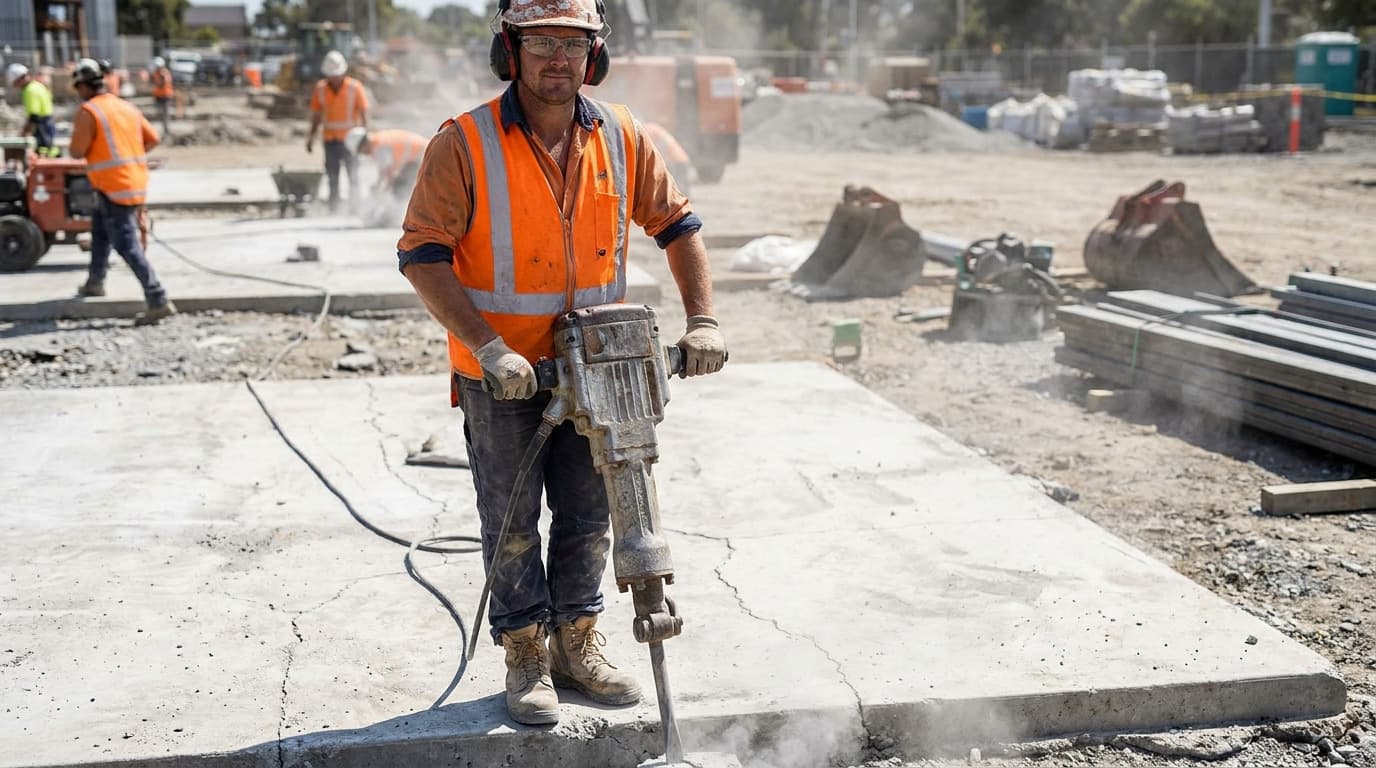
Everything about running a breaker pushes you toward gripping it tighter. It bucks, it wanders off the mark, it is heavy, and when your hands are cold or you are tired you hold on harder to keep it where you want it. That instinct is the problem, and it is the reason two men doing the same hours on the same tool can end up with very different hands. This Jackhammer Safety Toolbox Talk (Safety Talk / Tailgate Talk) is about why.
Here is the distinction that carries this whole talk: the harder you grip the tool, the more of its vibration goes into you. An occupational safety and health manager quoted by Safety+Health puts it directly: "People who grip a tool with a death grip increase the vibration coupling. They also fatigue themselves more quickly." Vibration does not simply arrive at your hands — it has to be conducted into them, and grip force is the conductor. OSHA's own guidance says the same thing from the other side: always allow the tool to do the work.
Where the boundary of this talk sits#
The five ergonomic risk factors as a set — repetition, high force, awkward posture, contact stress and hand-arm vibration — belong to the ergonomics talk, which owns that framework. Respirable crystalline silica and its exposure limits belong to the dust and silica talk. Noise dose, Table D-2 and the exchange rate belong to the noise talk; hearing protection belongs to the hearing conservation talk. The compressed air supply, hose provisions and the 1926.302(b)(2) safety clips and retainers on percussion tools belong to the compressed air talk. This talk owns the vibration dose itself and what it does to a hand.
What the vibration actually does#
Hand-arm vibration syndrome is not one injury. It is three, and they progress on different clocks.
Vascular. Vibration damages the small blood vessels in the fingers. OSHA describes it plainly: the blood vessels in the fingers collapse under repeated vibration exposure, the skin and muscle tissue do not get the oxygen they need, and eventually die. The visible sign is vibration white finger — episodes of blanching, usually triggered by cold, where fingers go white and numb before returning painfully.
Neurological. Damage to the nerves in the fingers and hands. This shows up first as tingling and numbness, then as loss of sensation and dexterity. Carpal tunnel syndrome sits alongside it.
Musculoskeletal. Loss of grip strength and hand function. In severe cases the hand muscles waste.
And the fact that decides how this talk ends: once HAVS is established, it does not reverse. Early symptoms may stabilise if exposure stops promptly, but the underlying nerve and blood-vessel damage does not repair. There is no treatment that gives the hand back.
Trigger time is the only number that matters#
This is where crews consistently underestimate their own exposure, and it is an arithmetic problem rather than an attitude problem.
The dose depends on two things: the magnitude of the vibration, measured as acceleration in metres per second squared (m/s²), and the time the hand is actually on the running tool. That second quantity is trigger time, and it is not the same as the time the job took.
A man who spends a full day on a breaking job may have perhaps ninety minutes of actual trigger time across it — or he may have four hours, depending on the work. Clock time badly overstates how much safe use you have, and it does so in the reassuring direction.
The magnitude matters enormously because the two multiply. Published guidance indicates that a high-vibration concrete breaker can reach the widely used 2.5 m/s² action value in roughly fifteen minutes of trigger time. A lower-vibration tool doing the same job gives you far longer before you reach the same dose.
So the two levers are the tool you pick and the minutes you hold it — and only one of those is usually discussed.
The exposure limits are not OSHA's#
Be precise about this, because crews are used to OSHA numbers and there are none here.
There is no OSHA standard for hand-arm vibration. No permissible exposure limit, no action level, no required assessment, no health surveillance requirement. OSHA addresses it through the General Duty Clause, Section 5(a)(1), as a recognised hazard.
What exists instead is guidance: the ACGIH publishes a Threshold Limit Value for hand-arm vibration — a consensus recommendation, not a regulation — and NIOSH criteria document 89-106 carries recommendations. The widely quoted 2.5 m/s² and 5 m/s² figures come from European and UK law, where they are legally enforceable, and they are cited in the US as recognised benchmarks rather than as rules.
Say that out loud when you use those numbers, so nobody repeats them as OSHA limits.
Controls, in the order that works#
OSHA's own guidance lists these, and the order is not arbitrary — it runs from removing vibration to enduring it better.
Damping and isolation on the equipment provide the most effective protection. Anti-vibration handles and mounts do more than anything a worker can do with technique.
Choose the lower-vibration tool for the job. Manufacturers publish vibration figures. On a long breaking job this decision has a bigger effect than anything else on the list.
Keep machines in proper working order. A worn or badly maintained tool vibrates more than the same tool serviced. A blunt point makes the operator lean and grip harder to achieve the same effect.
Alternate between vibrating and non-vibrating tools, and rotate the task across the crew rather than leaving it with one man because he is good at it.
Limit the hours anyone spends on a vibrating tool, and take 10 to 15 minute breaks every hour.
Then the grip. Hold the tool with only the force needed to keep it safely under control — and let its weight do the work rather than pushing down on it.
And keep hands warm and dry. Cold triggers the vascular attacks and also makes people grip harder, which feeds straight back into the anchor. Gloves keep hands warm; be honest that so-called anti-vibration gloves are not a substitute for reducing the vibration itself.
The rest of the jackhammer#
Vibration is what this talk owns, but the tool arrives with a set of hazards that must be named before anybody starts.
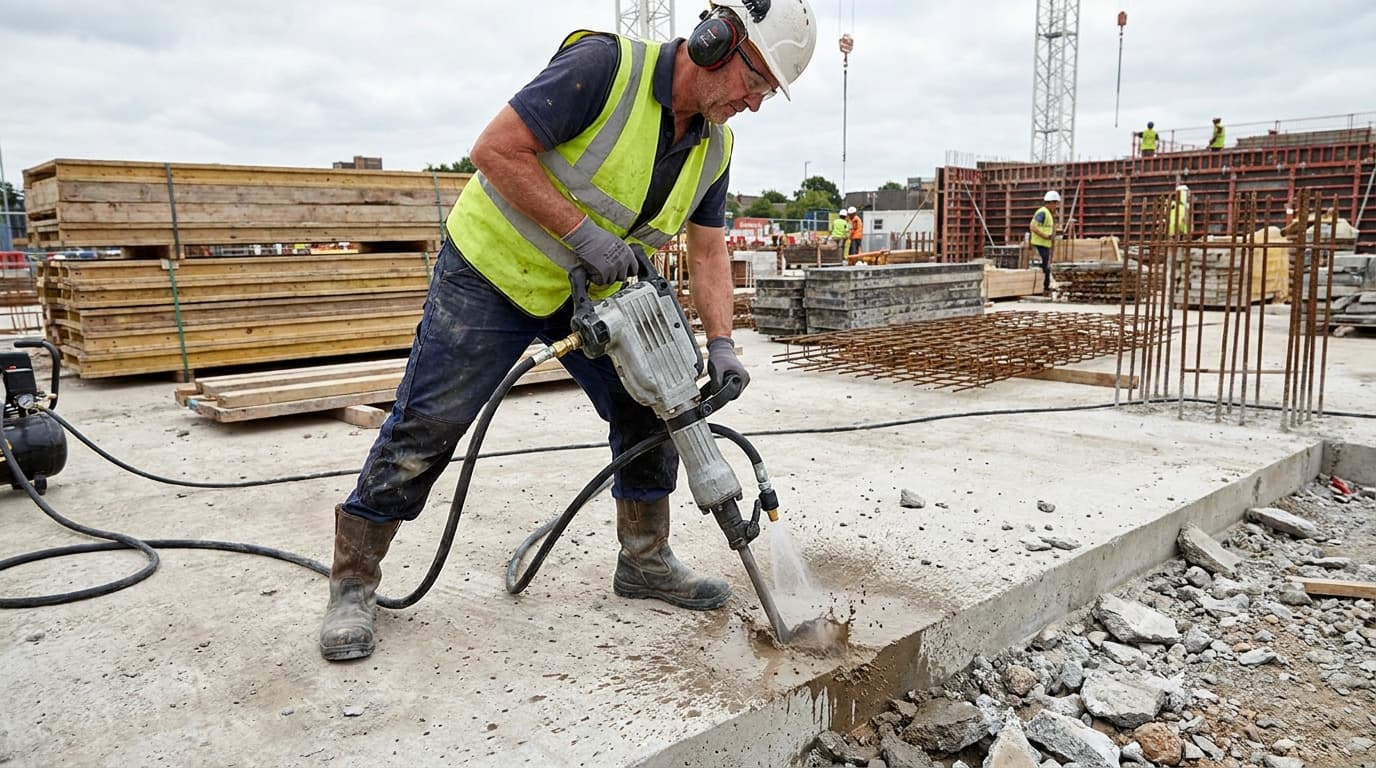
Silica. Breaking concrete, stone and masonry generates respirable crystalline silica. Water suppression or on-tool extraction is required, and 1926.1153 and its Table 1 govern — covered in the dust and silica talk.
Noise. Breakers routinely sit in the range where the permitted daily duration is short. The dose framework and Table D-2 sit in the noise talk; hearing protection in the hearing conservation talk.
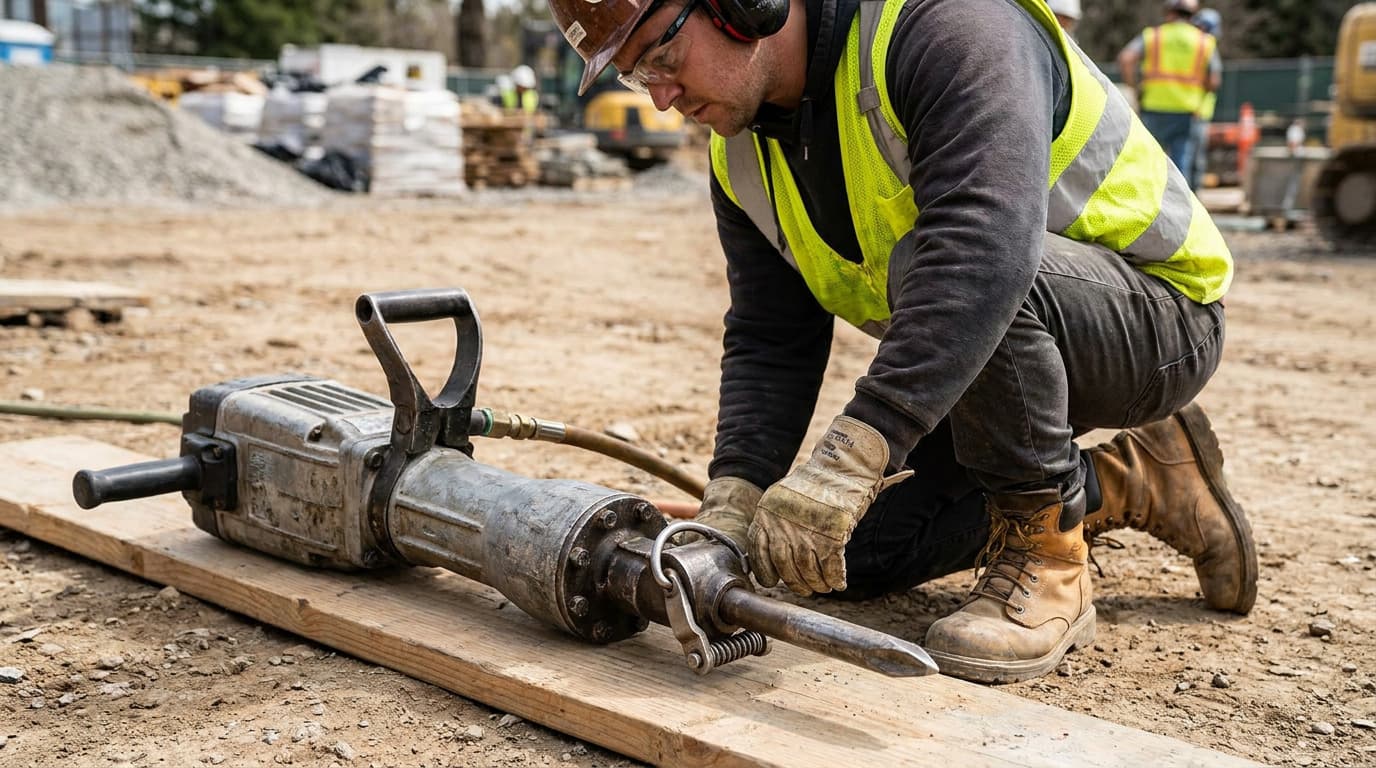
The retainer. Under 1926.302(b)(2), safety clips or retainers must be securely installed and maintained on pneumatic percussion tools to prevent attachments being expelled accidentally. A moil point leaving a breaker under power is a projectile. That provision belongs to the compressed air talk; what belongs here is checking it before you start.
Buried and embedded services. Breaking blind into a slab, a road or a wall is how live cables, gas, water and post-tensioned tendons get hit. Scan, locate and confirm before the first blow.
Posture and weight. Breakers are heavy, and the standard failure is a worker leaning their body weight onto the tool to make it cut faster. That adds force and awkward posture on top of the vibration — the ergonomics talk covers how those combine.
Feet and falling material. The point can skate off hard aggregate, and broken material drops. Boots, eye protection and a clear stance matter.
Where the duty sits#
There is no OSHA vibration standard, so the duty is assembled.
Section 5(a)(1), the General Duty Clause, is the citation route for a recognised hazard with no specific standard. 1926.21(b)(2) requires the employer to instruct each employee in the recognition and avoidance of unsafe conditions — for HAVS that means the symptoms, because early reporting is the only thing that stops progression. 1926.302(b)(2) covers the retainer. 1926.52 and 1926.101 cover noise and hearing protection. 1926.1153 covers respirable crystalline silica. 1926.95 and 1926.28(a) cover PPE.
And note the practical consequence of there being no standard: nobody will measure your exposure unless you decide to. There is no inspection that will do it for you.
What can go wrong?#
Gripping the tool hard to control it, and increasing the vibration coupling into your own hands.
Leaning your weight onto the breaker to make it cut faster, adding force and posture to the vibration.
Judging exposure by the length of the job rather than by trigger time.
Leaving the breaking work with one man because he is quick at it.
Working with cold hands, which triggers the vascular attacks and makes people grip harder.
Ignoring tingling and numbness as just part of the job, when it is the early, still-stoppable stage.
Running a worn tool or a blunt point, which raises vibration and makes the operator push harder.
Quoting 2.5 or 5 m/s² as OSHA limits, when OSHA has none.
How do we manage this properly?#
Pick the lowest-vibration tool that will do the work, using the manufacturer's published figures.
Plan the job in trigger time, not in hours on site, and share the task across the crew.
Build in 10 to 15 minute breaks every hour and alternate with non-vibrating work.
Use the lightest grip that keeps the tool under control, and let the tool's weight do the cutting.
Keep hands warm and dry, and treat cold weather as an exposure multiplier.
Maintain the tools — servicing, sharp points, working anti-vibration mounts.
Check the retainer on a pneumatic breaker before the first blow.
Confirm services are located before breaking into any slab, road or wall.
Set up water suppression or on-tool extraction for silica before starting, not after the dust appears.
Tell people the early symptoms and make reporting them normal — tingling, numbness, blanching fingers — because stopping exposure early is the only intervention that works.
Before you start#
- Confirm which tool is being used and whether a lower-vibration option is available.
- Confirm how much trigger time this job needs and who is sharing it.
- Confirm the break pattern for the shift.
- Confirm the tool has been serviced and the point is sharp.
- Confirm the safety clip or retainer is installed and sound.
- Confirm services have been scanned and located.
- Confirm dust control — water or on-tool extraction — is set up and working.
- Confirm hearing and eye protection, and that hands can be kept warm.
Talk it over#
- How many minutes will the trigger actually be down today, as opposed to how long the job takes?
- Has anyone here noticed tingling or numbness in their fingers after a breaking job?
- Who always ends up on the breaker, and why is it always them?
- Is there a lower-vibration tool on this site that would do this work?
The bottom line#
The harder you grip the tool, the more of its vibration goes into you — as an occupational safety and health manager quoted by Safety+Health puts it, "people who grip a tool with a death grip increase the vibration coupling" — and OSHA's own guidance says to always allow the tool to do the work. Hand-arm vibration syndrome is three injuries at once: vascular, where the blood vessels in the fingers collapse so that skin and muscle tissue do not get the oxygen they need and eventually die, showing as vibration white finger; neurological, beginning as tingling and numbness and progressing to lost sensation and dexterity, alongside carpal tunnel; and musculoskeletal, as lost grip strength and in severe cases muscle wasting. The decisive fact: once established, HAVS does not reverse — early symptoms may stabilise if exposure stops promptly, but the nerve and blood-vessel damage does not repair. Exposure is a dose, set by vibration magnitude in m/s² multiplied by trigger time — and trigger time is not clock time, which badly overstates the safe use available; published guidance indicates a high-vibration concrete breaker can reach the widely used 2.5 m/s² action value in roughly fifteen minutes of trigger time. Be precise about the law: there is no OSHA standard for hand-arm vibration — no PEL, no action level, no required assessment — only Section 5(a)(1) as a recognised hazard, with the ACGIH TLV and NIOSH criteria document 89-106 as guidance, and the familiar 2.5 and 5 m/s² figures coming from European and UK law where they are legally enforceable, cited in the US as benchmarks rather than rules. Controls in order: damping and isolation on the equipment give the most effective protection; choose the lower-vibration tool; keep machines in proper working order; alternate vibrating and non-vibrating tools and rotate the task; limit hours and take 10 to 15 minute breaks every hour; use only the grip force needed to keep the tool safely under control and let its weight do the work; and keep hands warm, since cold both triggers vascular attacks and makes people grip harder. Around the vibration sit silica under 1926.1153, noise under 1926.52, the 1926.302(b)(2) safety clip or retainer on pneumatic percussion tools, buried and embedded services, and the posture and weight problem the ergonomics talk covers. And the practical consequence of having no standard: nobody will measure your exposure unless you decide to.
Frequently asked questions about jackhammers and vibration#
Why does how I hold the tool matter?
Because vibration has to be conducted into the hand, and grip force is what conducts it. As an occupational safety and health manager quoted by Safety+Health puts it, "people who grip a tool with a death grip increase the vibration coupling. They also fatigue themselves more quickly." OSHA's guidance is to always allow the tool to do the work. Use only the force needed to keep the tool safely under control, and let its weight do the cutting rather than pushing down on it.
What is hand-arm vibration syndrome?
Three kinds of damage from the same cause. Vascular — the blood vessels in the fingers collapse under repeated vibration so that, as OSHA describes it, the skin and muscle tissue do not get the oxygen they need and eventually die, visible as vibration white finger blanching attacks. Neurological — tingling and numbness first, then lost sensation and dexterity, with carpal tunnel alongside. Musculoskeletal — lost grip strength, and in severe cases wasting of the hand muscles.
If I stop now, will my hands recover?
Not once it is established. Early-stage symptoms may stabilise if exposure stops promptly, but the underlying nerve and blood-vessel damage does not reverse. There is no treatment that returns the hand to how it was. That is precisely why the early symptoms matter so much: reporting tingling or numbness while it is still early is the only intervention with any leverage, and it only works if the exposure actually changes.
How is exposure measured?
As a dose — the vibration magnitude, in metres per second squared (m/s²), multiplied by the time your hand is on the running tool. That time is trigger time, and it is not the length of the job: clock time badly overstates the safe use available. Magnitude matters because the two multiply — published guidance indicates a high-vibration concrete breaker can reach the widely used 2.5 m/s² action value in roughly fifteen minutes of trigger time.
Are 2.5 and 5 m/s² OSHA limits?
No, and this matters when quoting them. There is no OSHA standard for hand-arm vibration — no permissible exposure limit, no action level, no required assessment. OSHA addresses it under Section 5(a)(1) as a recognised hazard. The 2.5 m/s² and 5 m/s² values come from European and UK law, where they are legally enforceable; in the US they function as recognised benchmarks, alongside the ACGIH Threshold Limit Value and NIOSH criteria document 89-106.
What actually reduces the exposure?
In order of effect: damping and isolation on the equipment provide the most effective protection; select a lower-vibration tool using the manufacturer's published figures; keep machines in proper working order, since worn tools and blunt points raise vibration and make the operator push harder; alternate vibrating and non-vibrating tools and rotate the task across the crew; limit hours and take 10 to 15 minute breaks every hour; then grip lightly. Keep hands warm — cold triggers vascular attacks and makes people grip harder.
What else does a breaking job need controlled?
Silica, since breaking concrete and masonry generates respirable crystalline silica — water suppression or on-tool extraction, under 1926.1153. Noise, under 1926.52. The retainer — 1926.302(b)(2) requires safety clips or retainers to be securely installed and maintained on pneumatic percussion tools, because a moil point leaving a breaker under power is a projectile. Buried and embedded services, located before the first blow. And posture, because leaning body weight onto the tool adds force to the vibration.
Download the jackhammer safety toolbox talk PDF#
Get this jackhammer safety toolbox talk as a print-ready PDF — available in English, Spanish, Portuguese, and Turkish. Print it, hand it to the crew, and collect signatures on the included attendance sheet.
Download the PDF — free account required. New members get 3 free downloads.
Related toolbox talks#
Sources#
- OSHA, Woodworking eTool — Health Hazards: Vibration: https://www.osha.gov/etools/woodworking/health-hazards/vibration
- Safety+Health, Hand-arm vibration syndrome: https://www.safetyandhealthmagazine.com/13117-hand-arm-vibration/
- CPWR Construction Solutions, Jackhammer rock and concrete surfaces — Hand-Arm Vibration: https://www.cpwrconstructionsolutions.org/general_labor/hazard/1035/jackhammer-rock-and-concrete-surfaces-hand-arm-vibration.html
This talk is general awareness guidance for training purposes. It is not medical advice and nothing in it is a diagnosis. Anyone experiencing tingling, numbness, loss of grip strength or blanching of the fingers should be assessed by a qualified medical professional and their exposure reviewed.
Written by FieldSafetyTalk's safety professional — a CSP, ASP, CHST and OSHA Authorized Outreach Trainer with 14+ years of international construction safety experience across federal, heavy civil, and industrial projects.