Securing Loads & Cargo
Updated 2026-08-06
In this bundle Jobsite Fundamentals & Compliance
Print-ready PDF
Download this talk as a print-ready PDF, available in 4 languages.
Everybody on a site has a mental rule for tying down a load, and it is usually some version of "enough straps that it looks right." That rule works nearly all the time, which is exactly the problem — it works until the one hard stop that tests it, and by then the load is deciding the outcome, not the driver. This Securing Loads & Cargo Toolbox Talk (Safety Talk / Tailgate Talk) replaces the eye with two numbers.
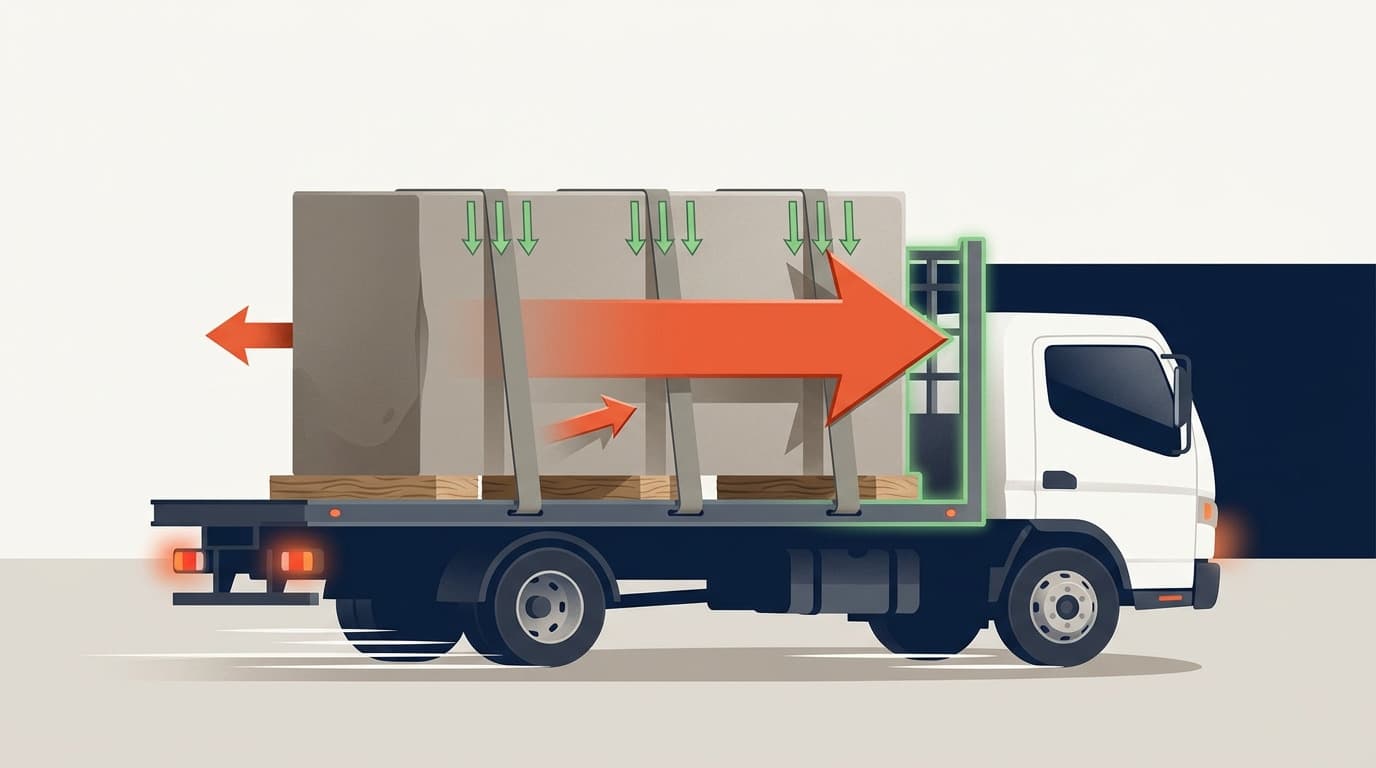
Here is the distinction that carries this whole talk: weight is not what holds a load down. Weight is what tries to throw it forward. The federal cargo securement rules are built on measured forces, not appearances. Under 49 CFR 393.102(a)(1), a securement system must withstand 0.8 g deceleration in the forward direction, 0.5 g acceleration in the rearward direction, and 0.5 g acceleration in a lateral direction — applied separately. So in a hard stop, a load generates roughly eight tenths of its own weight in forward force. Ten thousand pounds of pipe pushes forward with about eight thousand pounds. The heavier the load, the harder it tries to leave.
Where the boundary of this talk sits#
Stacking geometry and securing stored material on the ground under 1926.250 belong to the piling and shelving talk. Dump bodies, props and raised beds belong to the dump truck talk. Reversing alarms, the observer alternative and machine inspection belong to the heavy equipment talk. Hours of service under 49 CFR Part 395, adverse-condition driving under 392.14 and drug and alcohol testing under Part 382 each belong to their own talks. This talk owns Subpart I: what holds cargo on a vehicle and how you know it is enough.
The two numbers, and why both are required#
This is the part crews get wrong most often, and it is a compliance failure as well as a safety one.
Number one — the aggregate working load limit. Under 393.106(d), the combined working load limit of all the tiedowns must be at least one half the weight of the cargo. Add up the marked WLL of every device in the system; the total has to reach 50% of the load's weight. A 30,000 lb load needs tiedowns totalling at least 15,000 lb of working load limit.
Number two — the minimum number of tiedowns. Under 393.110, there is a separate hard minimum for how many tiedowns the article gets, based on its length and its weight. This is independent arithmetic. An inspector carries a tape measure for exactly this reason.
You have to satisfy both. You do not get to pick one. A load can have more than enough aggregate WLL and still be non-compliant because it is short of tiedowns for its length — or have the right count of straps that do not add up to half the weight. Two tests, both mandatory.
And note where the 50% figure comes from: it is not a rule of thumb that half the weight will hold. It is a floor derived from the g-forces in 393.102, which is why it cannot be argued down for a load that "isn't going anywhere."
The forces are not all the same#
Worth knowing because it explains the layout of the straps.
393.102(a)(1) sets the breaking-strength condition: 0.8 g forward, 0.5 g rearward, 0.5 g lateral. Forward is by far the largest — hard braking is the dominant case, which is why forward restraint gets the most attention.
393.102(a)(2) sets a second, lower set of conditions for the working load limit specifically: 0.435 g forward, 0.5 g rearward, and 0.25 g lateral. Two different tests on the same system for two different purposes.
And there is a vertical requirement people forget. 393.102(b): securement systems must provide a downward force equivalent to at least 20 percent of the weight of the article if it is not fully contained within the structure of the vehicle. A load sitting proud of the sides is not just being held against sliding — it has to be held down.
What actually counts as secured#
393.102(c) gives the equivalent means: cargo meets the performance requirements if it is immobilised so that it cannot shift or tip to the extent that the vehicle's stability or manoeuvrability is adversely affected.
Read that carefully. Blocking, bracing, dunnage and friction are part of the system, not optional extras that let you use fewer straps. A load that is properly blocked against the headboard is being restrained by the vehicle structure — but only if that structure is up to it.
Which brings the provision nobody reads. 393.104(c) requires that vehicle structures, floors, walls, decks, tiedown anchor points, headerboards, bulkheads, stakes, posts and associated mounting pockets used to contain or secure cargo be strong enough to meet the performance criteria of 393.102, with no damaged or weakened components — such as cracks or cuts — that will adversely affect their performance, including reducing the working load limit.
A cracked stake pocket reduces the rating of everything attached to it. The strap can be perfect and the system still fails, because the anchor was the weak link and nobody looked at it.

The device itself#
Tiedowns must not contain knots. A knot is not a rated connection and it changes the strength of the assembly in ways nobody can calculate at the roadside.
The WLL has to be legible. A device with an unreadable tag cannot be counted toward the aggregate — you cannot add up numbers you cannot read.
Damaged or unmarked devices are prohibited, along with compromised anchors, under 393.104.
Dunnage, chocks, cradles, shoring bars and blocking material must also be free of damage or defects that would compromise the securement system.
Mixing grades and types is where arithmetic goes wrong on site: a chain a grade lower than assumed, or webbing rated below what somebody remembered, changes the total without changing the appearance.
On a construction site specifically#
Most of this work is not long-haul. It is a flatbed moving plant between two parts of the same job, and that is where the shortcuts live.
A short move is not an exemption. The forces in 393.102 do not scale with distance. A hard stop at the site gate produces the same 0.8 g as one on the interstate.
Loading and unloading is when people get hurt. Standing in the fall line while releasing a tensioned strap is how loads come off onto people. Release from the side, expect movement, and assume the load has shifted in transit — because the rules exist precisely because it does.
Re-check after the first movement. Loads settle. Webbing relaxes. What was tight at the loading point is not necessarily tight at the gate.
Nobody stands where the load would go. That applies during tensioning, during transit stops, and above all during release.
Where the duty sits#
The cargo securement rules are 49 CFR Part 393, Subpart I — FMCSA, not OSHA — and they bind commercial motor vehicles.
393.100 requires cargo to be contained, immobilised or secured so it cannot shift, spill, blow off or fall. 393.102 sets the performance criteria. 393.104 sets standards for devices, vehicle structures and anchor points. 393.106 carries the general securement requirements including the aggregate working load limit of at least 50% of cargo weight. 393.108 covers determining the working load limit. 393.110 sets the minimum number of tiedowns. 393.116 to 393.136 add commodity-specific rules — logs, dressed lumber, metal coils, concrete pipe, intermodal containers, heavy vehicles and equipment, flattened vehicles, roll-on/roll-off containers and large boulders.
Device manufacturing standards come from consensus bodies — WSTDA for webbing, NACM for chain — referenced in 393.104(e).
Transit securement itself is governed by FMCSA, 49 CFR Part 393 Subpart I, not by an OSHA construction standard. On the OSHA side, 1926.21(b)(2) requires instruction, and Section 5(a)(1) applies behind it.
What can go wrong?#
Judging a load by eye instead of adding up the working load limits.
Meeting the WLL total but being short on tiedown count, or the reverse.
Assuming a heavy load will not move, when weight is what generates the forward force.
Using a device with an unreadable or missing WLL tag and counting it anyway.
Tying a knot in a strap to take up slack.
Anchoring to a cracked stake pocket or damaged rail.
Treating a short site move as exempt from the securement rules.
Standing in the fall line while releasing tension on a load that has shifted in transit.
How do we manage this properly?#
Know the load's weight before you rig it, because both tests start from that number.
Add up the working load limits and write the total down — aggregate WLL must reach at least 50% of cargo weight.
Count the tiedowns against 393.110 separately, using length and weight, and satisfy both tests.
Check every tag is legible before counting a device toward the total.
Inspect the anchor points, not just the straps — cracks and cuts in stake pockets, rails and bulkheads reduce the rating of what is attached to them.
Block and brace as part of the system, and confirm the structure taking that load is sound.
Apply the downward force requirement where cargo is not fully contained within the vehicle structure.
Re-check tension after the first short movement, and again after any stop.
Release from the side, never the fall line, and brief everyone that the load may have moved.
Never use knots, and never mix in an unrated or damaged device to make the count.
Before you start#
- Confirm the weight of the cargo.
- Confirm the aggregate working load limit of the tiedowns reaches at least half that weight.
- Confirm the number of tiedowns meets 393.110 for the article's length and weight.
- Confirm every device tag is legible and undamaged.
- Confirm anchor points, stake pockets and bulkheads are sound.
- Confirm blocking, bracing and dunnage are undamaged and correctly placed.
- Confirm who re-checks tension, and when.
- Confirm where people stand during tensioning and release.
Talk it over#
- What does this load weigh, and what is our aggregate working load limit?
- Have we counted the tiedowns as a separate check from the WLL total?
- Which strap on this trailer has a tag you cannot read?
- Where will you stand when the tension comes off?
The bottom line#
Weight is not what holds a load down. Weight is what tries to throw it forward. Under 49 CFR 393.102(a)(1) a securement system must withstand 0.8 g deceleration forward, 0.5 g rearward and 0.5 g lateral, applied separately — so a hard stop generates roughly eight tenths of the load's own weight in forward force, and the heavier the cargo the harder it tries to leave. Two separate tests follow and both are mandatory: under 393.106(d) the aggregate working load limit of all tiedowns must be at least one half the weight of the cargo — a 30,000 lb load needs 15,000 lb of combined WLL — and under 393.110 there is an independent minimum number of tiedowns based on the article's length and weight. A load can pass one and fail the other. The 50% figure is not a rule of thumb; it is a floor derived from the g-forces in 393.102. A second, lower set of conditions applies to the working load limit specifically at 393.102(a)(2): 0.435 g forward, 0.5 g rearward, 0.25 g lateral. And the vertical requirement is widely forgotten — 393.102(b) requires a downward force equivalent to at least 20 percent of the article's weight where cargo is not fully contained within the structure of the vehicle. On what counts as secured, 393.102(c) accepts cargo immobilised so that it cannot shift or tip to the extent that the vehicle's stability or manoeuvrability is adversely affected — so blocking, bracing and dunnage are part of the system, provided the structure holds. Which is why 393.104(c) matters: vehicle structures, decks, tiedown anchor points, headerboards, bulkheads, stakes, posts and mounting pockets must meet 393.102 with no damaged or weakened components such as cracks or cuts, including anything reducing the working load limit — a cracked stake pocket reduces the rating of everything attached to it. On devices: tiedowns must not contain knots, an unreadable WLL tag cannot be counted, and damaged or unmarked devices and compromised anchors are prohibited under 393.104, as is defective dunnage and blocking material. On site: a short move is not an exemption, because the forces do not scale with distance; re-check tension after the first movement; and release from the side, never the fall line, assuming the load has shifted. The rules are FMCSA, 49 CFR Part 393 Subpart I — with 393.116 to 393.136 adding commodity-specific requirements — while on the OSHA side 1926.21(b)(2) requires instruction and Section 5(a)(1) applies behind it.
Frequently asked questions about securing loads#
Why isn't a heavy load safer because it is heavy?
Because weight is what generates the force, not what resists it. Under 393.102(a)(1) the securement system must withstand 0.8 g deceleration in the forward direction, which means a hard stop pushes the cargo forward with roughly eight tenths of its own weight. Ten thousand pounds of material pushes with about eight thousand pounds. So the intuition that a heavy load "isn't going anywhere" is exactly backwards — the heavier it is, the harder it tries to leave.
What is the 50% rule?
Under 393.106(d), the combined working load limit of all the tiedowns must be at least one half the weight of the cargo. Add up the marked WLL of every device in the system and the total must reach 50% of the load's weight — a 30,000 lb load needs at least 15,000 lb of aggregate WLL. It is not a rule of thumb: it is a floor derived from the performance forces in 393.102, which is why it does not bend for a load that looks stable.
If the working load limits add up, do we still need a minimum number of straps?
Yes — they are two separate tests and both are mandatory. 393.106(d) governs the aggregate working load limit; 393.110 sets an independent minimum number of tiedowns based on the article's length and weight. A load can have ample aggregate WLL and still be non-compliant for having too few tiedowns over its length, or carry the right count of straps that do not total half the weight. Inspectors carry a tape measure for precisely this reason.
Does anything have to hold the load down as well as back?
Yes, and it is the most commonly missed provision. 393.102(b) requires securement systems to provide a downward force equivalent to at least 20 percent of the weight of the article of cargo where that article is not fully contained within the structure of the vehicle. A load sitting proud of the sides is not only being restrained against sliding and tipping — it must also be held down. If the article is fully contained within the vehicle structure, it may instead be secured under 393.106(b).
Do the anchor points matter as much as the straps?
They matter more than most crews assume, and 393.104(c) says so directly: vehicle structures, floors, walls, decks, tiedown anchor points, headerboards, bulkheads, stakes, posts and associated mounting pockets must be strong enough to meet 393.102, with no damaged or weakened components such as cracks or cuts that would adversely affect performance, including reducing the working load limit. A cracked stake pocket reduces the rating of everything attached to it — the strap can be perfect and the system still fail.
Can we knot a strap to take up slack?
No. Tiedowns must not contain knots. A knot is not a rated connection, and it changes the strength of the assembly in ways nobody can calculate at the roadside. The same principle covers the rest of the device rules under 393.104: damaged or unmarked devices are prohibited, an unreadable WLL tag means the device cannot be counted toward the aggregate, and dunnage, chocks, cradles, shoring bars and blocking material must be free of defects that compromise the system.
Do these rules apply to a short move on site?
Treat them as applying. The forces in 393.102 do not scale with distance — a hard stop at the site gate produces the same 0.8 g as one on the highway, and short moves are where the shortcuts live. The securement requirement itself is FMCSA's, under 49 CFR Part 393 Subpart I, and applies just the same. Also re-check tension after the first movement, because loads settle and webbing relaxes, and release from the side rather than the fall line on the assumption the load has shifted.
Download the securing loads and cargo toolbox talk PDF#
Get this securing loads and cargo toolbox talk as a print-ready PDF — available in English, Spanish, Portuguese, and Turkish. Print it, hand it to the crew, and collect signatures on the included attendance sheet.
Download the PDF — free account required. New members get 3 free downloads.
Related toolbox talks#
Sources#
- Cornell LII, 49 CFR § 393.102 — Minimum performance criteria for cargo securement devices and systems: https://www.law.cornell.edu/cfr/text/49/393.102
- eCFR, 49 CFR Part 393 Subpart I — Protection Against Shifting and Falling Cargo: https://www.govregs.com/regulations/expand/title49_chapterIII_part393_subpartI_section393.104
- FMCSA, Federal Register: Protection Against Shifting and Falling Cargo (8 June 2005): https://www.federalregister.gov/documents/2005/06/08/05-11332/parts-and-accessories-necessary-for-safe-operation-protection-against-shifting-and-falling-cargo
This talk is general awareness guidance for training purposes. It does not replace the applicable cargo securement regulations, the commodity-specific requirements at 49 CFR 393.116 to 393.136, or the manufacturer's ratings and instructions for the tiedowns and equipment in use. Securement calculations must be made against the actual load weight and device markings.
Written by FieldSafetyTalk's safety professional — a CSP, ASP, CHST and OSHA Authorized Outreach Trainer with 14+ years of international construction safety experience across federal, heavy civil, and industrial projects.