Portable Generator Safety
Updated 2026-07-28
In this bundle Electrical Safety
Print-ready PDF
Download this talk as a print-ready PDF, available in 4 languages.
Two arguments happen around every portable generator on every site. Somebody wants a ground rod driven, and somebody else says it is not needed. Somebody wants the machine tucked out of the wind by the doorway, and somebody else says move it further out. The regulation settles the first argument in a way that surprises most people, and the second argument is the one that actually fills hospital beds. This Portable Generator Safety Toolbox Talk (Safety Talk / Tailgate Talk) takes both.
Here is the distinction that carries this whole talk: a portable generator is not a power tool, it is a power system you carry to the job. It has its own source, its own grounding arrangement, its own neutral, and its own exhaust. Everything that a building's electrical system has a designer, an inspector and a utility for, this machine has only you for. And notice that Subpart K, which under 1926.402(b) does not cover generation, transmission and distribution installations, makes a point of saying that it does cover portable and vehicle-mounted generators used to provide power for equipment used at the jobsite. This one is ours.
The ground rod OSHA does not require#
29 CFR 1926.404(f)(3)(i) says it plainly: under the following conditions, the frame of a portable generator need not be grounded and may serve as the grounding electrode for a system supplied by the generator —
- (A) the generator supplies only equipment mounted on the generator and/or cord- and plug-connected equipment through receptacles mounted on the generator, and
- (B) the non-current-carrying metal parts of equipment and the equipment grounding conductor terminals of the receptacles are bonded to the generator frame.
Read what that describes: a generator sitting on the ground, with tools plugged directly into its own receptacles, and nothing else connected. That is the ordinary jobsite case, and in that case the frame is the grounding electrode. No rod, no clamp, no green wire into the dirt.
The reason is worth understanding rather than memorising. In that arrangement the generator is not referenced to earth at all — it is an isolated source. A ground rod does not make it safer; it does not give fault current a better path back to a source that is sitting right there in the frame. What keeps you alive is condition (B): every metal part and every receptacle ground terminal bonded back to that frame, so a fault inside a tool trips the generator's breaker instead of energising the tool casing.
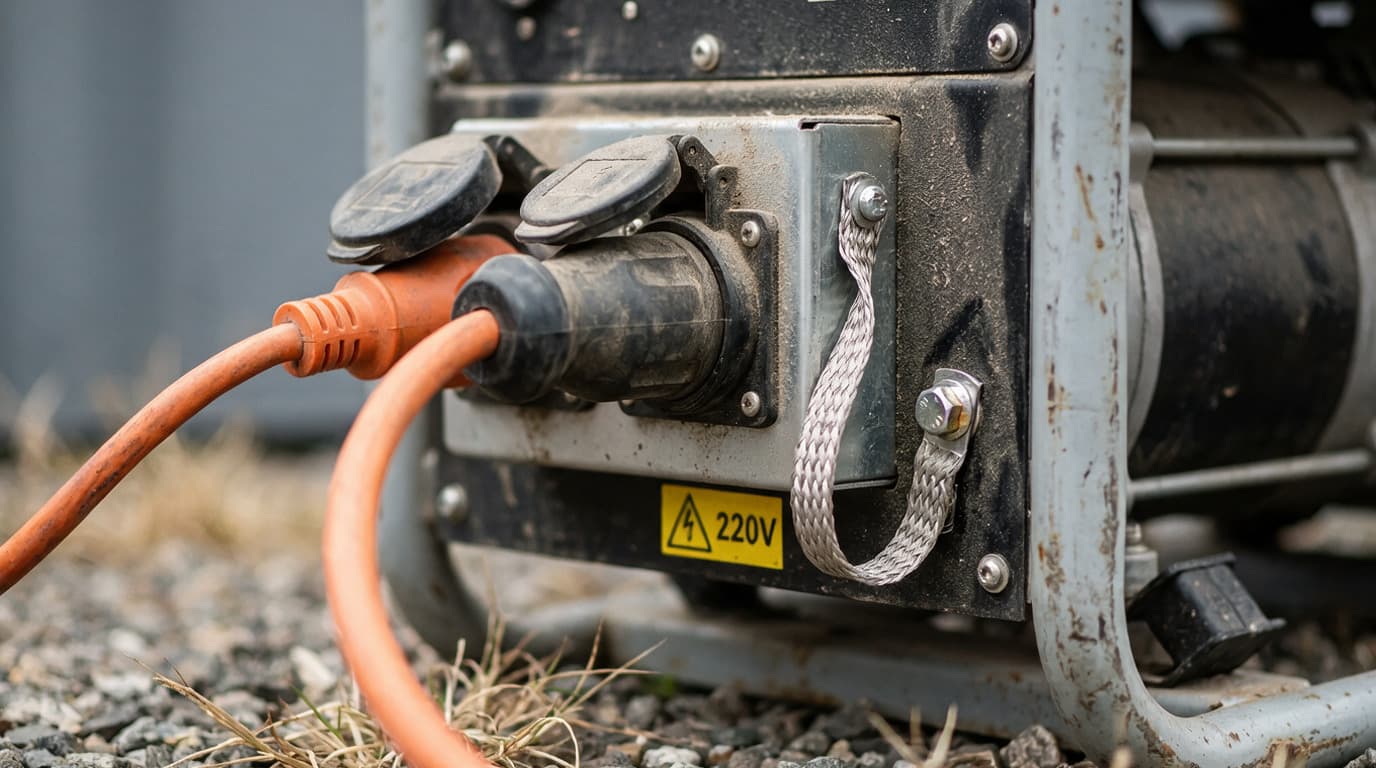
1926.404(f)(3)(ii) applies the same logic to a vehicle-mounted generator, allowing the vehicle frame to serve as the grounding electrode where the generator frame is bonded to the vehicle frame, the generator supplies only equipment on the vehicle and/or cord- and plug-connected equipment through receptacles on the vehicle or generator, and the rest of the section is complied with.
The moment the exemption stops applying#
Everything above depends on the generator feeding only its own receptacles. Run a feeder into a temporary panel, connect it to a building's wiring, or tie it into any distribution beyond the machine, and the arrangement has changed. The generator is now supplying a system, and 1926.404(f)(3)(iii) takes over: a neutral conductor shall be bonded to the generator frame if the generator is a component of a separately derived system — and no other conductor need be bonded to the frame.
That is the real decision point, and it is not a paperwork one. Grounding and bonding for a generator feeding a distribution system is qualified-person work under Subpart K, not something to be settled by whoever brought a sledgehammer and a rod. Ask two questions before anyone connects anything: is this generator feeding anything other than its own receptacles, and has a qualified person established the bonding arrangement for that connection.
Two related points belong here:
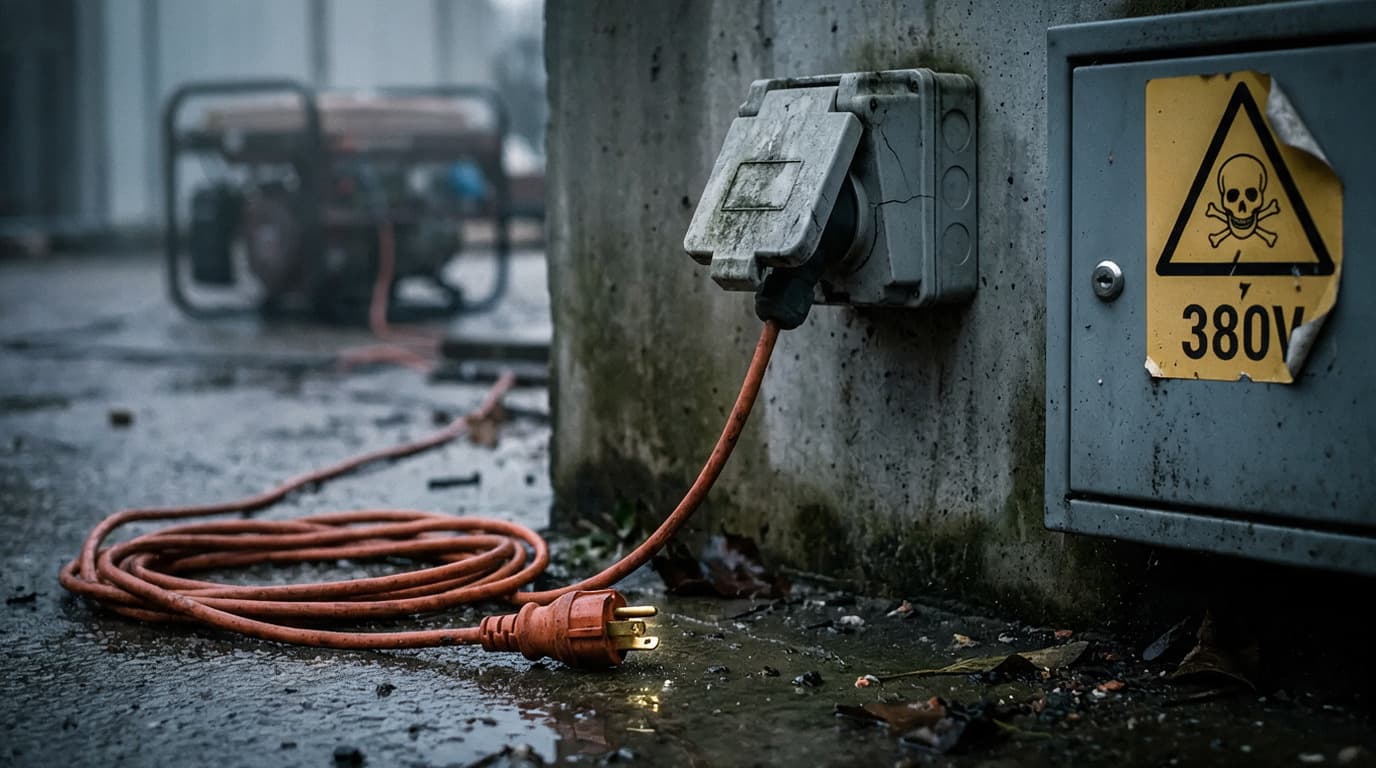
- Backfeed. Connecting a generator to a building's wiring without a proper transfer arrangement can push power back through the service and re-energise conductors that a utility crew believes are dead. That is a mechanism for killing somebody you will never meet. It is also why isolation of every source — generators included — is central to lockout/tagout, covered in its own talk.
- Ground-fault protection. The GFCI rule has an express carve-out for receptacles on a two-wire, single-phase portable or vehicle-mounted generator rated not more than 5 kW under specified conditions. That exemption is dealt with in the GFCI talk. Being exempt from the rule is not the same as being protected.
The exhaust kills more people than the electricity#
Carbon monoxide is colourless, odourless, and produced by every combustion engine on this site. OSHA's permissible exposure limit is 50 ppm as an 8-hour time-weighted average, applied to construction through 1926.55. NIOSH recommends a lower limit — 35 ppm as an 8-hour TWA with a 200 ppm ceiling — and its Pocket Guide gives an IDLH of 1,200 ppm, a concentration a running generator can create in a poorly ventilated space faster than anyone expects.
NIOSH, CPSC, OSHA, EPA and the Colorado health department published a joint alert (NIOSH Alert 96-118) on exactly this: workers poisoned by carbon monoxide from petrol-powered equipment — pressure washers, concrete saws, power trowels, floor buffers, welders, pumps, compressors and generators — used in buildings or semi-enclosed spaces.
That phrase does the work. Semi-enclosed means the places crews actually put generators: an open garage, a partly enclosed floor, a stairwell, a trench, a shaft, the lee side of a building, next to a doorway or a window because the cord will not reach. Opening a door does not make a space ventilated. The gas accumulates where the air does not move, and the first symptoms — headache, tiredness, poor concentration — are exactly the symptoms people on a long shift dismiss.
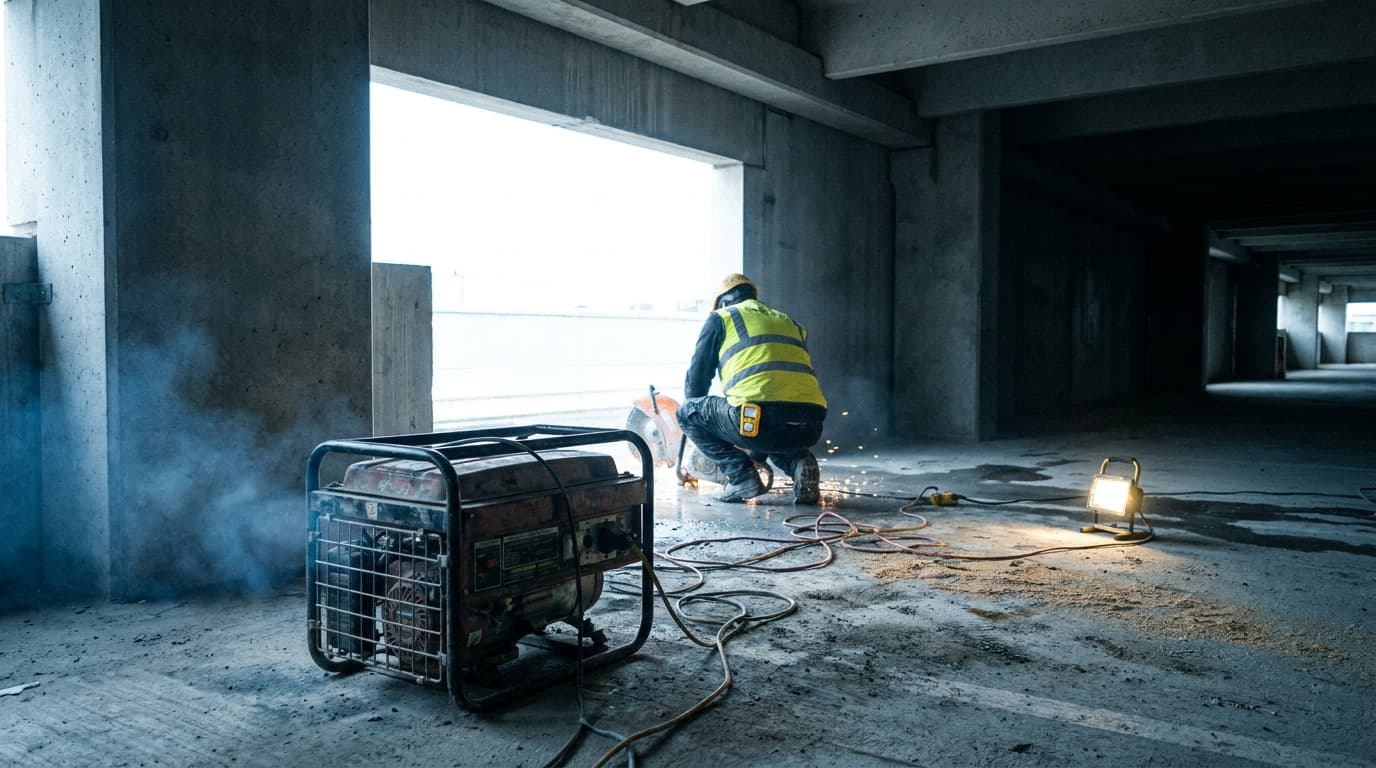
Site rule, and it is not negotiable: generators run outdoors, well away from doors, windows, vents and excavations, with the exhaust pointing away from anywhere people work. If someone tells you a generator has to run indoors, the answer is a different power source, not more ventilation.
What can go wrong?#
The generator drifts closer to the work. It starts outside, gets moved twice to reach the cord, and ends up next to a doorway with the wind blowing exhaust back into a room.
Somebody drives a rod and connects it, badly. A rod alone changes nothing useful and can create a hazard if it disturbs the bonding arrangement the generator relies on.
Backfeed onto a service. A cord made up with male plugs on both ends — a "suicide cord" — connected to a building outlet. There is no safe version of this.
Refuelling hot. Petrol onto a hot engine or exhaust. Fuel handling and container rules belong to the fuel storage talk; the generator-specific point is simple: shut it down and let it cool.
Overload and improvised cords. Loads well beyond the rating, cords too long and too light for the current, connections lying in water.
No monitoring. No CO detector anywhere near the crew, so the only alarm is somebody's headache.
How do we do this properly?#
Site it before you start it. Outdoors, downwind of the work, well clear of doors, windows, air intakes, vents, trenches and shafts, on stable ground. Exhaust pointing away from people.
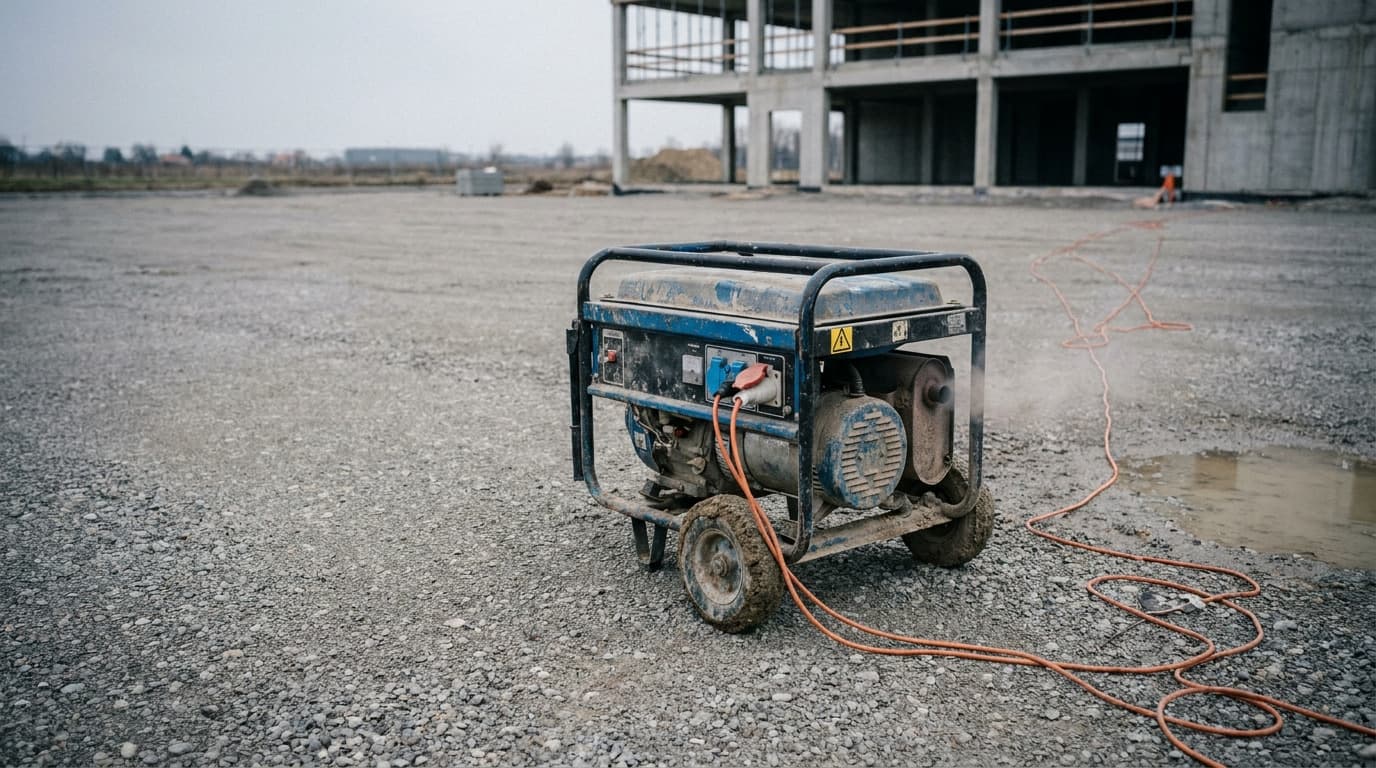
Answer the grounding question deliberately. If the generator supplies only cord- and plug-connected equipment through its own receptacles, and the receptacle ground terminals and metal parts are bonded to the frame, 1926.404(f)(3)(i) applies and no separate grounding electrode is required. If it feeds a panel or any distribution, stop and get a qualified person to establish the bonding.
Never connect a generator to building wiring without a proper transfer arrangement, and never with a double-ended cord.
Use CO monitoring where there is any degree of enclosure, and treat headache or nausea in more than one person as a gas event until proved otherwise.
Inspect the cords and the connections as you would any temporary power: three-wire, hard usage, out of the water, out of the traffic.
Shut down and cool before refuelling, and keep the fuel handling to the rules covered in the fuel storage talk.
Size the load honestly. Add up what will actually be running, and leave headroom for motor starting.
Before you start#
- Confirm the generator is outdoors and clear of every door, window, vent, intake, trench and shaft near the work.
- Confirm which way the exhaust points and which way the wind is going.
- Confirm what the generator feeds: its own receptacles only, or a distribution system.
- If it feeds a system, confirm a qualified person has established the grounding and bonding.
- Confirm nothing connects the generator to building or utility wiring.
- Confirm cords are hard-usage three-wire, undamaged, and clear of standing water.
- Confirm a CO monitor is present wherever the space is anything less than fully open.
Talk it over#
- Where is our generator sitting right now, and what is the nearest opening into an occupied space?
- Does anyone here believe a ground rod is always required? Where did that come from?
- What is plugged into it, and does the total draw fit the rating?
- Who would notice first if carbon monoxide was building up where you work?
The bottom line#
1926.404(f)(3)(i) allows the frame of a portable generator to serve as the grounding electrode — no separate ground rod — when the generator supplies only equipment mounted on it and cord- and plug-connected equipment through its own receptacles, and the metal parts and receptacle grounding terminals are bonded to the frame. Feed anything beyond that and it becomes a separately derived system, (f)(3)(iii) brings the neutral bonding requirement into play, and the arrangement is qualified-person work. Never tie a generator into building wiring without a proper transfer arrangement. And remember which hazard actually kills: carbon monoxide, 50 ppm OSHA PEL, 35 ppm NIOSH recommended limit with a 200 ppm ceiling, produced continuously by a machine that people keep moving closer to the doorway.
Frequently asked questions about portable generator safety#
Does OSHA require a ground rod for a portable generator?
Not in the ordinary jobsite case. 29 CFR 1926.404(f)(3)(i) provides that the frame of a portable generator need not be grounded and may serve as the grounding electrode where the generator supplies only equipment mounted on the generator and/or cord- and plug-connected equipment through receptacles mounted on the generator, and where the non-current-carrying metal parts of equipment and the equipment grounding conductor terminals of the receptacles are bonded to the generator frame.
When does a generator need to be grounded differently?
When it stops supplying only its own receptacles. Feeding a temporary panel, a building's wiring or any distribution system makes the generator part of a separately derived system, and 1926.404(f)(3)(iii) requires a neutral conductor to be bonded to the generator frame in that case. That arrangement should be established by a qualified person, not improvised on site.
Do generator receptacles need GFCI protection?
1926.404(b)(1)(ii) exempts receptacles on a two-wire, single-phase portable or vehicle-mounted generator rated not more than 5 kW, where the circuit conductors of the generator are insulated from the generator frame and all other grounded surfaces. Larger or differently configured generators are not covered by that exemption, and the exemption is a legal carve-out rather than a statement that protection is unnecessary.
Can I plug a generator into a wall outlet to power a building?
No. Connecting a generator to building wiring without a proper transfer arrangement can backfeed the service and energise conductors that utility workers believe are de-energised. A cord with a male plug at both ends is never acceptable. Any connection to permanent wiring is work for a qualified person with the correct transfer equipment.
How far from a building does a generator need to be?
There is no single distance in the construction standard, which is why the rule has to be about conditions rather than a number: outdoors, well away from doors, windows, air intakes, vents, trenches and shafts, with exhaust directed away from where people work, and never in a building or semi-enclosed space. NIOSH Alert 96-118 was issued specifically because workers have been poisoned using petrol-powered equipment in buildings and semi-enclosed spaces.
What is the OSHA exposure limit for carbon monoxide?
50 ppm as an 8-hour time-weighted average, applied to construction through 29 CFR 1926.55. NIOSH recommends 35 ppm as an 8-hour TWA with a 200 ppm ceiling, and its Pocket Guide lists an IDLH of 1,200 ppm. Compliance is measured against the OSHA limit; the lower recommended values exist because effects begin well below it.
What are the early signs of carbon monoxide exposure?
Headache, dizziness, weakness, nausea, tiredness and difficulty concentrating — all of which are easy to attribute to a long shift, heat or dehydration. If more than one person in the same area reports them, treat it as a gas event: get everyone into fresh air immediately, do not re-enter, and call emergency medical services.
Download the portable generator safety toolbox talk PDF#
Get this portable generator safety toolbox talk as a print-ready PDF — available in English, Spanish, Portuguese, and Turkish. Print it, hand it to the crew, and collect signatures on the included attendance sheet.
Download the PDF — free account required. New members get 3 free downloads.
Related toolbox talks#
Sources#
- OSHA, 29 CFR 1926.404 — Wiring design and protection: https://www.osha.gov/laws-regs/regulations/standardnumber/1926/1926.404
- OSHA, 29 CFR 1926.402 — Applicability (Subpart K): https://www.osha.gov/laws-regs/regulations/standardnumber/1926/1926.402
- OSHA, 29 CFR 1926.55 — Gases, vapors, fumes, dusts, and mists: https://www.osha.gov/laws-regs/regulations/standardnumber/1926/1926.55
- NIOSH/CDC, Carbon monoxide — IDLH documentation and Pocket Guide values: https://www.cdc.gov/niosh/idlh/630080.html
This talk summarises published regulatory and exposure guidance. It is not medical advice. Anyone who may have been exposed to carbon monoxide should be moved to fresh air and assessed by emergency medical services.
Written by FieldSafetyTalk's safety professional — a CSP, ASP, CHST and OSHA Authorized Outreach Trainer with 14+ years of international construction safety experience across federal, heavy civil, and industrial projects.