Subcontractor Communication
Updated 2026-08-06
In this bundle Jobsite Fundamentals & Compliance
Print-ready PDF
Download this talk as a print-ready PDF, available in 4 languages.
On a single-employer site, safety responsibility is simple: your company, your crew, your hazards. Almost no construction site works that way. A typical jobsite has a general contractor, several subcontractors, their sub-subs, and often independent operators and delivery drivers, all working the same space at the same time — and the hazards one company creates land on another company's people. That is the situation this talk is about, and it comes with a rule most crews have never been told: on a multi-employer site, OSHA can cite you for a hazard that never touched one of your own workers. This Subcontractor Communication Toolbox Talk (Safety Talk / Tailgate Talk) is about why communication between companies is not a courtesy on these sites — it is the specific thing the law holds you responsible for.
Here is the distinction that carries this whole talk: OSHA does not ask whose crew it was, it asks what role you played. When an inspector finds a hazard on a shared site, the question is not "which company owns these workers" — it is a two-step analysis of what role each employer played in relation to that hazard. Responsibilities under the multi-employer policy depend on the employer's role, not its job title. A general contractor is not automatically off the hook because the exposed workers belong to a sub; a sub is not automatically safe because it did not create the hazard. Each company's exposure is decided by what it did, what it controlled, and — again and again in the policy — what it communicated. That is why a talk about subcontractor communication is really a talk about liability: the telling and the asking are the acts that decide who gets cited.
Where the boundary of this talk sits#
The hazard communication talk owns chemical information and labeling. The stop-work authority talk owns the right to halt unsafe work. The situational awareness talk owns noticing hazards around you. This talk owns the multi-employer relationship itself — how OSHA assigns responsibility across companies on a shared site, and the communication each role is required to perform. Where the question is a specific hazard's controls, that is the hazard's own talk; this one owns who is answerable for it when more than one company shares the ground.
Four roles, and you can hold more than one#
OSHA's multi-employer citation policy sorts every employer on a shared site into one or more of four roles, and the role decides the duty. The creating employer is the one that caused the hazardous condition. The exposing employer is the one whose own workers are exposed to it. The correcting employer is the one responsible for fixing it — maintaining the guardrails, correcting the electrical issue. The controlling employer is the one with general supervisory authority over the site, with the power to correct violations itself or make others correct them — often the general contractor, established by contract or by the control it actually exercises in practice. The critical thing is that these are not mutually exclusive. An employer may have multiple roles at once: a sub that creates a hazard its own crew is then exposed to is both creating and exposing. Your first question on any shared site is not "am I responsible" but "which of these roles do I hold right now" — because you may hold several.
You can be cited for a hazard that never touched your crew#
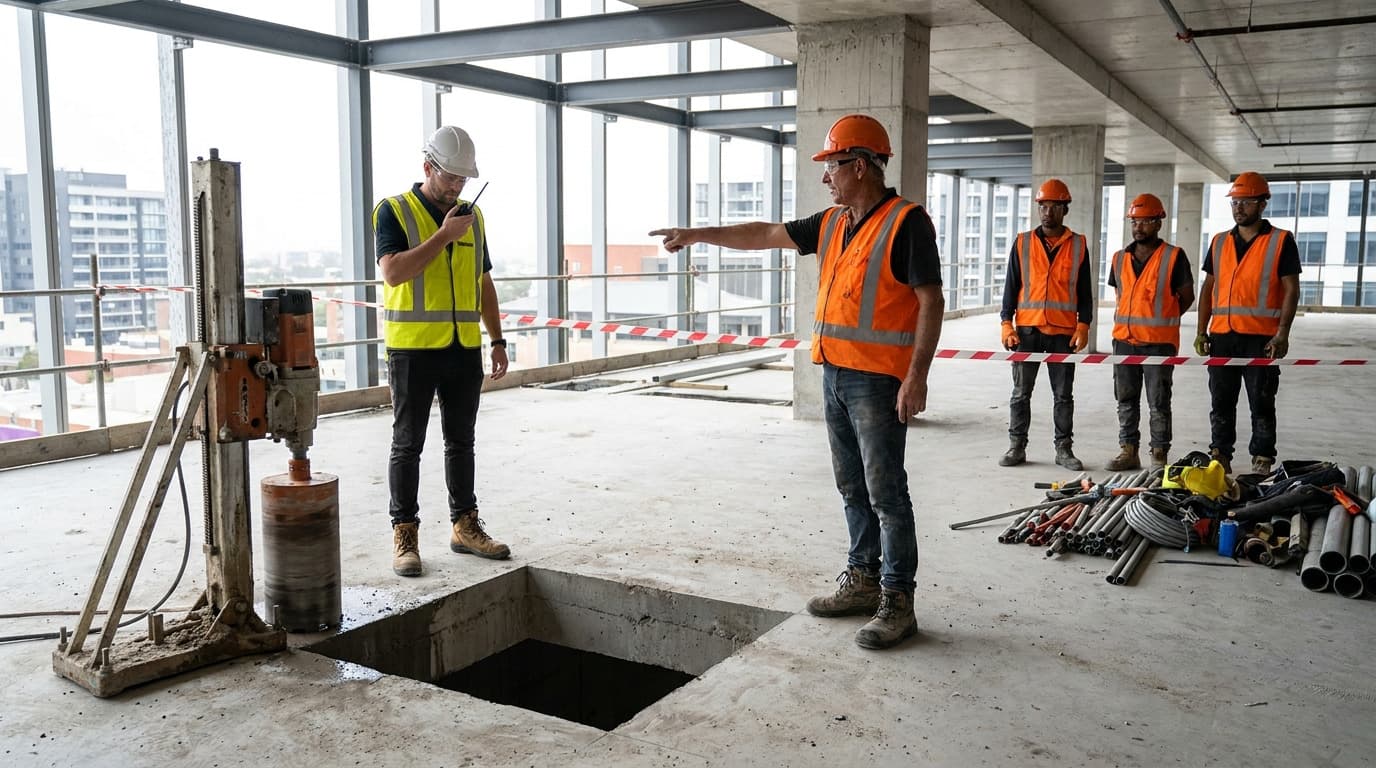
This is the part that surprises people, and it is the whole reason the roles matter. The creating employer is citable even if the only employees exposed are those of other employers at the site. Read that again: you can drill a hole, leave an unguarded opening, energize a line, and walk away — and if another company's worker is the one exposed, you are still the one cited, because you created the hazard. Your crew being clear does not clear you. The same logic runs the other way for the controlling employer, who can be cited for a subcontractor's hazard it should have caught. The doctrine exists precisely so that "those weren't my people" is not a defense. On a shared site, the hazard you create or control is your responsibility regardless of whose name is on the injured worker's badge.
When you're exposed but can't fix it: tell and ask#
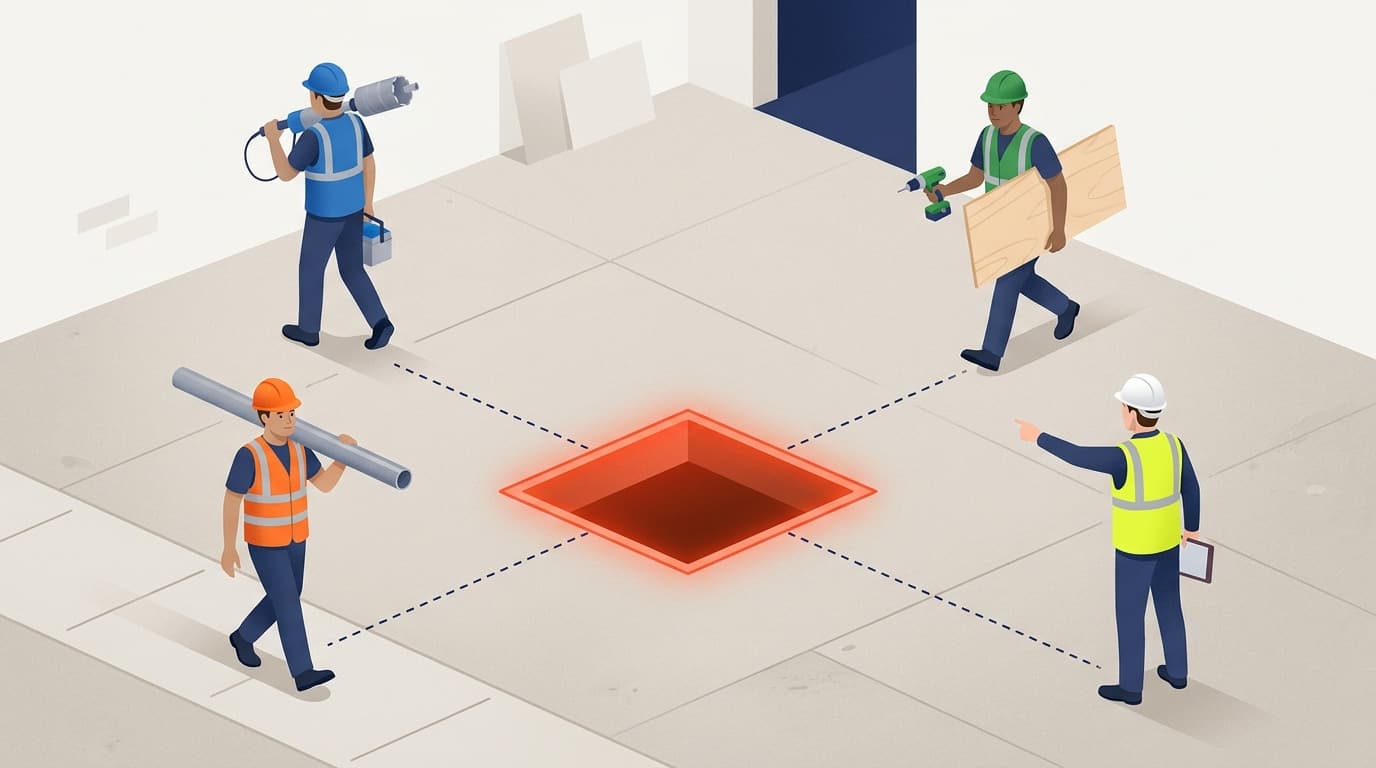
Here is where communication becomes the literal citation. Suppose your crew is the exposing employer — your people are working near a hazard — but you did not create it and you do not have the authority to fix it. You are not automatically off the hook. If the exposing employer lacks the authority to correct the hazard, it is still citable unless it does three specific things: ask the creating or controlling employer to correct the hazard; inform its own employees of the hazard; and take reasonable alternative protective measures to protect its crew in the meantime. Those three acts are the defense. Two of the three are pure communication — asking the responsible party, and telling your own people. A sub that spots another company's uncovered floor opening, says nothing, and routes its crew past it anyway has failed the test even though it did not create the danger. Seeing a hazard you cannot fix is not the end of your duty; it is the start of it.
The controlling employer: reasonable care means inspect and enforce#
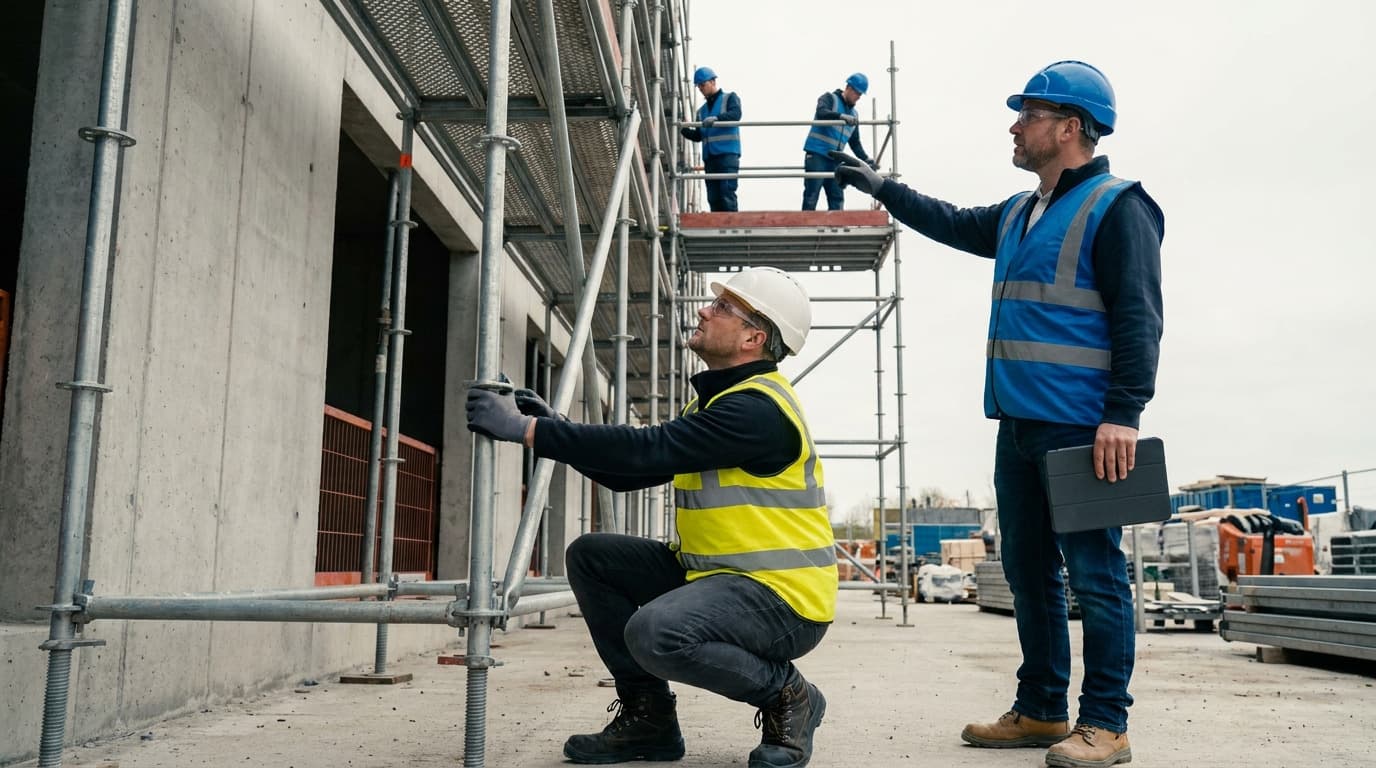
The controlling employer — usually the general contractor — carries a duty its size makes easy to underestimate: it must exercise reasonable care to prevent and detect violations across the whole site, including hazards created by its subcontractors. Reasonable care here is not a vague good intention; the policy names what it looks like: conducting periodic inspections of the site, having an effective system for promptly correcting hazards that are found, and enforcing the subcontractors' compliance with safety requirements. How closely and often depends on the situation — more frequent inspection is expected when a subcontractor has a history of non-compliance, or at the start of a project with a sub the controlling employer has never worked with and whose safety record it does not know. Importantly, the measures a controlling employer must take to satisfy this duty are less than what an employer must do to protect its own directly-exposed employees — the controlling employer is running a monitoring-and-enforcement system, not standing over every task. But a general contractor that never inspects, never corrects, and never enforces has not exercised reasonable care, and the fact that a sub created the hazard will not save it.
Where the duty sits#
The framework is OSHA's Multi-Employer Citation Policy, CPL 02-00-124, which sets the two-step analysis: first determine each employer's role — creating, exposing, correcting, or controlling — then determine whether that employer met the obligations of the role. Two rules from the directive are worth carrying: an employer may hold multiple roles, and only exposing employers can be cited for General Duty Clause violations — creating and controlling employers are cited under specific standards. The underlying authority is the OSH Act, Section 5(a)(1) and the standards themselves, and on construction sites the prime-contractor and subcontractor responsibility structure appears in 1926.16, with training duties in 1926.21(b)(2). An OSHA interpretation put the principle plainly: responsibilities under the multi-employer policy depend on the employer's role, not its job title. Where a site's own coordination plan or contract assigns specific duties, those apply on top of the policy, not instead of it.
What can go wrong?#
- A company creates a hazard, its own crew leaves, and another company's worker is injured and it is cited anyway.
- An exposing employer sees a hazard it cannot fix, says nothing, and routes its crew past it.
- An exposing employer fails to ask the responsible party to correct a known hazard.
- A controlling employer never inspects the site and misses a subcontractor's violation.
- A general contractor assumes "the sub is responsible for its own people" and enforces nothing.
- Two companies each assume the other secured a shared hazard, and neither does.
- A hazard is created on one shift and never communicated to the companies on the next.
- Nobody can say which employer holds which role, so no one performs the role's duty.
How do we manage this properly?#
- Ask first: which of the four roles do we hold for this hazard — maybe more than one?
- If you created it, fix it — your crew being clear does not clear you.
- If you're exposed and can't fix it: ask the responsible party, tell your crew, add interim protection.
- If you control the site: inspect, correct, and enforce — reasonable care is an active system.
- Communicate hazards across company lines, not just within your own crew.
- Confirm who owns each shared hazard before work starts, in writing where you can.
- Treat another company's exposed workers as your responsibility if you created or control the hazard.
- Never assume "not my crew" ends your duty — the policy is built to defeat that assumption.
Before you start#
- Confirm which companies share this work area and this shift.
- Confirm who is the controlling employer and who holds correcting authority.
- Confirm how hazards get communicated between companies here — the actual channel.
- Confirm your crew knows the hazards created by other trades nearby.
- Confirm any hazard you can't fix has been reported to the party who can.
- Confirm interim protection is in place for hazards awaiting correction.
- Confirm the controlling employer's inspection and correction system is running.
- Confirm shared hazards are handed over to the companies on the next shift.
Talk it over#
- On this site, who's the controlling employer — and does everyone know it?
- If you saw a hazard that belonged to another trade, who would you tell, and how?
- Has "that's not my crew" ever stopped someone here from reporting something?
- What hazard right now is shared between companies, and who owns fixing it?
The bottom line#
OSHA does not ask whose crew it was, it asks what role you played. On a multi-employer site the two-step analysis sorts every company into one or more of four roles — creating, exposing, correcting, controlling — and the role, not the job title, decides the duty. The consequence that surprises people is that the creating employer is citable even if the only workers exposed belong to other employers, so "not my crew" is not a defense. And the communication is the citation: an exposing employer who cannot fix a hazard must still ask the responsible party to correct it, inform its own crew, and add interim protection — two of those three are pure communication — while the controlling employer must exercise reasonable care through active inspection, correction, and enforcement across the whole site, a lighter duty than protecting its own workers but a real one. The framework is CPL 02-00-124, built on Section 5(a)(1), with the reminder that only exposing employers can be cited under the General Duty Clause. The test on any shared site is one question: for the hazard in front of you, which role do you hold — and have you done the telling and the asking that role requires?
Frequently asked questions about subcontractor communication#
Can I really be cited for another company's workers?
Yes. Under OSHA's multi-employer citation policy, the creating employer is citable even if the only employees exposed are those of other employers at the site. If you create a hazardous condition — an unguarded opening, an energized line, an unsafe scaffold — you can be cited for it whether or not any of your own crew was ever exposed, because you created it. The same is true for a controlling employer that fails to catch and correct a subcontractor's hazard. The whole point of the doctrine is that responsibility follows your role in relation to the hazard, not the company name on the exposed worker's badge.
What are the four employer roles?
Creating, exposing, correcting, and controlling. The creating employer caused the hazard. The exposing employer has its own workers exposed to it. The correcting employer is responsible for fixing it, such as maintaining fall protection. The controlling employer has general supervisory authority over the site — the power to correct violations or make others correct them — and is often the general contractor. An employer can hold more than one role at once; a sub that creates a hazard its own crew is exposed to is both creating and exposing. OSHA runs a two-step analysis: first identify the role or roles, then decide whether the employer met that role's obligations.
My crew is exposed to a hazard we didn't create and can't fix. What do we do?
Three things, and they are the difference between compliance and a citation. Ask the creating or controlling employer to correct the hazard. Inform your own employees of the hazard. And take reasonable alternative protective measures to protect your crew in the meantime — a different route, a barricade, whatever reduces the exposure until it is fixed. An exposing employer that lacks authority to correct a hazard is still citable if it fails to do these three. Two of them are communication: asking the responsible party and telling your own people. Silence is what gets cited.
What does "reasonable care" require from the general contractor?
As the controlling employer, the general contractor must exercise reasonable care to prevent and detect violations across the site. The policy names what that involves: conducting periodic inspections, having an effective system for promptly correcting hazards, and enforcing subcontractors' compliance with safety requirements. How often and how closely depends on the circumstances — more frequent inspections are expected when a sub has a history of non-compliance or is new and unproven. This duty is less than what a company must do to protect its own directly-exposed workers, but it is an active system, not a hands-off assumption that each sub handles itself.
Does the controlling employer's lighter duty mean it's usually safe?
No — lighter than the exposing employer's duty is not the same as light. A controlling employer that conducts no inspections, has no system to correct hazards, and never enforces subcontractor compliance has not exercised reasonable care and can be cited for a sub's hazard. The reduced standard reflects that the controlling employer is running a monitoring and enforcement program rather than performing each task, but the program has to actually exist and function. A general contractor that treats "the subs handle their own safety" as a policy has adopted exactly the posture the doctrine was written to reach.
Isn't this a management issue rather than a toolbox talk?
It affects the crew directly, which is why it belongs in a toolbox talk. Every worker on a shared site should know that a hazard created by another trade is still a hazard to them, that they should report hazards they see even when another company owns them, and that "not my crew" is never a reason to stay silent. The formal role analysis is management's job, but the communication that the policy rewards — telling your people, reporting across company lines, not walking past another trade's danger — happens at the crew level, every shift. The doctrine works best when everyone on the ground understands that safety crosses company lines.
Download the subcontractor communication toolbox talk PDF#
Get this subcontractor communication toolbox talk as a print-ready PDF — available in English, Spanish, Portuguese, and Turkish. Print it, hand it to the crew, and collect signatures on the included attendance sheet.
Download the PDF — free account required. New members get 3 free downloads.
Related toolbox talks#
Sources#
- OSHA, Multi-Employer Citation Policy — CPL 02-00-124 (two-step analysis; creating, exposing, correcting, controlling employer; creating employer citable even if only other employers' workers are exposed; only exposing employers citable under the General Duty Clause): https://www.osha.gov/enforcement/directives/cpl-02-00-124
- OSHA, CPL 02-00-124 directive text (exposing employer without authority must ask the creating/controlling employer to correct, inform its employees, and take reasonable alternative protective measures; controlling employer must exercise reasonable care to prevent and detect violations): https://www.osha.gov/sites/default/files/enforcement/directives/CPL_2-0_124.pdf
- OSHA, Multi-employer worksites — 29 CFR 1926.16 (prime contractor and subcontractor responsibility on construction sites): https://www.osha.gov/laws-regs/regulations/standardnumber/1926/1926.16
This talk is general awareness guidance for training purposes. It does not replace your employer's safety program, OSHA's Multi-Employer Citation Policy, the OSH Act General Duty Clause, the construction responsibility standards, or a competent person's duties, and it is not legal advice. Where a site coordination plan or contract assigns a specific responsibility, that assignment applies in addition to the policy.
Written by FieldSafetyTalk's safety professional — a CSP, ASP, CHST and OSHA Authorized Outreach Trainer with 14+ years of international construction safety experience across federal, heavy civil, and industrial projects.