Carbon Monoxide Poisoning
Updated 2026-08-01
In this bundle Health & Environmental Exposure
Print-ready PDF
Download this talk as a print-ready PDF, available in 4 languages.
Carbon monoxide kills people who did everything they were told to do. They tested the space. They looked at the meter. They saw a number that has meant "safe" their entire working life, and they climbed in. The gas that killed them was in the air the whole time, and nothing about that reading was wrong — it was simply answering a different question. This Carbon Monoxide Poisoning Toolbox Talk (Safety Talk / Tailgate Talk) is about the question the meter was actually answering.
Here is the distinction that carries this whole talk: carbon monoxide does not take the oxygen out of the air — it takes the oxygen out of your blood, so a space that is killing you still tests almost perfectly normal for oxygen. Every other atmospheric hazard a crew is trained on announces itself by pushing the oxygen number down. Carbon monoxide does not. It leaves the air chemically ordinary and attacks the part of you that carries the oxygen. An oxygen reading is not a CO reading, and it never was.
The number that proves it#
This is not a theoretical point. It has been measured at the scene of a fatality.
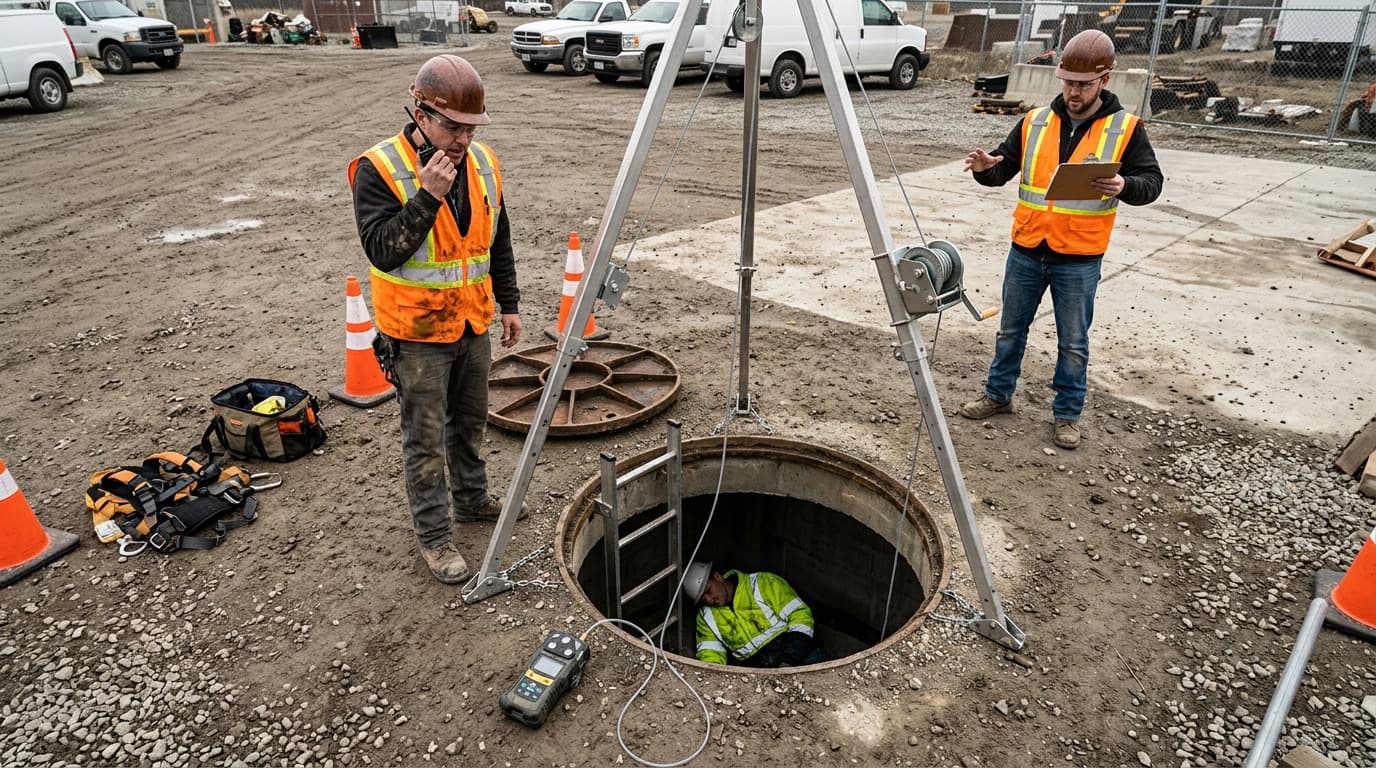
A municipal sewer project was installing new pipe and manholes. A crew finished a 12-foot (3.7 m) deep manhole and left the area. A subcontractor then detonated 265 pounds (120 kg) of nitroglycerin-based explosive in 20 boreholes, 40 to 60 feet (12 to 18 m) away, to break up rock. Forty-five minutes after the blast, a worker descended into that manhole and collapsed within minutes. Two co-workers went down after him. One retrieved the unconscious man before collapsing at the surface. The other rescuer died in the manhole. All of them had elevated carboxyhaemoglobin in their blood.
There was no engine in that manhole. Nothing was burning in it. The carbon monoxide had migrated through the soil and fractured rock from a blast the length of a tennis court away.
Now the measurement. When NIOSH investigated, air collected near the bottom of the manhole two days later contained 1,905 ppm carbon monoxide — well past the NIOSH IDLH of 1,200 ppm — alongside 19.5% oxygen.
Read those two numbers together, because they are the whole talk. 19.5% is exactly the line OSHA draws at 1926.1202, which defines an oxygen deficient atmosphere as one containing less than 19.5 percent oxygen by volume. An oxygen meter in that manhole would not have shown a deficiency. It would have sat right on the threshold and passed. And a man died in there.
Why the oxygen number cannot help you#
The arithmetic explains it, and the arithmetic is simple enough to do on a tailgate.
Carbon monoxide is toxic in parts per million. The IDLH of 1,200 ppm is 0.12% of the atmosphere. If you displace 0.12% of the air in a space, oxygen falls from about 20.9% to roughly 20.87%. No instrument on your site will show you that as a change. Even a concentration high enough to kill quickly is still a rounding error in the oxygen column.
That is the trap. Oxygen sensors detect displacement. Carbon monoxide does not work by displacement. It works by chemistry, inside the body, at concentrations far too small to move an oxygen reading. The only way to know CO is present is to measure CO specifically, with a sensor for that gas, at the place and time the work is happening.
What it does inside you#
The mechanism is worth understanding, because it explains every symptom the crew will see.
Carbon monoxide binds to haemoglobin — the protein in blood that carries oxygen — with an affinity roughly 200 to 250 times greater than oxygen's. It wins that competition easily and forms carboxyhaemoglobin (COHb), which cannot carry oxygen at all. That alone reduces how much oxygen your blood can move.
But there is a second effect, and it is the one that makes CO worse than simple suffocation. When CO occupies some binding sites, it increases the affinity of the remaining sites for oxygen — the oxyhaemoglobin dissociation curve shifts to the left. In plain terms: the oxygen still on board is held more tightly and released to your tissues less readily. So carbon monoxide reduces the oxygen you can carry and locks down what is left.
This is why a poisoned worker is not gasping and not blue. There is plenty of oxygen in the air and their breathing is unremarkable. The failure is downstream of the lungs entirely.
Why nothing warns you#
Take the warning systems one at a time and they all fail on this gas.
Your senses. Carbon monoxide is colourless, odourless and tasteless. Unlike solvent vapour, there is no smell to adapt to — there was never a smell.
Height. Carbon monoxide has a vapour density of about 0.97, meaning it is very slightly lighter than air but effectively the same density as air. It does not sink like chlorine or solvent vapour, and it does not rise and sit at the ceiling. It mixes evenly and does not stratify. There is no clean layer to put your head into, no advantage in crouching, and no "safe height" in a contaminated space. Where a solvent talk tells you to extract low because the vapour pools, that advice does nothing here — the concentration at your boots and at your hard hat are the same.
Your symptoms. Headache, dizziness, nausea, weakness, poor concentration and confusion are the early effects, and they are indistinguishable from a hot day, a long shift, a virus or a hangover. Worse, the confusion arrives before the collapse, so the person losing judgment is the person deciding whether to leave. And COHb levels correlate poorly with how ill somebody appears — you cannot grade the danger by how bad the casualty looks.
The oximeter in the first aid kit. A standard pulse oximeter shines two wavelengths of light and cannot tell carboxyhaemoglobin apart from oxyhaemoglobin. It counts the poisoned blood as saturated. In one published case series, oxygen saturation never fell below 96% despite carboxyhaemoglobin levels as high as 44%. A finger probe will report a dying casualty as normal. Only CO-oximetry measures it properly. If your kit has an oximeter, this is the single most important thing anyone on site can know about it.
Where it comes from on a construction site#
Anything that burns carbon fuel incompletely, which is most things.
Petrol and diesel engines — pumps, compressors, welders, generators, concrete saws, power trowels, pressure washers, floor buffers, plate compactors. Propane — forklifts, temporary heaters, torches. Temporary heating of any kind in enclosed or partly enclosed work. Vehicle exhaust in basements, parking structures and tented or sheeted areas. Explosives, as the case above shows, with CO travelling through ground into any void it can reach.
The phrase that matters is semi-enclosed. A structure does not need doors and a roof to hold CO. A sheeted scaffold, a tented deck, a partly backfilled trench, a stairwell, a plant room, a shaft, a vault or an unventilated basement will all hold it. Generator siting, grounding and the exposure limits themselves are covered in the portable generator talk; this talk is about what the gas does once it is in the air.
Where the duty sits#
There is no single OSHA standard for carbon monoxide in construction. Say that plainly rather than implying one exists.
The exposure limit is applied through 1926.55, Gases, vapors, fumes, dusts, and mists, which also sets the order of control: administrative or engineering controls must be implemented first wherever feasible, with protective equipment where such controls are not feasible. 1926.1202 supplies the atmospheric definitions used above and Subpart AA governs entry into permit spaces. 1926.353 covers ventilation for welding and cutting. 1926.21(b)(2) requires the employer to instruct each employee in the recognition and avoidance of unsafe conditions — which is what this talk is for. Where no specific provision reaches a hazard, Section 5(a)(1) of the OSH Act still requires a workplace free of recognised hazards likely to cause death or serious harm.
One control point that gets confused: an air-purifying respirator does not protect against carbon monoxide. A cartridge or dust mask is useless here. Protection means supplied air or SCBA, and that is a planned operation, not something you improvise at a manhole cover.
What can go wrong?#
Reading the oxygen column and calling the space clear, when nothing on the meter was measuring CO.
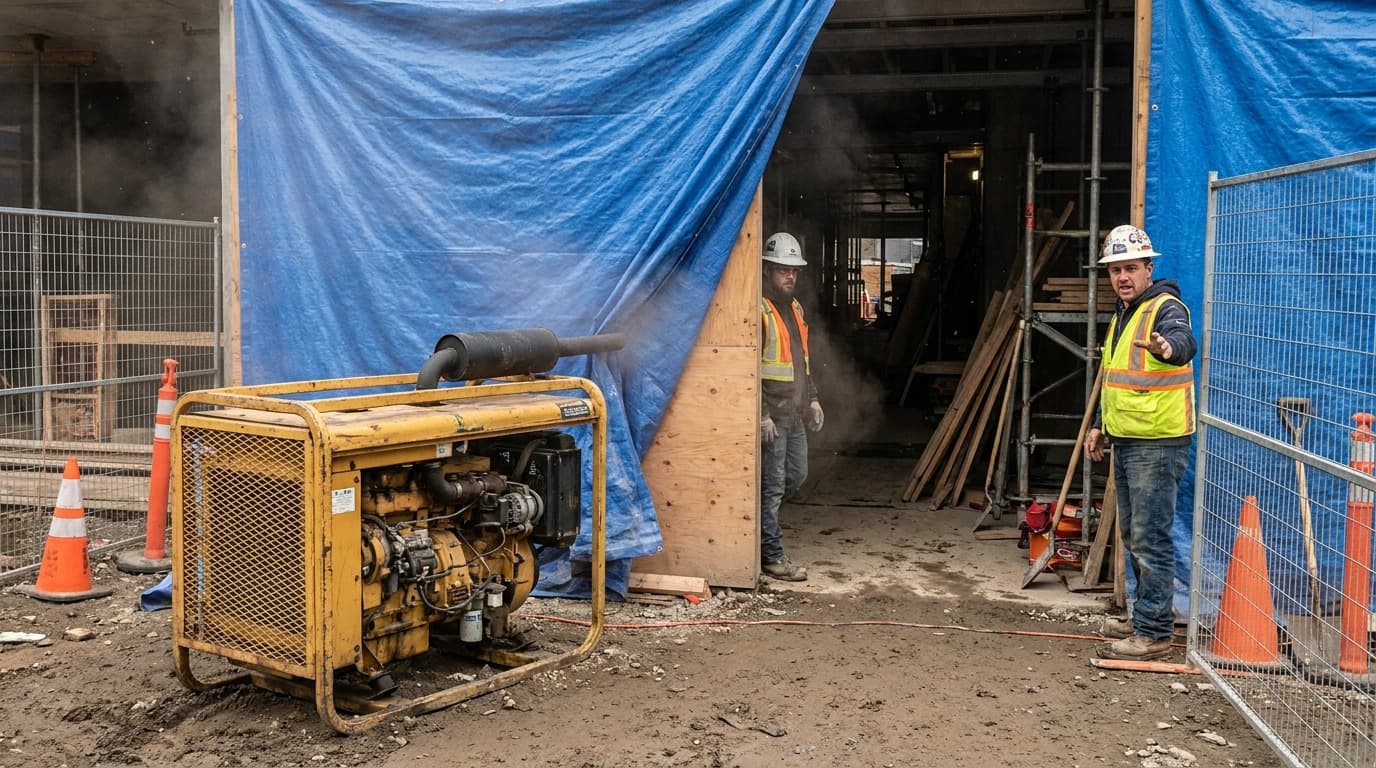
Running a petrol saw, pump or compressor inside a structure, a shaft, a vault or a sheeted enclosure.
Positioning a generator or plant "outside" but next to an opening, a window, an air intake or a trench that the exhaust drifts into.
Using an unvented propane heater to warm an enclosed area overnight, so the first crew in walks into a full space.
Entering a void, manhole or trench after nearby blasting, without treating soil migration as a live route.
Crouching or staying low in the belief that the bad air is above you.
Sending somebody back to work because the headache eased in fresh air and the oximeter read 98%.
Going down after a collapsed workmate without air, which is how the second and third casualties happen.
How do we manage this properly?#
Eliminate the source first. Electric, battery, hydraulic or air-driven equipment removes the hazard instead of managing it — this is the only control that cannot fail.
Keep combustion engines outside and downwind, well clear of openings, intakes, excavations and anywhere exhaust can drift or settle.
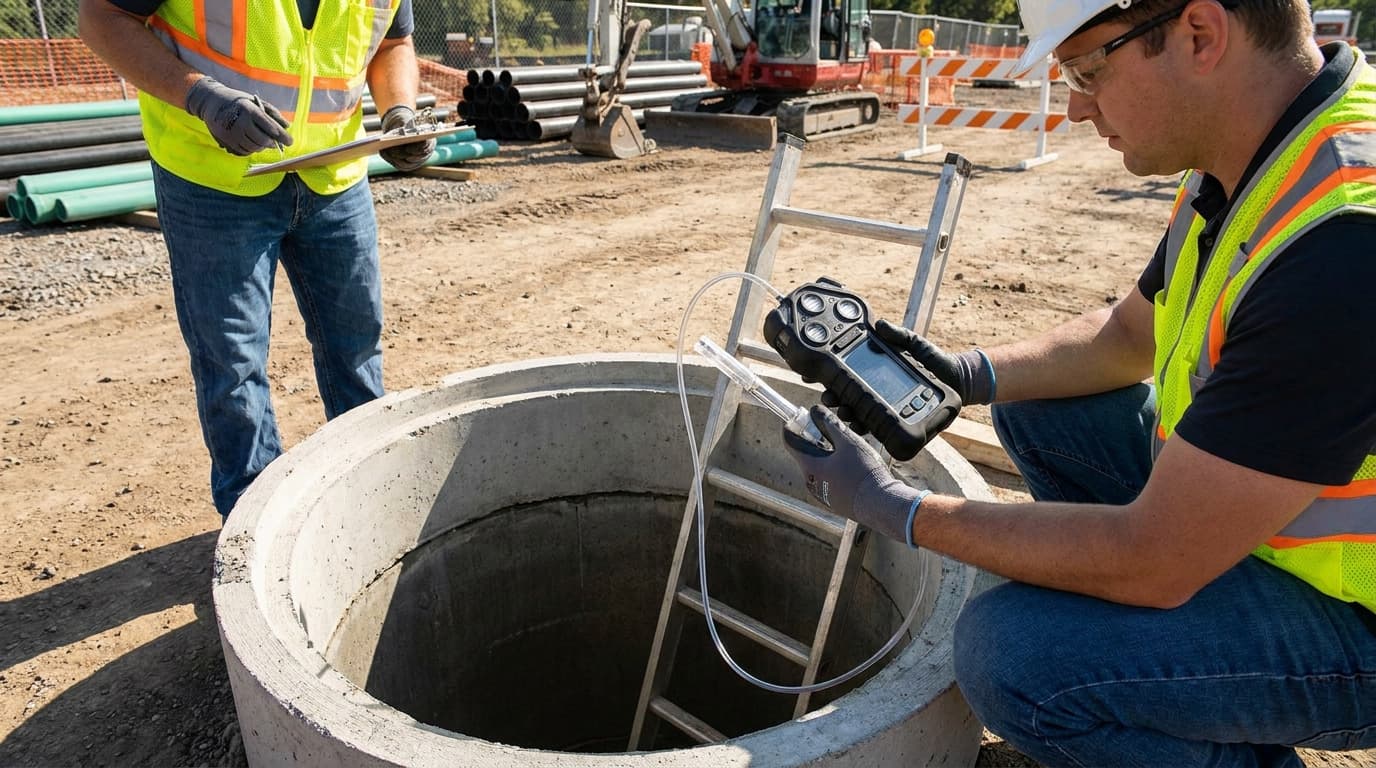
Monitor for CO specifically, with a calibrated, bump-tested instrument that has a CO sensor, before entry and continuously during work — not once at the top of the shift.
Test at the working position, not at the hatch, and remember that with CO there is no low point to favour because it does not stratify.
Treat semi-enclosed as enclosed. Sheeting, tenting, partial backfill and a single opening are enough to hold the gas.
Ventilate mechanically and confirm it worked with the meter, not by how the space feels or smells.
After blasting, treat every nearby void as contaminated until measured — CO travels through soil and can come back after ventilation.
Get anybody with headache, dizziness, nausea or confusion into fresh air and to medical assessment, and tell the clinician that CO exposure is suspected so the right test is used.
Nobody enters after a collapse without supplied air. Raise the alarm, start the rescue plan, and stay out.
Before you start#
- Confirm what fuel-burning equipment will run today and where its exhaust goes.
- Confirm whether an electric or battery alternative could be used instead.
- Confirm your monitor has a CO sensor, is in calibration and has been bump tested.
- Confirm who is testing, at what position, and how often during the work.
- Confirm the space is not semi-enclosed by sheeting, tenting or partial backfill.
- Confirm whether blasting has taken place nearby and how recently.
- Confirm the mechanical ventilation is running and the meter agrees it is working.
- Confirm everyone knows that nobody goes in after a casualty without supplied air.
Talk it over#
- What runs on petrol or propane in our work area today, and where does the exhaust actually go?
- Has anyone here ever cleared a space using only an oxygen reading?
- If a workmate came out of a vault with a headache, what would we do in the next ten minutes?
- Where on this site could carbon monoxide collect without anybody expecting it?
The bottom line#
Carbon monoxide does not take the oxygen out of the air — it takes the oxygen out of your blood, so a lethal space still reads as normal for oxygen. That is measured, not theoretical: NIOSH found 1,905 ppm CO — past the IDLH of 1,200 ppm — alongside 19.5% oxygen in a manhole where one worker died and two more were poisoned, after CO from 265 pounds (120 kg) of explosive detonated 40 to 60 feet (12 to 18 m) away migrated through soil into the void. 19.5% is exactly OSHA's oxygen deficiency line at 1926.1202, so the meter would have passed the space. The arithmetic is why: 1,200 ppm is 0.12% of the atmosphere, which moves oxygen from 20.9% to about 20.87% — invisible. Inside the body, CO binds haemoglobin with 200 to 250 times the affinity of oxygen, forms carboxyhaemoglobin, and shifts the oxyhaemoglobin dissociation curve to the left, so it both reduces the oxygen carried and holds back what is left. That is why the casualty is not breathless and not blue. Nothing warns you: the gas is colourless, odourless and tasteless; its vapour density of about 0.97 means it mixes evenly and does not stratify, so there is no safe height; symptoms mimic flu, heat and fatigue and correlate poorly with COHb; and a standard pulse oximeter reads it as normal — saturation stayed at or above 96% with COHb up to 44%, so only CO-oximetry is reliable. There is no single OSHA carbon monoxide standard: the limit applies through 1926.55, which requires engineering and administrative controls first, with 1926.1202 defining the atmosphere, 1926.353 covering welding ventilation and 1926.21(b)(2) requiring instruction. An air-purifying respirator does nothing against CO — only supplied air or SCBA. Measure for CO specifically, or you have not measured.
Frequently asked questions about carbon monoxide poisoning#
Will my gas meter pick up carbon monoxide?
Only if it has a carbon monoxide sensor. An oxygen sensor will not, and this is the most dangerous misunderstanding about the gas. Carbon monoxide is toxic at parts-per-million concentrations that are far too small to move an oxygen reading — the IDLH of 1,200 ppm is 0.12% of the atmosphere. Check what your instrument actually measures, that it is in calibration, and that it has been bump tested.
Does carbon monoxide sink or rise?
Neither, in any way you can use. Its vapour density is about 0.97, so it is marginally lighter than air but close enough to identical that it mixes evenly and does not stratify. There is no safe layer to crouch into and no benefit in keeping your head high. This is the opposite of solvent vapour and chlorine, which are heavier than air and pool in low places.
Can I smell it, or tell from the exhaust fumes?
No. Carbon monoxide is colourless, odourless and tasteless. You may well smell other combustion products in an exhaust stream, but that smell tells you nothing about the CO concentration, and its absence tells you nothing either. Do not use the presence or strength of exhaust odour to judge whether a space is safe.
Why does a poisoned worker not look like they are suffocating?
Because the failure is in the blood, not the lungs. CO binds haemoglobin 200 to 250 times more readily than oxygen and also shifts the dissociation curve to the left, so tissues are starved even though breathing is normal and the air contains plenty of oxygen. The casualty is typically not breathless and not blue — which is exactly why bystanders do not recognise what they are seeing.
Is a pulse oximeter reading of 98% reassuring after a suspected exposure?
No, and treating it as reassuring can be fatal. A standard pulse oximeter cannot distinguish carboxyhaemoglobin from oxyhaemoglobin and counts it as saturated. In published cases, saturation did not fall below 96% even at carboxyhaemoglobin levels of 44%. Only CO-oximetry measures it. Tell the clinician that CO exposure is suspected.
Can carbon monoxide reach a trench or manhole with no engine in it?
Yes. NIOSH documented a fatality in which CO from 265 pounds (120 kg) of explosive detonated 40 to 60 feet (12 to 18 m) away migrated through soil and fractured rock into a newly installed manhole, reaching 1,905 ppm. High levels returned after the manhole was ventilated, because the gas kept diffusing out of the ground for days. After nearby blasting, treat every void as contaminated until it is measured.
Will a respirator protect me from carbon monoxide?
Not an air-purifying one. A dust mask or cartridge respirator does nothing against CO, and believing otherwise has killed people. Protection requires supplied air or SCBA, which is planned work with trained users — never an improvised response at a manhole cover. Under 1926.55 the correct order is engineering and administrative controls first anyway: keep the source out, and ventilate.
Download the carbon monoxide poisoning toolbox talk PDF#
Get this carbon monoxide poisoning toolbox talk as a print-ready PDF — available in English, Spanish, Portuguese, and Turkish. Print it, hand it to the crew, and collect signatures on the included attendance sheet.
Download the PDF — free account required. New members get 3 free downloads.
Related toolbox talks#
Sources#
- NIOSH, Hazard ID: Carbon Monoxide Poisoning and Death After the Use of Explosives in a Sewer Construction Project (DHHS 98-122): https://www.cdc.gov/niosh/docs/98-122/
- OSHA, 29 CFR 1926.1202 — Definitions, Confined Spaces in Construction: https://www.osha.gov/laws-regs/regulations/standardnumber/1926/1926.1202
- NIOSH, Pocket Guide to Chemical Hazards — Carbon Monoxide: https://www.cdc.gov/niosh/npg/
This talk is general awareness guidance for training purposes. It is not medical advice and nothing in it is a diagnosis. Anyone with a suspected carbon monoxide exposure should be moved to fresh air and assessed by a qualified medical professional, who should be told that CO exposure is suspected.
Written by FieldSafetyTalk's safety professional — a CSP, ASP, CHST and OSHA Authorized Outreach Trainer with 14+ years of international construction safety experience across federal, heavy civil, and industrial projects.