Electrical Fire Prevention
Updated 2026-07-28
In this bundle Electrical Safety
Print-ready PDF
Download this talk as a print-ready PDF, available in 4 languages.
An electrical fire almost never starts at the thing you were worried about. It starts at a connection nobody could see, in a cord nobody inspected, or at a breaker doing exactly what it was designed to do while sitting on top of a pile of packaging. This Electrical Fire Prevention Toolbox Talk (Safety Talk / Tailgate Talk) is about the parts of Subpart K that exist to keep electricity from becoming an ignition source — including two sentences about breakers that almost nobody follows.
Here is the distinction that carries this whole talk: electricity does not burn; heat does. Current running through a conductor produces heat, and the amount depends on resistance. A good connection has almost none. A loose terminal, a corroded pin, a damaged strand, a cord coiled tight on a drum under full load — all of those add resistance in a small place, and heat concentrates there. That is why electrical fires start at joints, plugs and terminations far more often than in the middle of a cable.
Two sentences about breakers that nobody follows#
Overcurrent protection is the control that stops a conductor from carrying more current than it can safely carry — the primary fire control in any installation. 1926.404(e) then says two things about where those devices live that most sites ignore entirely.
(e)(1)(iv) — Location in or on premises. Overcurrent devices shall be readily accessible. Overcurrent devices shall not be located where they could create an employee safety hazard by being exposed to physical damage or located in the vicinity of easily ignitible material.
Read the end of that sentence and then look at your temporary panel. Timber offcuts stacked against it, packaging behind it, a pile of insulation, rags on top of the enclosure, a fuel can beside it. The standard prohibits siting the protective device near easily ignitible material — because when that device operates, it operates in a way the next clause has to deal with.
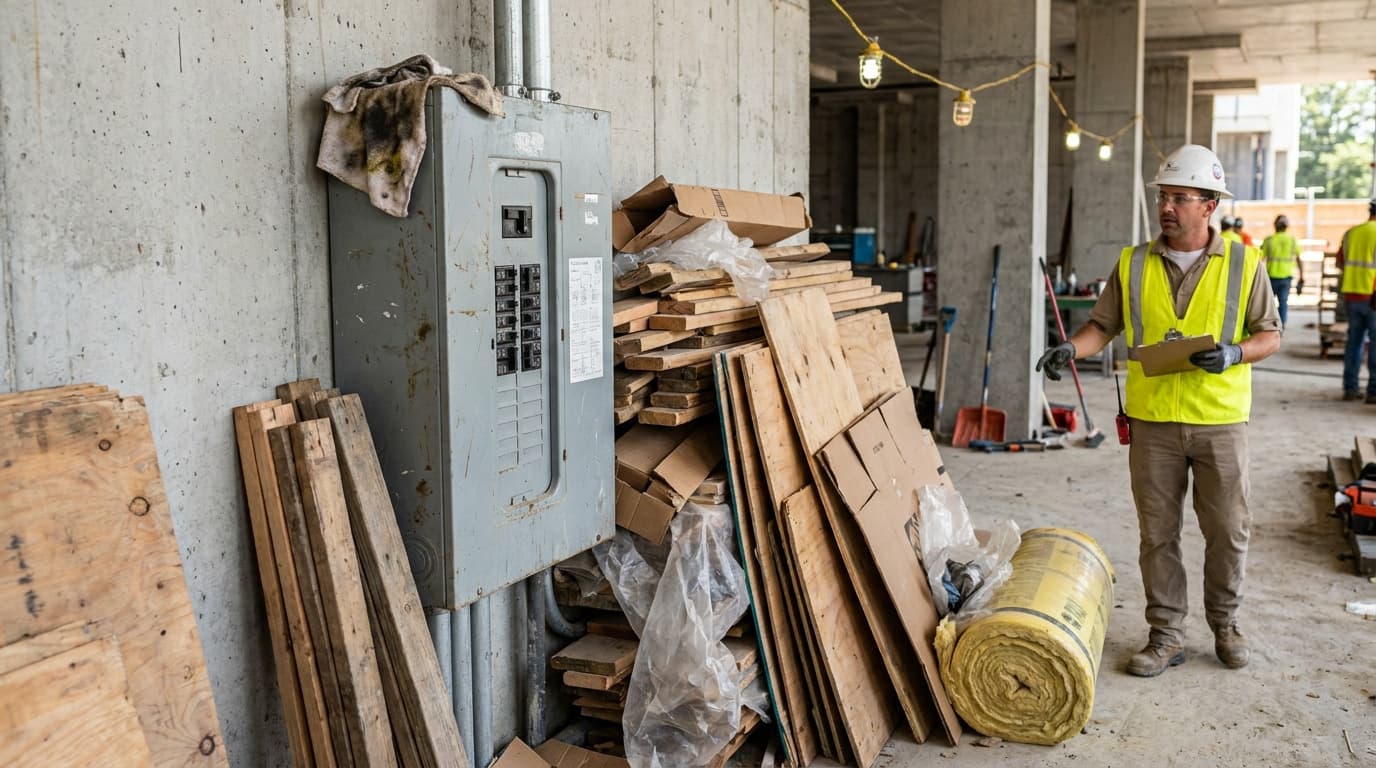
(e)(1)(v) — Arcing or suddenly moving parts. Fuses and circuit breakers shall be so located or shielded that employees will not be burned or otherwise injured by their operation.
That is the regulation telling you plainly that a fuse or breaker doing its job can burn the person standing in front of it. It is not a quiet click. Interrupting a fault is a violent event inside the enclosure, and the standard requires location or shielding so that nobody is hurt by it.
(e)(1)(vi)(A) adds the small thing that costs people during an incident: circuit breakers shall clearly indicate whether they are in the open (off) or closed (on) position. An unmarked panel in a smoke-filled container is a panel nobody can use.
Add the temporary-power rules that carry the same logic: branch-circuit conductors protected by overcurrent devices at their ampacity, runs kept clear of physical damage, and no branch-circuit conductor laid on the floor — those belong to the temporary power talk, and they are fire provisions as much as shock provisions.
The code Subpart K points to is from 1984#
1926.402(a) contains a deemed-compliance clause, and its date is worth knowing: if the electrical installation is made in accordance with the National Electrical Code ANSI/NFPA 70-1984, exclusive of Formal Interpretations and Tentative Interim Amendments, it will be deemed to be in compliance with §§1926.403 through 1926.408 — with exceptions.
Two things follow. First, the installation baseline OSHA formally recognises is an edition of the NEC published four decades ago. Modern practice, and most contract specifications, are far ahead of it, which is why "it meets code" and "it meets the current code" are not the same statement.
Second — and this is the interesting part — look at what OSHA carved out of that deemed compliance:
- §1926.404(b)(1) — ground-fault protection: the GFCI or assured equipment grounding conductor program choice.
- §1926.405(a)(2)(ii)(E) — all lamps for general illumination protected from accidental contact or breakage; metal-case sockets grounded.
- §1926.405(a)(2)(ii)(F) — temporary lights not suspended by their electric cords.
- §1926.405(a)(2)(ii)(G) — portable lighting in wet or conductive locations at 12 volts or less, or 120 volts with ground-fault protection.
- §1926.405(a)(2)(ii)(J) — extension cord sets of the three-wire type, designed for hard or extra-hard usage.
Those four temporary-power provisions and the ground-fault rule are the ones OSHA would not let a code edition satisfy on its behalf. They are, in other words, the provisions the agency considered too important to delegate — and three of the four are about lamps and cords, the two things most likely to start a fire on a construction site.
Where jobsite electrical fires actually start#
Cords used as fixed wiring. 1926.405(g)(1)(iii) prohibits flexible cords and cables, unless necessary for a permitted use, from being used as a substitute for the fixed wiring of a structure, run through holes in walls, ceilings or floors, run through doorways or windows except as permitted, attached to building surfaces, or concealed behind walls, ceilings or floors. Every one of those puts a cord somewhere a fault cannot be seen and heat cannot escape.
Damaged and repaired cords. A nicked jacket, a taped splice, a strained plug. Flexible cords are required to be used in continuous lengths without splice or tap, with the narrow exception for hard service cords No. 12 or larger repaired so the splice retains the insulation, sheath properties and usage characteristics of the cord.
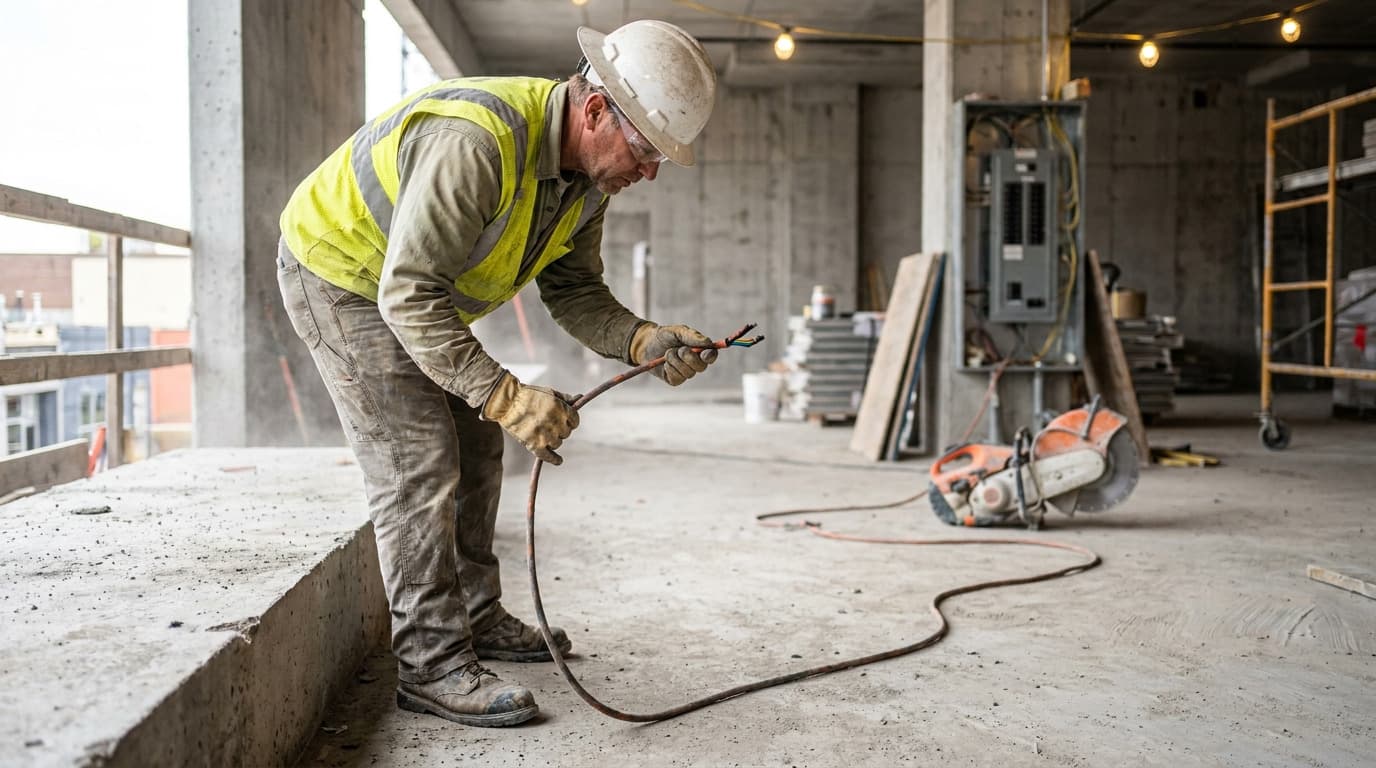
Loose terminations. The most common origin of all. Heat at a loose screw is invisible until the insulation chars.
Overloaded circuits and upsized protection. A breaker that keeps tripping gets replaced with a bigger one, and the conductor is now protected above its ampacity — the exact condition overcurrent protection exists to prevent.
Coiled cords under load. A reel run at full current without unwinding cannot shed its heat.
Temporary heaters and drying equipment on cord sets that were never rated for continuous full load.
Charging left running unattended overnight in a closed container — covered in the battery charging talk, and one of the fastest-growing causes of site fires.
How do we prevent them?#
Clear the space around every panel and breaker. Nothing easily ignitible in the vicinity, nothing stacked against the enclosure, and the device readily accessible — all three come straight out of (e)(1)(iv).
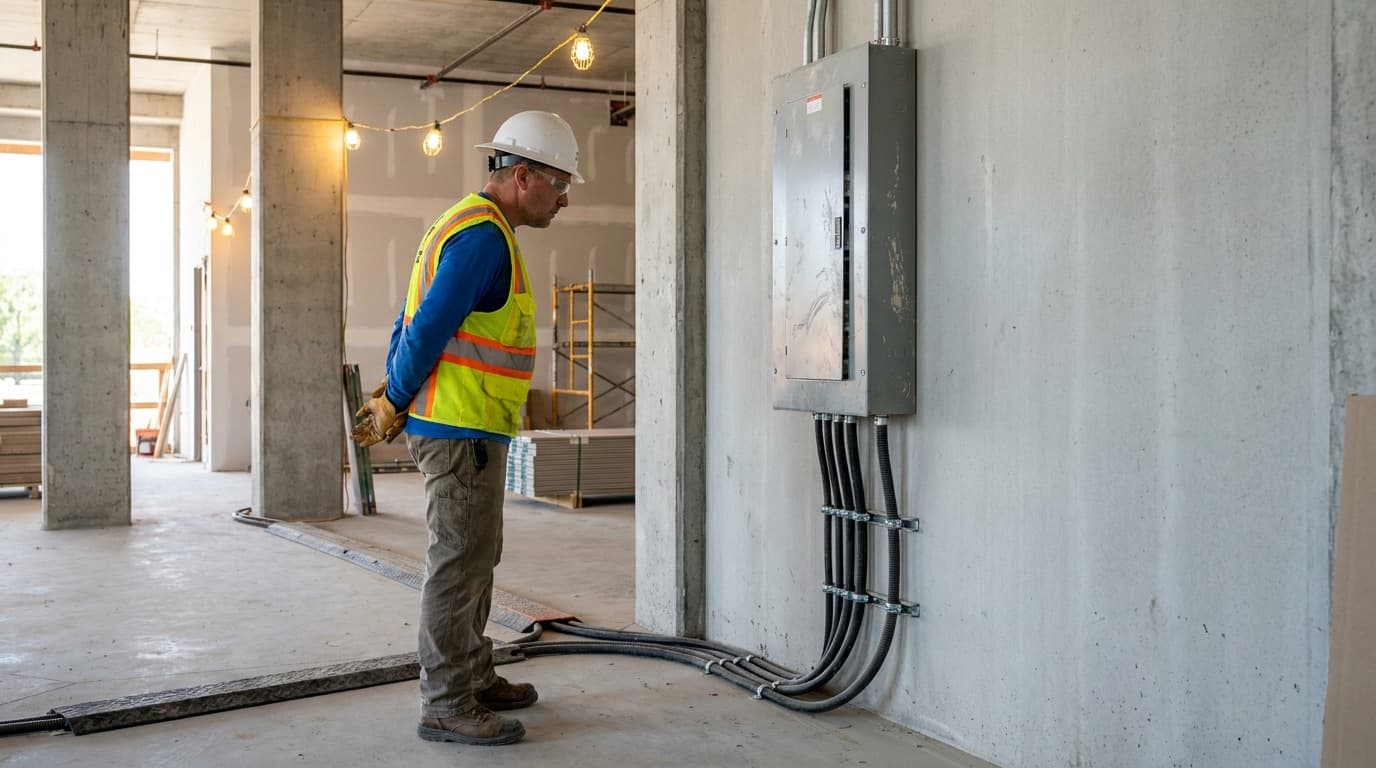
Never upsize protection to stop nuisance tripping. A device that trips repeatedly is reporting a real condition. Find the load or the fault.
Match the cord to the job. Three-wire, hard or extra-hard usage, correct current rating, fully unwound when loaded, and never used as fixed wiring.
Inspect terminations and connections, not just the middle of the cord. Warmth at a plug, discoloured pins, a smell of hot plastic — all are pre-fire indications, and all mean out of service.
Keep the panel legible. Circuit breakers clearly showing open or closed, circuits identified, and a route to the disconnect that stays clear.
Stand to the side when operating a breaker, and never operate one you have reason to believe is faulted into. The standard's own concern in (e)(1)(v) is that people get burned by these devices operating.
Have the right extinguisher and the right instinct — de-energise if you can, and use an agent rated for energised electrical equipment, covered in the fire extinguisher talk.
Before you start#
- Confirm the panel or distribution board you are working from is clear of ignitible material and readily accessible.
- Confirm nothing is stored on, against or under the enclosure.
- Confirm your cord sets are three-wire, hard usage, undamaged, and not routed through a doorway or hole without protection.
- Confirm no cord you will use is coiled on a drum while carrying a heavy load.
- Confirm no protective device on your circuit has been upsized or bypassed.
- Confirm you can identify the disconnect for the circuit, and that its position is legible.
Talk it over#
- What is stacked around our main temporary panel right now?
- Has anyone changed a breaker because it kept tripping? What was actually causing it?
- Where on this site is a cord doing the job of fixed wiring?
- If a panel caught fire during the night, what would burn next?
The bottom line#
Electrical fires are heat at a bad connection, and Subpart K's fire controls are mostly about where things are put. 1926.404(e)(1)(iv) requires overcurrent devices to be readily accessible and not located in the vicinity of easily ignitible material. (e)(1)(v) requires fuses and breakers to be located or shielded so employees are not burned by their operation — the standard's own acknowledgement that these devices operate violently. (e)(1)(vi)(A) requires breakers to indicate open or closed clearly. And 1926.402(a) deems compliance through the 1984 edition of the NEC while carving out ground-fault protection and four temporary-lighting and cord provisions — the ones OSHA would not delegate, three of which are about the lamps and cords that start the fires.
Frequently asked questions about electrical fire prevention#
What causes most electrical fires on construction sites?
Heat at a poor connection, and conductors carrying more current than they can safely handle. Loose terminations, damaged or repaired cords, coiled cords under load, and circuits whose overcurrent protection has been upsized to stop nuisance tripping account for a large share. The insulation chars long before anything visible happens.
What does OSHA say about where breaker panels can be located?
1926.404(e)(1)(iv) requires overcurrent devices to be readily accessible and states they shall not be located where they could create an employee safety hazard by being exposed to physical damage or located in the vicinity of easily ignitible material. Storing timber, packaging, rags or fuel around a temporary panel is contrary to that provision.
Can a circuit breaker injure the person operating it?
Yes, and the standard says so. 1926.404(e)(1)(v) requires fuses and circuit breakers to be so located or shielded that employees will not be burned or otherwise injured by their operation. Interrupting a fault is a violent event inside the enclosure, which is why location or shielding is a requirement rather than a courtesy.
Is it acceptable to fit a larger breaker if one keeps tripping?
No. Overcurrent protection is sized to the conductor's ability to carry current safely. Fitting a larger device leaves the conductor protected above its ampacity, which is the precise condition that leads to overheating and fire. Repeated tripping is information — find the overload or the fault.
What does Subpart K say about extension cords and fire?
1926.405(g)(1)(iii) prohibits flexible cords, unless necessary for a permitted use, from being used as a substitute for fixed wiring, run through holes in walls, ceilings or floors, run through doorways or windows other than as permitted, attached to building surfaces, or concealed behind walls, ceilings or floors. 1926.405(a)(2)(ii)(J) requires cord sets used with portable tools to be of the three-wire type, designed for hard or extra-hard usage.
Does complying with the National Electrical Code satisfy OSHA?
Partly, and the edition matters. 1926.402(a) provides that an installation made in accordance with ANSI/NFPA 70-1984, exclusive of Formal Interpretations and Tentative Interim Amendments, is deemed to comply with §§1926.403 through 1926.408 — except §1926.404(b)(1) and §1926.405(a)(2)(ii)(E), (F), (G) and (J). Those exceptions cover ground-fault protection, lamp guarding, suspension of temporary lights, low-voltage lighting in wet locations, and hard-usage cord sets.
Should I use water on an electrical fire?
Not on energised equipment. De-energise if it can be done safely, and use an agent rated for energised electrical equipment — the rating means the agent is non-conductive, not that the electricity has stopped being dangerous. Extinguisher selection and the classes are covered in the fire extinguisher talk.
Download the electrical fire prevention toolbox talk PDF#
Get this electrical fire prevention toolbox talk as a print-ready PDF — available in English, Spanish, Portuguese, and Turkish. Print it, hand it to the crew, and collect signatures on the included attendance sheet.
Download the PDF — free account required. New members get 3 free downloads.
Related toolbox talks#
Sources#
- OSHA, 29 CFR 1926.404 — Wiring design and protection: https://www.osha.gov/laws-regs/regulations/standardnumber/1926/1926.404
- OSHA, 29 CFR 1926.405 — Wiring methods, components, and equipment for general use: https://www.osha.gov/laws-regs/regulations/standardnumber/1926/1926.405
- OSHA, 29 CFR 1926.402 — Applicability (Subpart K): https://www.osha.gov/laws-regs/regulations/standardnumber/1926/1926.402
Written by FieldSafetyTalk's safety professional — a CSP, ASP, CHST and OSHA Authorized Outreach Trainer with 14+ years of international construction safety experience across federal, heavy civil, and industrial projects.