Manual Handling
Updated 2026-07-23
In this bundle Manual Handling & Body Mechanics
Print-ready PDF
Download this talk as a print-ready PDF, available in 4 languages.
Nobody gets carried off a site because of one bad lift. That is exactly what makes manual handling different from every other hazard we talk about. There is no moment where the injury announces itself — no fall, no arc, no machine catching a sleeve. Instead there are ten thousand lifts over fifteen years, and one ordinary morning your back does not work anymore. This Manual Handling Toolbox Talk (Safety Talk / Tailgate Talk) is about the injury that arrives slowly and stays permanently.
Here is the distinction that carries this whole talk: every other hazard on this site is an event. You either got hit or you did not. Manual handling injuries are cumulative — the damage accrues invisibly across years of loads that each felt manageable at the time. That changes what prevention means. You cannot recognize the dangerous lift by how it feels, because the dangerous lift feels exactly like the thousand that came before it. What protects you is not judgement in the moment, but eliminating the handling entirely wherever possible, and applying the same technique every time when it is not.
How dangerous is manual handling in construction?#
Manual handling injuries do not kill people, so the numbers get less attention than falls. They also affect far more workers. According to CPWR, the Center for Construction Research and Training, 33,200 construction workers had days away from work due to musculoskeletal disorders during 2021–2022 (CPWR Data Bulletin, June 2025, from BLS Survey of Occupational Injuries and Illnesses).
The picture that should concern you is the severity and the persistence:
- Musculoskeletal disorders cost the U.S. construction industry over $700 million in 2023 (CPWR, June 2025).
- Construction workers with an MSD had a median of 15 days away from work, compared with 11 days for all nonfatal construction injuries — these injuries keep people off longer than most (CPWR, June 2025).
- Specialty Trade Contractors had the highest MSD rate of any construction subsector at 28.4 per 10,000 full-time equivalent workers — nearly twice the rate of building construction and heavy civil (CPWR, June 2025).
- 40.5 percent of construction workers who suffered a work-related repetitive strain injury limited their activities for at least 24 hours, compared with 31.7 percent of workers in all other industries (CPWR, June 2025, from CDC National Health Interview Survey 2023).
- 15.2 percent of construction workers reported a lot of back pain in 2023, rising to 17.5 percent among workers aged 50 and over (CPWR, June 2025).
The exposure is close to universal. According to NIOSH research, nearly 90 percent of construction jobs require manual handling of materials for approximately half of the worker's time (Kaur et al., MMWR, 2021).
There is genuine good news in the trend: MSDs in private construction fell 21.1 percent between 2011 and 2022, and the rate dropped 42.8 percent (CPWR, June 2025). Planning and mechanical aids work. The remaining injuries are largely the ones where planning did not happen.
OSHA manual handling requirements#
There is no single OSHA lifting standard, and no legal maximum weight a worker may lift in the United States. The requirements sit in general duty and materials handling provisions:
- Hazard identification — 1926.20(b)(2). Employers must initiate and maintain accident prevention programs providing for frequent and regular inspections of the job site, materials, and equipment by a competent person.
- Training — 1926.21(b)(2). The employer must instruct each employee in the recognition and avoidance of unsafe conditions applicable to the work environment.
- Material storage — 1926.250(a)(1). Material stored in tiers must be stacked, racked, blocked, interlocked, or otherwise secured to prevent sliding, falling, or collapse.
- Aisles and passageways — 1926.250(a)(3). Aisles and passageways must be kept clear and in good repair, with no obstruction that could create a hazard.
- Housekeeping — 1926.250(b). Storage areas must be kept free from accumulation of materials that constitute hazards from tripping, fire, explosion, or pest harbourage.
The General Duty Clause, Section 5(a)(1) of the OSH Act, requires employers to furnish a workplace free from recognized hazards likely to cause death or serious physical harm — and OSHA has used it to cite ergonomic hazards where a recognized hazard existed and a feasible means of abatement was available.
On USACE and NAVFAC projects, EM 385-1-1 applies and contains more prescriptive manual handling guidance.
What can go wrong?#
The load is only one factor, and rarely the deciding one. Crews focus on weight because it is the visible variable. The research points elsewhere. NIOSH analysis found that in 2015, overexertion from lifting and lowering caused 30 percent of construction musculoskeletal disorders, while pushing, pulling, holding, carrying, and catching caused a further 37 percent (Kaur et al., MMWR, 2021). More injuries come from moving a load than from picking it up.
Posture multiplies the load. A weight held at arm's length imposes several times the spinal compression of the same weight held close. Bending and twisting under load is the single most damaging combination, because it loads the spine asymmetrically at its weakest orientation.
Repetition without recovery. The same modest load, lifted repeatedly across a shift with no variation and no recovery time, produces cumulative damage that a single heavy lift would not.
The awkward load rather than the heavy one. Sheet material, long pipe, unbalanced units, and anything without a decent handhold force the body into positions where technique becomes impossible.
Environmental factors nobody counts:
- Poor footing — mud, ice, uneven ground, debris underfoot
- Restricted space forcing a twisted or stooped posture
- Carrying while climbing stairs or a ladder
- Cold, which reduces tissue elasticity, and heat, which accelerates fatigue
- Poor lighting hiding an obstacle in the carry path
Fatigue at the end of the shift. Technique degrades as people tire, and the last loads of the day are lifted with the worst mechanics.
Team lifts without coordination. Two people lifting on different counts, at different speeds, or with unequal shares transfers the whole load unpredictably to one person.
How do we prevent manual handling injuries?#
Eliminate the lift first. This is the only control that works completely, and it is consistently underused:
- Order materials in smaller units or pre-cut lengths
- Have deliveries placed at the point of use, not at the gate
- Use mechanical aids — forklifts, hoists, carts, dollies, pallet jacks, vacuum lifters, pipe carts
- Raise the work rather than bending to it, using benches, trestles, or adjustable stands
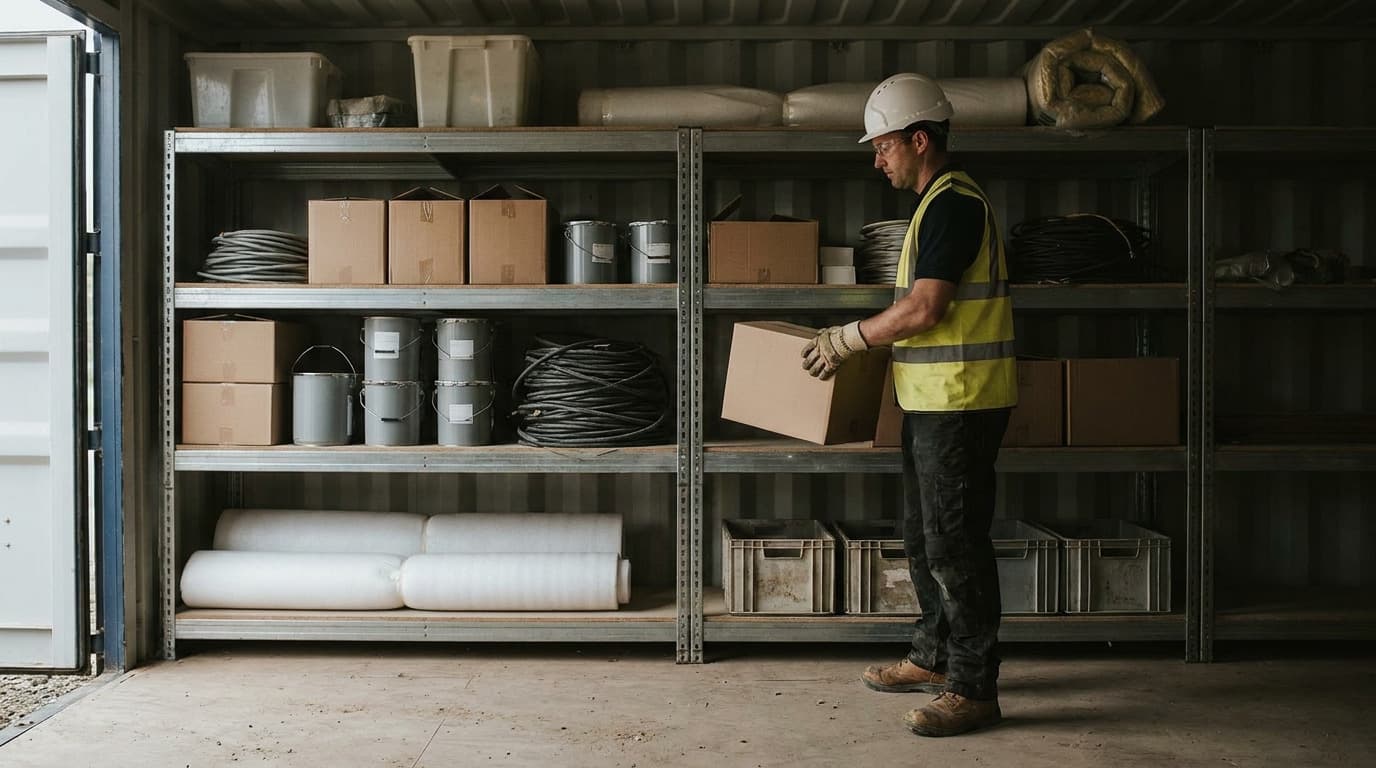
- Store materials between knee and shoulder height so no lift starts from the floor or ends overhead
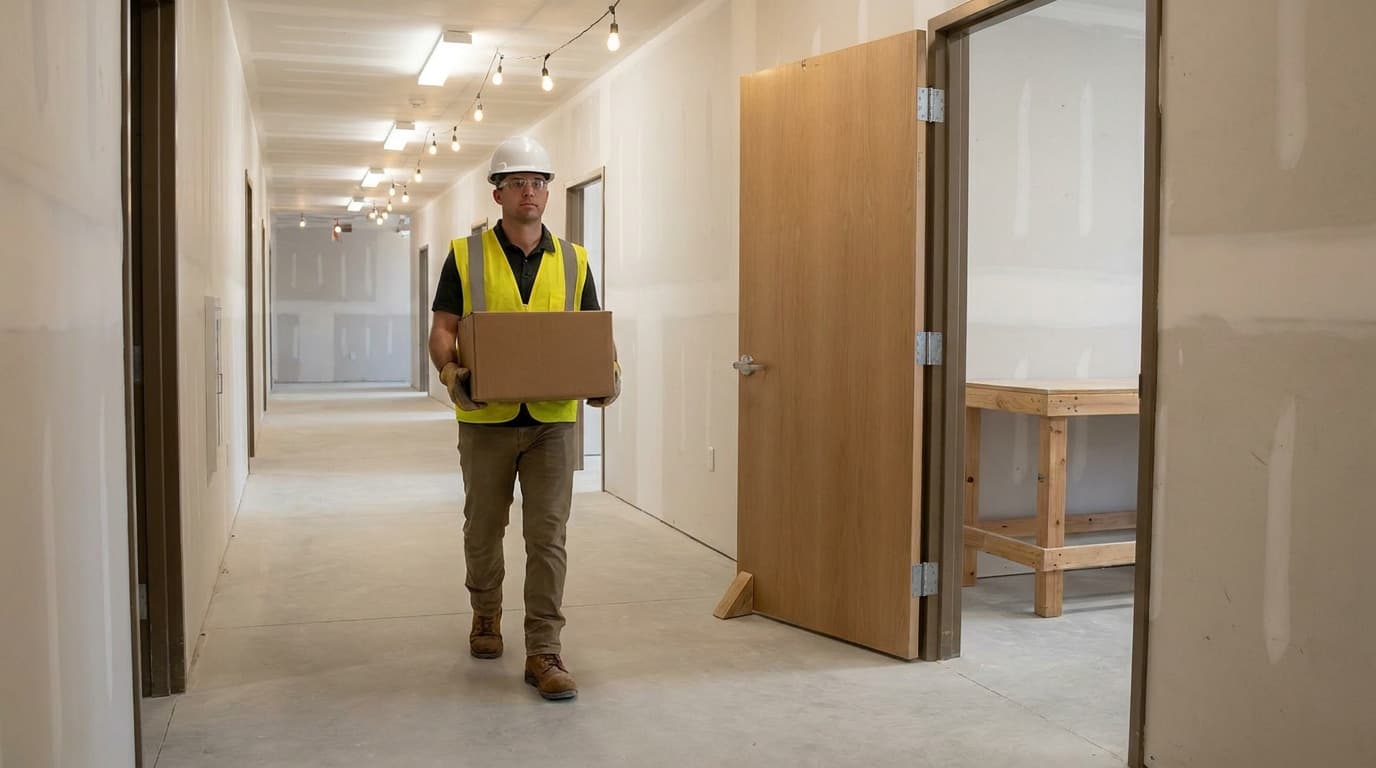
Plan the lift before you touch the load. Test the weight by tipping a corner. Check the route for obstructions, changes in level, and doors. Know where you are setting it down — and confirm that space is clear before you pick up.
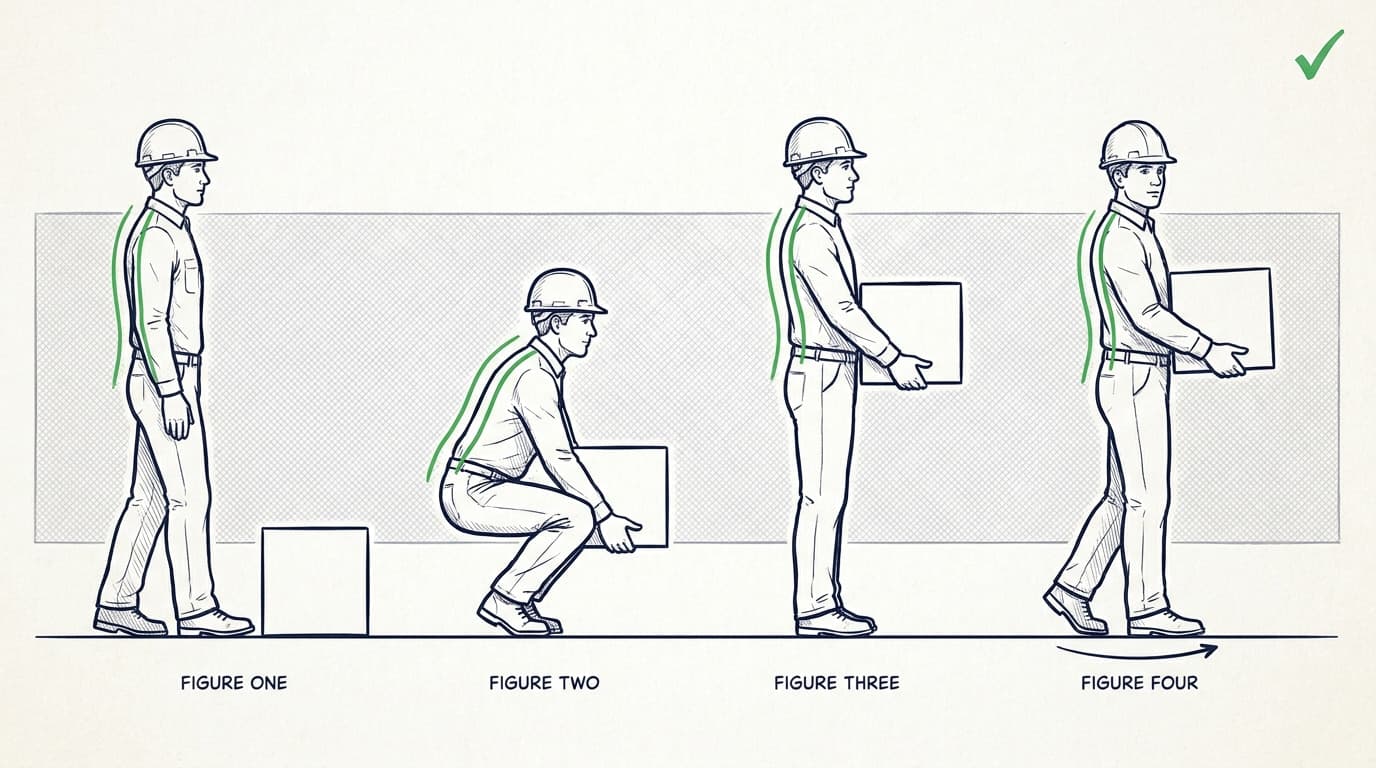
Use the technique every time, not just on heavy loads:
- Feet shoulder-width apart, one slightly forward for balance
- Bend the knees and hips, not the back — keep the natural curve of the spine
- Get a secure grip, using the palms rather than fingertips
- Hold the load close to the body, at around waist height
- Lift smoothly by straightening the legs — no jerking
- Turn with the feet, never twist the torso under load
- Set down using the same mechanics, and let go only when the load is fully supported
Coordinate every team lift. One person calls it. Agree the route, the destination, and the signal before lifting. Match people of similar height where possible. Nobody changes grip or speed without saying so.
Rotate tasks and build in recovery. Repetitive handling is a cumulative exposure, so vary the work across the shift and between workers where the job allows. Recovery time is a control, not a luxury.
Speak up early. Aching, tingling, numbness, or stiffness that persists after a shift is the early stage of an MSD, not normal tiredness. Reported early, most are recoverable. Worked through for months, many are not.
Before you start#
- Ask whether this load needs to be moved by hand at all, or whether a mechanical aid is available.
- Check the weight by tipping a corner before committing to the lift.
- Walk the route: obstructions, level changes, doorways, footing, and lighting.
- Confirm where the load is going and that the space is clear before you pick it up.
- Check your footing — mud, ice, debris, or uneven ground changes the whole calculation.
- For a team lift, agree who calls it, the route, and the signal before anyone bends down.
- Confirm materials are stored between knee and shoulder height where possible.
- Consider the cumulative load of the whole shift, not just this one lift.
Talk it over#
- What is the heaviest or most awkward thing we will move by hand today, and is there a mechanical aid that could do it instead?
- Who here has ongoing back, shoulder, or knee pain from this work? What task made it worse?
- Look at where our materials are stacked. How many lifts today will start from ground level, and could that be changed?
The bottom line#
Manual handling is the hazard with no single moment of injury — the damage accumulates across thousands of lifts that each felt manageable, and it keeps construction workers off the job longer than most injuries. You cannot feel the dangerous lift coming, so judgement in the moment will not protect you. Eliminate the handling wherever possible with mechanical aids and better material placement, store loads between knee and shoulder height, use the same technique every time regardless of weight, and report the early aches while they are still recoverable.
Frequently asked questions about manual handling#
What is the maximum weight a worker can lift under OSHA?
OSHA does not set a maximum lifting weight in the United States. There is no legal limit. Safe capacity depends on the load's size and shape, the posture required, how far it is carried, how often it is repeated, and the individual worker. The NIOSH Lifting Equation is the recognized tool for evaluating a specific lifting task.
How many construction workers suffer musculoskeletal disorders?
33,200 construction workers had days away from work due to musculoskeletal disorders during 2021–2022 (CPWR Data Bulletin, June 2025, from BLS data). These injuries cost the U.S. construction industry over $700 million in 2023, and construction workers averaged a median of 15 days away from work — more than the 11-day median for all nonfatal construction injuries.
What causes most manual handling injuries — lifting or carrying?
Carrying and moving, not lifting. NIOSH research found that pushing, pulling, holding, carrying, and catching caused 37 percent of construction musculoskeletal disorders in 2015, while lifting and lowering caused 30 percent (Kaur et al., MMWR, 2021). Planning the route and the destination matters as much as the technique used to pick the load up.
What is the correct technique for lifting?
Feet shoulder-width apart, bend the knees and hips rather than the back, keep the natural curve of the spine, grip with the palms, hold the load close to the body at around waist height, lift smoothly by straightening the legs, and turn with your feet rather than twisting your torso. Bending combined with twisting under load is the most damaging combination.
Which construction trades are most at risk?
Specialty Trade Contractors had the highest musculoskeletal disorder rate of any construction subsector at 28.4 per 10,000 full-time equivalent workers during 2021–2022 — nearly twice the rate of building construction (16.4) and heavy and civil engineering (15.3), according to CPWR's June 2025 Data Bulletin.
When should I report aching or stiffness?
Early. Persistent aching, tingling, numbness, or stiffness that does not resolve after a shift is the early stage of a musculoskeletal disorder, not ordinary tiredness. Reported early, most of these conditions are recoverable with modified duties. Worked through for months, many become permanent.
Download the manual handling toolbox talk PDF#
Get this manual handling toolbox talk as a print-ready PDF — available in English, Spanish, Portuguese, and Turkish. Print it, hand it to the crew, and collect signatures on the included attendance sheet.
Download the PDF — free account required. New members get 3 free downloads.
Related toolbox talks#
Sources#
- CPWR, Musculoskeletal Disorder (MSD) Trends in Construction, Data Bulletin June 2025: https://www.cpwr.com/wp-content/uploads/DataBulletin-June2025.pdf
- Kaur H, et al., Workers' Compensation Claim Rates and Costs for Musculoskeletal Disorders Related to Overexertion Among Construction Workers — Ohio, 2007–2017, MMWR 2021: https://www.cdc.gov/mmwr/volumes/70/wr/mm7016a1.htm
- OSHA, 29 CFR 1926 Subpart G — Materials Handling, Storage, Use, and Disposal: https://www.osha.gov/laws-regs/regulations/standardnumber/1926
- Bureau of Labor Statistics, Survey of Occupational Injuries and Illnesses: https://www.bls.gov/iif/
Written by FieldSafetyTalk's safety professional — a CSP, ASP, CHST and OSHA Authorized Outreach Trainer with 14+ years of international construction safety experience across federal, heavy civil, and industrial projects.