Flagging & Signaling Safety
Updated 2026-08-06
In this bundle Vehicle Safety
Working in Washington? See the WA DOSH edition → Washington (WA DOSH)
Print-ready PDF
Download this talk as a print-ready PDF, available in 4 languages.
Flagging is one of the most dangerous jobs on any construction site that touches a live road, and it is dangerous in a way that is easy to miss because it looks so simple — a person, a sign, some traffic. But look closer at what is actually happening. Every other tool used to control traffic around a work zone is an object: cones, barrels, barricades, signs, arrow boards. They are placed in harm's way precisely so that a person does not have to stand there. The flagger is the exception. The flagger is a human being deliberately positioned in the path of moving traffic, using nothing but a hand-held paddle and high-visibility clothing to command two-ton vehicles driven by strangers who may be distracted, speeding, drowsy, or impaired. This Flagging & Signaling Safety Toolbox Talk (Safety Talk / Tailgate Talk) is about protecting the one worker whose safety device is their own body.
Here is the distinction that carries this whole talk: a flagger is the one safety control that's a human being — every other traffic device is an object you put in harm's way so a person doesn't have to stand there, but a flagger is a person standing there on purpose, protecting the whole crew by being the most exposed worker on the site, armed with nothing but a paddle, high-visibility clothing, and an escape route. That framing changes how you think about flagger safety. A barricade does not need an escape route, because if a car hits it, the barricade is what gets destroyed — that is its job. A flagger has no such luxury. There is no barrier between the flagger and the traffic; the flagger is the barrier, the human layer that stops and releases vehicles so the crew behind can work. So everything about protecting a flagger is built on one assumption: that sooner or later, a driver will fail to see them or fail to stop, and the flagger has to survive that moment. Their protection is not a wall. It is position, visibility, standardized signals, and a way out.
Where the boundary of this talk sits#
Flagging connects to a few other talks, and this one owns the flagger's own exposure. The struck-by talk owns being hit by vehicles and equipment in general. The spotter talk owns the ground worker who guides a backing machine and stands in its danger zone. The distracted driving talk owns the driver's side of the problem. This talk owns the flagger specifically: a worker whose job is to stand in traffic and control it, whose only protection is visibility, position, standardized signals, and an escape route, and whose signaling must conform to a national standard so every driver understands it instantly. Where the hazard is a general struck-by, a spotter guiding equipment, or a distracted driver, those talks own the detail; this one owns the person deliberately placed in the roadway to protect everyone else.
The signals have to be a language everyone already speaks#
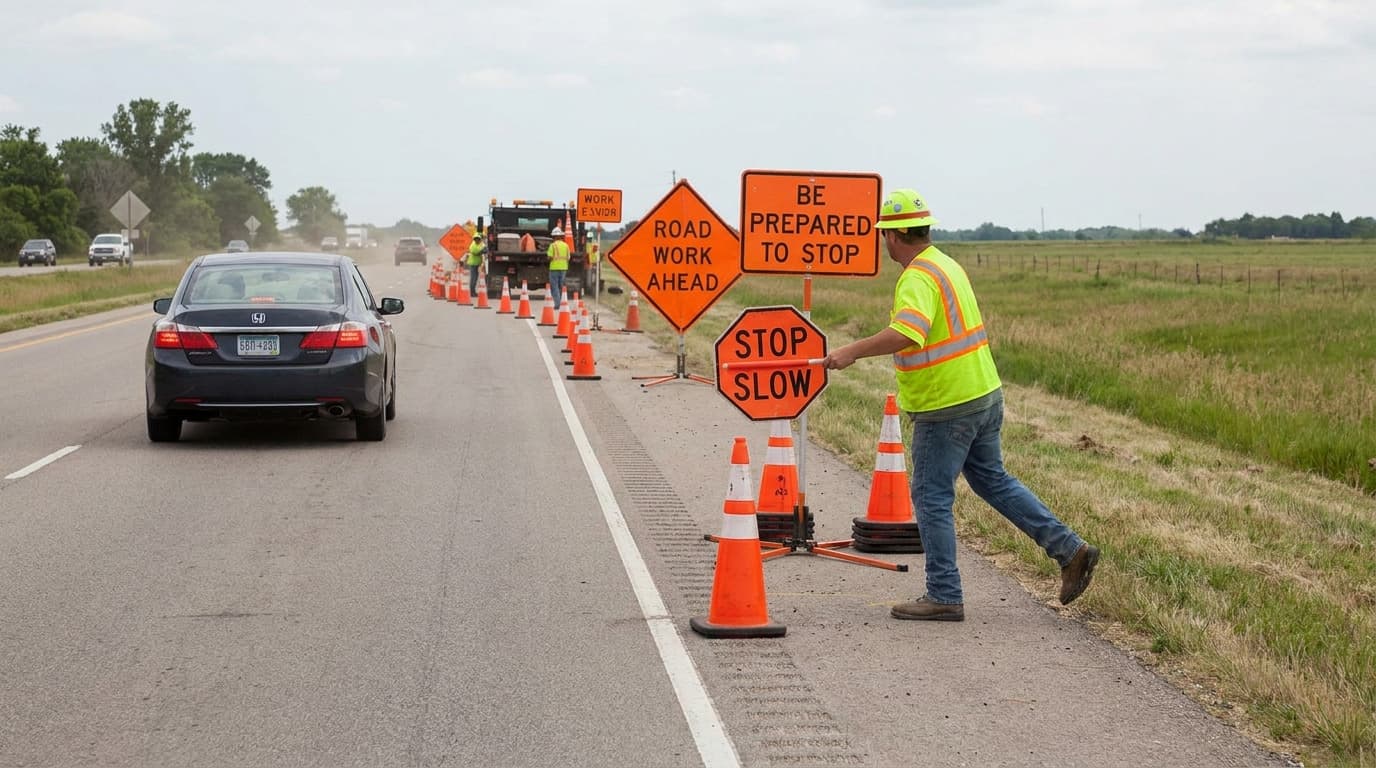
A flagger only works if every approaching driver understands the signal instantly, without thinking — which is why flagging is not improvised. In the United States, signaling by flaggers and the warning garments they wear must conform to Part 6 of the Manual on Uniform Traffic Control Devices, the MUTCD. That is not a suggestion; it is what the OSHA standard requires by reference. The primary tool is the STOP/SLOW paddle, held and displayed in the standardized way, because a paddle gives a clear, universally understood signal that works in all lighting. A hand-held flag is limited to specific, usually emergency circumstances. The reason for all this standardization is simple: a driver approaching at speed has a second or two to recognize the signal and react, and there is no time for a novel gesture or an unclear sign. The signals must be a language every driver already speaks, delivered exactly as the manual describes, so recognition is instant and the same everywhere.
Visibility is the flagger's first line of defense#
If a flagger's protection is being seen, then being conspicuous is not optional — it is the whole first layer of defense. Flaggers must wear high-visibility warning garments conforming to the MUTCD, which references the ANSI/ISEA 107 standard for high-visibility apparel: a Class 2 garment at minimum for most work zones, and Class 3 for high-speed roadways, complex traffic control, or night work, where the greater amount of fluorescent background and retroreflective material makes the flagger visible sooner and from farther away. But the garment is only half of it. A flagger can be wearing perfect apparel and still be invisible at the moment it matters, which is why the position matters as much as the clothing. A flagger must never stand in shade where they disappear against a dark background, never stand in a group where a driver cannot tell who is signaling, never stand where a parked vehicle or equipment blocks the driver's view of them, and never stand just around a curve where a driver has no time to react after seeing them. Being seen early and clearly is what buys the flagger the seconds they need.
Never turn your back on what can kill you#
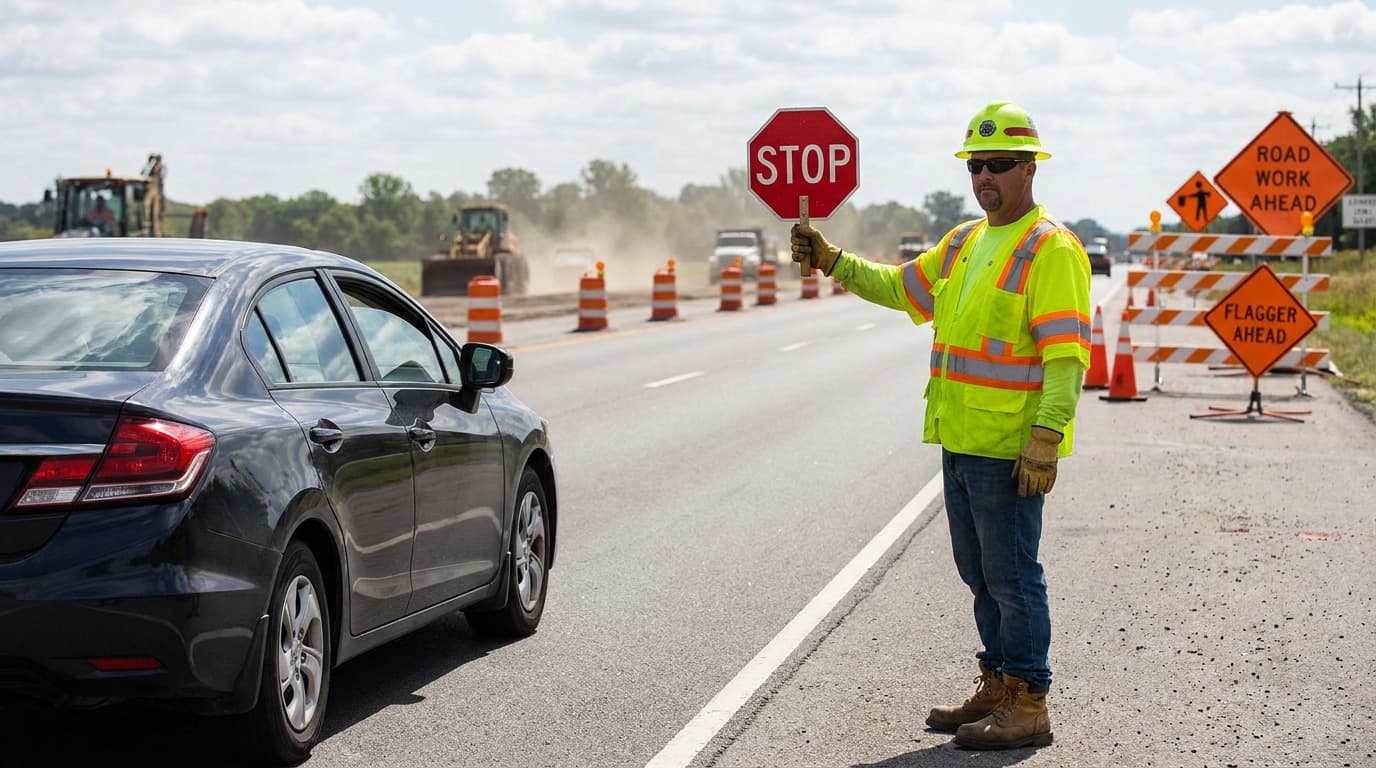
The single most important habit for a flagger is to keep facing the traffic they are controlling. A flagger who turns their back on approaching vehicles — to talk to a coworker, check on the work behind them, or look at their phone — has given up the one thing that lets them react: seeing the threat coming. The training materials are blunt about the behaviors that get flaggers killed, and they are all variations on losing awareness of the traffic: turning your back to approaching vehicles, making unnecessary conversation, daydreaming, reading, or listening to music through earphones. A flagger's attention belongs on the traffic they are controlling, continuously, because the entire value of a human flagger over an automated signal is judgment and reaction — and both require watching. The moment a flagger stops watching the road, they are no safer than the cone next to them, and far more fragile.
The escape route is planned before you take the position#
Because the working assumption is that a vehicle will eventually fail to stop, a flagger needs a planned escape route before they ever take their position — a direction they can move fast and a place they can get to that is out of the path of an out-of-control vehicle. This is not pessimism; it is the same logic as knowing where the exits are before you need them. The flagger picks a station that has somewhere to go — not backed against a barrier, a drop-off, or a wall — and keeps that escape path clear and in mind the whole time. When a vehicle does not slow, the flagger who has already decided where to go can be moving in the fraction of a second available; the flagger who has not is still deciding when it is too late. Alongside the escape route, the standardized traffic control plan for the work zone — the advance warning signs, the tapers that guide vehicles over, the buffer space — is what is supposed to slow traffic down before it ever reaches the flagger, so the flagger is the last layer of protection, not the first.
Where the duty sits#
The construction requirement lives in 1926.201(a), which states that signaling by flaggers and the warning garments worn by flaggers must conform to Part 6 of the MUTCD, incorporated by reference. OSHA does not have a separate, standalone flagging standard with its own detailed rules — it adopts the MUTCD, so the MUTCD is the real rulebook for how flaggers signal, what devices they use, and what they wear. Related provisions in Subpart G cover signs at 1926.200 and barricades that channel traffic at 1926.202. High-visibility apparel traces through the MUTCD to the ANSI/ISEA 107 consensus standard. Training is required under 1926.21(b)(2), and the MUTCD itself calls for flaggers to be trained — including in public contact, because flaggers interact with the driving public more than any other worker on the site. OSHA does not run a certification program; flagger cards come from state DOTs or private programs, and state requirements vary. The General Duty Clause, Section 5(a)(1) covers the recognized struck-by hazard throughout. Where a state DOT, the project's traffic control plan, or the MUTCD sets a specific requirement, that requirement governs.
What can go wrong?#
- A driver fails to see the flagger and does not slow or stop in time.
- The flagger stands in shade, in a group, or behind equipment and is not seen until too late.
- The flagger is positioned just past a curve, giving drivers no time to react.
- The flagger turns their back to traffic to talk, read, or check a phone.
- The flagger has no planned escape route and nowhere to go when a vehicle doesn't stop.
- Non-standard or improvised signals leave a driver unsure what to do.
- The flagger wears the wrong class of high-visibility apparel for the speed or for night work.
- Advance warning signs and tapers are missing, so traffic reaches the flagger at full speed.
How do we manage this properly?#
- Use only standardized MUTCD signals — the STOP/SLOW paddle, held and displayed correctly.
- Wear high-visibility apparel of the right class — Class 2 minimum, Class 3 for high-speed or night.
- Never turn your back on approaching traffic — attention stays on the road, continuously.
- Stand where you're seen early and clearly — not in shade, in a group, behind equipment, or past a curve.
- Plan an escape route before taking your position, and keep it clear and in mind.
- No phones, earphones, reading, or unnecessary conversation while flagging.
- Make sure advance signs, tapers, and buffer space slow traffic before it reaches you.
- Confirm the flagger is trained and the work zone follows the traffic control plan.
Before you start#
- Confirm the flagger is trained and knows the MUTCD signals for this work zone.
- Confirm the STOP/SLOW paddle is on hand and in good condition.
- Confirm high-visibility apparel is the right class for the road speed and lighting.
- Confirm the flagger's station lets drivers see them early — not in shade, past a curve, or behind equipment.
- Confirm a clear escape route exists from the flagger's position.
- Confirm advance warning signs, tapers, and the traffic control plan are set up ahead of the flagger.
- Confirm the flagger will keep facing traffic and stay off their phone.
- Confirm how the flagger and the crew will communicate during the operation.
Talk it over#
- Who's flagging today, are they trained, and do they have the right paddle and apparel?
- Where exactly is the flagger standing, and can an approaching driver see them early enough?
- What's the flagger's escape route if a vehicle doesn't stop — and is it clear?
- Are the advance signs and tapers up so traffic is already slowing before it reaches the flagger?
The bottom line#
A flagger is the one safety control that's a human being — every other traffic device is an object you put in harm's way so a person doesn't have to stand there, but a flagger is a person standing there on purpose, protecting the whole crew by being the most exposed worker on the site, armed with nothing but a paddle, high-visibility clothing, and an escape route. Because there is no barrier between the flagger and the traffic — the flagger is the barrier — everything protects them on the assumption a driver will eventually fail. Their signals must be the standardized MUTCD language every driver already understands, delivered with the STOP/SLOW paddle. Their high-visibility apparel must be the right class, and they must stand where they are seen early — never in shade, a group, behind equipment, or past a curve. They must never turn their back on the traffic, and they must have an escape route planned before they take the position. It all lives in 1926.201(a), which adopts Part 6 of the MUTCD by reference, with apparel through ANSI/ISEA 107. The question to carry is the one the flagger's life depends on: if the next driver doesn't stop, will I see them coming, and do I already know exactly where I'm going?
Frequently asked questions about flagging and signaling#
Why is flagging considered so dangerous?
Because the flagger is the only traffic-control device that is a living person. Every other tool — cones, barrels, barricades, signs, arrow boards — is an object placed in the road so a human does not have to be there; if a vehicle hits it, the object is what gets destroyed. The flagger has no such protection. They stand directly in the path of moving traffic, with nothing between them and the vehicles but their own visibility and judgment, controlling drivers who may be distracted, speeding, drowsy, or impaired. They take on this exposure so the rest of the crew can work behind them in relative safety. That is what makes flagging dangerous in a way that is easy to underestimate: it looks like just holding a sign, but it is actually a person deliberately absorbing the site's highest struck-by risk so that everyone else does not have to.
Why do the signals have to follow a national standard?
Because a driver approaching at speed has only a second or two to recognize the signal and react, and there is no time to interpret something unfamiliar. In the United States, flagger signaling must conform to Part 6 of the MUTCD, which OSHA requires by reference — so the STOP/SLOW paddle, held and displayed in the standardized way, means the same thing on every road in the country. If flaggers improvised their own gestures or used unclear signs, drivers would hesitate, and hesitation at speed is exactly what causes a flagger to be struck. Standardization turns the signal into a language every driver already speaks, so recognition is instant and identical everywhere. That is also why the paddle is preferred over a hand-held flag for most work: it gives a clearer, more universally understood signal that works in all lighting conditions, where a flag can be ambiguous.
What high-visibility clothing does a flagger need?
High-visibility warning garments that conform to the MUTCD, which references the ANSI/ISEA 107 standard — a Class 2 garment at minimum for most work zones, and Class 3 for high-speed roadways, complex traffic control, or night work. The difference matters: Class 3 has more fluorescent background material and more retroreflective striping, which makes the flagger visible sooner and from farther away, buying critical seconds where traffic is fast or light is poor. But the clothing is only half the protection. A flagger in perfect apparel can still be effectively invisible if they stand in shade against a dark background, stand in a group so a driver cannot tell who is signaling, or stand where equipment blocks the line of sight. So the right class of garment and a position where the flagger is genuinely conspicuous work together — neither one is enough on its own.
Why is turning your back on traffic such a serious mistake?
Because seeing the threat coming is the only thing that lets a flagger react, and turning away throws that away. The entire reason to use a human flagger instead of an automated signal is judgment and reaction — the ability to notice a vehicle that is not slowing and get out of the way. A flagger who turns their back to talk to a coworker, check the work behind them, read, or look at a phone has surrendered that ability and is no safer than a cone, but far more fragile. The training materials list these behaviors plainly as things that get flaggers killed: turning your back to approaching traffic, unnecessary conversation, daydreaming, reading, and listening to music through earphones. A flagger's attention has to stay on the traffic continuously, because the split second they need to escape only exists if they are watching for the vehicle that creates it.
What is an escape route and why does every flagger need one?
An escape route is a pre-planned direction and place a flagger can move to fast if a vehicle does not stop — and every flagger needs one because the entire job is built on the assumption that sooner or later, one won't. Before taking their position, the flagger picks a station that has somewhere to go: not backed against a barrier, a wall, a drop-off, or anything that traps them, but with a clear path out of the way of an out-of-control vehicle. They keep that path clear and in mind the whole time. The value of planning it in advance is time: when a vehicle fails to slow, the flagger who has already decided where to go can move in the fraction of a second available, while the flagger who has not is still deciding when it is too late. The escape route is the flagger's last line of defense, and it only works if it exists before the emergency, not after.
Does the flagger have to be certified?
The flagger has to be trained, and in practice that training is usually documented through a certification card, though the details depend on where you are. OSHA itself does not run a flagger certification program or issue cards; what OSHA requires is that flagging conform to Part 6 of the MUTCD, and the MUTCD says flaggers must be trained — including in public contact, since flaggers interact with the driving public more than any other worker on the site. The actual cards come from state DOTs or private programs, and requirements vary by state: some require a specific state-approved course and card for work on their roads, others rely on the MUTCD's training expectation without naming a course. The important points are that the flagger is genuinely trained in the signals and procedures for the work zone, that the employer has verified it, and that you check the state DOT or project owner's requirements before the work, because a card accepted in one state is not guaranteed to be accepted in another.
Download the flagging & signaling safety toolbox talk PDF#
Get this flagging and signaling safety toolbox talk as a print-ready PDF — available in English, Spanish, Portuguese, and Turkish. Print it, hand it to the crew, and collect signatures on the included attendance sheet.
Download the PDF — free account required. New members get 3 free downloads.
Related toolbox talks#
Sources#
- OSHA, Signaling — 29 CFR 1926.201(a) (signaling by flaggers and the warning garments worn by flaggers shall conform to Part 6 of the Manual on Uniform Traffic Control Devices, incorporated by reference): https://www.osha.gov/laws-regs/regulations/standardnumber/1926/1926.201
- OSHA, Safety Standards for Signs, Signals, and Barricades — Subpart G (1926.200 signs, 1926.201 signaling, 1926.202 barricades; OSHA adopts the MUTCD by reference rather than a standalone flagging standard; STOP/SLOW paddle as the primary hand-signaling device): https://www.osha.gov/laws-regs/regulations/standardnumber/1926/1926.200
- OSHA, Standard interpretation — traffic directing at highway construction areas (Jan 4, 2011) (employers on highway construction sites must comply with the signaling requirements of the MUTCD; flaggers make more contact with the public than any other highway worker and should be trained in traffic control and public contact): https://www.osha.gov/laws-regs/standardinterpretations/2011-01-04
This talk is general awareness guidance for training purposes. It does not replace your employer's traffic control program, OSHA Subpart G, the MUTCD, the project's traffic control plan, state DOT flagger requirements, or a competent person's duties, and it is not legal advice. Where a state DOT, the project traffic control plan, or the MUTCD sets a specific requirement, that requirement governs.
Written by FieldSafetyTalk's safety professional — a CSP, ASP, CHST and OSHA Authorized Outreach Trainer with 14+ years of international construction safety experience across federal, heavy civil, and industrial projects.