Respiratory Protection
Updated 2026-07-28
In this bundle Health & Environmental Exposure
Print-ready PDF
Download this talk as a print-ready PDF, available in 4 languages.
A respirator is the only piece of PPE that can be completely correct and completely useless at the same time. The right model, the right filter, in date, worn all shift — and delivering nothing, because the seal is broken by something nobody looked at. Everything in the respiratory standard exists to close that gap between wearing one and being protected by one. This Respiratory Protection Toolbox Talk (Safety Talk / Tailgate Talk) is about the order it demands.
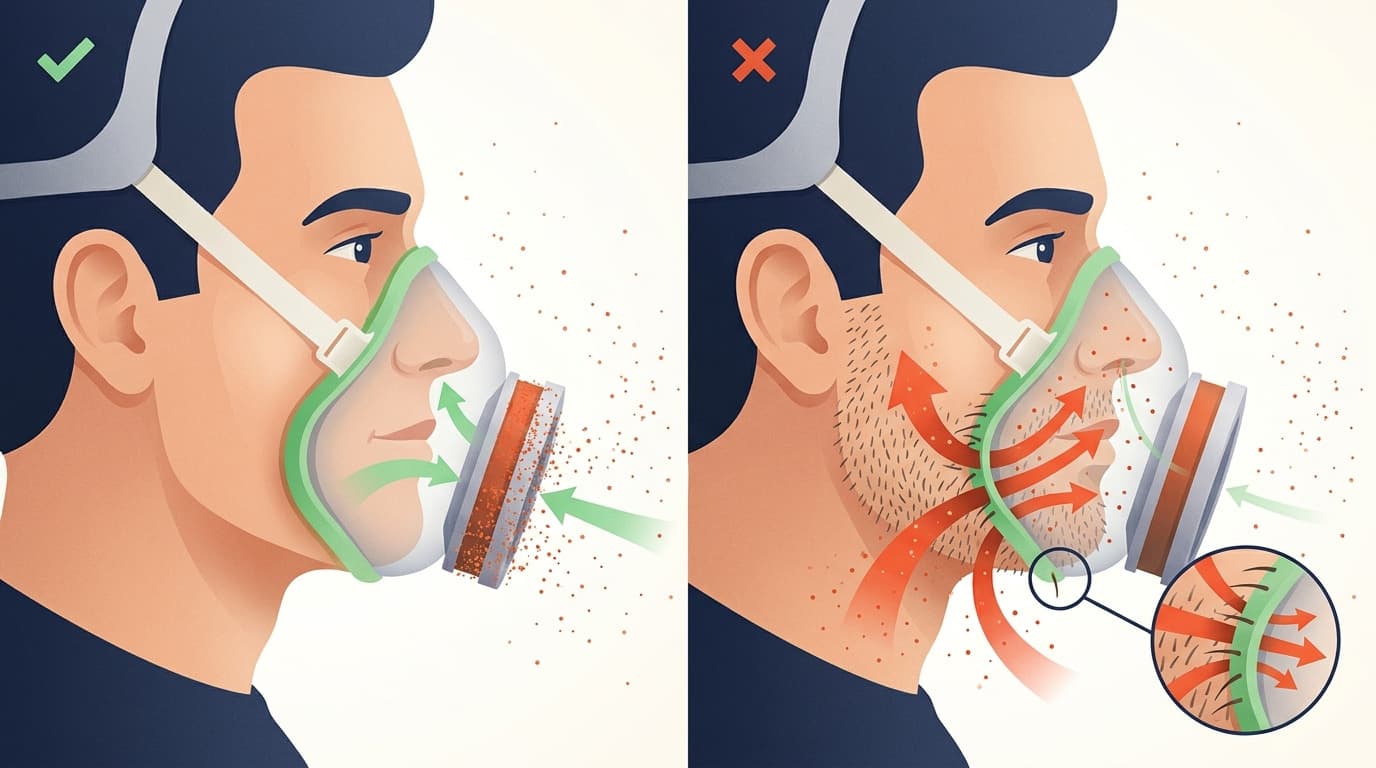
Here is the distinction that carries this whole talk: a respirator does not filter the air in the room — it filters the air that goes through the filter. Air takes the easiest path, and a gap at the seal is easier than a cartridge. That is why a half-face respirator with a broken seal is not "less protected" in proportion to the gap; the protection factor collapses. Everything else in the standard follows from that one fact.
The construction standard is one sentence#
29 CFR 1926.103 reads, in full:
The requirements applicable to construction work under this section are identical to those set forth at 29 CFR 1910.134 of this chapter.
That is the whole thing. Construction's respiratory protection standard is a pointer, and 1910.134 is the standard — which itself states that it applies to General Industry, Shipyards, Marine Terminals, Longshoring and Construction. So when someone says "that's a general industry rule," on respirators they are wrong: it is the construction rule too, by direct incorporation.
And the first thing 1910.134 says is that respirators are the last resort, not the first. Under (a)(1), in controlling occupational diseases caused by breathing contaminated air, the primary objective shall be to prevent atmospheric contamination, accomplished as far as feasible by accepted engineering control measures — enclosure or confinement of the operation, general and local ventilation, and substitution of less toxic materials. Respirators come after those have been applied, not instead of them.
The order is a gate, not a checklist#
Four things have to happen, and they cannot be reordered:
1. A written respiratory protection program, with a named administrator, covering selection, medical evaluation, fit testing, training, use and maintenance. Required whenever the employer requires respirator use.
2. Medical evaluation — before fit testing and before use. Wearing a respirator is work: it adds breathing resistance and heat, and it matters whether the person can do that safely. This is the step that most often gets skipped, and it is the one that makes everything after it invalid.
3. Fit testing — before first use, and at least annually. A fit test is a formal evaluation using an accepted protocol that determines whether a specific make, model and size can achieve an adequate seal on a specific face. Retesting is required when the worker changes to a different make, model, style or size, and when a physical change could affect the fit.
4. Training, so the worker knows why the respirator is necessary, how to don, doff and adjust it, how to perform a user seal check, and how to recognise medical signs that limit its use.
Then, every single time it goes on: a user seal check. That is not a fit test and does not substitute for one. The fit test happens annually in controlled conditions; the seal check happens at the work face, by the wearer, every time.
The seal rule people argue about#
1910.134(g)(1)(i)(A) prohibits respirators with tight-fitting facepieces from being worn by employees who have facial hair that comes between the sealing surface of the facepiece and the face, or that interferes with valve function.
And the fit-testing appendix goes further — it removes the argument entirely. Under Appendix A, the fit test shall not be conducted if there is any hair growth between the skin and the facepiece sealing surface, such as stubble beard growth, beard, moustache or sideburns which cross the respirator sealing surface. Any apparel that interferes with a satisfactory fit must be altered or removed.
Read that carefully, because it settles the conversation before it starts. It is not that a bearded worker fails the fit test. It is that the test cannot lawfully be conducted at all — so there is no valid fit test, and therefore no permitted use of a tight-fitting facepiece. A day's stubble is inside the prohibition.
The alternative is not an exemption; it is different equipment. Loose-fitting respirators — hoods and helmets — do not depend on a facial seal, and where shaving is not possible, that is the route. What does not exist is a middle ground where the seal is "close enough."
What can go wrong?#
Respirators handed out with nothing behind them. No written program, no medical evaluation, no fit test — the most commonly cited failure in this whole area.
Fit test on file, medical evaluation missing. The sequence was reversed, and the fit test rests on a step that never happened.
Stubble. Not a beard, just a couple of days — and the seal is already compromised.
A different mask from the one that was fit tested. Different make, model, style or size means the fit test does not carry across.
No user seal check. The annual fit test is treated as covering every day in between.
Cartridges past their service life. No change-out schedule based on the contaminant and concentration, and no end-of-service indicator.
Respirator used instead of ventilation. The engineering controls that 1910.134(a)(1) puts first were never attempted.
Voluntary use with no paperwork. Where employees choose to wear filtering facepieces the employer does not require, Appendix D still has to be provided.
How do we do this properly?#
Try to remove the atmosphere first. Ventilation, enclosure, extraction, substitution and wet methods — the standard's own hierarchy, and the only route that protects everyone in the area rather than the one person wearing the mask.
Run the sequence in order. Written program, then medical evaluation, then fit test, then use — with training before anyone relies on it.
Fit test the actual respirator. The make, model, style and size the person will wear, and again whenever any of those change.
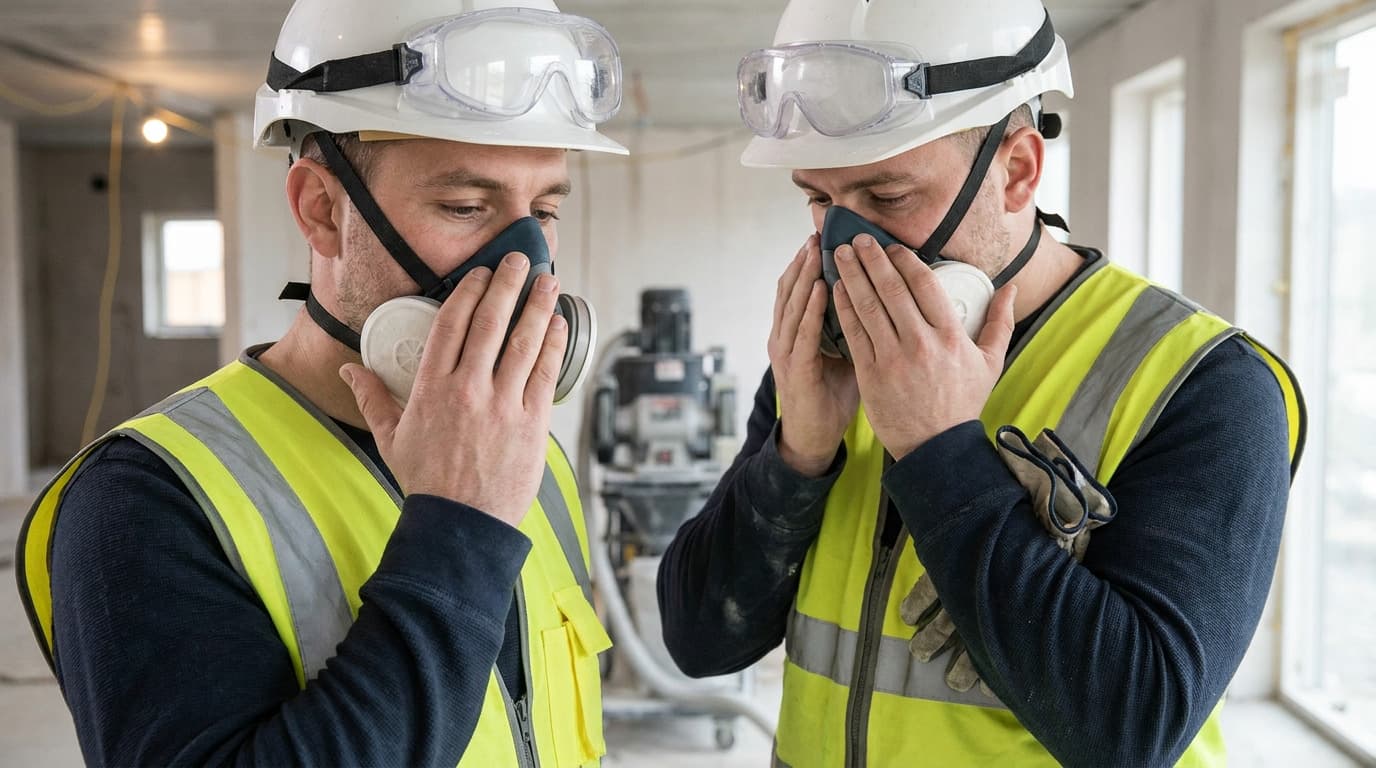
Seal check every time. Positive and negative pressure checks, or the manufacturer's equivalent, at the point of use.
Settle the facial hair question in advance. Clean-shaven at the sealing surface for tight-fitting facepieces, or a loose-fitting hood or helmet. Deciding this at the work face, with the job waiting, produces the wrong answer.
Match the cartridge to the contaminant, with a change-out schedule based on the substance and concentration rather than on when it starts to smell.
Store and maintain them. Clean, dry, protected from dust and deformation — not loose in a toolbox, and not shared without cleaning.
Handle voluntary use correctly, including providing Appendix D where filtering facepieces are worn by choice.
Before you start#
- Confirm whether engineering controls could remove the need for a respirator on this task.
- Confirm the written program exists and names an administrator.
- Confirm each wearer has a current medical evaluation, completed before their fit test.
- Confirm the fit test is current, and for the exact make, model, style and size in use.
- Confirm nobody wearing a tight-fitting facepiece has hair crossing the sealing surface.
- Confirm the cartridge or filter is correct for the contaminant and within its service life.
- Confirm everyone performs a user seal check when putting the respirator on.
- Confirm anyone unable to be clean-shaven has loose-fitting equipment or a different task.
Talk it over#
- Who here has had a medical evaluation — and was it before or after your fit test?
- Is the mask you wore this morning the same model you were fit tested on?
- When did you last do a seal check, and what did you actually check?
- What would it take to remove the dust instead of filtering it?
The bottom line#
1926.103 is one sentence: the construction requirements are identical to 29 CFR 1910.134, which by its own terms covers construction. That standard puts engineering controls first — under (a)(1) the primary objective shall be to prevent atmospheric contamination, as far as feasible by enclosure, ventilation and substitution. Then the order, which cannot be reversed: written program → medical evaluation → fit test → use, with training, plus a user seal check every time the respirator goes on. And the seal rule that ends the argument: 1910.134(g)(1)(i)(A) prohibits tight-fitting facepieces where facial hair comes between the sealing surface and the face, while Appendix A provides that a fit test shall not be conducted where there is any hair growth, including stubble, crossing the sealing surface. No valid fit test means no permitted use — and the alternative is loose-fitting equipment, not a lower standard.
Frequently asked questions about respiratory protection#
Does OSHA's respiratory standard apply to construction?
Yes, directly. 29 CFR 1926.103 states that the requirements applicable to construction work are identical to those set forth at 29 CFR 1910.134, and 1910.134 itself states that it applies to General Industry, Shipyards, Marine Terminals, Longshoring and Construction.
What has to happen before someone wears a respirator?
Three things, in order: a written respiratory protection program with a named administrator; a medical evaluation; and a fit test for the specific make, model, style and size — plus training. The medical evaluation comes before the fit test, and reversing the order invalidates what follows.
How often is fit testing required?
Before first use of a tight-fitting respirator and at least annually thereafter. Retesting is also required whenever the employee changes to a different respirator make, model, style or size, and whenever a physical change — significant weight change, facial scarring, dental changes or cosmetic surgery — could affect the fit.
Can someone with a beard wear a respirator?
Not a tight-fitting one. 1910.134(g)(1)(i)(A) prohibits tight-fitting facepieces where facial hair comes between the sealing surface and the face or interferes with valve function, and Appendix A provides that the fit test shall not be conducted where there is any hair growth — including stubble beard growth, beard, moustache or sideburns — crossing the sealing surface. The alternative is a loose-fitting hood or helmet, which does not rely on a facial seal.
Is a user seal check the same as a fit test?
No, and they do not substitute for each other. A fit test is a formal evaluation by a trained tester using an accepted protocol, done before first use and annually, that establishes whether a specific facepiece can seal on a specific face. A user seal check is what the wearer does every single time the respirator is put on, at the point of use.
Do respirators come before or after ventilation?
After. 1910.134(a)(1) states that in controlling occupational diseases caused by breathing contaminated air, the primary objective shall be to prevent atmospheric contamination, accomplished as far as feasible by accepted engineering control measures — enclosure or confinement, general and local ventilation, and substitution of less toxic materials.
What if someone wants to wear a dust mask voluntarily?
Voluntary use is treated differently from required use. Where employees choose to wear filtering facepieces that the employer does not require, the employer must still provide them with the information in Appendix D of the standard.
Download the respiratory protection toolbox talk PDF#
Get this respiratory protection toolbox talk as a print-ready PDF — available in English, Spanish, Portuguese, and Turkish. Print it, hand it to the crew, and collect signatures on the included attendance sheet.
Download the PDF — free account required. New members get 3 free downloads.
Related toolbox talks#
Sources#
- OSHA, 29 CFR 1926.103 — Respiratory protection: https://www.osha.gov/laws-regs/regulations/standardnumber/1926/1926.103
- OSHA, 29 CFR 1910.134 — Respiratory protection: https://www.osha.gov/laws-regs/regulations/standardnumber/1910/1910.134
- OSHA, 29 CFR 1910.134 App A — Fit Testing Procedures (Mandatory): https://www.osha.gov/laws-regs/regulations/standardnumber/1910/1910.134AppA
This talk summarises published regulatory guidance. It is not medical advice. Medical evaluation for respirator use, and any question about whether a person can safely wear one, are matters for a physician or other licensed health care professional.
Written by FieldSafetyTalk's safety professional — a CSP, ASP, CHST and OSHA Authorized Outreach Trainer with 14+ years of international construction safety experience across federal, heavy civil, and industrial projects.