Dust / Silica Exposure
Updated 2026-07-28
In this bundle Health & Environmental Exposure
Print-ready PDF
Download this talk as a print-ready PDF, available in 4 languages.
Silica dust is the hazard with the longest delay between the exposure and the consequence. Nothing hurts, nothing announces itself, and the particles that do the damage are the ones too small to see. What the standard does about that is unusual — it gives you a way to comply without ever measuring anything, and it takes that option away the moment you deviate from it. This Dust / Silica Exposure Toolbox Talk (Safety Talk / Tailgate Talk) is about which of those two positions you are in.
Here is the distinction that carries this whole talk: the dust you can see is not the dust that hurts you. Respirable crystalline silica is the fraction fine enough to reach deep into the lung, and it is invisible at the concentrations that matter. A visible cloud tells you a control has failed; a clear-looking cut does not tell you it is working. That is exactly why the standard is built around specified controls and measured exposures rather than around what the air looks like.
Two routes, and only two — 1926.1153#
Route one, Table 1 — paragraph (c). The standard lists 18 tasks — handheld saws, walk-behind saws, drills, grinders, jackhammers, rig-mounted core saws, vehicle-mounted drilling rigs, milling machines and the rest — and for each one specifies the engineering controls, work practices and respiratory protection required. Implement what the table says for your task, fully and properly, and you are compliant for that task without assessing exposure at all.
The table is specific rather than general. For a handheld power saw used outdoors for four hours or less per day, the table requires integrated water delivery and no respirator. Use the same saw for more than four hours, or at any time indoors, and a respirator with an assigned protection factor of at least 10 is required. Same tool, same material — the duration and the location change the answer.
Route two, alternative exposure control methods — paragraph (d). For tasks not listed on Table 1, or where the employer does not fully and properly implement the Table 1 controls, the obligation changes completely: assess employee exposures, keep them at or below the PEL of 50 µg/m³ as an 8-hour TWA, and work through the hierarchy of controls, with respirators only where engineering and work practice controls are not sufficient.
That is the whole architecture, and the sting is in the phrase "fully and properly." Table 1 is a safe harbour, and it is one you forfeit by partial compliance. Running the saw with the water off, letting the tank run dry, removing the shroud because it obstructs the cut, or using a vacuum that has not been maintained — any of those moves you out of (c) and into (d), where you now owe air monitoring and PEL compliance you have not done.
Where the standard starts — and it is not about the material#
Paragraph (a) sets the scope: the standard applies to all occupational exposures to respirable crystalline silica in construction work, except where employee exposure will remain below 25 µg/m³ as an 8-hour TWA under any foreseeable conditions. That figure — 25 µg/m³ — is the action level, and it is the doorway to the standard.
Read what that threshold is written in terms of. It is an exposure number, not a material-content number. There is no minimum percentage of silica a material must contain before the rule applies; what matters is what the work puts into the air. Concrete, block, brick, mortar, stone, tile, terrazzo, engineered stone, sand and fill are all in scope when the work produces respirable dust from them.
And OSHA has said the exception is narrow: it applies where below-action-level exposures are expected or achieved without using engineering or other controls. If you need the water or the vacuum to stay below 25 µg/m³, you are inside the standard, not outside it.
What OSHA says about a bit of dust#
There is a practical question every crew asks: the vacuum is running and there is still some dust — is that a violation?
OSHA's own answer is that an employer generating a limited amount of dust while performing a Table 1 task is not in violation if it is fully and properly implementing the specified engineering controls, work practices and respiratory protection, including operating and maintaining the controls so as to minimise emissions. A small amount of dust can be expected even with new equipment operating as the manufacturer intended.
But it adds the test that matters: a noticeable increase in dust emissions may indicate that the dust control system is not operating properly. Not the presence of dust — the change in it. A cut that is suddenly dustier than the last one is telling you something about the water flow, the filter or the shroud.
The parts that are not about the tool#
Written exposure control plan and competent person — paragraph (g). The employer must have a written plan, and must designate a competent person to implement it — including making regular inspections of the worksite, materials, equipment and control measures in use to ensure the plan is properly implemented. That is a named person with authority, not a document in a folder.
Housekeeping. Dry sweeping and compressed air may not be used for cleaning where they could contribute to employee exposure, unless no alternative method is feasible. This is where good silica control most often collapses: the cutting is controlled and then the cleanup puts everything back into the air.
Medical surveillance. Where the standard requires it, it is offered to employees, and it exists because silicosis, lung cancer and chronic obstructive pulmonary disease develop long after the exposure that caused them.
What can go wrong?#
The water is off. Tank empty, valve closed, hose kinked, or the operator turned it off because it made a mess. Table 1 compliance ends there.
The shroud or vacuum is removed to see the cut or reach the corner — the single most common way a controlled task becomes an uncontrolled one.
The vacuum is undersized or unmaintained. Wrong filter, full bag, no HEPA where the table calls for it, and the extraction is theatre.
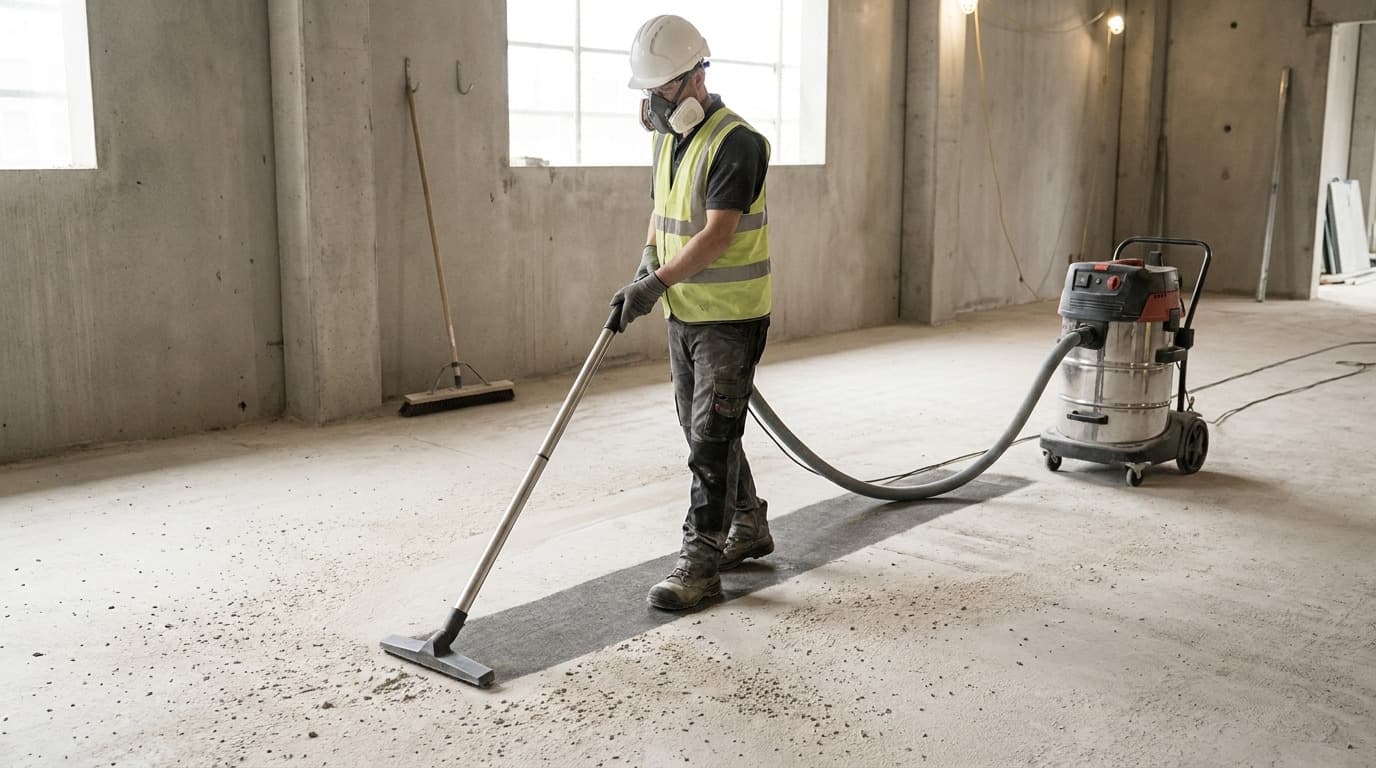
Cleanup undoes the control. Dry sweeping or blowing down at the end of a well-controlled cut.
Indoors is treated like outdoors. The table draws a hard line between them, and enclosed or partially enclosed spaces concentrate everything.
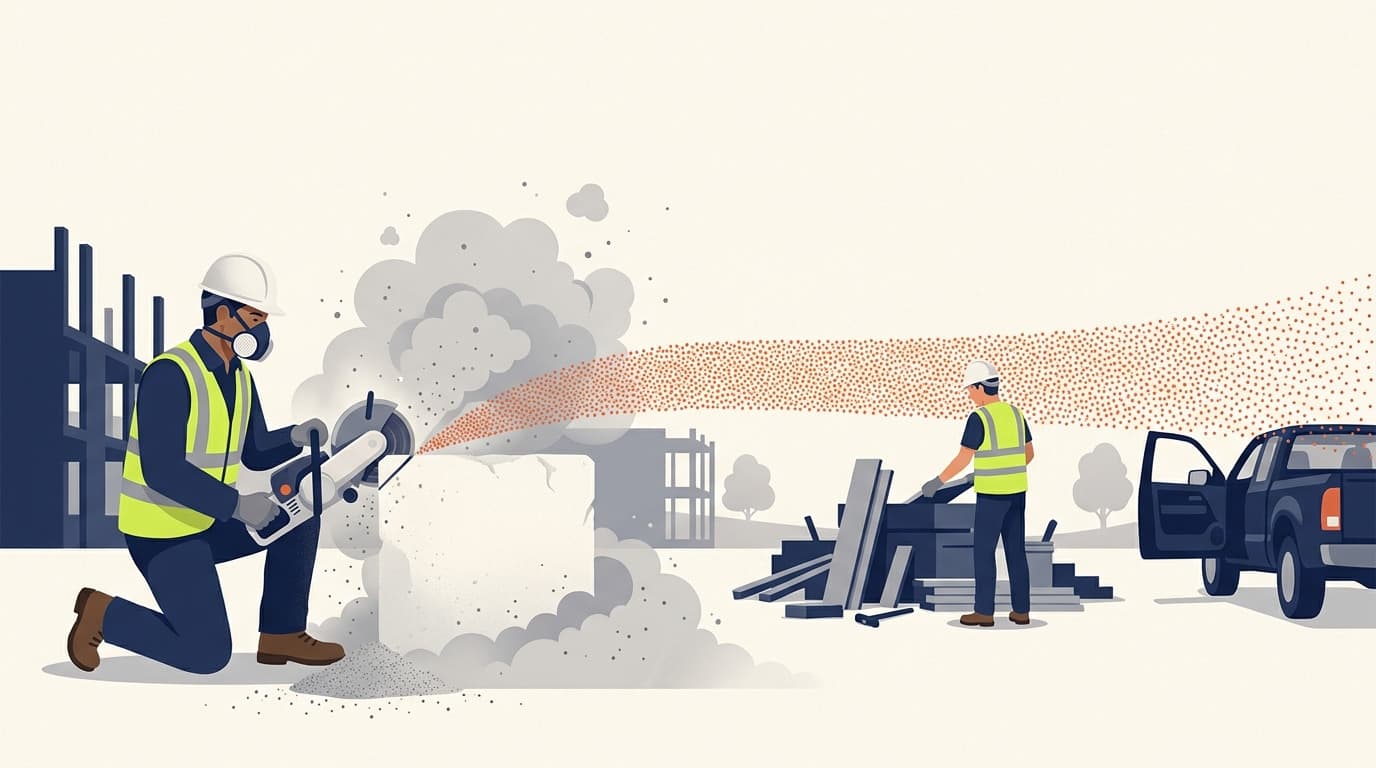
Nearby workers are forgotten. The operator has the respirator; the labourer standing three metres away in the plume does not.
Nobody owns the plan. No competent person, no inspections, and the written plan does not match what happens on site.
Clothing carries it home. Dust on overalls, in vehicles, in the changing area.
How do we control this properly?#
Decide the route before the tool starts. Is this task on Table 1, and are we implementing everything it specifies? If not, we are in paragraph (d) and someone needs to have assessed exposure.
Run the controls as designed. Water on and flowing at the specified rate, shroud fitted, extraction connected, filter clean, hose clear — every cut, not the first one.
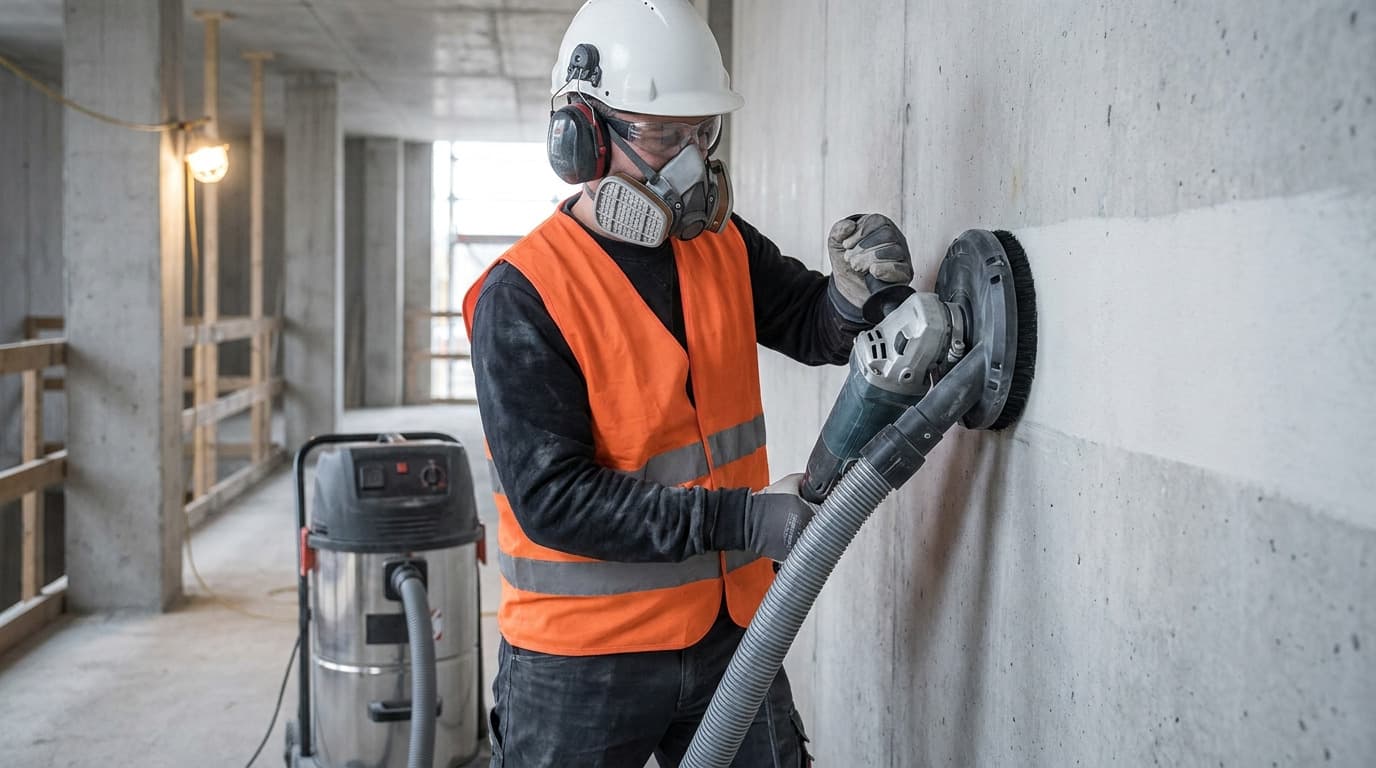
Watch for the change, not the cloud. More dust than the last cut means the control has degraded. Stop and fix it rather than finishing the job.
Respect the four-hour and indoor triggers in the table, and treat any enclosed or partially enclosed area as demanding more, not less.
Never dry sweep or blow down where it could raise silica dust. Wet methods and HEPA vacuums, every time.
Keep other trades out of the plume. The exposure does not stop at the operator, and neither should the control.
Name the competent person and let them inspect. Regular inspections of the work, the equipment and the controls, with authority to stop and correct.
Keep the dust out of the vehicle and the house. Change, clean down, and never take it home on clothing.
Before you start#
- Confirm whether your task is on Table 1, and exactly what the table specifies for it.
- Confirm the duration and location — over four hours, or indoors, changes the requirement.
- Confirm water is connected and flowing, or extraction is connected with a clean, correct filter.
- Confirm the shroud or hood is fitted and undamaged.
- Confirm the respirator required by the table is available, correct and worn.
- Confirm nobody else is working inside the dust plume.
- Confirm the cleanup method is wet or HEPA — never dry sweeping or compressed air.
- Confirm you know who the competent person is and how to raise a failed control.
Talk it over#
- Which of today's tasks is on Table 1, and which is not?
- Has anyone turned the water off on a saw? What made that seem reasonable?
- Who is standing downwind of the cut, and what are they wearing?
- How does the dust get from this cut into somebody's car?
The bottom line#
1926.1153 offers exactly two routes. Under paragraph (c), implement the engineering controls, work practices and respiratory protection specified on Table 1 for your task fully and properly, and you comply without assessing exposure. Deviate at all — or work on a task not listed — and paragraph (d) takes over: assess exposures, apply the hierarchy of controls and keep employees at or below the PEL of 50 µg/m³ as an 8-hour TWA. The standard's doorway is the action level of 25 µg/m³, written as an exposure threshold rather than a material-content threshold, and the exception applies only where you stay below it without relying on controls. OSHA accepts that a limited amount of dust can occur while Table 1 controls are properly run — but treats a noticeable increase in emissions as a sign the control has failed. Behind all of it: a written exposure control plan, a competent person making regular inspections, and no dry sweeping or compressed air.
Frequently asked questions about silica dust#
What is the OSHA silica exposure limit for construction?
The permissible exposure limit is 50 µg/m³ as an 8-hour time-weighted average, and the action level is 25 µg/m³ as an 8-hour TWA. Under 1926.1153(a) the standard applies to all occupational exposures to respirable crystalline silica in construction work except where exposure will remain below 25 µg/m³ under any foreseeable conditions.
What is Table 1 and do I have to use it?
Table 1 in 1926.1153(c) lists 18 construction tasks with the engineering controls, work practices and respiratory protection specified for each. Using it is optional — an employer may instead follow the alternative exposure control methods in paragraph (d) — but if you do follow Table 1 fully and properly, you are not required to assess exposure for that task.
What happens if we only partly follow Table 1?
You lose the safe harbour. Paragraph (d) applies to tasks not listed on Table 1 and to tasks where the employer does not fully and properly implement the specified controls, which means assessing exposure, applying the hierarchy of controls and ensuring no employee is exposed above the PEL of 50 µg/m³. Turning the water off or removing a shroud moves you into that regime immediately.
Is a little visible dust a violation?
Not by itself. OSHA has stated that an employer generating a limited amount of dust on a Table 1 task is not in violation where it is fully and properly implementing the specified controls, since some dust can be expected even from new equipment working as intended. However, a noticeable increase in dust emissions may indicate the dust control system is not operating properly — the change is the warning sign, not the presence.
Does the standard only apply to materials with a certain silica content?
No. The scope in 1926.1153(a) is written in terms of employee exposure — below 25 µg/m³ as an 8-hour TWA under any foreseeable conditions — rather than in terms of how much silica a material contains. What matters is what the work puts into the air, which is why concrete, masonry, stone, tile and similar materials are routinely in scope.
Why does the table treat indoor work differently?
Because enclosure concentrates exposure. For a handheld power saw, Table 1 requires no respirator when the saw is used outdoors for four hours or less per day, but requires a respirator with an assigned protection factor of at least 10 when it is used for more than four hours, or at any time indoors. The same tool and material produce a different requirement based on duration and location.
Can we sweep up afterwards?
Not dry, where it could contribute to exposure. Dry sweeping and the use of compressed air for cleaning are not permitted where they could contribute to employee exposure unless no alternative method is feasible. Wet sweeping and HEPA-filtered vacuuming are the expected methods — and cleanup is where a well-controlled cut is most often undone.
Download the silica dust toolbox talk PDF#
Get this dust and silica exposure toolbox talk as a print-ready PDF — available in English, Spanish, Portuguese, and Turkish. Print it, hand it to the crew, and collect signatures on the included attendance sheet.
Download the PDF — free account required. New members get 3 free downloads.
Related toolbox talks#
Sources#
- OSHA, 29 CFR 1926.1153 — Respirable crystalline silica: https://www.osha.gov/laws-regs/regulations/standardnumber/1926/1926.1153
- OSHA, Respirable Crystalline Silica — Construction information and FAQs: https://www.osha.gov/silica-crystalline/construction-info
- OSHA, OSHA's Respirable Crystalline Silica Standard for Construction (Fact Sheet): https://www.osha.gov/sites/default/files/publications/OSHA3681.pdf
This talk summarises published regulatory guidance. It is not medical advice. Anyone concerned about a respiratory symptom or a past silica exposure should be assessed by a physician or other licensed health care professional.
Written by FieldSafetyTalk's safety professional — a CSP, ASP, CHST and OSHA Authorized Outreach Trainer with 14+ years of international construction safety experience across federal, heavy civil, and industrial projects.