Sun and UV Safety
Updated 2026-08-06
In this bundle Health & Environmental Exposure
Print-ready PDF
Download this talk as a print-ready PDF, available in 4 languages.
Every crew that works outdoors thinks about the sun in terms of heat — how hot the day is, how much water to drink, where the shade is. That is real, and it matters, but it treats the sun as one hazard when it is actually two. This Sun and UV Safety Toolbox Talk (Safety Talk / Tailgate Talk) is about the second one, the one you cannot feel, and about why the way most people judge sun exposure — by how hot and bright it feels — misses the part that does the lasting damage.
Here is the distinction that carries this whole talk: the sun harms you two completely separate ways, and the more dangerous one you cannot feel. One is heat — the thermal load that causes heat exhaustion and heat stroke, which you feel building and can respond to. The other is ultraviolet radiation — an invisible form of radiation that penetrates your skin and changes the structure of the cells, causing sunburn now and skin cancer years later. These are different hazards with different controls on different timescales. You can do everything right for heat — drink the water, take the breaks, use the shade to cool down — and still take the full UV dose, because covering up for radiation is a different job than cooling down from heat. And UV gives you no same-day feedback the way heat does: the damage is cumulative, it adds up quietly over seasons and years, and by the time it shows up as skin cancer, the exposure that caused it happened long ago.
Where the boundary of this talk sits#
The heat stress talk owns the thermal side of the sun — heat exhaustion, heat stroke, water-rest-shade for cooling, the body overheating. The skin hazards talk owns skin damage from chemicals, irritants, and contact. This talk owns the sun as a source of UV radiation — sunburn, long-term skin and eye damage, and skin cancer, and the protection that blocks the rays rather than cools the body. Where the question is the body overheating or a chemical on the skin, those talks own it; this one owns the invisible radiation coming off the sun and what stops it from reaching you.
UV is radiation, and it is invisible#
The reason UV is easy to underestimate is that nothing about it registers as dangerous in the moment. It is not the heat and it is not the brightness — UV is a separate, invisible part of sunlight, a form of radiation that you cannot see or feel landing on you. It penetrates the skin and changes the structure of skin cells, which is what drives both the immediate sunburn and the long-term cancer risk. There are two kinds that reach you at ground level: UVA, the most abundant, which penetrates beyond the top layer of skin and is linked to deeper damage and cancer risk, and UVB, which penetrates less deeply but still causes sunburn and some skin cancers. Because it is invisible and delivers no immediate pain — the sunburn shows up hours later — there is no natural feedback telling you to stop. That is the core problem: with heat, your body warns you; with UV, nothing does until the damage is done.
The dose adds up, and there is no off day#
Two facts make UV especially easy to mismanage on a jobsite. The first is that the harm is cumulative. Skin cancer from occupational sun exposure is not usually the result of one bad burn — it is the total dose absorbed over years of working outdoors, one unprotected shift at a time. Every hour in the sun without protection adds to a lifetime total, which means the protection you skip on an ordinary day is not harmless; it is a deposit into a risk that pays out decades later. Even a few serious sunburns measurably increase the lifetime risk of skin cancer.
The second fact is that there is no off day. UV comes through cloud cover, so an overcast day still delivers a significant dose even though it does not feel bright or hot. It reflects off surfaces — concrete, metal, water, light-colored materials — so you can be dosed from below and the side, not just from overhead. And it is strongest in the middle of the day: the sun's intensity peaks between roughly 10 a.m. and 4 p.m., which is exactly when most work happens. The dangerous combination is a cool, cloudy day in that window, when it does not feel like a sun day and the protection comes off — but the UV dose is still landing. The rule that follows is that UV protection is not a hot-and-sunny-day measure; it is an every-outdoor-day measure.
The hard-hat gap and how to actually protect against it#
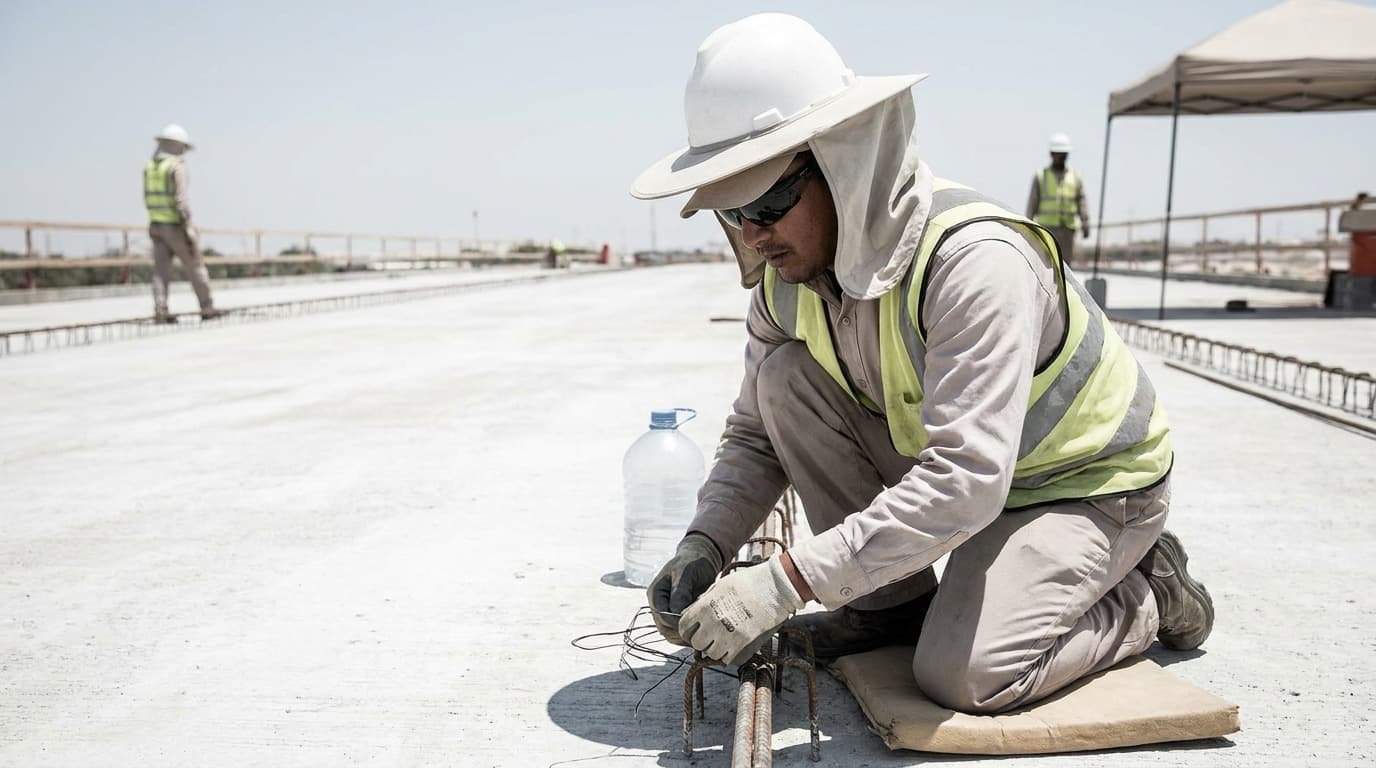
Protecting against UV means blocking or covering, not cooling, and there is one gap on a construction site that matters more than any other. A hard hat protects the crown of the head but leaves the face, ears, back of the neck, and forearms fully exposed — and those are among the most common sites for occupational skin cancer. So the hard hat, essential as it is, is not sun protection, and the exposed areas it leaves are exactly where the protection needs to go.
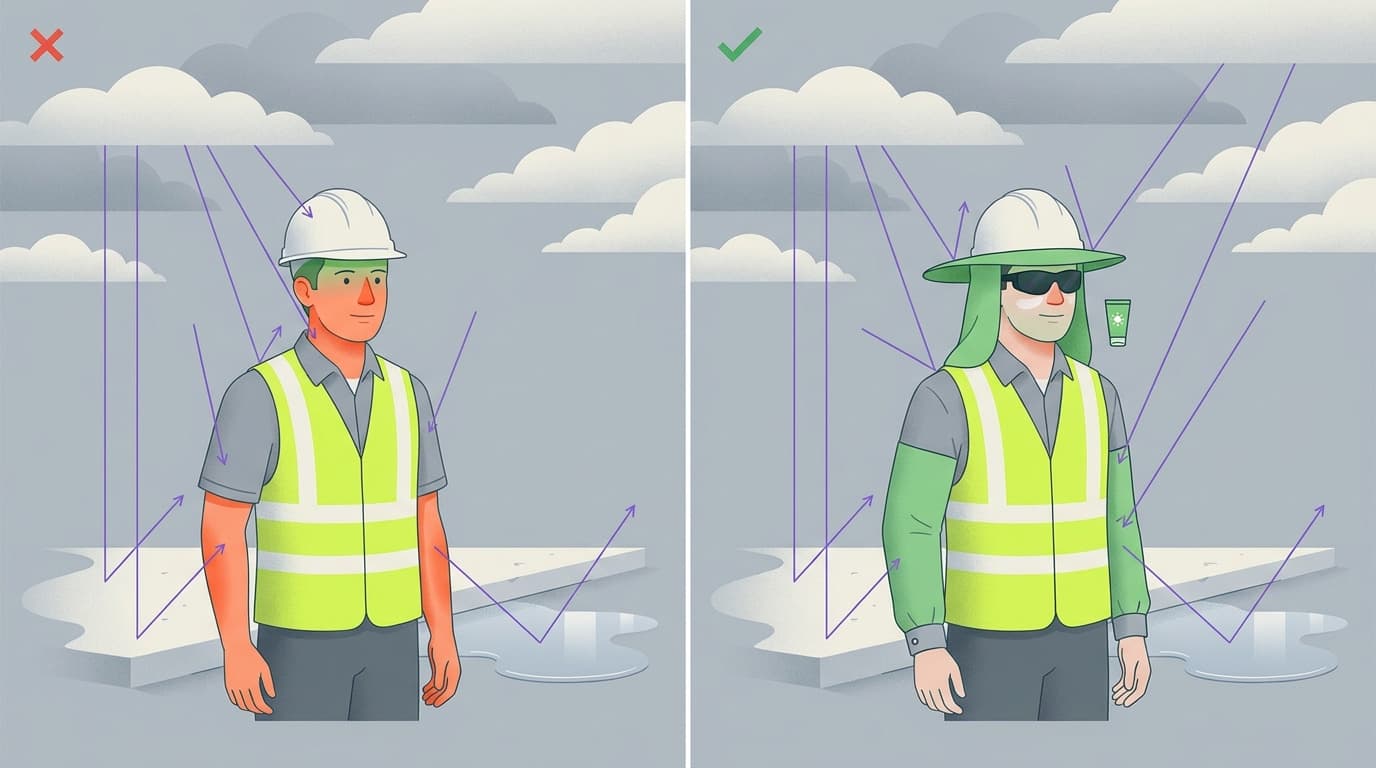
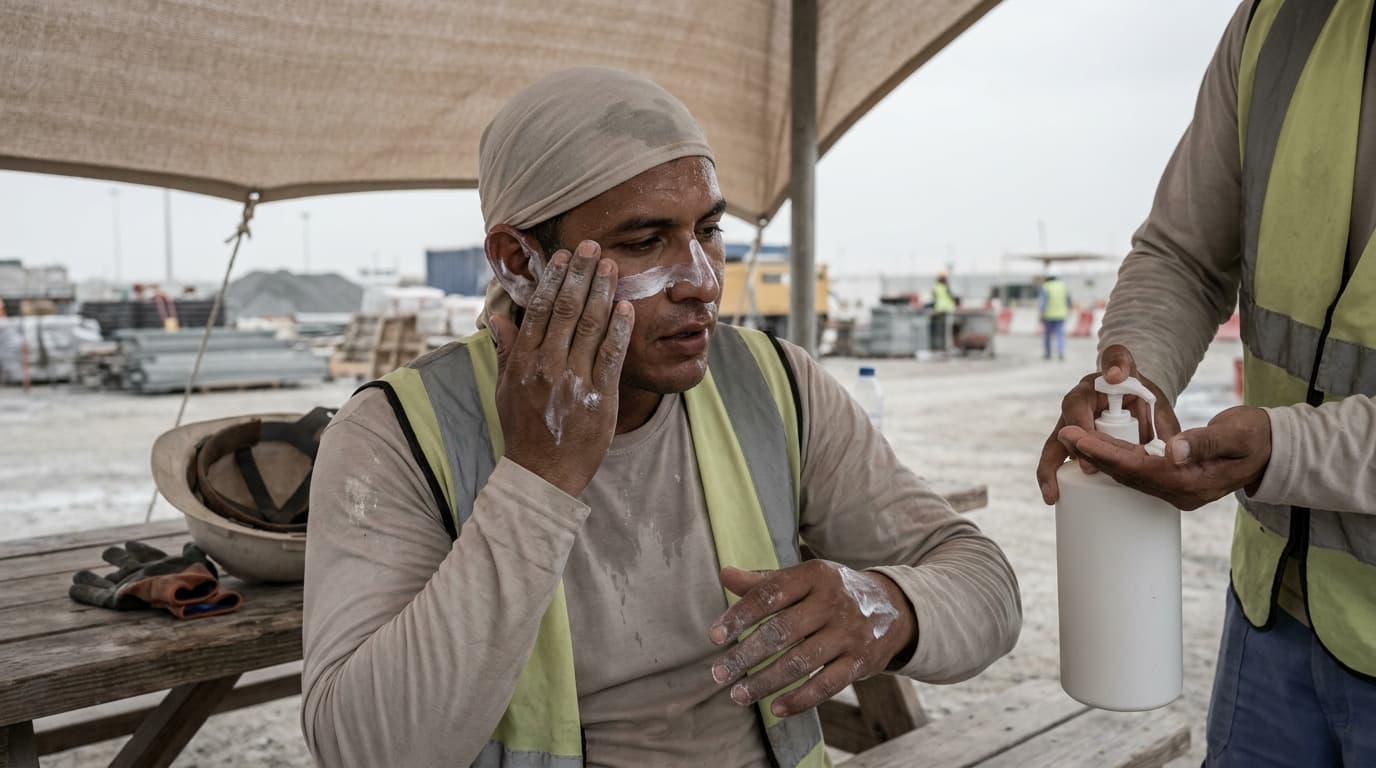
OSHA's own guidance on sun exposure lays out what works: protective clothing that does not transmit visible light — long sleeves and long pants in tightly woven or UPF-rated fabric; a broad-brimmed hat, or a brim and neck shade added to the hard hat, to cover the face, ears, and neck; UV-blocking sunglasses that stop UVA and UVB, to protect the eyes; and sunscreen of SPF 15 or higher, applied frequently — and reapplied, because it sweats and rubs off over a shift. Where clothing and shade are not feasible for a task, sunscreen carries more of the load, but it works best as a backup to covering up, not a replacement for it. And shade matters: seek it during breaks, especially in the peak 10 a.m. to 4 p.m. window, and where the work allows, schedule the most sun-exposed tasks outside that window. Putting shade where the crew already gathers for breaks is what makes it actually get used.
Where the duty sits#
Sun and UV exposure is one of several outdoor hazards with no dedicated OSHA standard, and it routes through the general duty the same way lightning and heat do — with one addition.
There is no numbered UV standard. OSHA addresses UV exposure under the General Duty Clause, Section 5(a)(1) of the OSH Act, which requires a workplace free of recognized hazards, and occupational UV exposure is a recognized hazard. OSHA has also stated that it addresses sun radiation indirectly under the PPE standard, 1910.132(a) — employers are to use effective protection such as wide-brim hats and long-sleeve clothing, and where sunscreen is the only effective means for a task, it may be used too. The practical guidance is OSHA's harmful sun exposure pocket card and NIOSH's outdoor-worker materials — both advisory, creating no independent legal obligation, but defining what "recognized protection" looks like. There is no widely accepted occupational UV exposure limit. A handful of US states mandate shade access above a set temperature, so a state rule may add specific requirements. On federal contract work, EM 385-1-1 addresses sun and heat within its health provisions. Where a state rule or a contract sets a specific requirement, that requirement governs.
What can go wrong?#
- A worker manages the heat well — water, rest, shade — but takes the full UV dose with skin uncovered.
- Protection comes off on a cool or cloudy day, when UV is still coming through the clouds.
- The face, ears, neck, and forearms are left exposed because the hard hat "covers the head."
- Sunscreen is applied once in the morning and never reapplied through a sweaty shift.
- The most sun-exposed tasks are done in the 10 a.m. to 4 p.m. peak with no shade breaks.
- UV reflects off concrete, metal, or water and doses areas that feel shaded.
- Sunglasses are skipped, leaving the eyes exposed to UVA and UVB.
- Years of unprotected shifts accumulate into a skin cancer that traces back to routine exposure.
How do we manage this properly?#
- Treat the sun as two hazards — cool down for heat, and cover up for UV; they are different jobs.
- Protect every outdoor day, not just hot, bright ones — UV comes through cloud and reflects off surfaces.
- Cover the hard-hat gap — face, ears, neck, and forearms — with a brim, neck shade, and sleeves.
- Wear UPF or tightly woven clothing, a broad-brimmed hat, and UV-blocking sunglasses.
- Use sunscreen SPF 15+ and reapply it through the shift; treat it as a backup to covering up.
- Seek shade on breaks, especially in the 10 a.m.–4 p.m. peak, and schedule sun-heavy tasks outside it where possible.
- Put shade where the crew already gathers so it gets used.
- Watch for skin changes over time and raise them early — most skin cancers are curable if caught early.
Before you start#
- Confirm exposed skin — face, ears, neck, forearms — is covered or has sunscreen, not just the head.
- Confirm sunscreen SPF 15+ is available and there is a plan to reapply through the shift.
- Confirm broad-brimmed hats or hard-hat brims and neck shades are available.
- Confirm UV-blocking sunglasses are available for eye protection.
- Confirm there is shade for breaks, placed where the crew gathers.
- Confirm the plan accounts for UV on cool and cloudy days, not just hot bright ones.
- Confirm sun-heavy tasks are scheduled outside the 10 a.m.–4 p.m. peak where the work allows.
- On federal work, confirm the EM 385-1-1 sun and heat provisions are in place.
Talk it over#
- Which parts of your skin are exposed right now that the hard hat does not cover?
- On a cool, cloudy day, does your sun protection come off — even though the UV is still there?
- When did you last reapply sunscreen, and is there any on your ears, neck, and forearms?
- Where is our shade for breaks, and is it somewhere we'd actually use it?
The bottom line#
The sun harms you two completely separate ways, and the more dangerous one you cannot feel. Heat is the thermal load you feel building and manage with water, rest, and shade. UV is an invisible form of radiation that penetrates the skin and changes the cells, causing sunburn now and skin cancer years later — a different hazard with different controls, so you can manage the heat perfectly and still take the full UV dose. Two facts make it easy to mismanage: the harm is cumulative, the total of years of unprotected shifts rather than one bad burn, so the protection you skip on an ordinary day is a deposit into a risk that pays out decades later; and there is no off day, because UV comes through cloud cover, reflects off concrete and metal and water, and peaks from 10 a.m. to 4 p.m. whether or not it feels hot or bright. The gap that matters most on a site is that a hard hat leaves the face, ears, neck, and forearms exposed — the most common sites for occupational skin cancer — so protection has to go exactly there: UPF or tightly woven clothing, a broad-brimmed hat or hard-hat brim and neck shade, UV-blocking sunglasses, sunscreen SPF 15+ reapplied through the shift, and shade on breaks. The duty runs through the General Duty Clause 5(a)(1) and the PPE standard 1910.132(a), guided by OSHA's sun-exposure pocket card and NIOSH, because there is no numbered UV standard. The test for any outdoor day is one question: am I protected against the radiation I cannot feel — not just cooled down from the heat I can?
Frequently asked questions about sun and UV safety#
Isn't sun safety just part of heat safety?
No — they are two separate hazards from the same source. Heat is the thermal load that causes heat exhaustion and heat stroke, which you feel and manage with water, rest, and shade to cool down. UV is invisible radiation that penetrates the skin and causes sunburn and skin cancer, managed by covering up and blocking the rays. You can do everything right for heat and still take the full UV dose, because cooling down and covering up are different jobs. This talk is about the UV half.
If it's cool or cloudy, do I still need sun protection?
Yes. UV comes through cloud cover, so an overcast day still delivers a significant dose even though it does not feel bright or hot. It also reflects off concrete, metal, and water, so you can be dosed from surfaces around you, not just from overhead. The most dangerous situation is a cool, cloudy day in the 10 a.m. to 4 p.m. window, when it does not feel like a sun day and the protection comes off — but the UV is still landing. Protect every outdoor day, not just hot bright ones.
My hard hat covers my head — isn't that enough?
No. A hard hat protects the crown but leaves the face, ears, back of the neck, and forearms fully exposed — and those are among the most common sites for occupational skin cancer. The hard hat is essential for impact, but it is not sun protection. Add a brim and a neck shade to cover the face, ears, and neck, wear long sleeves for the forearms, and use sunscreen on any skin that stays exposed.
How does sunscreen fit in with clothing and shade?
Clothing, a broad-brimmed hat, sunglasses, and shade are the primary protection because they physically block the UV. Sunscreen of SPF 15 or higher is important, especially for skin you cannot cover, but it works best as a backup to covering up rather than a replacement — and it has to be reapplied through the shift because it sweats and rubs off. Where covering up is not feasible for a task, sunscreen carries more of the load, but the covered areas are still better protected.
Why does UV damage matter if I don't burn?
Because the harm is cumulative and largely invisible. Occupational skin cancer is usually the total dose absorbed over years of outdoor work, not the result of a single burn, so even exposure that never turns into a visible sunburn is adding to a lifetime risk. UV also causes eye damage and premature skin aging along the way. By the time it shows up as skin cancer, the exposure that caused it happened long before — which is why protecting on ordinary days, not just when you burn, is the point.
Is there an OSHA standard for UV exposure?
There is no numbered UV standard. OSHA addresses UV exposure under the General Duty Clause, Section 5(a)(1), which requires protection from recognized hazards, and has stated it also addresses sun radiation indirectly under the PPE standard, 1910.132(a). The practical guidance is OSHA's harmful sun exposure pocket card and NIOSH's outdoor-worker materials, which are advisory. Some states mandate shade access above a set temperature. Employers can be cited under the General Duty Clause for ignoring known UV risks.
Download the sun and UV safety toolbox talk PDF#
Get this sun and UV safety toolbox talk as a print-ready PDF — available in English, Spanish, Portuguese, and Turkish. Print it, hand it to the crew, and collect signatures on the included attendance sheet.
Download the PDF — free account required. New members get 3 free downloads.
Related toolbox talks#
Sources#
- OSHA, Protecting Yourself in the Sun / Harmful Sun Exposure (pocket-card guidance: protective clothing, broad-brimmed hats, UV sunglasses, SPF 15+, shade 10 a.m.–4 p.m.; advisory, not a standard): https://www.osha.gov/sites/default/files/publications/OSHA3166.pdf
- CDC/NIOSH, Sun Exposure at Work — Outdoor Workers (UV as invisible radiation; UVA/UVB; sunburn and skin cancer risk): https://www.cdc.gov/niosh/outdoor-workers/about/sun-exposure.html
- OSHA, Standard Interpretation — sunscreen and sun radiation under 1910.132(a) (sun radiation addressed indirectly under the PPE standard): https://www.osha.gov/laws-regs/standardinterpretations/1998-04-16
This talk is general awareness guidance for training purposes. It does not replace your employer's health-hazard or sun-safety program, the OSHA PPE standard, the OSH Act General Duty Clause, applicable state shade rules, a medical evaluation of skin changes, or a competent person's duties, and it is not medical or legal advice. If you notice a changing mole or skin lesion, seek a medical evaluation.
Written by FieldSafetyTalk's safety professional — a CSP, ASP, CHST and OSHA Authorized Outreach Trainer with 14+ years of international construction safety experience across federal, heavy civil, and industrial projects.