Repetitive Strain
Updated 2026-08-06
In this bundle Manual Handling & Body Mechanics
Print-ready PDF
Download this talk as a print-ready PDF, available in 4 languages.
Most of the injuries we talk about on a site have a moment — the fall, the cut, the pinch, the strain of one bad lift. You can point to the second it happened and the thing that caused it. Repetitive strain is the exception, and that is exactly what makes it dangerous. It has no moment. There is no lift you can point to, no drop, no slip, no single event to write on an incident form. This Repetitive Strain Toolbox Talk (Safety Talk / Tailgate Talk) is about the injury that builds so slowly you do not notice it happening, and about why the way you treat the first small signs decides whether it ever becomes serious.
Here is the distinction that carries this whole talk: a repetitive strain injury is the sum of thousands of movements, each of which was fine on its own. No single trigger-pull, keystroke, twist of a wrench, or overhead reach hurt you. The harm is cumulative — it is the total, repeated over hours and days and weeks, that wears down a tendon or presses on a nerve until the tissue can no longer recover between shifts. This changes how you have to think about it. You cannot prevent a repetitive strain injury by being careful during "the dangerous part," because there is no dangerous part — there is only the same safe-feeling motion done too many times with too little recovery. Once you see it that way, the whole approach — vary the task, take the micro-breaks, fix the posture and the tool, and above all listen to the early signs — stops being wellness advice and becomes the only way to stop an injury you will otherwise never see coming.
Where the boundary of this talk sits#
The manual handling and proper-lifting talks own the single lift — the heavy or awkward load and the technique to move it. The back injuries talk owns the back specifically, and the general ergonomics talk owns workstation setup broadly. The eye strain talk owns the eyes. This talk owns repetitive strain as a mechanism — the cumulative-microtrauma injury that comes from doing the same motion over and over, whatever body part it lands in, and the early warning signs that are your only chance to catch it. Where the question is one heavy lift, the back alone, or a whole workstation layout, those talks own it; this one owns the injury that has no single event and builds up over time.
The injury with no moment#
Think about what "injury" normally means on a site: something happened, at a time, and now a part of you is hurt. Repetitive strain does not work like that. The medical name is a musculoskeletal disorder (MSD) — an injury of the muscles, nerves, tendons, ligaments, joints, cartilage, or spinal discs — and the defining feature is that it is not caused by any instantaneous event. It is specifically not a slip, a trip, a fall, or a struck-by. It is caused by force, repetition, awkward posture, and vibration applied over time, and it develops gradually — which is why you will never be able to say when it started.
The everyday names are the ones you already know: carpal tunnel syndrome, tendonitis, tennis elbow, De Quervain's in the thumb, trigger finger, rotator-cuff problems in the shoulder. Each of these is the same story told about a different joint: a motion repeated so many times, with so little recovery, that the tissue broke down faster than the body could rebuild it. The trap is that on any given day, none of it feels like an injury. The motion that will eventually cause carpal tunnel feels completely fine the ten-thousandth time, just as it did the first. That is the whole problem — the feedback that keeps you safe from a fall or a cut is missing here.
The four things that turn a motion into an injury#
If there is no single event, what actually causes the damage? The risk factors are a short, known list, and an MSD usually needs more than one of them present at the same time.
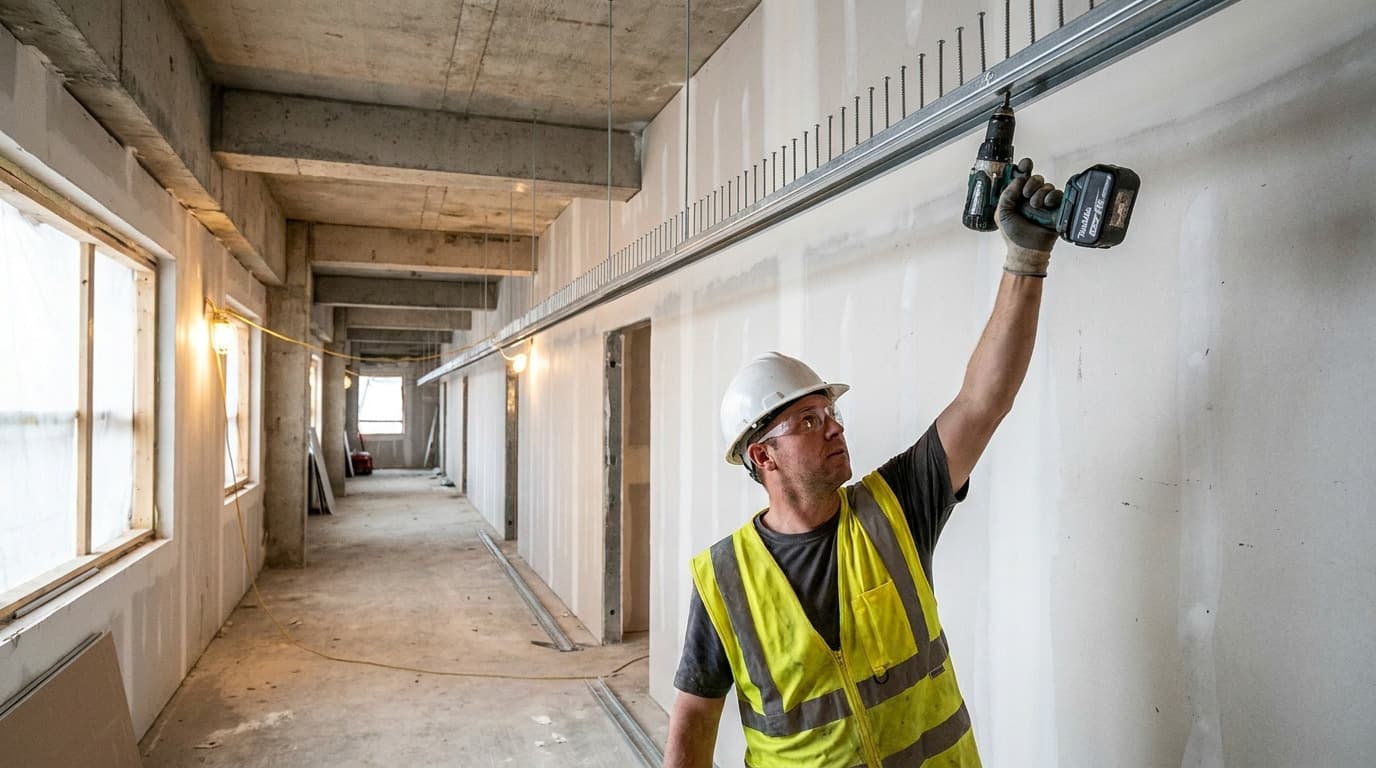
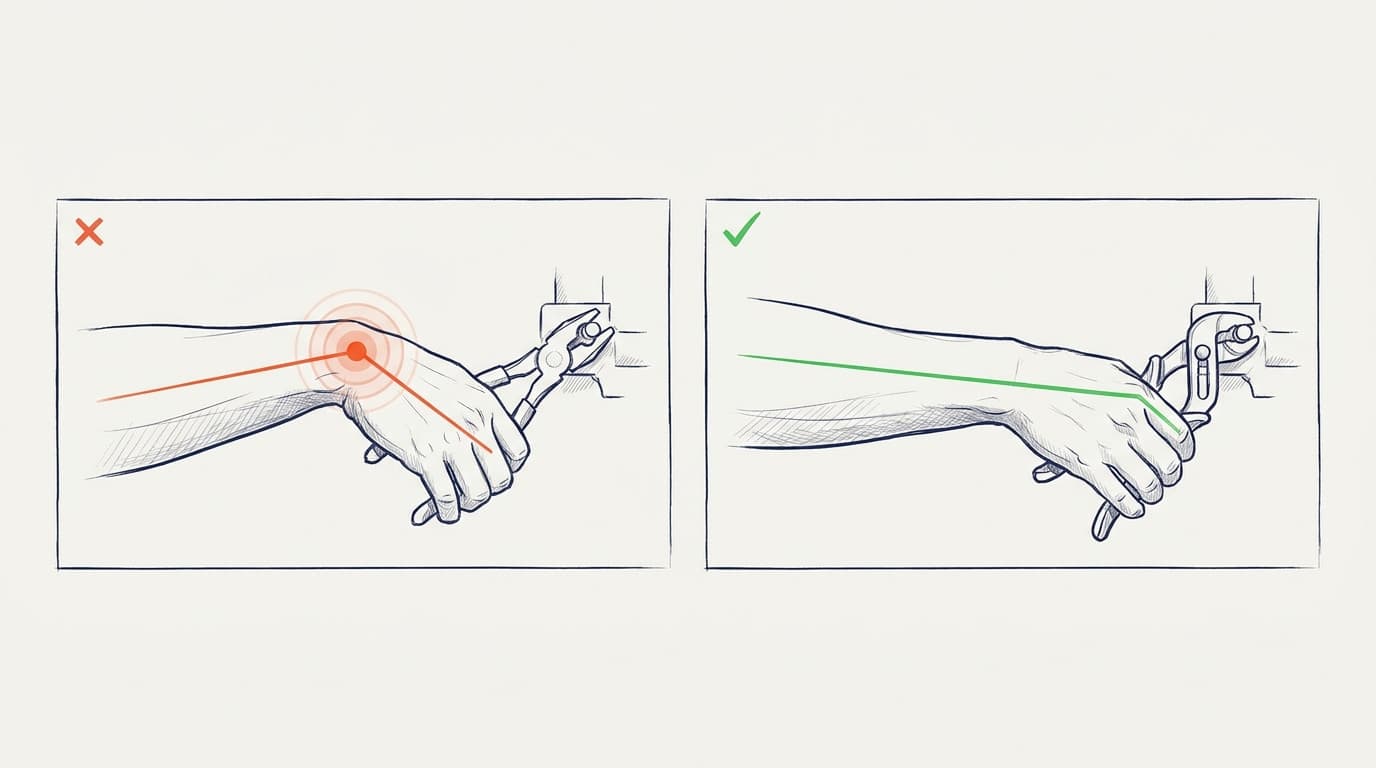
The first is repetition — the same movement cycle after cycle, especially with little variation and few breaks. The second is force — how hard the muscles have to work: gripping a tool tightly, pinching a component, pushing or pulling. The third is awkward posture — any position away from neutral, held or repeated: a bent or cocked wrist, a raised elbow, a reach overhead, a twisted or bent back. The fourth is vibration — from power tools especially, hand-arm vibration over long periods. Add duration — the longer any of these runs without recovery — and contact stress, a hard tool edge or table edge pressing into a body part, and you have the full set. The danger multiplies when several are present together: a task that is repetitive and forceful and done with a bent wrist is far more damaging than any one of those alone. This is why "it's just typing" or "it's just running the driver" misses the point — the question is never the one motion, it is how many times, how hard, in what posture, for how long.
Why the warning signs are the whole game#
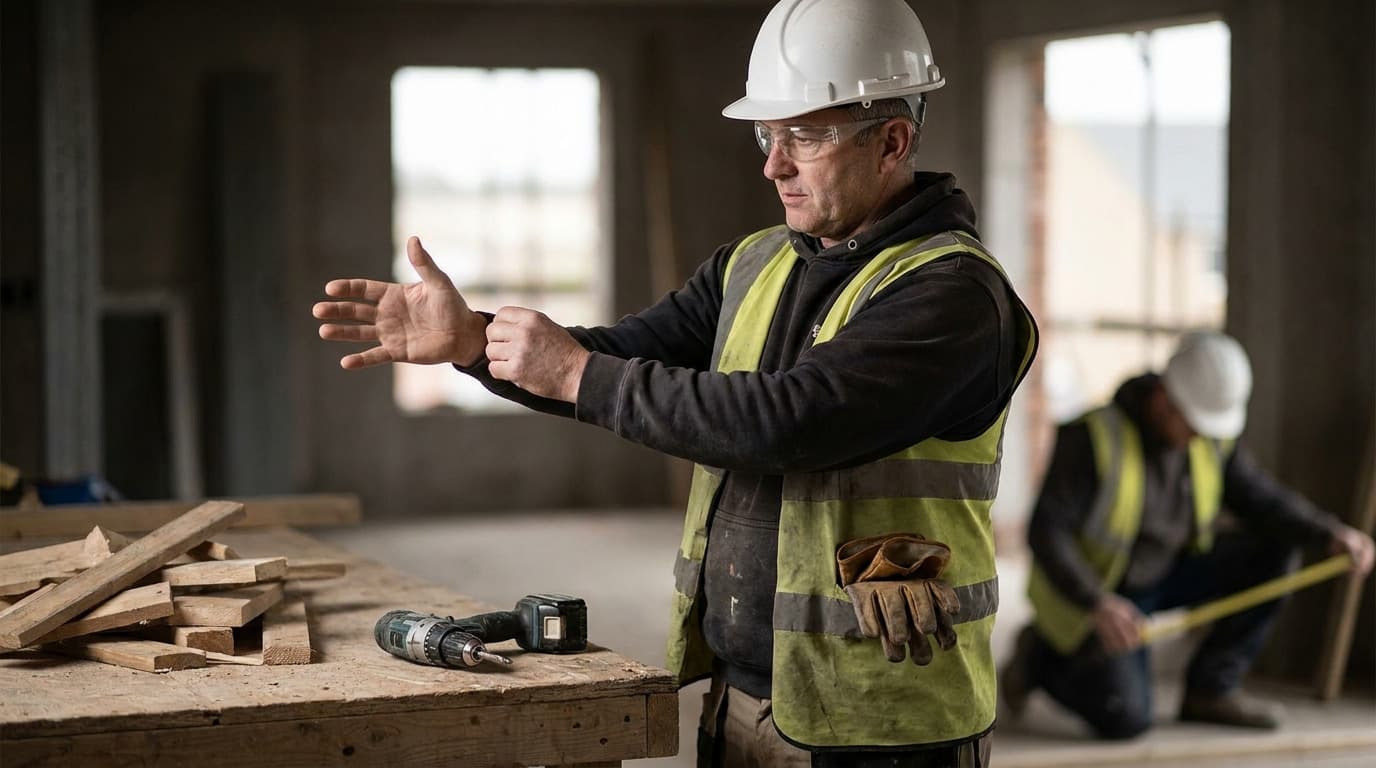
Because the injury is invisible until it is advanced, the early symptoms are not a minor detail — they are the only data you get before the damage becomes lasting. And they are easy to dismiss, because at first they are mild and they go away with rest. The pattern to watch for is specific: tingling, numbness, aching, burning, stiffness, weakness, or reduced grip in the hands, wrists, forearms, elbows, shoulders, or neck. The tell is the timing — symptoms that show up during or after a shift and ease overnight or over the weekend, then come back when you go back to the task. That cycle is the early stage of a musculoskeletal disorder announcing itself, and it is the window in which the injury is still reversible.
The mechanism of harm — the thing that actually turns a nuisance into a permanent problem — is treating those signs as "just soreness" and working through them. Every time you push past the early symptoms, the tissue gets less recovery and the damage compounds. By the time the pain is constant, no longer eased by rest, and starting to affect your grip or your sleep, the disorder is well established and much harder to reverse. So the single most important behavior in this whole talk is the least dramatic one: report the early signs and act on them while they still come and go. That is not being soft. That is catching the one injury on the site that gives you a warning before it becomes permanent.
How we actually prevent it#
You break the injury by breaking the risk factors, and most of the fixes are small.
Vary the task. Rotating between different motions gives each muscle group recovery while another works. The same crew doing the same repeated motion all shift is the classic setup; mixing tasks or rotating people is the classic fix. Take the micro-breaks. Brief, frequent pauses to shake out the hands, stretch, and let the tissue recover do far more than one long break, because recovery between the repetitions is what is missing. Fix the posture and the tool. Keep the wrist straight rather than bent, keep work at a height that does not force a reach or a stoop, and choose or adjust tools so you are not gripping harder or twisting more than the job needs — a different handle, a bent-nose tool, or a support can take a body part out of the awkward posture entirely. Reduce the force. Sharp blades, well-maintained tools, power assist where it exists, and not gripping harder than necessary all lower the load. And manage vibration — anti-vibration gloves, well-maintained tools, and breaks from continuous vibrating-tool use. None of these is dramatic, which is precisely why they get skipped — but against an injury made of small repeated insults, small repeated fixes are exactly the right scale.
Where the duty sits#
Repetitive strain is one of the few areas where the United States deliberately has no specific standard.
OSHA published an ergonomics standard that took effect in November 2000, and it was repealed in early 2001 — so there is no federal ergonomics rule. OSHA instead addresses ergonomic hazards under the General Duty Clause, Section 5(a)(1) of the OSH Act, which requires employers to provide a workplace free from recognized hazards likely to cause serious harm. In practice, OSHA identifies an ergonomic hazard by pointing to the task conditions — high force, repetition, awkward posture, contact stress, vibration — not to the wording of any written policy. The prevention framework comes from NIOSH, whose guidance on identifying risk factors and controlling them is the recognized reference. General safety-training and hazard-assessment duties under 1926.20 / 1926.21 apply, and on federal contract work EM 385-1-1 addresses ergonomics as part of its health-hazard program. A few US states — California, Minnesota, and Washington among them — have their own ergonomics rules that go beyond the federal baseline, so where a state or a contract sets a specific requirement, that requirement governs.
What can go wrong?#
- A worker does the same forceful, repetitive motion all shift, every shift, with no task variation.
- Early tingling and aching are dismissed as "just soreness" and worked through until the damage is permanent.
- A tool forces a bent wrist or a tight grip, adding awkward posture and force to the repetition.
- Overhead or twisted-posture work is repeated for long periods with no recovery.
- Continuous vibrating-tool use runs for hours with no breaks.
- No one reports the symptoms because there was no "accident" to report.
- The task is treated as safe because no single motion is dangerous — missing that the total is the hazard.
- Contact stress from a hard tool or table edge presses on a nerve shift after shift.
How do we manage this properly?#
- Understand the injury is cumulative — the total of many safe-feeling motions, not any one of them.
- Vary the task or rotate people so each muscle group gets recovery.
- Take frequent micro-breaks to shake out, stretch, and let tissue recover between repetitions.
- Fix posture and tools — keep the wrist neutral, work at the right height, choose tools that reduce reach, grip, and twist.
- Reduce force and vibration — sharp blades, maintained tools, power assist, anti-vibration measures.
- Watch for the early signs — tingling, numbness, aching, weakness that comes with the task and eases with rest.
- Report and act on symptoms early, while they still come and go and the injury is still reversible.
- Never treat "no single event" as "no hazard" — the total exposure is the hazard.
Before you start#
- Confirm you know which of your tasks are repetitive, forceful, or done in awkward posture.
- Confirm task rotation or variation is planned for long repetitive work.
- Confirm tools and work heights are set to keep wrists neutral and reduce reach and grip.
- Confirm micro-breaks are built into long repetitive or vibrating-tool tasks.
- Confirm you know the early warning signs and that reporting them is expected, not discouraged.
- Confirm anti-vibration measures are in place for continuous vibrating-tool use.
- Confirm anyone already feeling early symptoms has raised them.
- On federal work, confirm ergonomics is covered in the site health-hazard program.
Talk it over#
- Which of our tasks is the most repetitive, and is anyone feeling it in their hands, wrists, or shoulders?
- Have you ever had tingling or aching after a shift that eased by Monday? That is the signal we are talking about.
- Where could we rotate tasks or add a micro-break to give a body part recovery?
- Is there a tool or a work height here that is forcing a bent wrist or a hard grip we could fix?
The bottom line#
Repetitive strain is the sum of thousands of movements, each of which was fine on its own. It is the one injury on the site with no moment — no lift, no drop, no slip to point to — because the harm is cumulative: force, repetition, awkward posture, and vibration applied over time, wearing down a tendon or pressing on a nerve faster than the body can recover between shifts. That is why you cannot prevent it by being careful during "the dangerous part" — there is no dangerous part, only the same safe-feeling motion done too many times with too little recovery. The risk factors are a short list — repetition, force, awkward posture, vibration, multiplied by duration and contact stress — and they do the most damage in combination. Because the injury is invisible until it is advanced, the early warning signs are the only data you get: tingling, numbness, aching, and weakness that come with the task and ease with rest, in the hands, wrists, elbows, shoulders, or neck. The mechanism that turns a nuisance into a permanent disorder is treating those signs as "just soreness" and working through them, so the single most important behavior is the least dramatic one — report and act on the early signs while they still come and go. The fixes match the injury's scale: vary the task, take the micro-breaks, fix the posture and tools, reduce force and vibration. The United States deliberately has no ergonomics standard — it was repealed in 2001 — so the duty runs through the General Duty Clause 5(a)(1) and NIOSH guidance, with the hazard identified by the task conditions themselves. The test for any repetitive task is one question: is this motion, times how many, in what posture, for how long — and is anyone already feeling the early signs we are trained to catch?
Frequently asked questions about repetitive strain#
Why is repetitive strain called an injury with no moment?
Because unlike a fall, a cut, or a bad lift, there is no single event that caused it. The damage is cumulative — the total of thousands of movements, each of which felt fine on its own, repeated with too little recovery until a tendon wears down or a nerve is compressed. You will never be able to say when it started, which is exactly why it is dangerous and why there is nothing to write on an incident form until it is already serious.
What are the early warning signs I should watch for?
Tingling, numbness, aching, burning, stiffness, weakness, or reduced grip in the hands, wrists, forearms, elbows, shoulders, or neck. The key tell is the timing: symptoms that appear during or after a shift and ease overnight or over the weekend, then return when you go back to the task. That come-and-go pattern is the early, still-reversible stage of a musculoskeletal disorder, and it is your only warning.
If no single motion is dangerous, how do I get injured?
Through the total, not the individual motion. The risk factors are repetition, force, awkward posture, and vibration, multiplied by how long they run without recovery. Any one motion is safe; the same motion thousands of times, especially combined with a hard grip or a bent wrist, breaks the tissue down faster than the body rebuilds it. The hazard is the accumulation, which is why "it's just typing" or "it's just running the driver" misses the real risk.
Should I report symptoms if nothing actually "happened"?
Yes — and this is the most important thing in the talk. Because there is no accident, people assume there is nothing to report, and they work through the early signs until the injury is permanent. The early, come-and-go symptoms are the window in which the disorder is still reversible. Reporting them is not being soft; it is catching the one injury on the site that gives you a warning before it becomes lasting.
What actually prevents it?
Breaking the risk factors, mostly with small fixes: vary the task or rotate people so muscle groups recover; take frequent micro-breaks to let tissue recover between repetitions; fix posture and tools to keep the wrist neutral and reduce reach, grip, and twist; reduce force with sharp blades and maintained tools; and manage vibration with anti-vibration measures and breaks. None of it is dramatic, which is why it gets skipped — but small repeated fixes are the right scale for an injury made of small repeated insults.
Is there an OSHA standard for ergonomics?
No. OSHA published an ergonomics standard that took effect in November 2000, and it was repealed in early 2001, so there is no federal ergonomics rule. OSHA addresses ergonomic hazards under the General Duty Clause, Section 5(a)(1), identifying the hazard by the task conditions — force, repetition, awkward posture, contact stress, vibration — and NIOSH guidance is the recognized prevention reference. Some states, such as California, Minnesota, and Washington, have their own ergonomics rules that go further.
Download the repetitive strain toolbox talk PDF#
Get this repetitive strain toolbox talk as a print-ready PDF — available in English, Spanish, Portuguese, and Turkish. Print it, hand it to the crew, and collect signatures on the included attendance sheet.
Download the PDF — free account required. New members get 3 free downloads.
Related toolbox talks#
Sources#
- OSHA, Ergonomics — Overview (MSDs, risk factors; no ergonomics standard, General Duty Clause enforcement): https://www.osha.gov/ergonomics
- CDC/NIOSH, About Ergonomics and Work-Related Musculoskeletal Disorders (cumulative cause: force, repetition, awkward posture, vibration; not instantaneous events): https://www.cdc.gov/niosh/ergonomics/about/index.html
- CDC/NIOSH, Step 1: Identify Risk Factors (neutral vs awkward/static posture; identifying WMSD risk): https://www.cdc.gov/niosh/ergonomics/ergo-programs/risk-factors.html
This talk is general awareness guidance for training purposes. It does not replace your employer's ergonomics or health-hazard program, a medical evaluation of symptoms, the OSH Act General Duty Clause, applicable state ergonomics rules, or a competent person's duties, and it is not medical or legal advice. If you are experiencing persistent symptoms, seek a medical evaluation.
Written by FieldSafetyTalk's safety professional — a CSP, ASP, CHST and OSHA Authorized Outreach Trainer with 14+ years of international construction safety experience across federal, heavy civil, and industrial projects.