Stretching Before Work
Updated 2026-07-31
In this bundle Manual Handling & Body Mechanics
Print-ready PDF
Download this talk as a print-ready PDF, available in 4 languages.
Stretch-and-flex is one of the most widely adopted programmes in construction, and one of the least examined. It gets run every morning on thousands of sites on the strength of an assumption nobody checks. This talk checks it — and the honest answer is more interesting than either "it works" or "it's a waste of time." This Stretching Before Work Toolbox Talk (Safety Talk / Tailgate Talk) is about what the programme actually does.
Here is the distinction that carries this whole talk: the stretching is probably not preventing the injuries — and that is not a reason to stop doing it, it is a reason to stop relying on it. The published position is that research on workplace stretching programmes has produced mixed results: some studies found modest reductions in injuries and time off work, others found no reduction, and some found negative effects. That is not a strong foundation for the industry's main musculoskeletal control, and treating it as one is where the real risk sits.
Warm-up is not stretching#
This is the single most useful correction in the talk, because most programmes get it backwards.
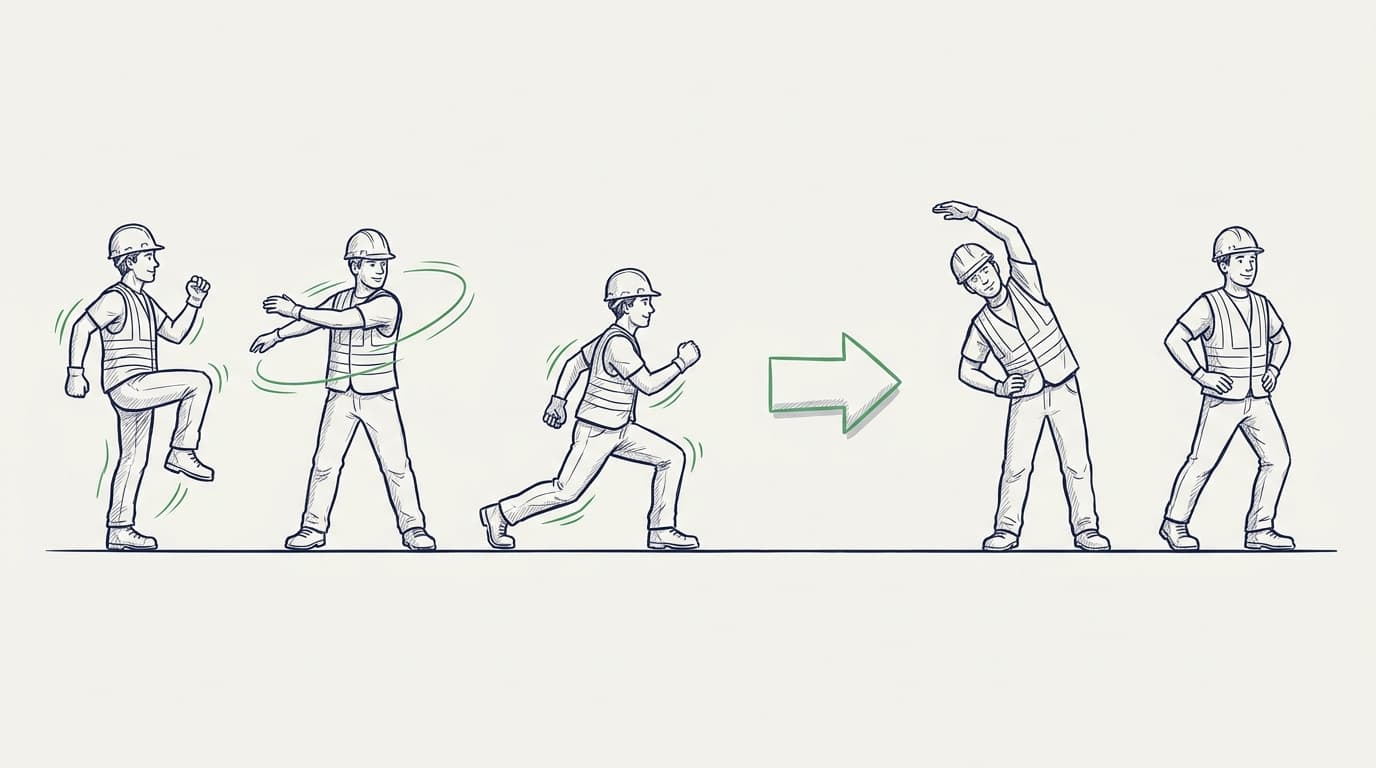
Warming up means moving large muscle groups — the extensors and flexors of the arms and legs — to increase circulation and generate heat. It changes the physical state of the tissue.
Stretching lengthens a muscle-tendon unit and increases range of motion. It is a different action with different effects.
The published guidance is that stretching is best done after warming up, not first thing in the morning — and that most workplace stretching programmes do not follow that protocol. They put cold people in a circle at seven in the morning and have them hold static stretches, which is close to the opposite of what the physiology supports.
So if you keep one change from this talk, make it this: move first, then stretch if you are going to. Two minutes of walking, arm swings and easy range-of-motion work before anything is held.
What stretching does not do#
Being precise here matters, because vagueness is what lets a programme substitute for real controls.
There is no evidence that stretching increases the ability of musculoskeletal tissues to withstand high force exertions. That is the mechanism that matters most in construction — the load, the awkward reach, the repeated exertion.
By contrast, there is a strong theoretical basis that reducing forces through ergonomic design protects musculoskeletal tissue: fewer newtons through the tissue means more cycles before failure.
Put plainly: stretching is being asked to do a job only design can do. The comparison that lands with most crews is the back belt — an intervention that was everywhere in this industry, widely believed in, and did not turn out to prevent the injuries it was sold against.
What stretching does do — and it is not nothing#
A talk that stops at the criticism would be as unbalanced as the poster it is criticising. The documented benefits are real:
Increased range of motion and flexibility.
Reduced discomfort. Workers report feeling better, and that matters on its own terms.
Psychosocial benefits — programmes have been associated with reduced stress, better job satisfaction and improved sense of self-efficacy.
And then the benefits nobody writes into the programme objectives, which may be the largest:
It gets the crew in one place at the start of the shift, which is when briefing, planning and communication actually happen.

It reveals condition. Somebody who cannot raise an arm, who is guarding a shoulder, who winces — that is visible in a stretch circle and invisible in a car park. This is the highest-value thing a stretch programme does and it is entirely accidental.
It is a daily signal that the employer expects the day to start deliberately rather than at a run.
None of those require the stretching to prevent a single injury. They are good reasons to keep the programme and terrible reasons to count it as your musculoskeletal control.
The recordability trap#
This one catches sites out, and it is worth knowing precisely.
OSHA has drawn a line between preventive exercise and exercise recommended as treatment. In a letter of interpretation, OSHA noted that exercises that are generally part of safe work practices commonly recommended for anyone engaged in certain tasks or working with certain equipment are not considered medical treatment.
The corollary is the trap: exercises recommended to treat a condition count as medical treatment, and medical treatment beyond first aid is one of the criteria that makes a case recordable under 1904.7. OSHA issued enforcement guidance in May 2024 to help inspectors decide when stretching and related techniques are recordable.
The practical rule for a supervisor: a general set of stretches offered to everybody is preventive. Prescribing a specific stretch to a specific worker for a specific complaint has changed character — and at that point the right move is occupational health or a physician, not an improvised remedy at the tailgate.
Where the duty sits#
There is no OSHA ergonomics standard. It is important to say that plainly rather than imply otherwise. What applies:
Section 5(a)(1) — the General Duty Clause and recognised hazards, which is the route by which ergonomic hazards are cited where a feasible means of abatement exists.
1926.21(b)(2) — instruction in the recognition and avoidance of unsafe conditions.
1926.20(b)(1) — the employer must initiate and maintain such programs as may be necessary to comply.
1904.7 — the recording criteria, including medical treatment beyond first aid.
What can go wrong?#
The programme treated as the control, so nobody looks at the loads, the reaches or the layout.
Static stretching on cold bodies at the start of a shift, against the published protocol.
Competitive stretching — pushing to the point of pain, which is an injury mechanism in itself.
A specific stretch prescribed for a specific complaint, quietly turning a preventive programme into medical treatment.
Somebody's visible discomfort noticed and not acted on, which wastes the most valuable thing the circle produces.
A worker with an existing injury made to participate.
Ten minutes of stretching followed by a badly designed lift, which is the whole problem in one image.
Attendance recorded as evidence of an ergonomics programme.
How do we manage this properly?#
Keep the programme, change the claim. Run it for the warm-up, the gathering and the visibility — not as your musculoskeletal control.
Move before you stretch. Circulation and heat first; hold anything only after.
Make it voluntary in intensity. Nobody stretches into pain, and nobody competes.
Use the circle to look at people. A supervisor who watches how the crew moves for two minutes learns more than any form provides.
Act on what you see. Adjust the task, not just the person.
Route specific complaints to occupational health, and keep prescribed exercise out of the tailgate — both for the worker's sake and for the recordkeeping line.
Then do the real work: reduce the forces. Mechanical aids, delivery to point of use, working heights, two-person handling, rotation, and layout that removes carries. That is what has the evidence behind it.
And be honest with the crew. Telling a crew the truth about a programme they have done a thousand times buys more credibility than any poster.
Before you start#
- Confirm you have moved and raised your heart rate before holding any stretch.
- Confirm nobody is stretching into pain or competing.
- Confirm anyone carrying an injury has said so and is not being pushed.
- Confirm the supervisor is actually watching how people move, not just counting heads.
- Confirm today's tasks have been looked at for load, reach and repetition — not just the stretches.
- Confirm any specific complaint is going to occupational health, not to an improvised exercise.
- Confirm mechanical aids for today's heaviest task are on site and working.
- Confirm the programme is not being counted as your ergonomics control.
Talk it over#
- Does anyone here believe the morning stretch has prevented an injury?
- What is the heaviest or most awkward task today, and what would make it lighter?
- Who is carrying something at the moment that they have not mentioned?
- If we stopped stretching tomorrow, what would we lose?
The bottom line#
The stretching is probably not preventing the injuries — and that is a reason to stop relying on it, not to stop doing it. Research on workplace stretching programmes has produced mixed results: some modest reductions, others no reduction and even negative effects. Get the physiology the right way round: warming up means moving large muscle groups to increase circulation and generate heat, while stretching lengthens tissue — and published guidance is that stretching is best done after warming up, not first thing in the morning, which most programmes do not follow. Critically, there is no evidence that stretching increases the ability of tissue to withstand high force exertions, whereas there is a strong theoretical basis that reducing forces through ergonomic design does — stretching is being asked to do a job only design can do, much as the back belt was. What it genuinely delivers is range of motion, reduced discomfort, psychosocial benefit, and — accidentally, and most valuably — a daily look at how the crew is moving. Watch the recordkeeping line: generally recommended preventive exercises are not medical treatment, but exercise prescribed to treat a condition is, and medical treatment beyond first aid makes a case recordable under 1904.7. There is no OSHA ergonomics standard; 5(a)(1) is the route for ergonomic hazards.
Frequently asked questions about stretching before work#
Does stretching before work prevent injuries?
The evidence is mixed and does not support relying on it. Research on workplace stretching programmes has found some modest reductions in injuries and time off work in a few studies, no reduction in others, and even some negative effects. Published commentary has compared it to the back belt — widely adopted, widely believed in, and not shown to prevent the injuries it was aimed at.
What is the difference between warming up and stretching?
Warming up means moving large muscle groups — arm and leg extensors and flexors — to increase circulation and generate heat, changing the physical state of the tissue. Stretching lengthens the muscle-tendon unit and increases range of motion. They are different actions, and the guidance is that stretching is best done after warming up, not cold first thing in the morning.
Why doesn't stretching protect against heavy or awkward work?
Because the mechanism does not match the hazard. There is no evidence that stretching increases the ability of musculoskeletal tissues to withstand high force exertions — which is exactly what construction work applies. By contrast there is a strong theoretical basis that reducing forces through ergonomic design protects tissue, because fewer forces mean more cycles before failure.
So should we stop doing it?
No — change what you claim it does. The documented benefits are real: increased range of motion and flexibility, reduced discomfort, and psychosocial benefits including reduced stress and better job satisfaction. It also gathers the crew at the start of a shift and — most valuably and entirely by accident — makes visible who is moving badly, guarding a shoulder or wincing. Keep the programme; stop counting it as your musculoskeletal control.
Can stretching make an injury recordable?
It can, depending on why it was recommended. OSHA has indicated that exercises generally part of safe work practices commonly recommended for anyone doing certain tasks are not medical treatment. But exercise recommended to treat a condition counts as medical treatment, and medical treatment beyond first aid is a recording criterion under 1904.7. OSHA issued enforcement guidance in May 2024 on when such techniques are recordable.
What should a supervisor do if someone reports discomfort at the stretch circle?
Route it properly rather than solving it there. A general set of stretches offered to everyone stays preventive; prescribing a specific stretch to a specific person for a specific complaint changes its character — for the worker's benefit and for the recordkeeping position. The right destination is occupational health or a physician, plus a look at whether the task itself needs adjusting.
Is there an OSHA ergonomics standard?
No. There is no OSHA ergonomics standard, and it would be wrong to imply otherwise. Ergonomic hazards are addressed through the General Duty Clause, Section 5(a)(1), on recognised hazards where a feasible means of abatement exists, supported by 1926.21(b)(2) on instruction and 1926.20(b)(1) on maintaining necessary programmes.
Download the stretching before work toolbox talk PDF#
Get this stretching before work toolbox talk as a print-ready PDF — available in English, Spanish, Portuguese, and Turkish. Print it, hand it to the crew, and collect signatures on the included attendance sheet.
Download the PDF — free account required. New members get 3 free downloads.
Related toolbox talks#
Sources#
- AIHA, Questioning Stretching Programs: https://publications.aiha.org/questioning-stretching-programs
- Washington State Department of Labor & Industries, Do workplace stretching programs help prevent injuries?: https://lni.wa.gov/safety-health/_docs/StretchingAndInjuries.pdf
- OSHA, 29 CFR 1904.7 — General recording criteria: https://www.osha.gov/laws-regs/regulations/standardnumber/1904/1904.7
This talk summarises published occupational health literature for training purposes. It is not medical advice and nothing in it is a diagnosis. Anyone with pain, discomfort or an existing injury should be assessed by occupational health, a physician or another qualified health professional rather than treated with exercises recommended on site.
Written by FieldSafetyTalk's safety professional — a CSP, ASP, CHST and OSHA Authorized Outreach Trainer with 14+ years of international construction safety experience across federal, heavy civil, and industrial projects.