Fall Clearance Awareness
Updated 2026-07-24
In this bundle Fall Protection & Heights
Print-ready PDF
Download this talk as a print-ready PDF, available in 4 languages.
A worker can be wearing a certified harness, clipped to a 5,000-pound anchor, with a lanyard that has never been out of spec, and still be killed by the ground. The system works exactly as designed. It arrests the fall in textbook fashion. It just finishes doing so eighteen inches below the concrete. This Fall Clearance Awareness Toolbox Talk (Safety Talk / Tailgate Talk) is about the one fall protection question that has nothing to do with the quality of your equipment.
Here is the distinction that carries this whole talk: every other rule in Subpart M asks whether the system will hold. Fall clearance asks whether the system has room to work. Those are separate questions with separate answers, and a crew can pass the first one perfectly while failing the second one fatally. Arresting a fall is not instantaneous and it is not short. The system needs a specific amount of empty air underneath you to do its job, and if that air is not there, the equipment does not fail — it simply runs out of distance.
Why fall clearance gets missed#
There is no dedicated national dataset isolating deaths caused by insufficient clearance; these are recorded as falls to a lower level like any other, so treat any figure you see quoted for it with suspicion. But there is something better than a statistic here, and it is sitting in plain sight in the text of the standard.
29 CFR 1926.502(d)(16)(iii) contains two requirements joined by one word. A personal fall arrest system, when stopping a fall, shall be rigged such that an employee can neither free fall more than 6 feet (1.8 m), nor contact any lower level.
Almost everyone in construction can quote the first half. The six-foot free fall limit is on every training slide in the industry. The second half — nor contact any lower level — is the same sentence, the same subparagraph, carrying exactly the same legal force, and it is the half that gets left off. That is the entire problem in one line. A six-foot lanyard on a compliant anchor satisfies the free-fall requirement completely and still violates the standard if the worker reaches the deck. Compliance was never about the lanyard. It was always about the distance underneath.
There is a second, quieter provision worth knowing. The Note to 1926.502(d)(16) says the Appendix C compliance presumption applies where the employee's combined person and tool weight is less than 310 pounds (140 kg). At 310 pounds or more, the employer must appropriately modify the criteria and protocols to provide proper protection for the heavier weight, or the system is not deemed compliant. A heavier worker carrying a heavier tool belt falls further before stopping — and almost nobody checks this.
OSHA fall clearance requirements (29 CFR 1926 Subpart M)#
- Free fall and lower-level contact — 1926.502(d)(16)(iii). The system must be rigged so the employee can neither free fall more than 6 feet nor contact any lower level. Both conditions, not either.
- Deceleration distance — 1926.502(d)(16)(iv). The system must bring the employee to a complete stop and limit maximum deceleration distance to 3.5 feet (1.07 m). This is distance travelled after free fall ends, and it counts toward what you need below you.
- System strength — 1926.502(d)(16)(v). Sufficient strength to withstand twice the potential impact energy of a 6-foot free fall, or the free fall distance the system permits, whichever is less.
- Self-retracting devices — 1926.502(d)(12) and (d)(13). SRLs that automatically limit free fall to 2 feet (0.61 m) or less must sustain 3,000 pounds; those that do not limit it to 2 feet, along with ripstitch and tearing or deforming lanyards, must sustain 5,000 pounds. That 2-foot threshold is why an SRL is the usual answer when clearance is short.
- Positioning devices — 1926.502(e)(1). A positioning device must be rigged so the employee cannot free fall more than 2 feet. Positioning equipment is not fall arrest equipment and must not be substituted for it.
- Training — 1926.503(a)(2). Training must be given by a competent person. Appendix C (d) is explicit that it should include estimation of free fall distance, including determination of deceleration distance, and total fall distance to prevent striking a lower level. In other words, OSHA expects the people at height to be able to do this arithmetic — not just their supervisor.
Appendix C is where the practical guidance lives:
- Paragraph (k), free fall. The tie-off point should be at or above the harness attachment point. Attaching at the working surface will often produce a free fall greater than 6 feet: if a 6-foot lanyard is used, the total free fall is the distance from the working level up to the harness attachment point plus the 6 feet of lanyard. A few extra feet of free fall significantly increases arresting force, possibly to the point of causing injury.
- Paragraph (l), elongation and deceleration. Lanyard stretch and deceleration device stopping distance must be added to the free fall distance to arrive at total fall distance. A long lifeline adds its own elongation on top. Sufficient distance must be maintained between the employee and obstructions below. Also: allow a minimum of 12 feet (3.7 m) of lifeline below the securing point of a rope grab, terminated so the device cannot slide off the end.
- Paragraph (m), obstructions. The tie-off location must account for obstructions in the potential fall path, and tie-offs that minimise exaggerated swinging should be chosen.
- Paragraph (h)(6), horizontal lifelines. Sag matters. At 15 degrees of sag the force amplification is about 2:1; at 5 degrees it is about 6:1. Sag also adds directly to how far you drop before the line takes the load.
On USACE and NAVFAC projects, EM 385-1-1 applies and is more prescriptive on clearance calculation and documentation in several places.
What can go wrong#
Tying off at or below foot level. The single most common clearance error, and Appendix C (k) names it directly. Anchoring at the walking surface means the fall begins with the distance from your feet up to your dorsal D-ring — roughly five feet on most adults — before the lanyard even starts to pay out. A 6-foot lanyard tied off at your boots is an eleven-foot free fall, which is both over the legal limit and far more arresting force than the system was tested for.
Using a 6-foot shock-absorbing lanyard at low heights. This is the classic fatality. On a mezzanine, a low steel frame, a truck bed, or a second-floor deck, the worker is high enough to require fall protection and not high enough for a 6-foot lanyard to work. The equipment is compliant. The geometry is not.
Counting only the lanyard. Free fall is one of at least four numbers. Deceleration distance (up to 3.5 feet under (d)(16)(iv)), harness stretch, and the distance from your D-ring down to your feet all sit below the free fall in the total. Appendix C (l) requires them to be added together, not chosen between.
Swing fall. Clearance is almost always measured straight down. If you are working laterally away from the anchor, you do not fall straight down — you swing through an arc. That arc can bring you into a wall, a column, or scaffolding at speed, and the low point of the swing is lower than the point directly below the anchor. Everything in the arc is in your fall path.
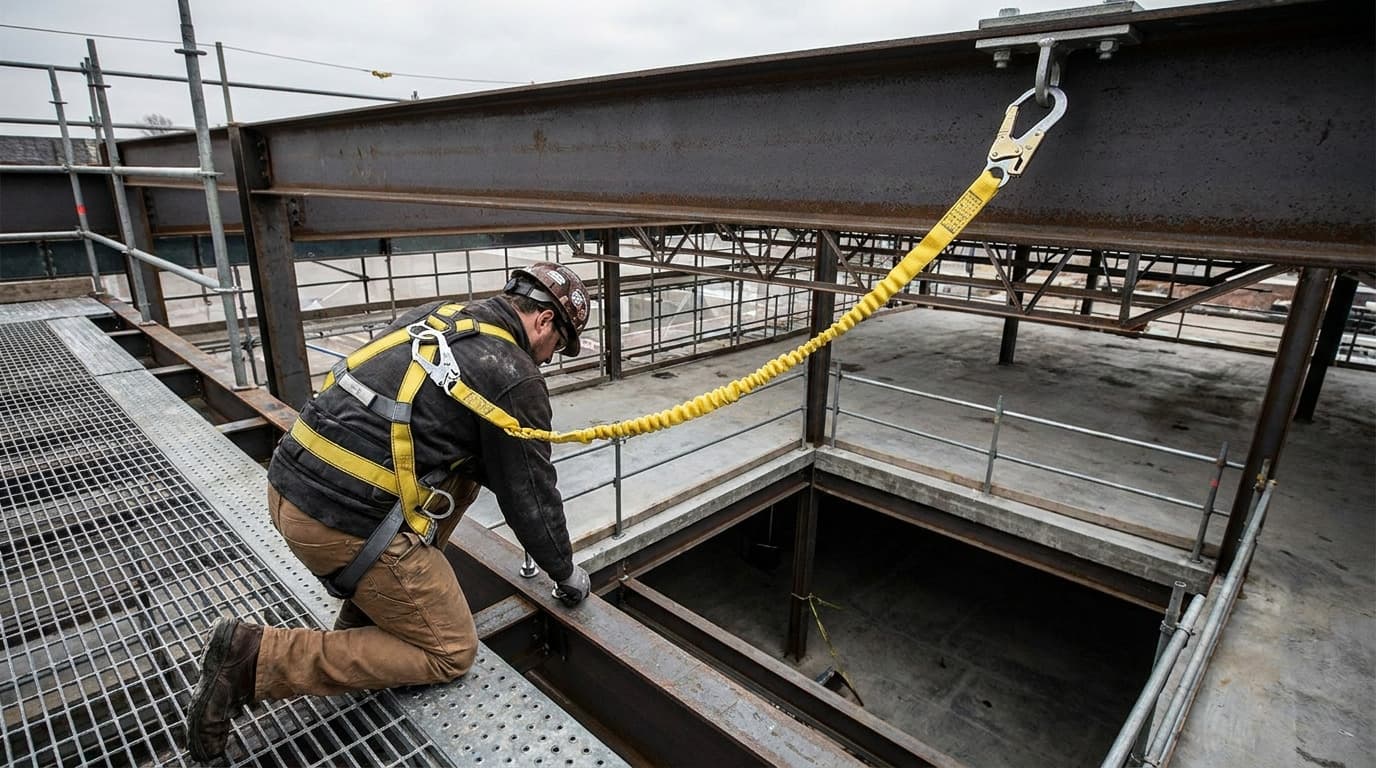
Horizontal lifeline sag. A horizontal lifeline is not a rigid beam. Under load it deflects, and that deflection is added fall distance before the system begins to arrest anything at all.
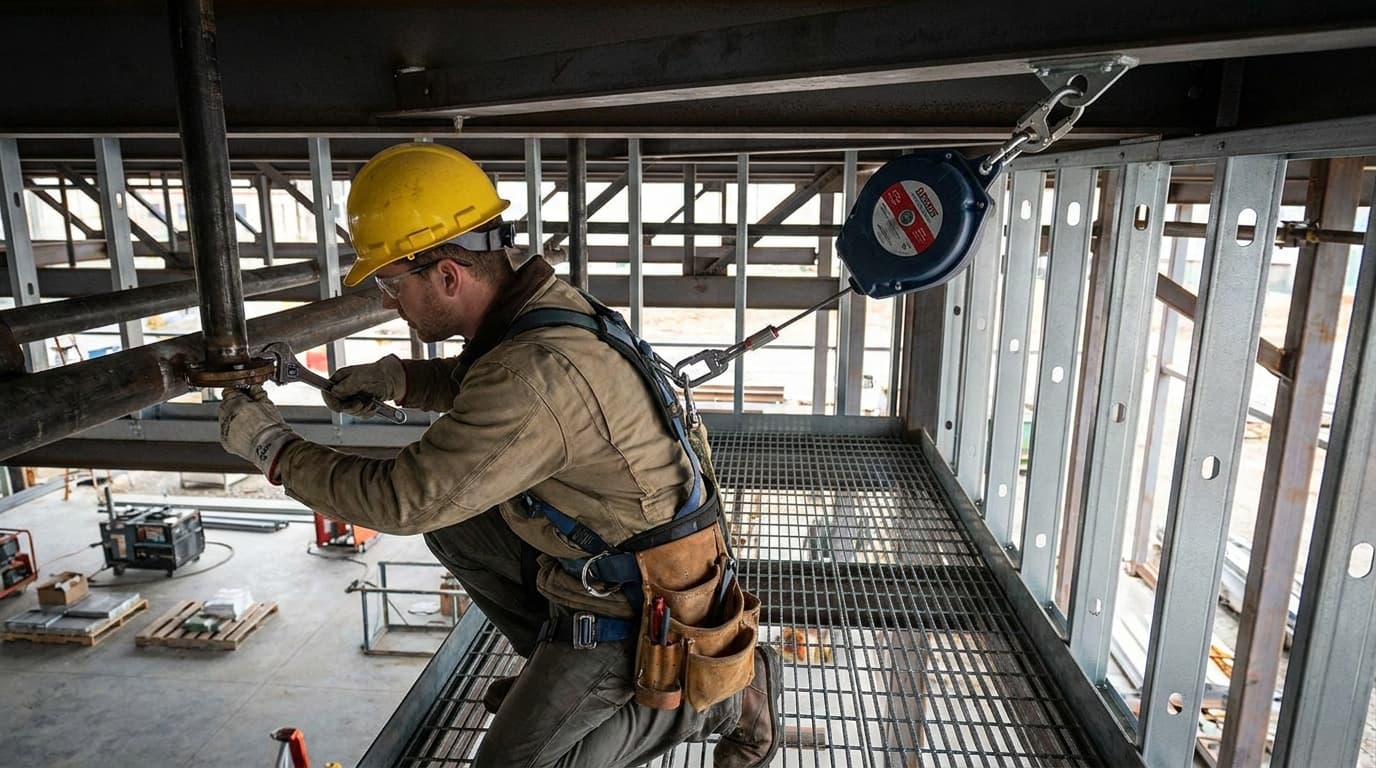
Self-retracting lifelines used below the D-ring. SRLs limit free fall because they lock quickly — but a standard SRL anchored below shoulder level allows slack to develop, may not lock as designed, and exposes the lifeline to a sharp edge on the way. Only devices specifically rated for foot-level or leading-edge use may be anchored that way.
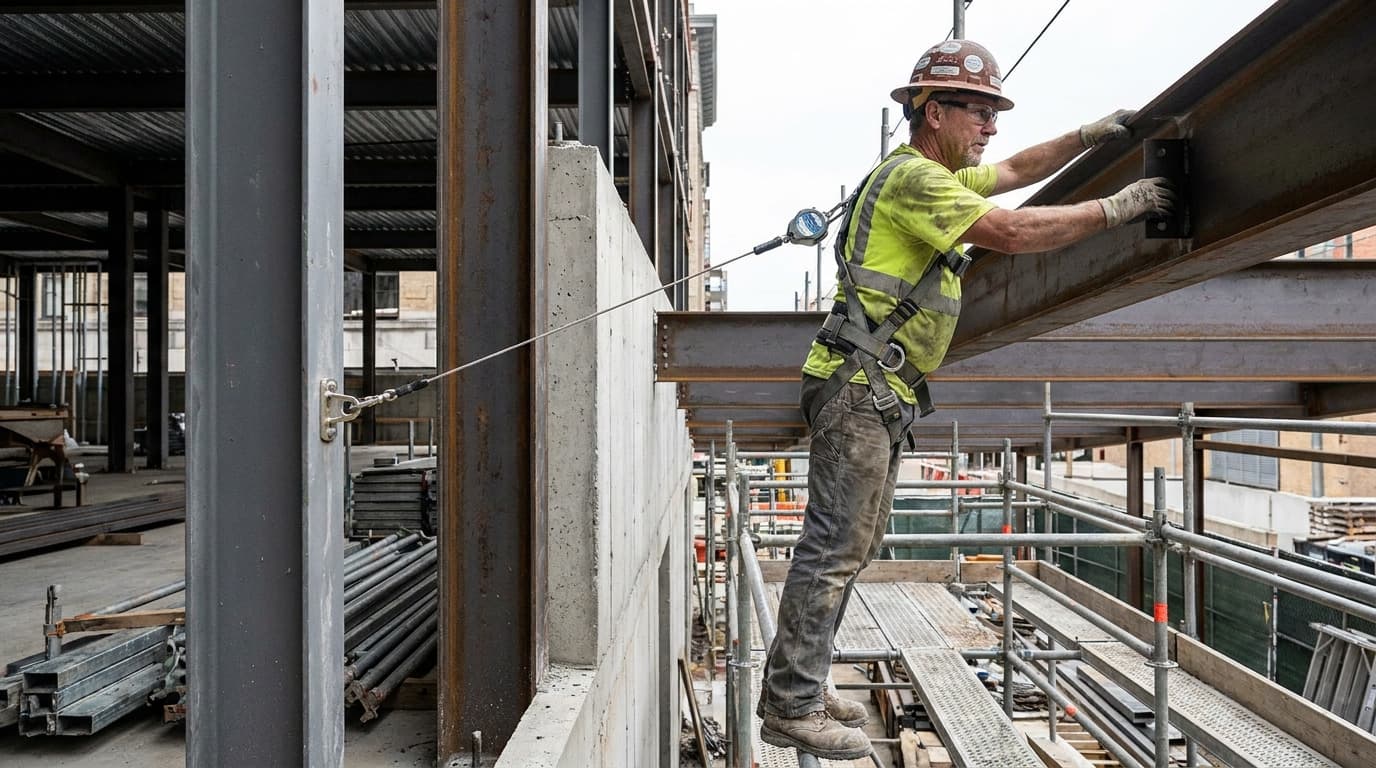
Rope grabs with too little line beneath. Appendix C (l) asks for at least 12 feet of lifeline below the rope grab's securing point, terminated at the end. Without it, a worker can slide past the end of the lifeline and the grab simply comes off.
Deployed shock packs and unknown equipment. A partially deployed energy absorber has already spent some of its stopping distance. Equipment with unreadable labels cannot be assigned a deceleration distance at all — so its clearance cannot be calculated.
Combined weight over 310 pounds. Worker plus tools plus the belt. Past that threshold the Appendix C presumption no longer applies and the numbers must be re-derived for the actual load.
And the failure underneath all of them: nobody measured. The distance below the work was estimated by eye, from above, by somebody who was not going to be the one hanging in it.
How do we get fall clearance right?#
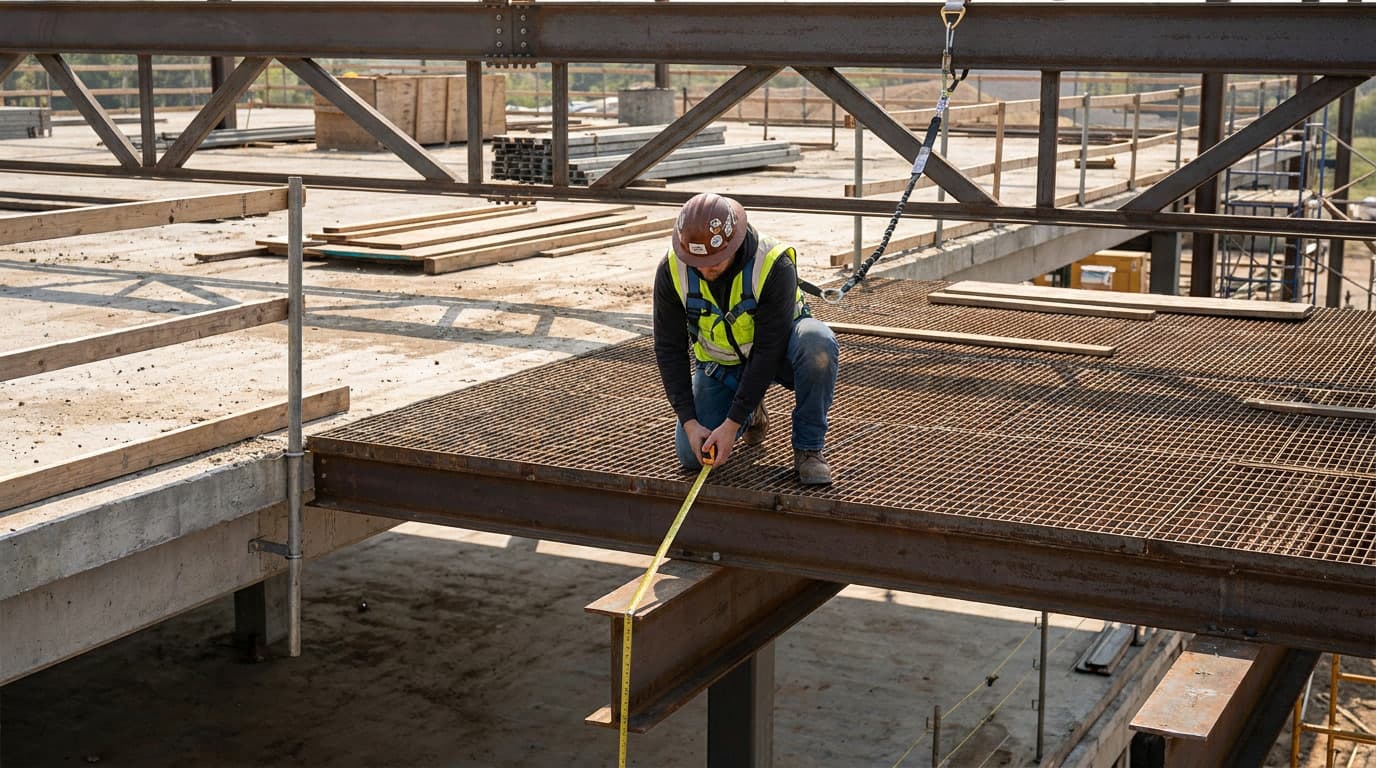
Measure the drop. Do not estimate it. Total fall distance is arithmetic, and arithmetic needs a real number underneath it. Measure from the walking surface to the nearest obstruction below — not to the ground, to whatever you would hit first.
Add every component, in this order. Appendix C (l) requires the sum, and it looks like this:
- Free fall distance — from the anchor position and the length of the connector. Capped at 6 feet by (d)(16)(iii), and less if the anchor is overhead.
- Deceleration distance — capped at 3.5 feet by (d)(16)(iv), but read the actual figure off your equipment's label.
- Harness stretch — the D-ring rides up and the webbing elongates during arrest. Manufacturer's figure.
- Height from your dorsal D-ring to your feet — your own body, roughly five feet for most adults, and worth actually measuring for the crew.
- A safety margin — clear air between your boots and the obstruction, so the arrest ends above it rather than at it.
Take the values from your equipment, not from a rule of thumb. For a common configuration — 6-foot shock-absorbing lanyard, anchor at D-ring height, an average-height worker — the total lands in the region of eighteen feet. That figure is an illustration, not a standard. It is not in the regulation, it changes with every component you swap, and publishing it as universal is how people end up with the wrong answer. Two of the five numbers above are fixed by OSHA; the rest come off the label on the gear in your hand.
Tie off overhead wherever you can. Appendix C (k) says the tie-off should be at or above the harness attachment point. Every foot you raise the anchor is a foot of free fall removed from the total, and free fall is the component that drives arresting force hardest.
Use an SRL when clearance is short. An SRL that limits free fall to 2 feet or less under (d)(12) removes most of the free-fall component. Below roughly the mid-teens in feet, a 6-foot lanyard usually cannot be made to work and the honest answer is different equipment — or a guardrail instead of arrest.
Check the swing before you clip. Look at where the anchor is relative to where you will be working. Work as close to directly below the anchor as the task allows, and walk your eye through the full arc: what is in it, and how low does the bottom of the swing go?
Account for horizontal lifeline sag. Get the deflection figure from the qualified person who designed the system, and add it. Do not assume the line is a straight rail.
Re-run the numbers when anything changes. A different lanyard, a lower anchor, a deck that gets removed below, a change in the work position. Clearance is not a property of the equipment; it is a property of the equipment plus this specific location, and it expires the moment either one changes.
Ask what happens after the arrest, too. A system with adequate clearance leaves a worker suspended. Under 1926.502(d)(20) the employer must provide for prompt rescue or assure self-rescue, and that plan has to exist before the fall, not after.
Before you start#
- Measure the actual distance from your working surface to the nearest obstruction below.
- Identify your anchor and confirm it is at or above your dorsal D-ring.
- Read the deceleration distance and harness stretch figures off your own equipment's labels.
- Add free fall, deceleration distance, harness stretch, your D-ring-to-feet height, and a safety margin.
- Compare that total against the distance you measured — and if it does not fit, stop and change the system.
- Walk the swing arc: how far to one side will you be working, and what is in the path?
- If a horizontal lifeline is in use, get the sag figure from the qualified person who designed it.
- Confirm a rope grab, if used, has at least 12 feet of lifeline beneath it and a terminated end.
- Confirm combined worker and tool weight is under 310 pounds, or that the system has been re-evaluated.
- Confirm the rescue plan exists and someone can execute it now.
Talk it over#
- How far is it from where you are standing to the first thing you would hit? Not to the ground — to the first thing. Has anyone measured it today?
- Your anchor is over there and you will be working over here. Draw the arc you would swing through. What is in it?
- If your lanyard is six feet, where does that put you after deceleration and harness stretch — and does the deck below have room for that?
The bottom line#
29 CFR 1926.502(d)(16)(iii) says a fall arrest system must be rigged so a worker can neither free fall more than 6 feet nor contact any lower level, and the second half of that sentence is the one that kills people. Arresting a fall takes distance: free fall, then up to 3.5 feet of deceleration, then harness stretch, then the length of your own body below the D-ring. Appendix C requires those to be added together, using the figures from your specific equipment rather than a remembered rule of thumb. Measure the drop, tie off overhead, switch to an SRL when the clearance is short, walk the swing arc before you clip, and treat any change in anchor, equipment, or work position as a reason to run the numbers again.
Frequently asked questions about fall clearance#
What is fall clearance?
Fall clearance is the vertical distance required below a worker for a personal fall arrest system to stop a fall before the worker contacts a lower level. It is required by 29 CFR 1926.502(d)(16)(iii), which states the system must be rigged so the employee can neither free fall more than 6 feet nor contact any lower level. It is a property of the equipment combined with the specific location — not of the equipment alone.
How do I calculate fall clearance?
Add the components, as Appendix C to Subpart M, paragraph (l) requires: free fall distance, plus deceleration distance, plus harness stretch and lanyard elongation, plus the distance from your dorsal D-ring to your feet, plus a safety margin. Two values are capped by OSHA — free fall at 6 feet under (d)(16)(iii) and deceleration distance at 3.5 feet under (d)(16)(iv). The rest must come from the manufacturer's instructions for the specific equipment you are wearing.
What is the maximum deceleration distance allowed?
3.5 feet (1.07 m), under 29 CFR 1926.502(d)(16)(iv). The system must bring the employee to a complete stop within that distance. It is measured after free fall ends, and it counts toward the total clearance you need below you.
Can I use a 6-foot lanyard at any height?
No. A 6-foot shock-absorbing lanyard needs substantial clearance beneath the worker, and on mezzanines, low steel, and second-floor decks there is often not enough. The lanyard can be entirely compliant and still leave the worker contacting the lower level, which violates 1926.502(d)(16)(iii). Where clearance is short, a self-retracting lifeline limiting free fall to 2 feet or less under 1926.502(d)(12) — or a guardrail instead of arrest — is the correct answer.
What is swing fall?
Swing fall is what happens when a worker is positioned laterally away from the anchor point and falls: instead of dropping straight down, they swing through an arc, which can carry them into walls, columns, or structure at speed. The bottom of that arc is also lower than the point directly beneath the anchor, so it eats clearance. Appendix C, paragraph (m) directs that tie-off locations account for obstructions in the potential fall path and minimise exaggerated swinging.
Why should the anchor be overhead?
Because the anchor position sets the free fall distance. Appendix C, paragraph (k) states the tie-off point should be at or above the harness attachment point, and warns that attaching at the working surface will often produce a free fall greater than 6 feet — with a 6-foot lanyard, total free fall becomes the distance from the working level up to the harness attachment point plus the lanyard length. More free fall means more total distance needed and higher arresting force on the body.
Does the worker's weight affect fall clearance?
Yes. The Note to 1926.502(d)(16) states that the Appendix C compliance presumption applies where combined person and tool weight is under 310 pounds (140 kg). At 310 pounds or more, the employer must modify the criteria and protocols to provide proper protection for the heavier weight, or the system is not deemed compliant. Heavier loads travel further before stopping.
Download the fall clearance toolbox talk PDF#
Get this fall clearance toolbox talk as a print-ready PDF — available in English, Spanish, Portuguese, and Turkish. Print it, hand it to the crew, and collect signatures on the included attendance sheet.
Download the PDF — free account required. New members get 3 free downloads.
Related toolbox talks#
- Fall Protection
- Anchor Point Selection
- How to Inspect a Safety Harness
- Fall Rescue and Suspension Trauma
Sources#
- OSHA, 29 CFR 1926.502 — Fall protection systems criteria and practices: https://www.osha.gov/laws-regs/regulations/standardnumber/1926/1926.502
- OSHA, 1926 Subpart M Appendix C — Personal Fall Arrest Systems, Non-Mandatory Guidelines: https://www.osha.gov/laws-regs/regulations/standardnumber/1926/1926SubpartMAppC
- OSHA, 29 CFR 1926.503 — Training requirements: https://www.osha.gov/laws-regs/regulations/standardnumber/1926/1926.503
Written by FieldSafetyTalk's safety professional — a CSP, ASP, CHST and OSHA Authorized Outreach Trainer with 14+ years of international construction safety experience across federal, heavy civil, and industrial projects.