Tornado and Severe Wind
Updated 2026-08-06
In this bundle Health & Environmental Exposure
Print-ready PDF
Download this talk as a print-ready PDF, available in 4 languages.
A tornado is not like most jobsite hazards, where you see the danger building and decide what to do about it. A tornado can form in minutes and be on you before any official warning reaches your phone. This Tornado and Severe Wind Toolbox Talk (Safety Talk / Tailgate Talk) is about why that speed changes everything, why the decisions that keep you alive are made before the warning rather than during it, and where to go when the seconds start counting.
Here is the distinction that carries this whole talk: a tornado can arrive faster than the warning system — so tornado safety is decided before the warning, not during it. With lightning you get a buffer; the storm announces itself with thunder and you have time to walk to shelter. A tornado may give you no such margin — some develop so fast there is no time for a warning to be issued at all. That means the thing that protects you is not your reaction when the alert comes; it is what you already know and have already set up: where the designated shelter is, how long it takes to reach, and whether you can get there in the seconds you may have. If you are working out the answer to "where do I go?" when the warning sounds, you have started too late.
Where the boundary of this talk sits#
The severe weather and extreme weather talks own storms in general. The lightning talk owns the strike. The emergency evacuation routes talk owns getting out of a building in an emergency. This talk owns the tornado and sudden severe-wind event specifically — the watch-versus-warning decision, sheltering from a tornado, and protecting yourself from wind-driven debris. Its companion, the high winds talk, owns sustained high wind as an ongoing work condition — when to stop cranes and lifts and secure materials. Where the question is general storm planning, lightning, or building evacuation, those talks own it; this one owns the "take cover now" moment.
Watch versus warning: the whole margin lives here#
The single most important piece of knowledge for a tornado is the difference between a watch and a warning, because that difference is where your entire margin of safety lives.
A tornado watch means conditions are right and a tornado is possible in your area. It is not a signal to take cover — it is a signal to prepare: keep an eye on the weather, confirm where the shelter is, make sure everyone knows the plan, and be ready to move fast. A tornado warning is far more serious: it means a tornado has actually been spotted or shown up as rotation on radar, and everyone should take shelter immediately. The mistake that hurts people is treating these as the same alert with different words. They are not. The watch is your window to get ready; the warning means you are out of time. Everything you can do calmly — finding the shelter, accounting for the crew, stopping exposed work — belongs in the watch. If you wait until the warning to do those things, you are doing them in the seconds when you should already be sheltered.
Because a tornado can form with no warning at all, workers should also know the signs — a dark, greenish sky; a large, low, rotating cloud; a loud roar like a freight train; flying debris — and treat any of them as a reason to shelter now, whether or not an alert has come through. Trust verified alerts from the National Weather Service or a NOAA weather radio over rumors.
Where to shelter, and where not to#
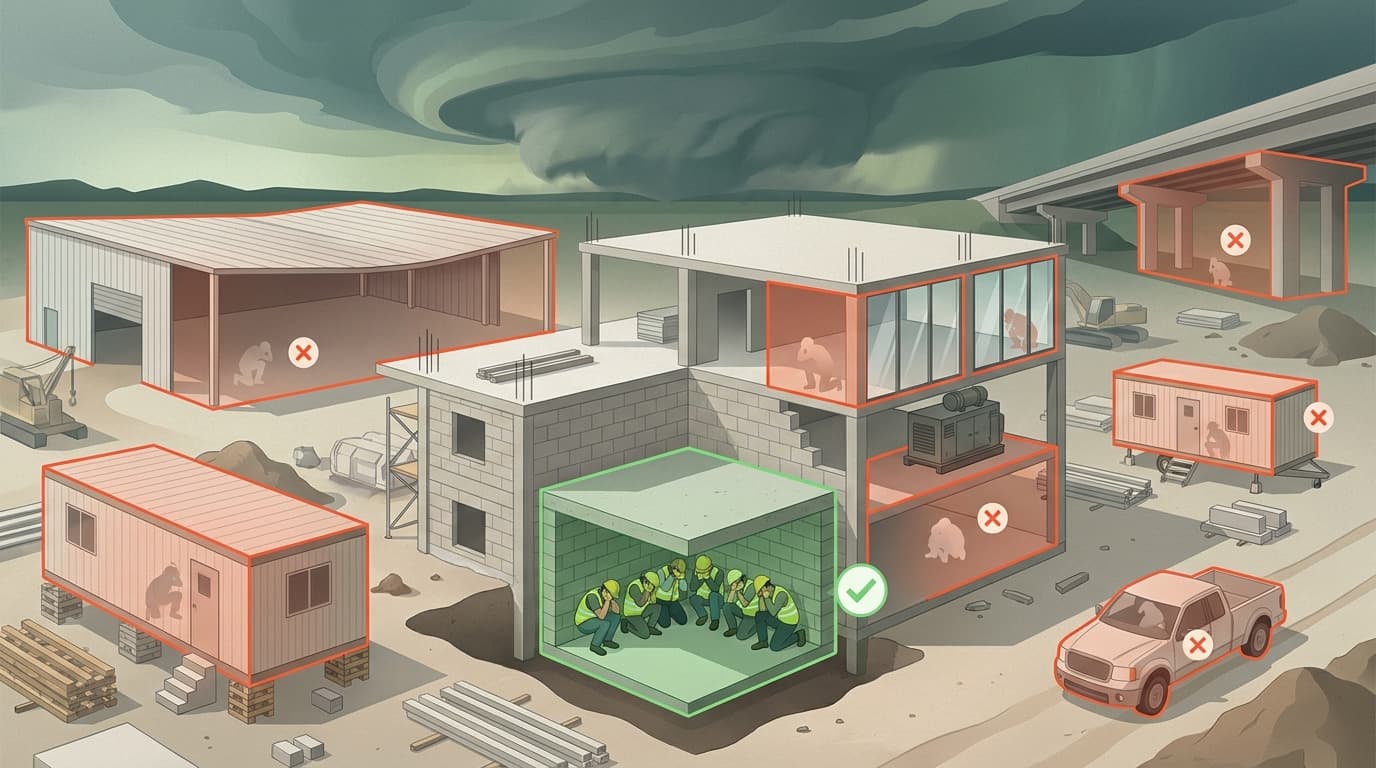
If the value is in already knowing where to go, then knowing what makes a good shelter matters. On a fixed site, the safest place is a small, windowless interior room or hallway on the lowest floor — ideally reinforced concrete, brick, or block, with a heavy floor or roof system overhead. Get to the lowest level you can, put as many walls between you and the outside as possible, and stay away from glass.
What to avoid is just as important, and it is not obvious. Avoid large open rooms with flat, wide-span roofs — warehouses, cafeterias, big auditoriums — because those roofs are usually supported only by the outside walls, and a tornado's forces will collapse them. Avoid taking shelter directly below heavy machinery or stored materials that could fall through the floor onto you. Stay away from doors, windows, and outside walls. If there is no time to reach the shelter, get under something sturdy that will support or deflect falling debris, and cover your head and neck — because most tornado injuries and deaths come from falling objects and flying debris, not from the wind lifting people. And skip the myths: opening windows does not help and wastes time, and a highway overpass is more dangerous, not safer, because wind speeds increase underneath it.
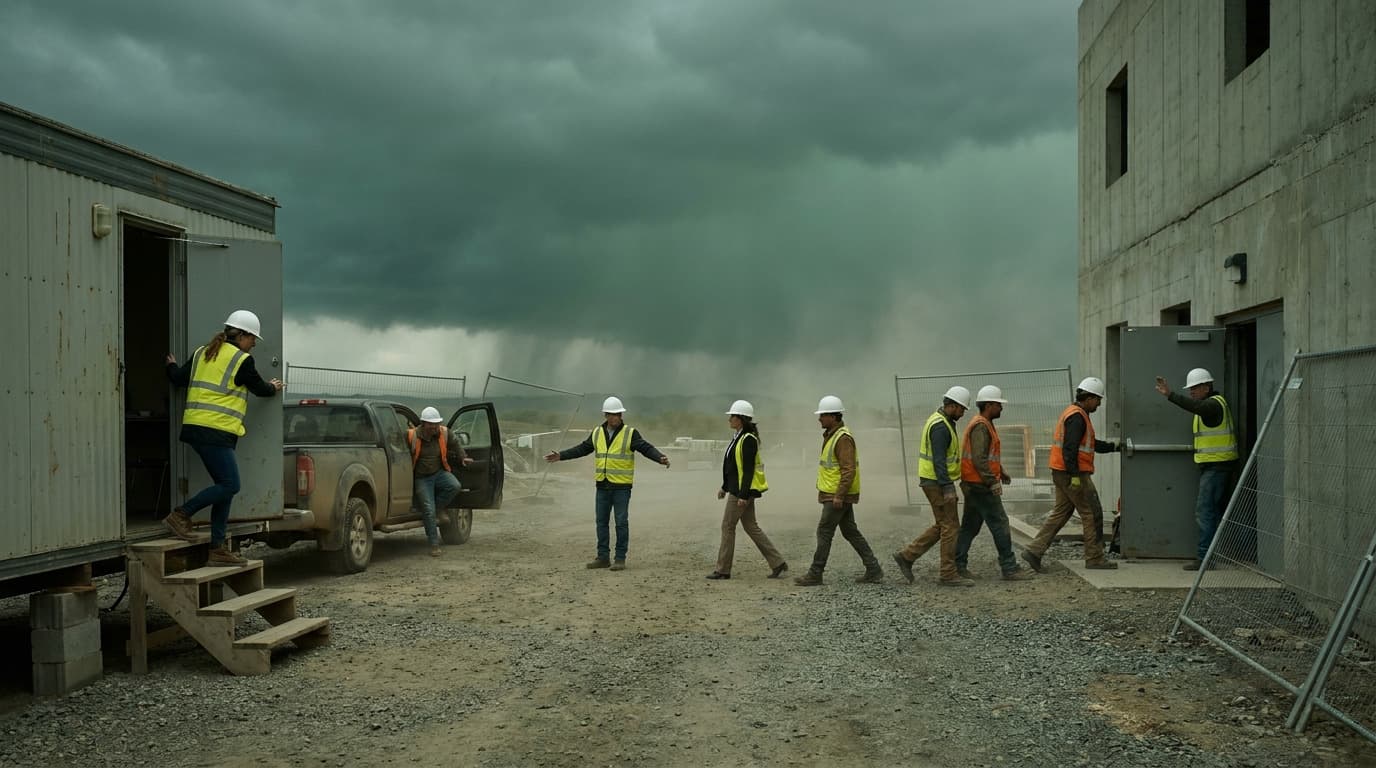
On a construction site, this is harder — there often is no hardened building nearby — which is exactly why the shelter location has to be identified in advance and why a site may need to stop and send workers to a substantial structure well before the wind arrives. If you are caught in a vehicle or trailer, these offer almost no protection from a tornado and should be left for a substantial building whenever possible.
After it passes#
A tornado's hazards do not end when the wind stops. Remain sheltered until an all-clear is given — at a fixed site this may be an employer announcement — because a second cell can follow. When you do come out, watch for downed power lines, gas leaks, structural damage, and debris, do not move seriously injured people unless they are in further danger, and call for medical help rather than searching damaged areas yourself.
Where the duty sits#
Tornadoes and severe wind fall under the same general framework as the rest of the weather group, with a couple of specific hooks.
OSHA has no tornado standard — its regulations do not mention tornadoes specifically — and it does not require employers to build tornado shelters. What it does require is the machinery to respond: a written Emergency Action Plan under 1910.38 (which must cover emergencies such as severe weather, and must be written unless the employer has 10 or fewer employees), and a means to alert workers — an alarm system under 1910.165 that everyone recognizes and knows the correct response to. Behind those, the General Duty Clause, Section 5(a)(1) requires protection from recognized hazards, and severe wind is one. The practical framework is the joint OSHA-NOAA tornado-preparedness guidance: a plan with identified shelter locations, accountability procedures to account for everyone, and training so the crew knows the alarm and the response. On federal contract work, EM 385-1-1 carries severe-weather provisions. Where a site plan or contract sets specific shelter or stop-work requirements, those govern.
What can go wrong?#
- A crew waits for an official warning, and the tornado arrives before one is issued.
- Workers do not know where the designated shelter is until the warning sounds — too late to reach it.
- People treat a watch like a warning, or a warning like a watch, and lose their margin.
- Shelter is taken in a warehouse or big open room whose wide-span roof then collapses.
- Someone shelters directly under heavy machinery or stored materials on the floor above.
- Workers stay in a vehicle or trailer that offers almost no protection from a tornado.
- The crew comes out too soon, before the all-clear, into a following cell.
- After the storm, someone contacts a downed power line or enters a damaged structure.
How do we manage this properly?#
- Decide shelter before the warning — know where it is and how long it takes to reach.
- Know watch versus warning: watch = prepare; warning = shelter immediately.
- Act during the watch — confirm shelter, account for the crew, stop exposed work.
- Shelter in a small, windowless interior room on the lowest floor, away from glass.
- Avoid wide-span roofs (warehouses, big rooms) and spots under heavy machinery or materials.
- If caught out, get under something sturdy and cover your head and neck — debris is the killer.
- Leave vehicles and trailers for a substantial building whenever possible.
- Stay sheltered until the all-clear, then watch for downed lines, gas leaks, and debris.
Before you start#
- Confirm everyone knows the designated tornado shelter and how long it takes to reach.
- Confirm the site alarm or warning signal for "shelter now" is known to the whole crew.
- Confirm the Emergency Action Plan covers severe weather and accounts for all personnel.
- Confirm someone is monitoring NWS/NOAA alerts on high-risk days.
- Confirm the crew knows watch (prepare) versus warning (shelter immediately).
- Confirm the crew knows the tornado warning signs in case no alert comes.
- Confirm workers know to leave vehicles and trailers for a real building.
- On federal work, confirm the EM 385-1-1 severe-weather provisions are in place.
Talk it over#
- If a warning sounded right now, where would you go, and could you get there in a minute?
- Do you know the difference between a watch and a warning — and what each one means for us?
- What's our signal that means shelter now, and does everyone recognize it?
- On this site, what's the nearest substantial building — and how far is it from where you're working?
The bottom line#
A tornado can arrive faster than the warning system, so tornado safety is decided before the warning, not during it. Unlike lightning, which announces itself and gives you time, a tornado may form with no warning at all — so what protects you is what you already know and have set up: where the designated shelter is, how long it takes to reach, and whether you can get there in the seconds you may have. The load-bearing knowledge is watch versus warning: a watch means a tornado is possible and it is time to prepare — confirm shelter, account for the crew, stop exposed work; a warning means one has been spotted and it is time to shelter immediately. The whole margin lives in acting during the watch, not scrambling during the warning. Shelter in a small, windowless interior room on the lowest floor, away from glass; avoid wide-span roofs and spots under heavy machinery, because most tornado deaths come from falling objects and flying debris, so if you are caught out, get under something sturdy and cover your head and neck. Leave vehicles and trailers for a substantial building, and stay sheltered until the all-clear. The duty runs through the Emergency Action Plan (1910.38), the alarm requirement (1910.165), and the General Duty Clause 5(a)(1) — OSHA has no tornado standard and does not require shelters, but it requires the plan and the warning. The test for any high-risk day is one question: if a warning sounded this second, does everyone already know where to go and how to get there — or would we be figuring it out with no time left?
Frequently asked questions about tornado and severe wind safety#
What's the difference between a tornado watch and a warning?
A watch means conditions are right and a tornado is possible in your area — it is a signal to prepare: monitor the weather, confirm the shelter location, and be ready to move. A warning means a tornado has actually been spotted or shown up as rotation on radar, and everyone should take shelter immediately. The critical mistake is treating them as the same alert with different words. The watch is your window to get ready; the warning means you are out of time.
Why do you say safety is decided before the warning?
Because a tornado can form in minutes and arrive before any official warning is issued, the thing that protects you is not your reaction to the alert — it is what you have already set up. If you know exactly where the shelter is and can reach it in the seconds you may have, you are protected; if you are working out "where do I go?" when the alarm sounds, you have started too late. That is why the preparation belongs in the watch, or before, not in the warning.
Where is the safest place to shelter on a site?
A small, windowless interior room or hallway on the lowest floor, ideally reinforced concrete, brick, or block with a heavy floor or roof overhead. Get to the lowest level, put as many walls between you and the outside as possible, and stay away from glass. Avoid large open rooms with flat, wide-span roofs — warehouses, cafeterias — because those roofs are supported only by the outside walls and will collapse. Do not shelter directly under heavy machinery or stored materials on the floor above.
What if I can't reach the shelter in time?
Get under something sturdy that will support or deflect falling debris, and cover your head and neck — most tornado injuries and deaths come from falling objects and flying debris, not the wind lifting people. Stay away from doors, windows, and outside walls. Do not shelter in a vehicle or trailer if there is any way to reach a substantial building, and never try to shelter under a highway overpass, where wind speeds actually increase.
Are cars, trailers, and overpasses safe?
No. Vehicles and construction trailers offer almost no protection from a tornado and should be left for a substantial building whenever possible. Highway overpasses are a dangerous myth — wind speeds increase underneath them, making them worse, not safer. Opening windows to "equalize pressure" is also a myth that only wastes time; high winds and debris, not pressure changes, do the damage. Trust verified NWS or NOAA alerts over social-media rumors.
Does OSHA require a tornado shelter?
No. OSHA has no tornado standard and does not require employers to build tornado shelters. What it does require is a written Emergency Action Plan under 1910.38 that covers severe weather and accounts for all personnel, and a means to alert workers under 1910.165 that everyone recognizes. Behind those, the General Duty Clause requires protection from recognized hazards. So the legal obligation is the plan, the warning, and the training — the shelter location must be identified even if a dedicated shelter is not built.
Download the tornado and severe wind toolbox talk PDF#
Get this tornado and severe wind toolbox talk as a print-ready PDF — available in English, Spanish, Portuguese, and Turkish. Print it, hand it to the crew, and collect signatures on the included attendance sheet.
Download the PDF — free account required. New members get 3 free downloads.
Related toolbox talks#
Sources#
- OSHA, Tornado Preparedness and Response (develop an emergency plan; shelter locations; watch vs warning; aftermath hazards): https://www.osha.gov/tornado
- OSHA, Emergency Action Plans — 1910.38 (written EAP required, covering severe-weather emergencies): https://www.osha.gov/laws-regs/regulations/standardnumber/1910/1910.38
- National Weather Service, Tornado Safety (watch vs warning; shelter guidance; myths): https://www.weather.gov/safety/tornado
This talk is general awareness guidance for training purposes. It does not replace your employer's emergency action plan or severe-weather program, the OSHA emergency-planning standards, the OSH Act General Duty Clause, or a competent person's duties, and it is not legal advice. Where a site plan or contract sets a stricter requirement, that requirement governs.
Written by FieldSafetyTalk's safety professional — a CSP, ASP, CHST and OSHA Authorized Outreach Trainer with 14+ years of international construction safety experience across federal, heavy civil, and industrial projects.