Extension Cords
Updated 2026-07-28
In this bundle Jobsite Fundamentals & Compliance
Print-ready PDF
Download this talk as a print-ready PDF, available in 4 languages.
The extension cord is the most-handled piece of electrical equipment on any construction site and the least inspected. It gets dragged, driven over, pinched in doors, hung on nails, joined to another cord and left in water — and then somebody picks it up with wet hands. Most of what goes wrong with cords is covered by a small number of specific prohibitions that almost nobody has read. This extension cords talk covers them.
Here is the distinction that carries this whole talk: a cord is temporary equipment being used as if it were permanent installation. Every prohibition in the standard exists to stop that drift. A cord run through a wall, stapled to a beam or hidden above a ceiling has stopped being a portable connection and become the building's wiring — without any of the protection, inspection or fire rating that wiring would have.
The five prohibited uses — 1926.405(g)(1)(iii)#
Flexible cords and cables shall not be used:
(A) As a substitute for the fixed wiring of a structure
(B) Where run through holes in walls, ceilings, or floors
(C) Where run through doorways, windows, or similar openings, except as permitted in paragraph (a)(2)(ii)(I)
(D) Where attached to building surfaces
(E) Where concealed behind building walls, ceilings, or floors
Five prohibitions, and they describe almost every cord problem on a construction site in one list. But two of them carry exceptions that are widely misread in both directions.
Doorways are permitted — if protected. The exception in (a)(2)(ii)(I) provides that flexible cords and cables shall be protected from damage, that sharp corners and projections shall be avoided, and that cords may pass through doorways or other pinch points if protection is provided to avoid damage. So running a cord through a doorway is not automatically a violation. Running one through an unprotected doorway is.
Holes in walls are sometimes permitted too. OSHA has interpreted the (B) prohibition as not applying where the cord is being used for one of the purposes listed in (g)(1)(i) — which include the connection of portable lamps and of appliances. And OSHA has confirmed that cord-and-plug connected portable construction power tools — hand drills, portable saws, compressors for air nailers — meet the definition of appliance in 1926.449. That is a genuinely useful interpretation, and it is worth knowing rather than arguing about.
What is never permitted, in any reading: using a cord as the building's wiring, attaching it to building surfaces, or concealing it behind walls, ceilings or floors.
Splices, marking and usage rating#
Splices — (g)(2)(iii). Flexible cords shall be used only in continuous lengths without splice or tap. There is one exception: hard service flexible cords No. 12 or larger may be repaired if spliced so that the splice retains the insulation, outer sheath properties, and usage characteristics of the cord being spliced. That is a repair specification, not permission for a taped joint — and it does not cover the light cords most commonly damaged.
Marking — (g)(2)(ii). Type SJ, SJO, SJT, SJTO, S, SO, ST and STO cords shall not be used unless durably marked on the surface with the type designation, size, and number of conductors. An unmarked cord cannot be verified as suitable, which is why bargain cords are a false economy on site.
Usage rating. Flexible cords used with temporary and portable lights must be designed for hard or extra-hard usage — the S-series types above are the hard and extra-hard service designations. Household cords are not built for a construction site and are not permitted where hard usage is required.
Strain relief — (g)(2)(iv). Flexible cords shall be connected to devices and fittings so that strain relief is provided which prevents pull being transmitted directly to joints or terminals. Cords fail at the plug because someone pulled them out by the cable.
Condition and support — 1926.416(e)#
Two short provisions that cover most of what an inspection finds:
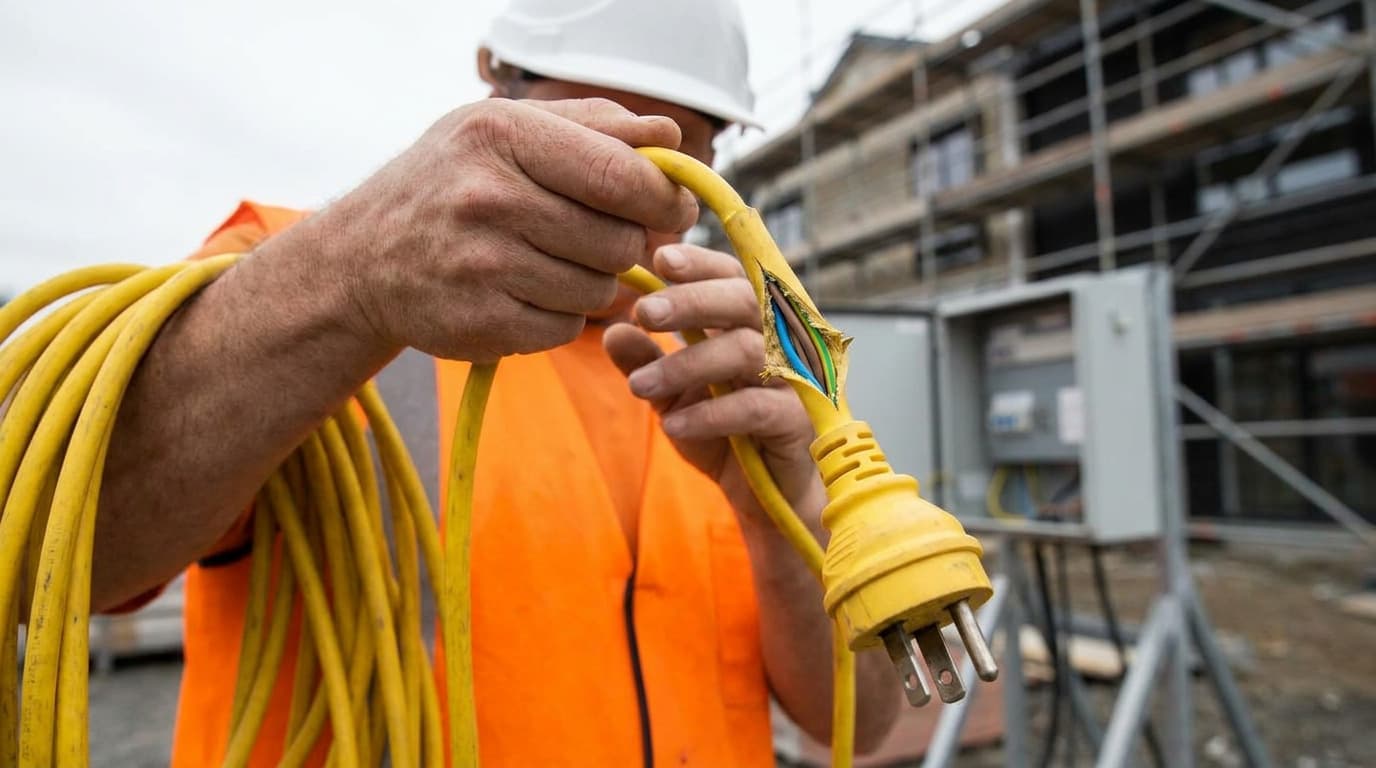
Worn or frayed electric cords or cables shall not be used. No repair by tape, no "it's only the outer sheath," no using it until the end of the shift.
Extension cords shall not be fastened with staples, hung from nails, or suspended by wire. All three damage the insulation at exactly the point where nobody looks — and the staple is the worst of them, because it can penetrate the sheath without any visible sign.
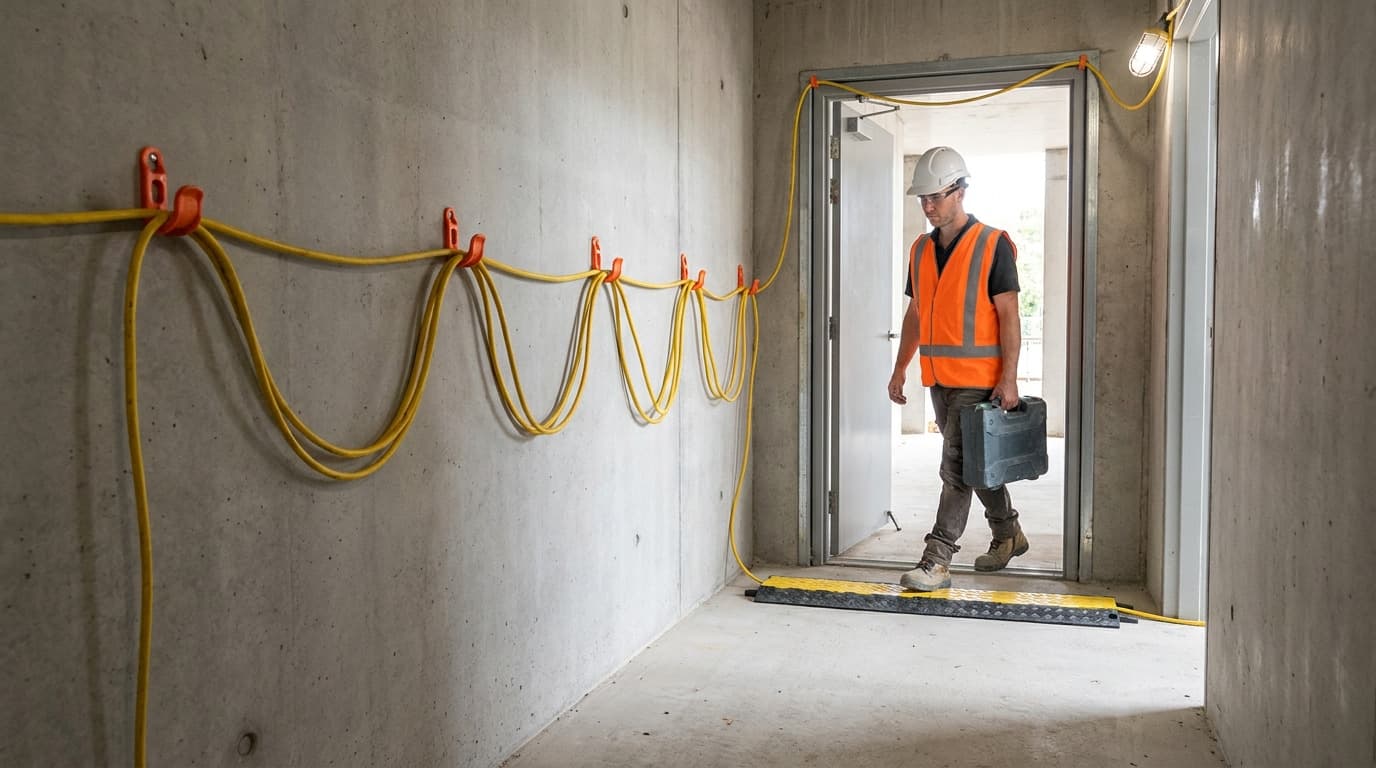
Cord support is a real problem worth solving properly: use purpose-made hooks or cable hangers that do not compress or pierce the cable, keep cords off the floor and out of traffic routes where practicable, and route them so they are not run over by plant.
Ground fault protection for cord-connected equipment is covered in the GFCI talk, and the wider temporary installation in the temporary power talk. This one is about the cord itself.
What can go wrong?#
A cord run through a wall or above a ceiling and left as the permanent supply for weeks.
Stapled or nailed to a beam, with the fixing through the sheath.
Taped joints between two damaged cords, or a light cord spliced at all.
Household cords on site, unmarked and not rated for hard usage.
A cord pinched in a door with no protection, crushed a little more each time it closes.
Cords in standing water, or lying across a wet slab.
Damaged plugs and missing earth pins, with the cord still in service.
Undersized cord on a long run, overheating under load.
Cords across access routes, which is a trip hazard before it is an electrical one.
How do we manage this properly?#
Inspect before every use. The whole length, both ends, the sheath at the plug and any point where it has been supported.
Take damaged cords out of service immediately and physically remove them — a frayed cord left in the store gets used.
Never staple, nail or hang cords by wire. Use proper hooks or hangers that do not pinch or pierce.
Protect at pinch points. If a cord must pass a doorway, protect it — that is what makes the exception apply.
Use hard or extra-hard usage cords, durably marked with type, size and number of conductors.
Do not splice light cords at all, and repair only hard service cords No. 12 or larger in a way that retains insulation, sheath and usage characteristics.
Size the cord for the load and the length, because voltage drop and heat build with distance.
Route cords out of traffic and off wet ground, and cover or bridge them where they must cross a route.
Never let a cord become the wiring. If a supply is needed for weeks, it needs a proper temporary installation.
Before you start#
- Confirm the cord is marked with its type, size and number of conductors.
- Confirm it is rated for hard or extra-hard usage.
- Confirm the full length is undamaged, with no taped joints or exposed conductors.
- Confirm both plug and socket are intact, with all pins present.
- Confirm it is not stapled, nailed or hung by wire anywhere along its run.
- Confirm any doorway or pinch point it passes through is protected.
- Confirm it is not run through holes in walls or concealed above ceilings as a permanent supply.
- Confirm it is out of standing water and out of traffic routes.
Talk it over#
- Look at the nearest cord — how is it supported?
- Is there a taped joint anywhere on this site?
- Which cord here has been the temporary supply for longest?
- What would you do with a frayed cord you found right now?
The bottom line#
1926.405(g)(1)(iii) prohibits flexible cords used as a substitute for the fixed wiring of a structure, run through holes in walls, ceilings or floors, run through doorways, windows or similar openings (except as permitted in (a)(2)(ii)(I)), attached to building surfaces, or concealed behind building walls, ceilings or floors. Two exceptions matter: cords may pass through doorways or other pinch points if protection is provided to avoid damage, and OSHA has interpreted the holes-in-walls prohibition as not applying where the cord serves a listed purpose such as portable lamps or appliances — which includes cord-and-plug construction power tools. (g)(2)(iii) requires cords to be used only in continuous lengths without splice or tap, with repair permitted only for hard service cords No. 12 or larger where the splice retains insulation, sheath and usage characteristics. (g)(2)(ii) requires durable surface marking of type, size and conductor count, and cords for temporary and portable lights must be hard or extra-hard usage. And 1926.416(e): worn or frayed cords shall not be used, and extension cords shall not be fastened with staples, hung from nails, or suspended by wire.
Frequently asked questions about extension cords#
Can an extension cord run through a doorway?
Yes, with protection. 1926.405(g)(1)(iii)(C) prohibits cords run through doorways, windows or similar openings except as permitted in (a)(2)(ii)(I) — which provides that cords shall be protected from damage, that sharp corners and projections shall be avoided, and that they may pass through doorways or other pinch points if protection is provided. An unprotected cord in a door is the violation; a protected one is not.
Can a cord be run through a hole in a wall?
Sometimes. The prohibition in (g)(1)(iii)(B) has been interpreted by OSHA as not applying where the cord is used for one of the purposes listed in (g)(1)(i) — including connection of portable lamps and appliances. OSHA has confirmed that cord-and-plug connected portable construction power tools generally meet the definition of appliance in 1926.449.
What can never be done with a cord?
Three things, in any reading of the standard: using it as a substitute for the fixed wiring of a structure, attaching it to building surfaces, and concealing it behind building walls, ceilings or floors. Those prohibitions carry no exception, and together they describe a cord that has quietly become the building's wiring.
Can a damaged extension cord be repaired?
Only in narrow circumstances. 1926.405(g)(2)(iii) requires flexible cords to be used only in continuous lengths without splice or tap, and permits repair only of hard service flexible cords No. 12 or larger, spliced so that the splice retains the insulation, outer sheath properties and usage characteristics of the original. Taped joints and repairs to lighter cords are not permitted. Separately, 1926.416(e) prohibits the use of worn or frayed cords entirely.
How should cords be supported?
Not by staples, nails or wire. 1926.416(e) provides that extension cords shall not be fastened with staples, hung from nails, or suspended by wire — each of which damages the insulation at the point of support. Use purpose-made hooks or cable hangers that neither compress nor pierce the sheath.
What does "hard usage" mean?
It is the service rating of the cord's construction, shown in the type designation. Flexible cords used with temporary and portable lights must be designed for hard or extra-hard usage, and under (g)(2)(ii) types such as S, SO, ST, STO, SJ, SJO, SJT and SJTO must be durably marked on the surface with the type designation, size and number of conductors. A cord you cannot identify cannot be shown to be suitable.
Why do cords fail at the plug?
Because of strain. 1926.405(g)(2)(iv) requires flexible cords to be connected to devices and fittings so that strain relief is provided, preventing pull being transmitted directly to joints or terminals. Cords unplugged by pulling the cable rather than the plug fail exactly there — and the damage is usually inside the moulding where it cannot be seen.
Download the extension cords toolbox talk PDF#
Get this extension cords toolbox talk as a print-ready PDF — available in English, Spanish, Portuguese, and Turkish. Print it, hand it to the crew, and collect signatures on the included attendance sheet.
Download the PDF — free account required. New members get 3 free downloads.
Related toolbox talks#
Sources#
- OSHA, 29 CFR 1926.405 — Wiring methods, components, and equipment for general use: https://www.osha.gov/laws-regs/regulations/standardnumber/1926/1926.405
- OSHA, 29 CFR 1926.416 — General requirements (electrical safety-related work practices): https://www.osha.gov/laws-regs/regulations/standardnumber/1926/1926.416
- OSHA, Letter of Interpretation, 16 January 2003 — Acceptable uses of flexible temporary cords/cables on construction sites: https://www.osha.gov/laws-regs/standardinterpretations/2003-01-16