Daylight Saving Time (DST) Safety
Updated 2026-10-19
In this bundle Jobsite Fundamentals & Compliance
Print-ready PDF
Download this talk as a print-ready PDF, available in 4 languages.
Twice a year the clock on the wall moves an hour and nothing else does. In March the crew shows up on Monday short an hour of sleep that nobody got back over the weekend. In November the shift ends at the same time it always has, but the sun is already down for the drive home. This Daylight Saving Time (DST) Safety Toolbox Talk (Safety Talk / Tailgate Talk) is about the two days a year when the schedule and the body disagree, why they are dangerous in different ways, and what a construction crew changes in the week after each one.
Where the boundary of this talk sits#
The fatigue management talk owns sleep debt as a year-round hazard. The fatigued driving talk owns microsleep at the wheel. The working at night talk owns lighting and night traffic once a job runs after dark on purpose. The winter driving talk owns ice and snow. All are linked. This talk owns the two Sundays the clock moves and the week after each: why the spring change takes something from the body that Monday's schedule does not give back, why the fall change takes nothing from the body but moves an hour of darkness onto the end of the shift, and what the crew does differently in each of those weeks. It is written for construction, where the day starts before the sun in both seasons and the drive home runs into traffic that just lost its daylight.
The anchor#
Here is the distinction that carries this whole talk: the clock moves an hour in a single night, but the body takes days to move with it and the sun does not move at all — so spring forward is a sleep problem that peaks on Monday, when workers arrive on less sleep and both injuries and fatal crashes climb for a week, and fall back is a light problem that starts the first evening, when sunset jumps an hour earlier by the clock and the end of the shift, the drive home, and the walk across the parking lot all land in the dark — which is why the crew treats the Monday after March like a short-sleep day and the week after November like the first week of night work.
The rule, and the two Sundays#
Since 2007, under the Energy Policy Act of 2005, Daylight Saving Time in the United States begins at 2 a.m. on the second Sunday in March, when clocks jump to 3 a.m., and ends at 2 a.m. on the first Sunday in November, when they fall back to 1 a.m. Hawaii and most of Arizona do not change. The next change is Sunday, November 1, 2026, when clocks fall back; the one after is Sunday, March 14, 2027, when they spring forward. Nothing about the work changes on either date. The weight of the pipe, the height of the deck, and the speed of the traffic are the same on Monday as they were on Friday. What changes is the worker and the light.
Spring forward: the hour the body does not get back#
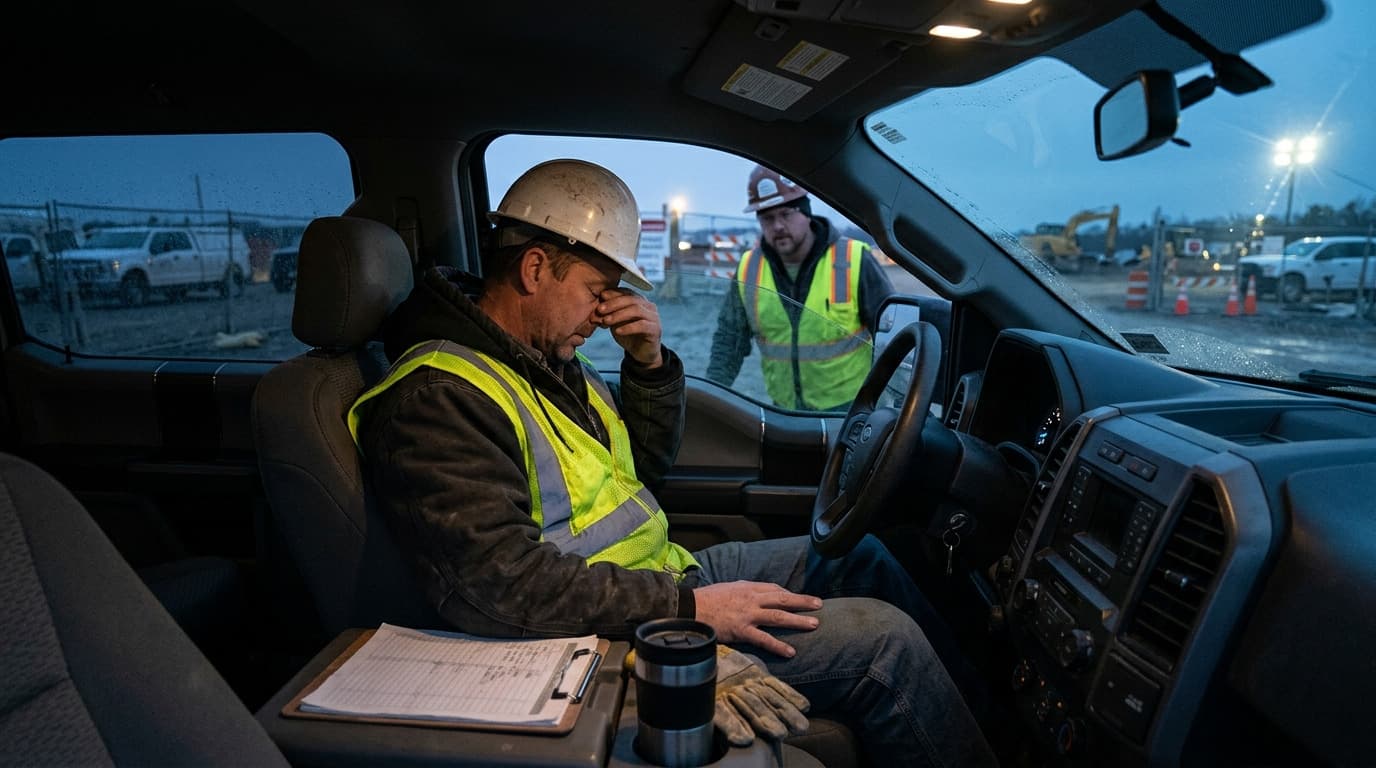
The sleep comes off the top of the night, and for a construction worker the top of the night is already short. A study that put sleep data from the American Time Use Survey next to twenty-four years of mine injury reports — 576,292 injuries reported to the Mine Safety and Health Administration from 1983 to 2006 — found that people slept about 40 minutes less on the Sunday night of the spring change, and that on the Monday after it there were 3.6 more injuries than on other Mondays, about a 5.7 percent rise. The injuries were also worse: roughly 68 percent more workdays lost. The fall change showed no significant change in injuries or sleep.
The road shows the same thing. A study of 732,835 fatal crashes in the federal Fatality Analysis Reporting System from 1996 to 2017 found fatal crash risk about 6 percent higher in the week after the spring change — about 28 deaths a year that would not otherwise have happened — and worse toward the western edge of each time zone, where the sun comes up later by the clock and the morning commute runs in the dark. The fall change produced no net increase; the risk simply moved later in the day.
The reason is not mysterious. The AAA Foundation for Traffic Safety compared drivers' sleep in the 24 hours before a crash: compared with a driver who slept seven hours or more, a driver on six to seven hours had 1.3 times the crash rate, five to six hours 1.9 times, four to five hours 4.3 times, and under four hours 11.5 times. The lost hour does not land on a rested worker. It lands on the one who was already getting six, and makes him a five-hour driver on Monday morning. OSHA has no daylight saving standard, but its worker fatigue guidance puts the numbers on the table: injury risk 18 percent higher on evening shifts and 30 percent higher on night shifts than on day shifts, and 37 percent higher on a 12-hour day. Monday after March is a day to shorten, not to stretch.
Fall back: nothing lost, but the dark moves#
Falling back gives the hour back, and most people sleep it. The hazard is outside the body. On Saturday the sun set after the shift ended; on Monday, by the clock, it sets an hour earlier, and the last hour of work, the walk to the truck, and the drive home are in the dark. The NHTSA count for 2022 is the whole argument: 7,522 pedestrians killed, 78 percent of them in the dark, and the single worst block of the day was 6 to 8:59 p.m., with 26 percent of the deaths. After the first Sunday in November, that block begins at dusk.
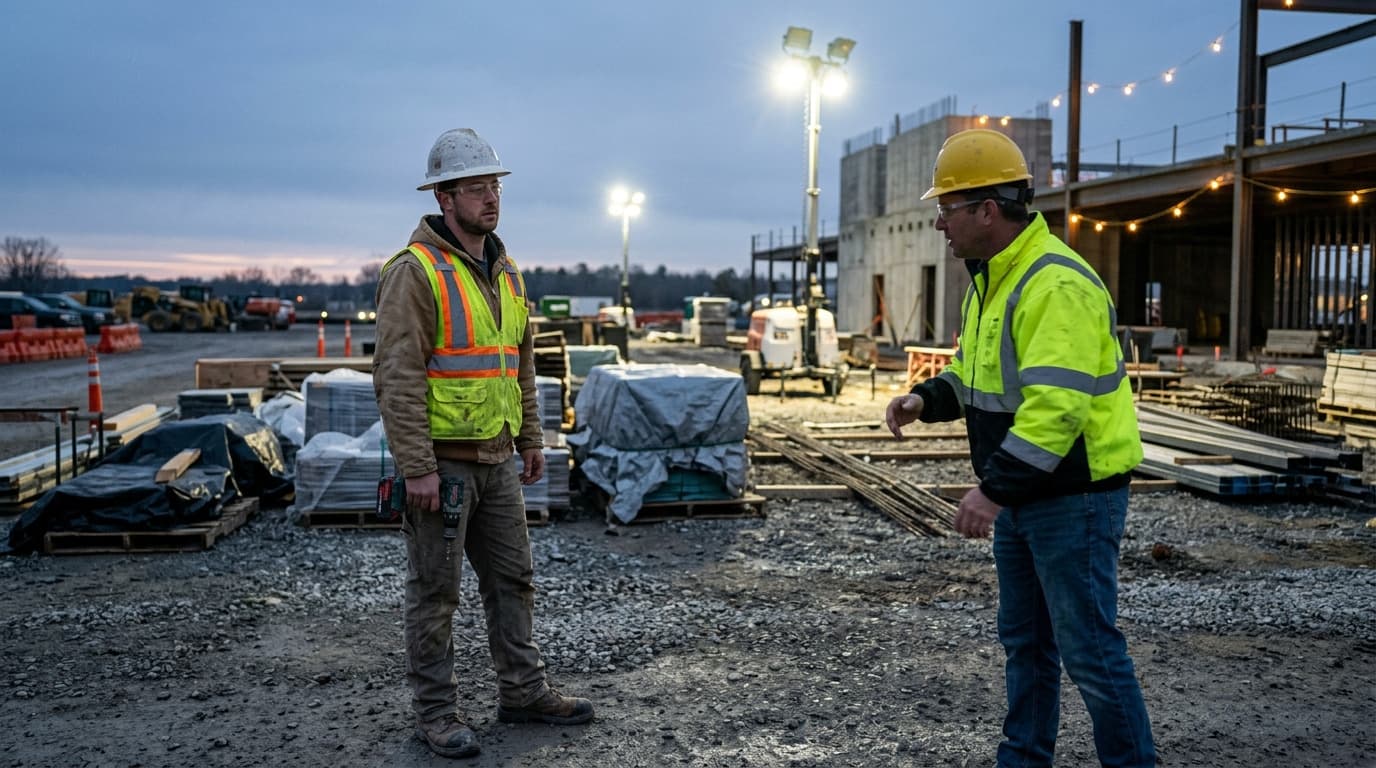
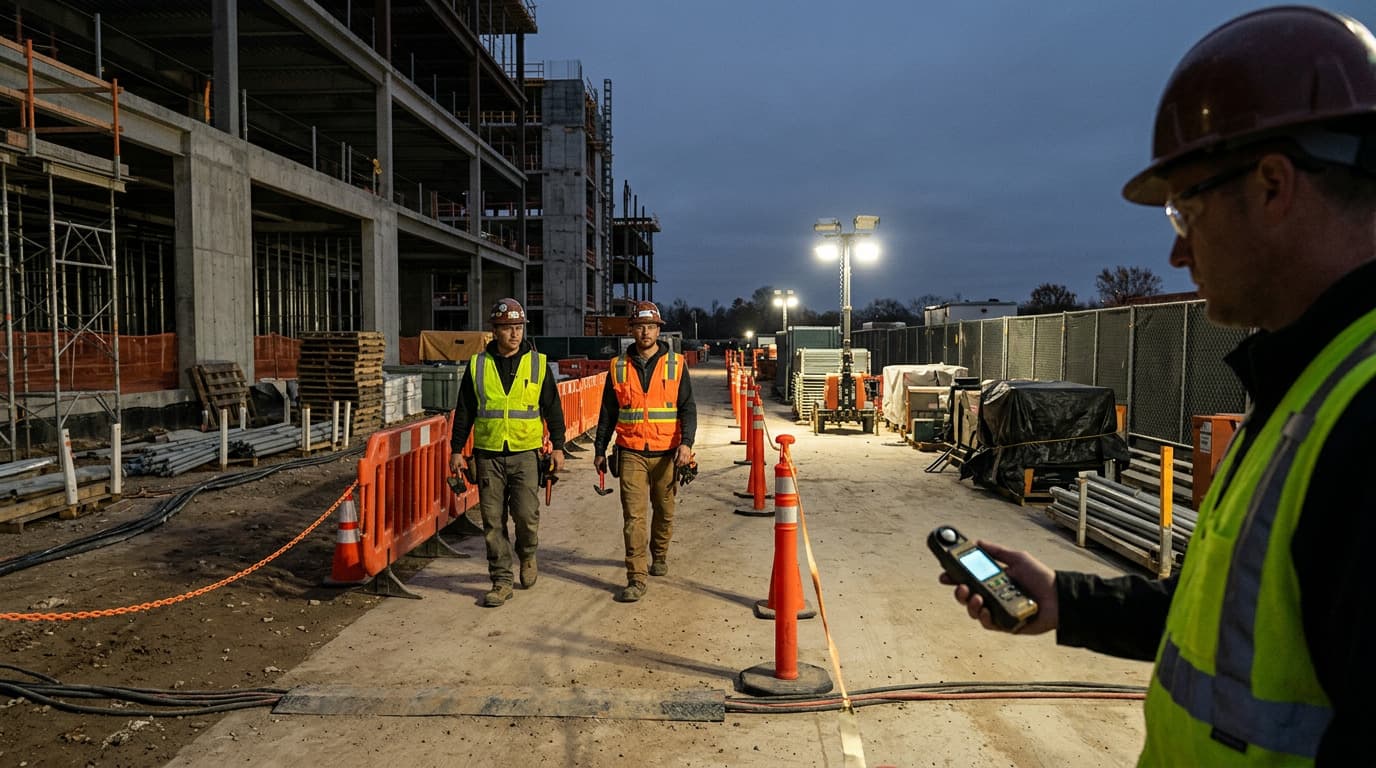
On the site, the last hour of the shift is now a lighting question. Under 1926.56(a), construction areas, ramps, runways, corridors, offices, shops, and storage areas are lit to the minimums in Table D-3 while any work is in progress: 5 foot-candles for general construction area lighting; 3 foot-candles for general construction areas, concrete placement, excavation and waste areas, access ways, active storage areas, loading platforms, refueling and field maintenance areas; 5 indoors in warehouses, corridors, hallways and exitways; 10 in construction plant and shops; 30 in first aid stations, infirmaries, and offices. A site that met those numbers at 4:30 in October may not meet them at 4:30 in November, and the rule does not wait for the schedule to catch up.
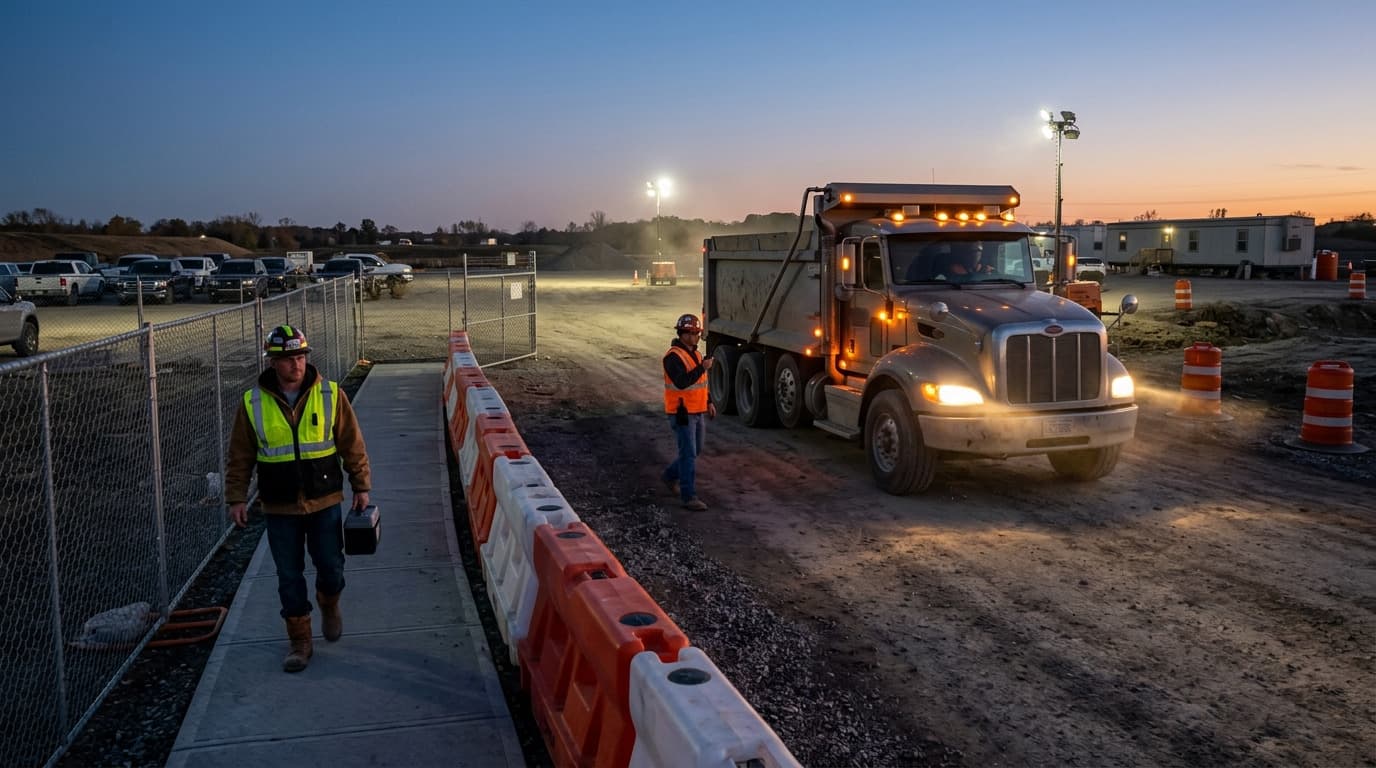
The other question is being seen. Under 1926.651(d), workers exposed to public vehicular traffic near excavations wear warning vests or other suitable garments marked with or made of reflectorized or high-visibility material. Under 1926.201(a), flaggers' garments meet the MUTCD. And in a 2009 letter OSHA said that in highway and road construction work zones, high-visibility apparel is required under the General Duty Clause for every employee exposed to being struck by public or construction traffic, not only flaggers. Dusk is the worst light of the day for a driver's eyes, and after fall back it arrives during the busiest hour of the site — equipment backing up, trucks leaving, people walking to the gate.
What the body is doing#
The body runs on a clock of its own, set by light, and it moves a little at a time. An hour on the wall is a small jet lag, and most people take several days to settle into it, which is why the Monday is worse than the Sunday and the week is worse than the day. After the spring change the morning is darker and the body still thinks it is an hour earlier; after the fall change the evening is darker and some people wake before the alarm for a few days. Neither is a weakness and neither is an excuse. It is a known pattern with a date on it, and the crew plans around it the way it plans around a heat wave.
Where the duty sits#
There is no OSHA standard with "daylight saving" in it. The duties are the ones that were there all along, arriving on a schedule. Section 5(a)(1) of the OSH Act is the employer's duty to keep the workplace free of recognized hazards; OSHA's worker fatigue guidance describes fatigue as one and its 2009 letter uses the same clause for high-visibility apparel in work zones. 1926.56(a) and Table D-3 set the lighting the last hour of the shift must meet. 1926.651(d) and 1926.201(a) set the high-visibility garments for excavation workers near traffic and for flaggers. The scheduling decisions — what gets done on the Monday after spring forward, where the lights go before the first dark evening — belong to the employer and the supervisor; the sleep belongs to the worker.
What can go wrong?#
- Monday after spring forward, a carpenter on five hours of sleep misses the last rung of a ladder he has climbed a thousand times.
- The 5:30 a.m. drive to the site is in the dark for the first time since fall, on four hours of sleep, at eleven times the crash rate.
- The first Monday of November a truck backs toward the gate at 5:10 p.m. and the spotter is in a gray hoodie.
- The excavation crew works the last hour with the lights still on the trailer because nobody needed them Friday.
- A pour scheduled to finish at 5:00 runs long, and the finishers are working by headlights.
- A worker crosses the public road to the parking lot at dusk, in the hour NHTSA's numbers say is the worst of the day.
How do we manage this properly?#
- Move bedtime before the clock moves — 15 to 20 minutes earlier for the three nights before spring forward, so the hour is gone before Monday needs it.
- Make the Monday after spring forward a short-sleep day on the schedule — no first-time tasks, no critical lifts, no overtime, one extra break, and a buddy check at the morning huddle: who slept, who didn't.
- Use the AAA line at the gate — under five hours of sleep, you do not drive the crew truck; say so, and the supervisor finds another driver.
- Set the lights before the first dark evening — walk the site the Friday before fall back and place the temporary lighting to Table D-3 for every area that will be worked in the last hour.
- High-visibility on from the first dark Monday — vests or garments per 1926.651(d), 1926.201(a) and the 2009 letter for anyone near traffic, and for everyone walking to the gate at dusk.
- Move traffic-heavy work earlier — backing, deliveries, and equipment moves into daylight for the first week of November, headlights on at dusk, one spotter in view.
- Name the week — say "this is time-change week" at the Monday huddle, both seasons; a hazard with a name gets watched.
Before you start#
Know which Sunday it is and what it did: spring forward took an hour of sleep, fall back took an hour of evening light. At the Monday huddle after spring forward, ask who slept and shorten the day for the ones who didn't; put the first-time tasks and the heavy lifts on Tuesday. The Friday before fall back, walk the site at the time the shift will end on Monday, with a light meter if you have one, and place lights where the last hour of work will be. Check high-visibility garments on everyone who will be near traffic or walking to the gate at dusk. Confirm the drive-home plan for anyone on short sleep.
Talk it over#
- What time does the sun set on the Monday after fall back, and which of our tasks run past it?
- Who on this crew drives more than 30 minutes to the site, and what time do they leave?
- Where were the lights last November, and are they still there?
- What is the first-time task we had planned for the Monday after spring forward, and can it move?
- Would you tell the foreman you slept four hours? Why not?
The bottom line#
The clock moves an hour in a night; the body takes days and the sun does not move at all. Spring forward is a sleep problem that lands on Monday — about 40 minutes less sleep, more and worse injuries, 6 percent more fatal crashes for a week — so the Monday after March is a short day with no first-time work, and nobody on under five hours drives. Fall back is a light problem that lands on the first evening — sunset an hour earlier by the clock, the last hour of the shift under Table D-3 lights, high-visibility on, traffic work moved into daylight. Treat time-change week like the known hazard it is, and the Monday after is just a Monday.
Frequently asked questions about daylight saving time safety#
When do the clocks change?
Daylight Saving Time begins at 2 a.m. on the second Sunday in March and ends at 2 a.m. on the first Sunday in November, under the Energy Policy Act of 2005. The next change is November 1, 2026 (fall back); then March 14, 2027 (spring forward). Hawaii and most of Arizona do not change.
Is the Monday after spring forward really more dangerous?
Yes. The study of 24 years of mine injury reports found 3.6 more injuries on the Monday after the spring change — about 5.7 percent — and about 68 percent more lost workdays, with no comparable change after the fall transition. The fatal-crash study found a 6 percent higher risk for the whole week after.
Does falling back cause injuries?
The injury study found no significant change in injuries or sleep after the fall transition, and the crash study found no net increase in fatal crashes. What changed was when the crashes happened: risk fell before noon and rose after it. The fall hazard is darkness at the end of the shift, not fatigue.
How much does one lost hour of sleep matter for driving?
It depends where it comes from. The AAA Foundation found drivers on six to seven hours had 1.3 times the crash rate of drivers on seven or more; four to five hours, 4.3 times; under four hours, 11.5 times. An hour taken from a six-hour sleeper moves him two rows down that table.
What lighting do we need for the last hour of the shift after fall back?
The minimums in 1926.56 Table D-3 apply while any work is in progress: 5 foot-candles for general construction area lighting, 3 for excavation, concrete placement, access ways, active storage, loading, refueling and field maintenance areas, 10 for plant and shops, 30 for first aid stations and offices. If the last hour is now after sunset, those numbers have to be met by lights.
Do we need high-visibility clothing just because it gets dark earlier?
Near public traffic at an excavation, yes, under 1926.651(d); as a flagger, yes, under 1926.201(a) and the MUTCD; in a highway or road construction work zone, yes for every worker exposed to traffic, under OSHA's 2009 letter and the General Duty Clause. For everyone else, the first dark evening of November is a good reason to wear it anyway, especially on the walk to the gate.
Why plan around it if it only happens twice a year?
Because it happens on a known date, with known numbers behind it, and the fix is cheap: a few earlier nights, a lighter Monday, lights placed on a Friday, vests on. A hazard you can see coming and choose not to plan for is the kind that ends up in the incident report.
Download the daylight saving time safety toolbox talk PDF#
Download this Daylight Saving Time (DST) Safety Toolbox Talk (Safety Talk / Tailgate Talk) as a printable PDF in English, Spanish, Portuguese, and Turkish for your next tailgate meeting, and run it the Friday before the clocks change.
Related toolbox talks#
Sources#
- U.S. Naval Observatory, Astronomical Applications Department, Daylight Time (DST begins the second Sunday in March and ends the first Sunday in November, at 2 a.m. local time; set by the Energy Policy Act of 2005, Pub. L. 109-58, beginning in 2007; Hawaii and most of Arizona do not observe): https://aa.usno.navy.mil/faq/daylight_time
- Barnes, C. M., & Wagner, D. T. (2009). Changing to daylight saving time cuts into sleep and increases workplace injuries. Journal of Applied Psychology, 94(5), 1305 — as summarized in the American Psychological Association press release (40 minutes less sleep on the Sunday night of the spring change; 3.6 more injuries on the following Mondays; approximately 68 percent more lost workdays; 576,292 MSHA-reported injuries, 1983–2006; no significant change after the fall transition): https://www.apa.org/news/press/releases/2009/09/daylight-injury
- Fritz, J., VoPham, T., Wright, K. P., & Vetter, C. (2020). A Chronobiological Evaluation of the Acute Effects of Daylight Saving Time on Traffic Accident Risk. Current Biology (732,835 fatal motor vehicle accidents, FARS 1996–2017; 6 percent increase in fatal accident risk in the week after the spring transition, about 28 fatal accidents per year; stronger further west within a time zone; no overall change after the fall transition, with risk shifting from before noon to after noon): https://epidownload.i-med.ac.at/download/public/LV%20Ulmer/mci/R/Fatal_traffic_accidents/DST_and_traffic_accidents.pdf
- AAA Foundation for Traffic Safety, Tefft, B. C. (December 2016). Acute Sleep Deprivation and Risk of Motor Vehicle Crash Involvement (crash rate relative to 7+ hours of sleep in the past 24 hours: 6–7 hours 1.3×, 5–6 hours 1.9×, 4–5 hours 4.3×, under 4 hours 11.5×): https://aaafoundation.org/acute-sleep-deprivation-risk-motor-vehicle-crash-involvement/
- NHTSA, Traffic Safety Facts — Pedestrians: 2022 Data, DOT HS 813 590 (July 2024) (7,522 pedestrian fatalities; 78 percent in the dark; 26 percent between 6 and 8:59 p.m.): https://crashstats.nhtsa.dot.gov/Api/Public/ViewPublication/813590
- OSHA, Long Work Hours, Extended or Irregular Shifts, and Worker Fatigue — Hazards (injury risk 18 percent greater on evening shifts and 30 percent greater on night shifts than day shifts; 12-hour days associated with a 37 percent increased risk of injury): https://www.osha.gov/worker-fatigue/hazards
- OSHA, 29 CFR 1926.56 — Illumination ((a) minimum illumination intensities in Table D-3 while any work is in progress: 5, 3, 5, 5, 10 and 30 foot-candles by area): https://www.osha.gov/laws-regs/regulations/standardnumber/1926/1926.56
- OSHA Standard Interpretation, August 5, 2009 — High-visibility apparel in highway/road construction work zones (1926.201(a) and the MUTCD for flaggers; 1926.651(d) for employees exposed to public vehicular traffic near excavations; high-visibility apparel required under the General Duty Clause for all other work-zone employees exposed to being struck by public or construction traffic): https://www.osha.gov/laws-regs/standardinterpretations/2009-08-05
Written by FieldSafetyTalk's safety professional — a CSP, ASP, CHST and OSHA Authorized Outreach Trainer with 14+ years of international construction safety experience across federal, heavy civil, and industrial projects.