Pneumatic Tools
Updated 2026-08-06
In this bundle Tools & Machinery
Print-ready PDF
Download this talk as a print-ready PDF, available in 4 languages.
Pick up a pneumatic drill, a chipping hammer, an impact wrench, or a grinder, and it feels like any other power tool — you point it, you pull the trigger, it works. But there is a difference that hides in plain sight, and it changes where the danger lives. With a corded or cordless tool, the energy is in the tool: let go of the trigger and it winds down in your hand. With a pneumatic tool, the energy is not in the tool at all — it is in the charged air line running back to the compressor, a line that is under pressure the whole time and stays under pressure after the tool goes silent. This Pneumatic Tools Toolbox Talk (Safety Talk / Tailgate Talk) is about that difference, because almost every pneumatic injury people do not see coming is a hazard of the hose and the stored air, not the working end everyone is watching.
Here is the distinction that carries this whole talk: every other tool's power is in your hand; a pneumatic tool's power is in the hose behind it — a charged line that stays a whip and a launcher after the tool goes quiet, which is why the pneumatic hazards you forget are all behind the trigger, not in front of it. The bit, the chisel, the nail — those get your attention, and other talks cover them. What gets forgotten is the line: a pressurized hose that becomes a whip if the tool disconnects, a fitting that becomes a projectile if the connection fails, a stream of air that can drive through skin. The tool going quiet does not mean the system is safe, because the pressure does not live in the tool. Until the air is off and the line is bled, the hazard is still charged.
Where the boundary of this talk sits#
Several talks share this territory, and keeping them straight is the point. The compressed air safety talk owns the rules on cleaning with compressed air — the 30-psi limit — and the detailed hose provisions. The nail gun talk owns pneumatic nailers and the trigger and muzzle question. The powder- and fuel-actuated tool talk owns those firing systems, and the high-pressure machines talk owns high-pressure equipment. The hand and power tools talk owns general tool safety. This talk owns what ties all pneumatic tools together: that their power is stored in the air line, and the hazards of the connection, the hose, and the compressed air itself — the whip, the projectile, and the injection. Where the question is a specific tool or the cleaning limit, those talks own it; this one owns the pneumatic system as a class.
Keeping the connection from failing#
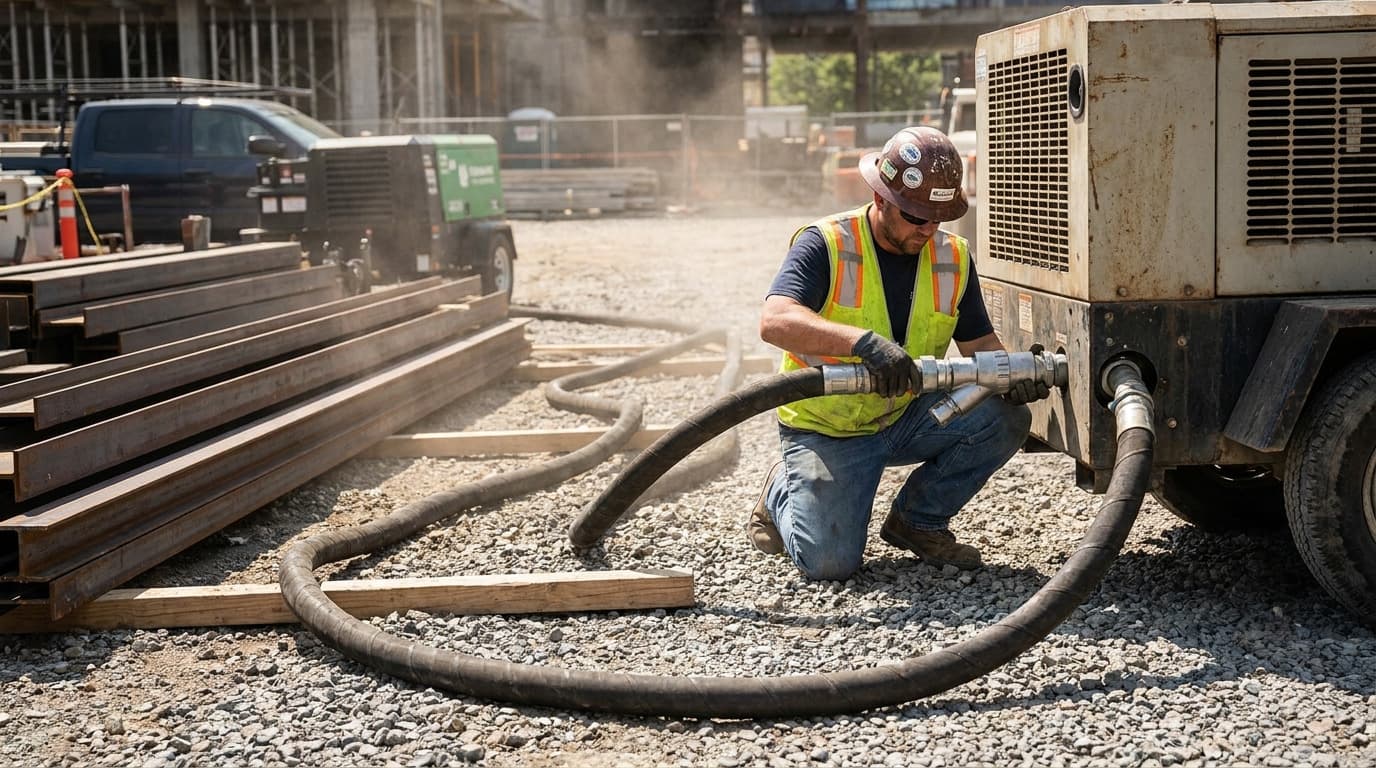
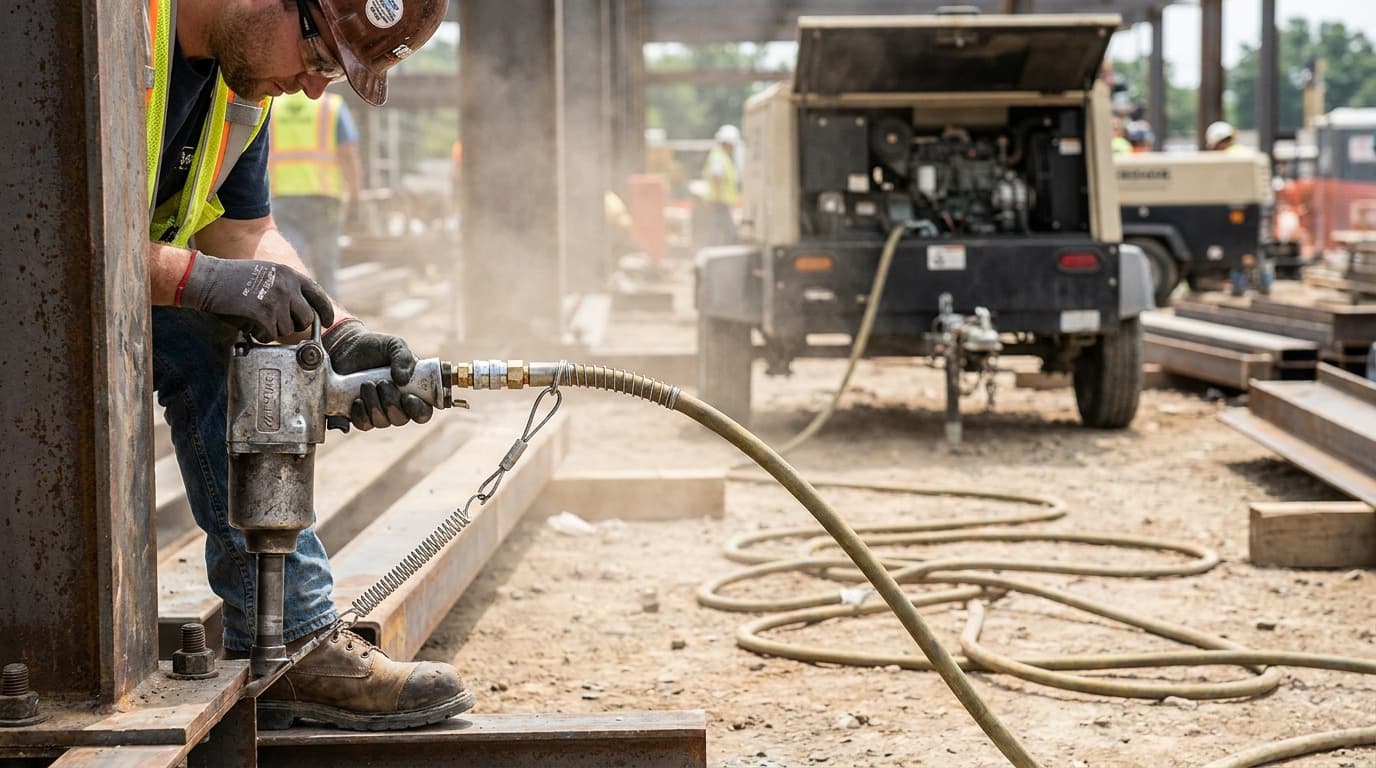
The single most important pneumatic rule exists because of the whip. OSHA requires that pneumatic power tools be secured to the hose or whip by some positive means to prevent the tool from becoming accidentally disconnected, and the agency has stated plainly that the purpose of this rule is to prevent the hazard of a pressurized air hose whipping around if the tool separates from it. A charged hose that comes loose does not fall to the ground — it thrashes with the full force of the air behind it, and a flailing metal coupling at the end of it can break bone or take an eye. A positive means is a device that will not let go on its own: a proper locking quick-disconnect, a whip check, a pin or clip. It is not a friction push-on fitting and it is not tape. The same logic runs through the whole standard: safety clips or retainers must be installed on percussion tools so the attachment cannot be expelled, and hoses must never be used to hoist or lower tools, because that loads the connection in a way it was never meant to take.
Keeping the pressure inside the system#
The second family of connection rules is about the hose and fittings holding the pressure they carry. The manufacturer's safe operating pressure for hoses, pipes, valves, filters, and fittings must not be exceeded — every component has a rating, and the weakest one sets the safe limit for the whole assembly, so a cheap fitting on a good hose is a cheap-fitting system. Beyond that, any air hose with more than a half-inch inside diameter must have a safety device at the source of supply or the branch line that reduces pressure if the hose fails. This is the excess-flow valve, and it is the answer to the worst hose failure: a large-bore line that bursts or blows off does not just leak, it releases its whole volume at once and whips violently, and the source-side device is what starves that failure of air before it can do its damage. Checking that the hoses are rated, undamaged, and protected at the source is as much a part of pneumatic safety as anything you do with the tool.
Keeping the air off your body#
The other way compressed air injures is completely different from the whip, and it is the one people underestimate most: injection. Compressed air, or fluid driven by it, can pass through skin and enter the body, and it does not take a dramatic pressure to do real harm. A stream of compressed air played against the skin can force air into the tissue and, through a break in the skin, into the bloodstream as an air embolism — a genuine medical emergency from what feels like a harmless puff. This is a large part of why compressed air is not a cleaning tool for your clothes or your skin, and why the cleaning-with-air rules and their limit are treated so seriously in the compressed air talk. The extreme version is the airless spray gun: guns that atomize paint or fluid at a thousand psi or more can inject that fluid deep into a hand or finger through intact skin in an instant, which is why OSHA requires them to have a trigger safety device and a diffuser, and why an airless-injection wound is a surgical emergency even when it looks like a pinprick. Air and fluid under pressure do not respect skin the way we assume they do.
The everyday hazards on top of all that#
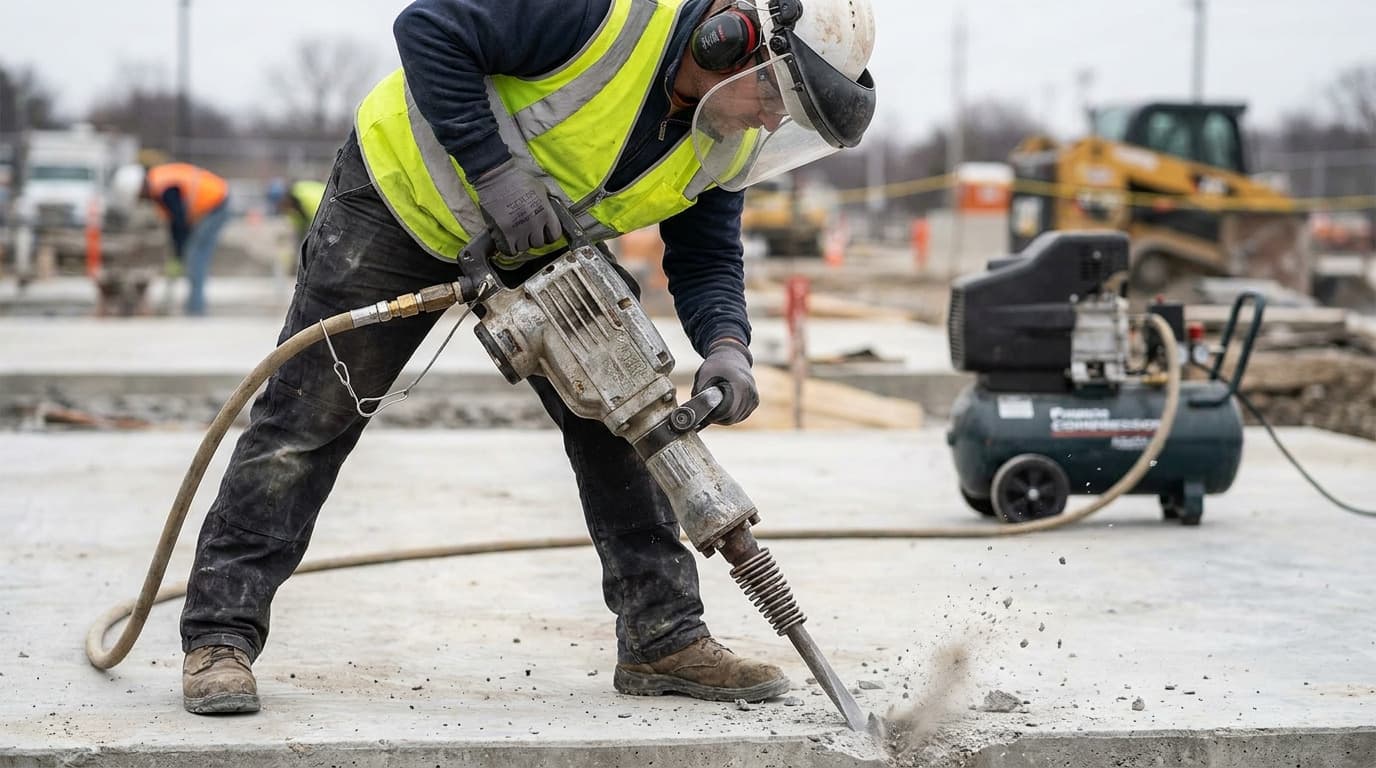
Layered over the pressure hazards are the ordinary ones that come with the working end, and they still count. Pneumatic tools are loud — often loud enough to require hearing protection, which is why the noise and hearing conservation talks matter around them. They throw chips, dust, and debris, so eye and face protection is not optional. Many are heavy and vibrate, bringing the hand-arm and ergonomic hazards. And the tool itself must be maintained in safe condition, with any guards it is designed to accept in place when it is used. None of these replace the pressure-and-hose story that makes pneumatic tools distinct — they sit on top of it. The complete picture is a tool whose forgotten hazards are in the line behind it and whose obvious hazards are at the end in front of it, and both halves need managing.
Where the duty sits#
The pneumatic tool requirements live in 1926.302(b): the positive means securing the tool to the hose, the safety clips on percussion tools, the muzzle device on high-pressure fastener tools, the 30-psi cleaning limit, the rule against exceeding the manufacturer's pressure rating, the ban on hoisting with hoses, the source-side safety device on hoses over half an inch, and the trigger safety and diffuser on high-pressure airless spray guns. General tool duties — maintaining tools in safe condition and providing PPE against flying objects and harmful dusts — sit in 1926.300, and the duties to train workers and address recognized hazards run through 1926.21(b)(2) and the General Duty Clause, Section 5(a)(1). Where this talk names a rule that another talk owns in detail — the 30-psi cleaning limit belongs to the compressed air talk, the muzzle device to the nail gun talk — treat those talks as the authority on the specifics; this talk's job is the pneumatic system as a whole. And where a manufacturer's instruction or a site rule sets a specific requirement, that requirement governs.
What can go wrong?#
- A tool disconnects from a charged hose and the line whips, striking a worker.
- A push-on fitting with no positive locking lets a tool blow off the hose under pressure.
- A percussion tool without a safety clip expels its attachment like a projectile.
- A large-bore hose bursts with no source-side safety device and thrashes at full volume.
- Compressed air is used to blow off clothing or skin and forces an air embolism.
- An airless spray gun injects paint into a hand through intact skin.
- A hose is used to hoist a tool and the connection fails under the load.
- A fitting rated below the system pressure fails and becomes a projectile.
How do we manage this properly?#
- Treat the hose as charged until the air is off and the line is bled — the tool going quiet isn't safe.
- Secure the tool to the hose with a positive means — locking quick-disconnect, whip check, pin or clip, never a push-on.
- Keep safety clips and retainers on percussion tools so attachments can't be expelled.
- Never exceed the manufacturer's pressure rating — the weakest fitting sets the limit.
- Make sure hoses over half an inch have a source-side safety device for hose failure.
- Never blow compressed air at skin or clothing, and never use a hose to hoist a tool.
- Treat any air or airless-injection contact with the body as a medical emergency, however small it looks.
- Wear eye, face, and hearing protection for the working-end hazards on top of all this.
Before you start#
- Confirm the tool is secured to the hose by a positive locking means, not a friction fitting.
- Confirm percussion tools have their safety clips or retainers in place.
- Confirm hoses and fittings are rated for the system pressure and undamaged.
- Confirm large-bore hoses have a source-side pressure-relief device.
- Confirm no one intends to clean skin or clothing with compressed air.
- Confirm the airless spray gun's trigger safety and diffuser are working, if one is in use.
- Confirm eye, face, and hearing protection for everyone in the work area.
- Confirm you know how to shut off and bleed the line before disconnecting.
Talk it over#
- Which of our air tools are connected with a real positive locking device, and which are push-on?
- Has anyone here seen a hose whip when a tool came loose?
- Do we ever use compressed air to blow ourselves off — and does everyone know why that's dangerous?
- When you disconnect a tool, do you shut off and bleed the line first, or just pull it?
The bottom line#
Every other tool's power is in your hand; a pneumatic tool's power is in the hose behind it — a charged line that stays a whip and a launcher after the tool goes quiet, which is why the pneumatic hazards you forget are all behind the trigger, not in front of it. The rules split into two jobs, and both trace to that stored air. Keep the connection from failing — a positive means securing the tool to the hose so it cannot fire off and whip, safety clips so a percussion attachment cannot be expelled, no hoisting on hoses, and never exceeding the fittings' pressure rating with a source-side device to starve a failed large-bore hose. And keep the air off your body — because compressed air injures a second, unrelated way, injection: a puff against skin can drive an air embolism, and an airless spray gun can inject fluid through intact skin as a surgical emergency. Those live in 1926.302(b), with the 30-psi cleaning limit and the muzzle device owned in detail by the compressed air and nail gun talks. On top of the pressure story sit the ordinary working-end hazards — noise, flying debris, vibration — that call for eye, face, and hearing protection. The question to carry is the one that separates a pneumatic tool from every other: the tool is quiet, but is the line still charged — and have I secured the connection, rated the hose, and kept the air off my body before I trust it?
Frequently asked questions about pneumatic tools#
What makes a pneumatic tool different from other power tools?
Where its energy is stored. A corded or cordless tool holds its energy in the tool — release the trigger and it winds down in your hand. A pneumatic tool's energy is in the compressed air line running back to the compressor, which stays under pressure whether or not the tool is running. That is why the hazards people forget are behind the trigger, in the hose and the connection, rather than at the working end. It is also why the tool going quiet does not mean the system is safe: the pressure lives in the line, so until the air is shut off and the hose is bled, the whip and projectile hazards are still charged. Understanding that one difference reframes the whole tool.
Why does the tool have to be locked to the hose?
To prevent the hose from whipping. OSHA requires pneumatic tools to be secured to the hose by a positive means that will not let go accidentally, and it has stated the purpose directly: to prevent the hazard of a pressurized air hose whipping around if the tool becomes disconnected. A charged hose that separates from its tool does not drop — it thrashes with the full force of the air behind it, and the metal fitting on the end can break bone or destroy an eye. A positive means is a locking quick-disconnect, a whip check, a pin, or a clip — something designed not to release on its own. A plain friction push-on fitting is not a positive means, because it can blow off under pressure, which is exactly the failure the rule exists to prevent.
Can compressed air really injure you through the skin?
Yes, and this is the hazard people most underestimate. Compressed air played against the skin can force air into the tissue, and through any break in the skin it can enter the bloodstream as an air embolism — a real medical emergency from what feels like a harmless puff. This is a major reason compressed air must never be used to blow off skin or clothing. The extreme version is the airless spray gun, which atomizes paint or fluid at a thousand psi or more and can inject that fluid deep into a finger or hand through intact skin in an instant. An injection wound can look like a pinprick and still be a surgical emergency, because the fluid spreads through the tissue under the skin. Air and fluid under pressure pass through skin far more easily than people assume.
What is the safety device on a large hose for?
To starve a burst hose of air before it can do damage. OSHA requires any air hose with more than a half-inch inside diameter to have a safety device at the source of supply or the branch line that reduces pressure if the hose fails. A large-bore line carries a lot of air, and if it bursts or blows off a fitting, it releases that whole volume at once and whips violently. The source-side device — an excess-flow valve — senses the sudden surge of a failure and cuts the air off at the supply, so the hose loses its power to thrash almost immediately. It is a hose-failure safeguard rather than a tool safeguard, which is why it is easy to forget, and why checking for it is part of setting up a pneumatic system safely.
Do the 30-psi cleaning rule and the nail gun trigger belong to this talk?
Not in detail — those are owned by other talks, and this one points to them. The 30-psi limit on using compressed air for cleaning, and the detailed hose provisions, belong to the compressed air safety talk. The muzzle safety device and the trigger question on pneumatic nailers belong to the nail gun talk. Powder- and fuel-actuated tools have their own talk, and high-pressure machines have theirs. This talk's job is the thing they all share — that a pneumatic tool's power is stored in the air line, and the hazards of the connection, the hose, and the compressed air itself. When your question is about a specific limit or a specific tool, go to the talk that owns it; when it is about the pneumatic system as a whole, it is here.
What PPE do I need for pneumatic tools?
Eye and face protection and hearing protection, at a minimum, on top of managing the pressure hazards. Pneumatic tools throw chips, dust, and debris from the working end, so eye and face protection is required, and many are loud enough to require hearing protection — which is why the noise and hearing conservation talks matter around them. Many are also heavy and vibrate, bringing hand-arm vibration and ergonomic concerns over time. None of this PPE addresses the hose-and-pressure hazards that make pneumatic tools distinct — a face shield does nothing about a whipping hose — so treat the PPE as protecting you from the working end while the connection, hose, and air-off-the-body discipline protects you from the stored energy behind the tool. Both halves are needed.
Download the pneumatic tools toolbox talk PDF#
Get this pneumatic tools toolbox talk as a print-ready PDF — available in English, Spanish, Portuguese, and Turkish. Print it, hand it to the crew, and collect signatures on the included attendance sheet.
Download the PDF — free account required. New members get 3 free downloads.
Related toolbox talks#
Sources#
- OSHA, Power-operated hand tools — 29 CFR 1926.302(b) (pneumatic power tools secured to the hose or whip by a positive means to prevent accidental disconnection; safety clips or retainers on percussion tools; manufacturer's safe operating pressure not exceeded; hoses not used for hoisting; source-side safety device on hoses over ½-inch inside diameter; trigger safety and diffuser on airless spray guns at 1,000 psi or more): https://www.osha.gov/laws-regs/regulations/standardnumber/1926/1926.302
- OSHA, Use of quick-disconnect on pneumatic power tools; §1926.302(b)(1) (standard interpretation, 2003) (the purpose of the positive-means requirement is to prevent the hazard of a pressurized air hose whipping around if the tool becomes accidentally disconnected): https://www.osha.gov/laws-regs/standardinterpretations/2003-11-14
- OSHA, General requirements — 29 CFR 1926.300 (all hand and power tools maintained in safe condition; PPE provided against falling, flying, abrasive, and splashing objects and harmful dusts): https://www.osha.gov/laws-regs/regulations/standardnumber/1926/1926.300
This talk is general awareness guidance for training purposes. It does not replace your employer's tool safety program, the OSHA power-operated hand tool standards, the OSH Act General Duty Clause, the tool or compressor manufacturer's instructions, or a competent person's duties, and it is not legal advice. Where a manufacturer's instruction or a site rule sets a specific requirement, that requirement governs.
Written by FieldSafetyTalk's safety professional — a CSP, ASP, CHST and OSHA Authorized Outreach Trainer with 14+ years of international construction safety experience across federal, heavy civil, and industrial projects.