Chlorine Gas Awareness
Updated 2026-08-01
In this bundle Health & Environmental Exposure
Print-ready PDF
Download this talk as a print-ready PDF, available in 4 languages.
Chlorine is the rare industrial gas that tells you it is there. It is greenish-yellow, it stings, and it smells unmistakable. Crews take a certain comfort in that — a gas you can smell feels like a gas you can manage. That comfort is misplaced, and the reason has nothing to do with how strong the smell is. This Chlorine Gas Awareness Toolbox Talk (Safety Talk / Tailgate Talk) is about the part of the exposure that gives you no signal at all.
Here is the distinction that carries this whole talk: the chlorine that makes you cough is the chlorine that stopped at your throat — the chlorine that does the real damage is the part that went past it without a sound. Your upper airway is a filter, and how much it catches depends on how soluble the gas is in water. Chlorine sits in the awkward middle: soluble enough to burn your eyes and throat on contact, but not soluble enough to be scrubbed out before it reaches the deep lung. So the coughing fit measures the fraction that was caught. It does not measure the fraction that got through — and that fraction is the one that puts you in hospital hours later.
Where the boundary of this talk sits#
Chlorine cylinders, ton containers and their valves, caps and storage are covered in the compressed gas cylinder talk. What to do when something is already on the ground or in the air is covered in the chemical spill response talk. Respirator selection and fit are covered in the respiratory protection talk. This talk owns what chlorine does to a person who breathes it, and why the injury does not finish when the exposure does.
Where it turns up in construction#
More often than crews expect, and rarely with a hazmat label on the day.
Water main disinfection. New and repaired potable mains are disinfected to consensus standards such as ANSI/AWWA C651, using liquid chlorine gas through a vacuum-operated chlorinator, or sodium or calcium hypochlorite. That is routine heavy civil work carried out by pipe crews, not chemists.
Water and wastewater treatment plants, where construction and maintenance contractors work alongside live chlorination systems in 150 lb cylinders or one-ton containers.
Pools, tanks and reservoirs during commissioning and cleaning.
Accidental generation. Sodium hypochlorite — ordinary bleach — releases chlorine gas when it is mixed with an acid, including many descalers, brick and masonry cleaners and toilet cleaners. Nobody plans this one. It happens in a plant room or a site cabin because two products got used on the same surface, or poured into the same bucket.
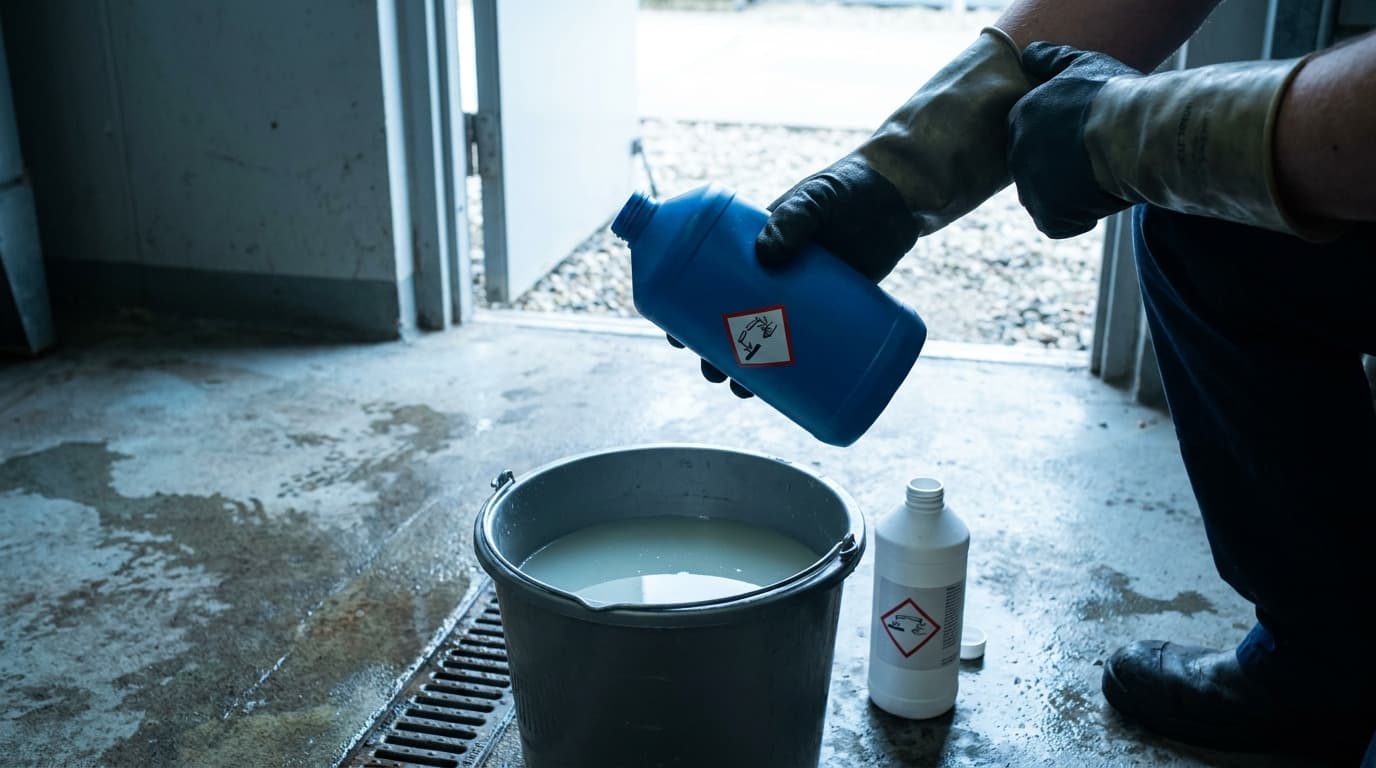
Liquefied chlorine also causes frostbite on skin contact, which is a separate injury from the inhalation hazard.
Solubility decides where the injury lands#
This is the mechanism, and it is worth ten minutes on its own.
An inhaled irritant gas dissolves in the wet lining of the airway. A highly water-soluble gas is captured almost entirely in the nose, mouth and throat. It produces immediate, intense upper-airway pain — and that pain drives people out of the area fast, which is protective. Ammonia behaves this way and is covered in its own talk.
Chlorine has intermediate solubility. On moist tissue it hydrolyses rapidly into hypochlorous acid and hydrochloric acid, which is what causes the burning. But only a small fraction is absorbed in the upper airway at low concentrations. The rest travels down to the bronchi, bronchioles and alveoli and does its damage there, in tissue with no pain nerves worth speaking of and enormous surface area.
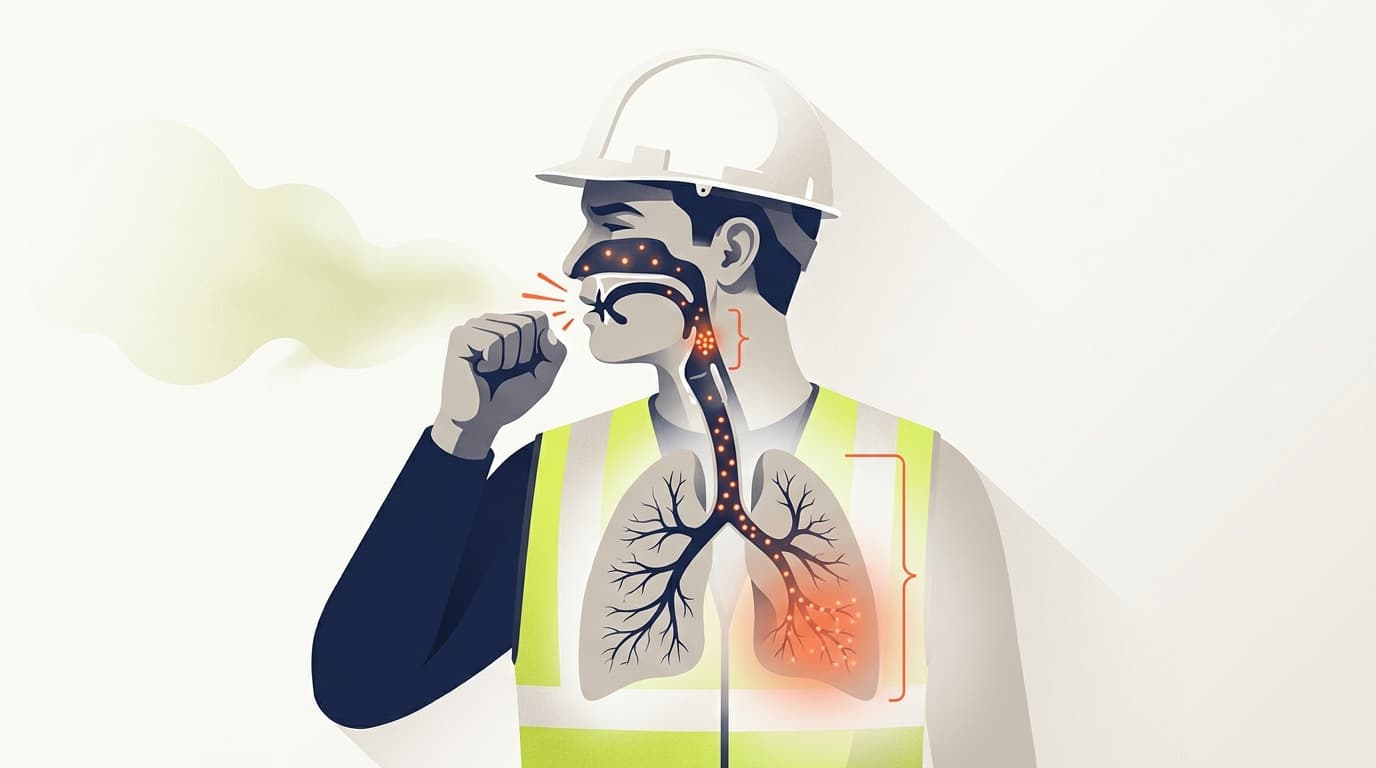
So the warning you get is produced by the part that was caught, and it is systematically weaker than the exposure it is warning you about. A mild sore throat and a bit of coughing is not evidence of a mild exposure. It is evidence that some chlorine stopped in your throat, and it says nothing about how much did not.
The injury arrives late#
This is what turns a bad shift into a fatality, and it is the single most important operational fact in this talk.
NIOSH states that pulmonary injury may progress for several hours, and that accumulation of fluid in the lungs — pulmonary oedema — may be delayed up to 24 hours. ATSDR similarly notes that symptoms may be apparent immediately or delayed for a few hours. In moderate exposures, oedema commonly develops within 2 to 4 hours; in severe exposures it can appear within 30 to 60 minutes, with copious airway secretions. The majority of chlorine deaths occur within 24 hours and are from respiratory failure.
Line that up against how a site actually behaves. Somebody gets a face full of gas at a valve vault at ten in the morning. They cough, their eyes stream, they walk into fresh air and after twenty minutes they say they feel fine. They do feel fine. The acid injury in their small airways has not yet produced fluid. They go back to work, or they drive themselves home. The dangerous hours are the ones nobody is watching.
Feeling better is not evidence of getting better. Anyone with a suspected significant chlorine exposure needs medical assessment and a period of observation decided by a clinician — not by the casualty, and not by the supervisor. For previously healthy people who are treated, pulmonary function usually returns to pre-exposure levels within about 7 to 14 days.
The smell is not a control#
Chlorine's warning properties are better than carbon monoxide's, which has none at all. That is a low bar, and the detail matters.
Reported odour thresholds for chlorine range from about 0.03 to 3.5 ppm — a spread of more than a hundredfold between individuals. That range straddles the legal limit entirely. Some people will not notice the odour until it is more than three times the exposure limit. Add odour fatigue, which sets in during continuous exposure, and the smell stops being information.
Use it as one thing only: an evacuation trigger. If you can smell chlorine where you did not expect chlorine, leave, upwind and uphill, and report it. Never use it the other way round — the absence of smell is not clearance, and a smell that fades is not an improvement.
The numbers, and how little room they leave#
Two figures put the hazard in proportion.
The OSHA permissible exposure limit for chlorine is 1 ppm as a CEILING — listed in 1910.1000 Table Z-1 and applied to construction through 1926.55. Note carefully what a ceiling means: it must not be exceeded at any time. It is not an eight-hour average, so there is no arithmetic that lets a short high exposure be balanced out by a clean afternoon.
The NIOSH IDLH for chlorine is 10 ppm.
Ten times the legal ceiling is immediately dangerous to life or health. For comparison, carbon monoxide's PEL is 50 ppm and its IDLH is 1,200 ppm — a factor of twenty-four. Chlorine gives you barely one order of magnitude between the limit you are supposed to stay under and the concentration that can stop you escaping. There is no comfortable middle band with this gas.
For reference, NIOSH recommends 0.5 ppm as a 15-minute ceiling, and the ACGIH threshold limit value is 0.5 ppm with a short-term limit of 1 ppm. ACGIH and AWWA are consensus standards, not OSHA rules — useful benchmarks, but the enforceable figure is the OSHA ceiling.
It goes down, and it stays down#
Chlorine gas is roughly two and a half times heavier than air. It does not disperse upward. It flows downhill and pools in exactly the places construction works: trenches and excavations, valve vaults and meter pits, manholes, sumps, basements, tank bottoms, wet wells and the low corner of a sloping plant room.
Three consequences follow. The concentration at the bottom of a pit is not the concentration at the rim, so a reading taken at the hatch tells you little. The gas travels, flowing along the ground away from the release to somewhere nobody associates with chlorine. And a low space that has been quiet for hours can still be full, because there is nothing to lift the gas out of it without mechanical ventilation.
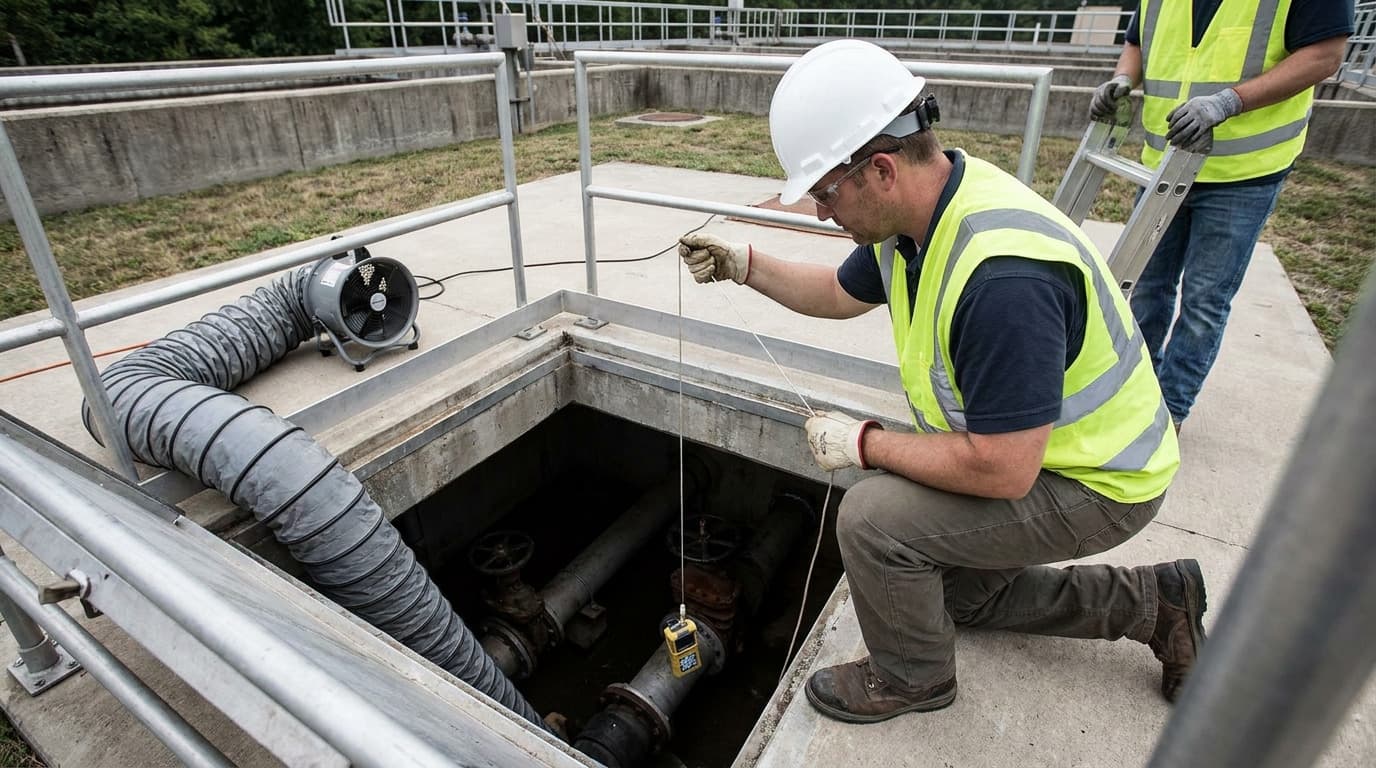
This is the opposite of carbon monoxide, which mixes evenly and does not stratify. Two gases, two completely different search patterns — do not carry the habits of one into the other.
Non-flammable does not mean it will not burn things#
Chlorine is a non-flammable gas. Crews hear that and file it under "no fire risk," which is wrong.
Chlorine is a strong oxidiser. It can ignite organic and combustible materials — wood, paper, oil, rags, greases — on contact. Hydrocarbons and oils near a chlorine system are a genuine hazard, which is why chlorine equipment is kept scrupulously free of oil and grease. The gas will not burn. It will make other things burn.
Where the duty sits#
There is no OSHA standard specific to chlorine in construction beyond the exposure limit. State that plainly.
The ceiling applies through 1926.55, which also requires that engineering and administrative controls be implemented first wherever feasible, with protective equipment where controls are not feasible. 1926.59 brings hazard communication into construction, so the safety data sheet for the actual product governs. 1926.50(g) requires suitable facilities for quick drenching or flushing of the eyes and body within the work area where employees may be exposed to injurious corrosive materials.
The provision most often missed is 1910.119, Process Safety Management. Chlorine appears in Appendix A with a threshold quantity of 1,500 pounds (680 kg) — a figure a water treatment works passes easily with ton containers. Where a process is covered, 1910.119(h) reaches contractors performing maintenance, repair, turnaround, major renovation or specialty work on or adjacent to that process. The host employer must inform contract employers of known potential fire, explosion or toxic release hazards and explain the emergency action plan; the contract employer must train and instruct its own people accordingly. If you are working at a plant with a covered chlorine process, that briefing is your legal entitlement — ask for it.
What can go wrong?#
Treating a coughing fit as the measure of the exposure, and standing people down rather than sending them for assessment.
Letting somebody drive home after a chlorine exposure because they said they felt better.
Mixing bleach with an acidic cleaner in a bucket, a drain or a plant room, and generating chlorine gas indoors.
Entering a valve vault, pit or trench near a chlorination system without testing at the working depth.
Taking a gas reading at the rim of a low space and treating it as representative.
Using the smell as an all-clear — or assuming a fading smell means the air is clearing.
Storing oil, grease or rags near chlorine equipment, on the assumption that a non-flammable gas poses no fire risk.
Working at a treatment plant without asking the host what chlorine is on site, where it is, and what the alarm and evacuation plan is.
How do we manage this properly?#
Ask before you mobilise. At any water, wastewater or pool facility, establish what form and quantity of chlorine is present, where the alarms are, and what the evacuation route is.
Get the process safety briefing in writing where a covered process is involved, and make sure the crew — not just the supervisor — has heard it.
Read Section 8 of the SDS for the actual product before handling, including for hypochlorite solutions used on water mains.
Never mix cleaning products, and control what comes onto site — the accidental release usually starts with two ordinary bottles.
Test low spaces at the working depth with an instrument that has a chlorine sensor, in calibration and bump tested, before entry and during work.
Ventilate mechanically from the low point, because the gas will not leave a pit on its own.
Move upwind and uphill on any release, and account for people rather than investigating the source.
Send every suspected exposure for medical assessment, tell the clinician it was chlorine, and let a clinician decide the observation period — never the casualty.
Keep oil, grease and combustibles away from chlorine equipment, and flush eyes or skin immediately and at length using the drenching facilities required by 1926.50(g).
Before you start#
- Confirm what chlorine is present on this site, in what form, and in what quantity.
- Confirm whether a process safety briefing under 1910.119(h) applies and has been given.
- Confirm you have read Section 8 of the SDS for the product in use.
- Confirm your gas monitor has a chlorine sensor and is calibrated and bump tested.
- Confirm any pit, vault or trench will be tested at working depth, not at the rim.
- Confirm the mechanical ventilation extracts from the low point.
- Confirm the eyewash and drenching facilities are in the work area and working.
- Confirm everyone knows that a chlorine exposure means medical assessment, not a sit-down.
Talk it over#
- Where on this site could chlorine be present without any of us expecting it?
- What cleaning products are in our stores, and could any two of them be mixed by accident?
- If someone got a face full of gas at the vault this morning, what would we do at midday?
- Which low spaces here would hold gas after everyone thought it had cleared?
The bottom line#
The chlorine that makes you cough is the chlorine that stopped at your throat; the chlorine that harms you went past it without a sound. Chlorine has intermediate water solubility, so it is caught only partly in the upper airway and penetrates to the bronchi and alveoli, where it hydrolyses to hypochlorous and hydrochloric acid — which means the severity of the coughing does not measure the size of the dose. The injury then arrives late: NIOSH states pulmonary injury may progress for several hours and pulmonary oedema may be delayed up to 24 hours, commonly 2 to 4 hours after moderate exposure and 30 to 60 minutes after severe, and most chlorine deaths occur within 24 hours from respiratory failure. So feeling better is not getting better — every suspected exposure goes for medical assessment, and a clinician sets the observation period. Recovery of lung function in previously healthy people treated appropriately is usually 7 to 14 days. The smell is not a control: reported odour thresholds range from about 0.03 to 3.5 ppm, some people do not notice it until more than three times the exposure limit, and odour fatigue removes it — use it as an evacuation trigger only. The margins are thin: the OSHA PEL is 1 ppm as a CEILING that must never be exceeded, under 1910.1000 Table Z-1 applied through 1926.55, while the NIOSH IDLH is just 10 ppm — only ten times the legal limit, against a factor of twenty-four for carbon monoxide. NIOSH recommends a 0.5 ppm 15-minute ceiling and ACGIH sets 0.5 ppm — consensus standards, not OSHA rules. Physically, chlorine is about two and a half times heavier than air, so it pools in trenches, vaults, pits, manholes and basements and must be tested at working depth and ventilated from the low point — the opposite of carbon monoxide. It is non-flammable but a strong oxidiser that can ignite wood, paper, oil and rags. On duties: there is no chlorine-specific OSHA construction standard; 1926.55 requires controls before PPE, 1926.59 brings HazCom and the SDS, 1926.50(g) requires quick drenching and flushing facilities, and 1910.119 Appendix A lists chlorine at a 1,500 pound (680 kg) threshold quantity, with 1910.119(h) placing duties on contractors working on or adjacent to a covered process — and on the host to brief them.
Frequently asked questions about chlorine gas#
If I can smell chlorine, am I already overexposed?
Not necessarily, and that is the problem — the smell is unreliable in both directions. Reported odour thresholds range from about 0.03 to 3.5 ppm, so some people detect it well below the limit while others do not notice it until it is more than three times the exposure limit. Odour fatigue then removes the signal during continuous exposure. Treat any unexpected chlorine smell as an evacuation trigger, and never treat its absence or fading as clearance.
I coughed a bit but I feel fine now. Do I really need to be checked?
Yes. This is the most dangerous moment in a chlorine incident. NIOSH states that pulmonary injury may progress for several hours and that pulmonary oedema may be delayed up to 24 hours — commonly 2 to 4 hours after a moderate exposure. The coughing measured only the fraction of gas caught in your throat, not the fraction that reached your deep lung. Feeling better is not evidence of getting better. Go for assessment, say it was chlorine, and let a clinician set the observation period.
Why is chlorine worse in the lungs than a gas that hurts more immediately?
Because of water solubility. A highly soluble gas is captured almost entirely in the nose and throat, causing immediate severe pain that drives people out fast. Chlorine's intermediate solubility means only part of it is absorbed up top; the rest reaches the bronchioles and alveoli, hydrolysing there into hypochlorous and hydrochloric acid. The warning is weaker precisely because the gas is travelling further.
Does chlorine collect high or low?
Low. Chlorine is roughly two and a half times heavier than air, so it flows downhill and pools in trenches, excavations, valve vaults, meter pits, manholes, sumps, wet wells and basements. Test at the working depth, not at the rim, and ventilate mechanically from the low point. Note this is the exact opposite of carbon monoxide, which mixes evenly and does not stratify.
How can chlorine gas appear on a site with no chlorine cylinders?
By accident, from ordinary products. Sodium hypochlorite — bleach — releases chlorine gas when mixed with an acid, and acids are common in descalers, masonry and brick cleaners and toilet cleaners. A plant room, a site cabin or a bucket is all it takes. Control what cleaning products come on site and never mix them.
Chlorine is non-flammable, so there is no fire risk. True?
False, and this catches people out. Chlorine will not burn, but it is a strong oxidiser and can ignite organic and combustible materials such as wood, paper, oil, greases and rags on contact. This is why chlorine equipment is kept free of oil and grease. The gas does not burn — it makes other things burn.
Does OSHA have a chlorine standard for construction?
There is no chlorine-specific OSHA construction standard. The PEL of 1 ppm as a ceiling comes from 1910.1000 Table Z-1 and applies through 1926.55, which also requires engineering and administrative controls first. 1926.59 brings hazard communication and the SDS; 1926.50(g) requires quick drenching and flushing facilities. Separately, 1910.119 lists chlorine in Appendix A at a threshold quantity of 1,500 pounds (680 kg), and where that process safety standard applies, paragraph (h) places duties on both the host and the contractor.
Download the chlorine gas awareness toolbox talk PDF#
Get this chlorine gas awareness toolbox talk as a print-ready PDF — available in English, Spanish, Portuguese, and Turkish. Print it, hand it to the crew, and collect signatures on the included attendance sheet.
Download the PDF — free account required. New members get 3 free downloads.
Related toolbox talks#
Sources#
- NIOSH, Chlorine: Lung Damaging Agent — Emergency Response Safety and Health Database: https://www.cdc.gov/niosh/ershdb/emergencyresponsecard_29750024.html
- NIOSH, Documentation for Immediately Dangerous to Life or Health Concentrations — Chlorine: https://www.cdc.gov/niosh/idlh/7782505.html
- ATSDR, Medical Management Guidelines for Chlorine: https://wwwn.cdc.gov/TSP/MMG/MMGDetails.aspx?mmgid=198&toxid=36
This talk is general awareness guidance for training purposes. It does not qualify anyone to handle chlorine containers, operate chlorination equipment or respond to a chlorine release, all of which require specific training and authorisation. It is not medical advice and nothing in it is a diagnosis; anyone with a suspected chlorine exposure should be assessed by a qualified medical professional, who should be told that chlorine exposure is suspected.
Written by FieldSafetyTalk's safety professional — a CSP, ASP, CHST and OSHA Authorized Outreach Trainer with 14+ years of international construction safety experience across federal, heavy civil, and industrial projects.