Aerial (Boom) Lift Safety
Updated 2026-08-06
In this bundle Fall Protection & Heights
Print-ready PDF
Download this talk as a print-ready PDF, available in 4 languages.
A boom lift and a scissor lift look like two versions of the same idea — both raise a worker to height on a machine — but they behave so differently that OSHA regulates them under entirely separate standards, and the difference is the whole point of this talk. A scissor lift goes straight up and down over its own base, which is why the law treats it as a mobile scaffold. A boom lift does something a scissor lift cannot: it puts you in a basket at the end of a long arm that extends up and outward, away from the base of the machine. That reach is what makes a boom lift useful, and it is also what makes it a fundamentally more dangerous machine to be standing in. This Aerial (Boom) Lift Safety Toolbox Talk (Safety Talk / Tailgate Talk) is about why the protections that are enough on a scissor lift are not enough here.
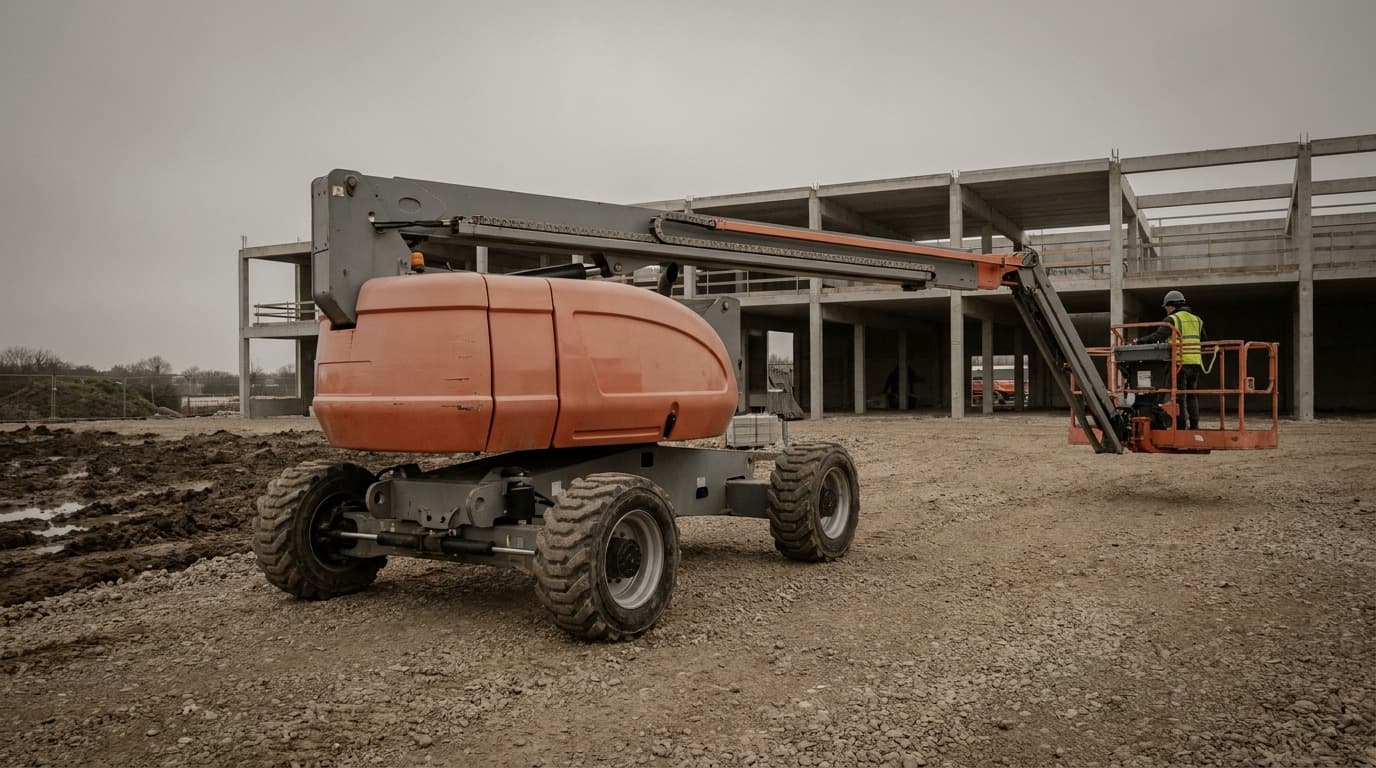
Here is the distinction that carries this whole talk: a scissor lift only goes straight up over its own base, but a boom lift carries you out on the end of a long arm — away from the base, where the machine can tip toward a side it isn't standing on, and the arm can jolt or swing hard enough to throw you clean out of the basket, which is why the guardrails that are enough on a scissor lift are not enough here, and you are tied off the entire time. When your platform is directly over the base, your weight sits inside the machine's footprint and guardrails are enough to keep you from casually stepping over the edge. But when you are out at the end of a boom, your weight is on a lever far from the base, the machine's stability depends on where that arm is pointed, and every movement of the arm — a start, a stop, a swing, a bounce over rough ground — can pitch the basket sharply. On a boom lift the danger is not stepping over the rail; it is being thrown over it, or with it. That single difference drives every rule that follows.
Where the boundary of this talk sits#
This talk has close relatives, and keeping them straight matters. The aerial scissor lift talk owns the scissor lift — the vertical-only platform that OSHA treats as a scaffold, where intact guardrails satisfy the fall protection rules. The scissor lift rescue talk owns getting a stranded worker down from one. This talk owns the boom lift specifically: the extensible or articulating boom, the cherry picker, the bucket truck — the machines OSHA classifies as aerial lifts, where the arm reaches out past the base and changes everything about tip-over, ejection, and tie-off. Where the machine goes straight up and is treated as a scaffold, that is the scissor lift's talk; where the machine reaches out on an arm and is treated as an aerial lift, that is this one. The two are not interchangeable, and applying scissor-lift thinking to a boom lift is one of the most common and dangerous mistakes on a site.
Why you tie off the entire time#
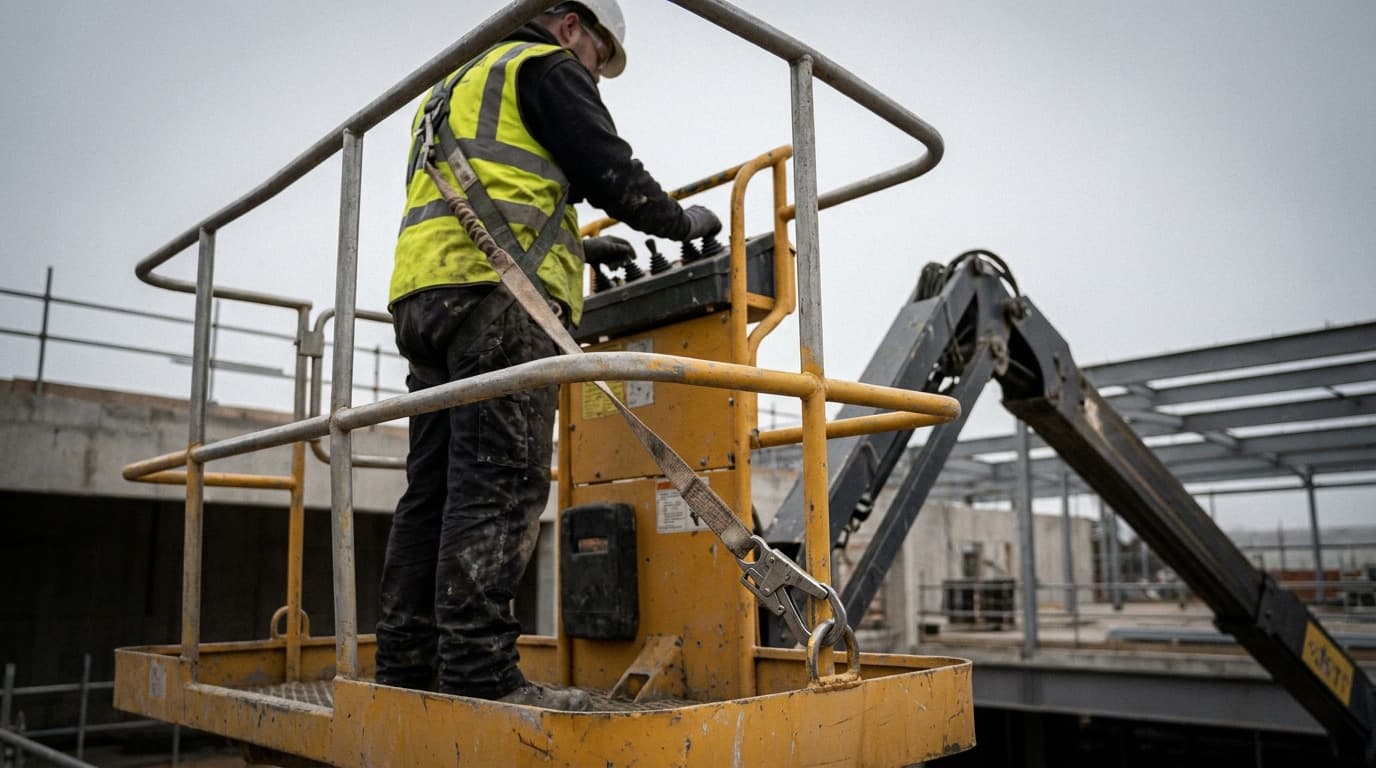
The most important rule on a boom lift, and the sharpest break from the scissor lift, is the tie-off. On an aerial lift a body harness must be worn and a lanyard attached to the boom or basket whenever you are working from it — and this applies at every height, with no exception for guardrails and no exception for being near the ground. But the reason is not what most people assume. The tie-off on a boom lift is not primarily a fall arrest system to catch you after you fall; its purpose is to keep you from being bounced or catapulted out of the basket when the arm makes a hard movement, or from being thrown out if you lean your center of gravity over the rail. That changes what you clip to and how. You attach a short lanyard to the manufacturer's anchor point inside the basket, so that if the arm jolts you are held in the basket, not left dangling below it on a six-foot lanyard where you could still be thrown clear. It is a restraint, keeping you where you belong, more than a net catching you after the worst has happened.
What never counts as an anchor#
Because the tie-off is to the machine, one rule is absolute: you never tie off to anything outside the lift. The standard specifically prohibits attaching your lanyard to an adjacent pole, structure, or piece of equipment while working from an aerial lift. It feels intuitive that clipping to a solid steel beam next to you would be safer than clipping to the basket you are standing in — but it is exactly wrong. If the lift moves or drifts and you are anchored to something outside it, you can be pulled out of the basket, or the movement can wrench you against a fixed point. The basket is engineered with an anchor rated for that lift, and that anchor moves with you as the machine moves. The rule to carry is simple: the only place your lanyard goes is the manufacturer's anchor point in the basket — never the building, never the scaffold, never the pole you happen to be working next to.
The three ways a boom lift kills#
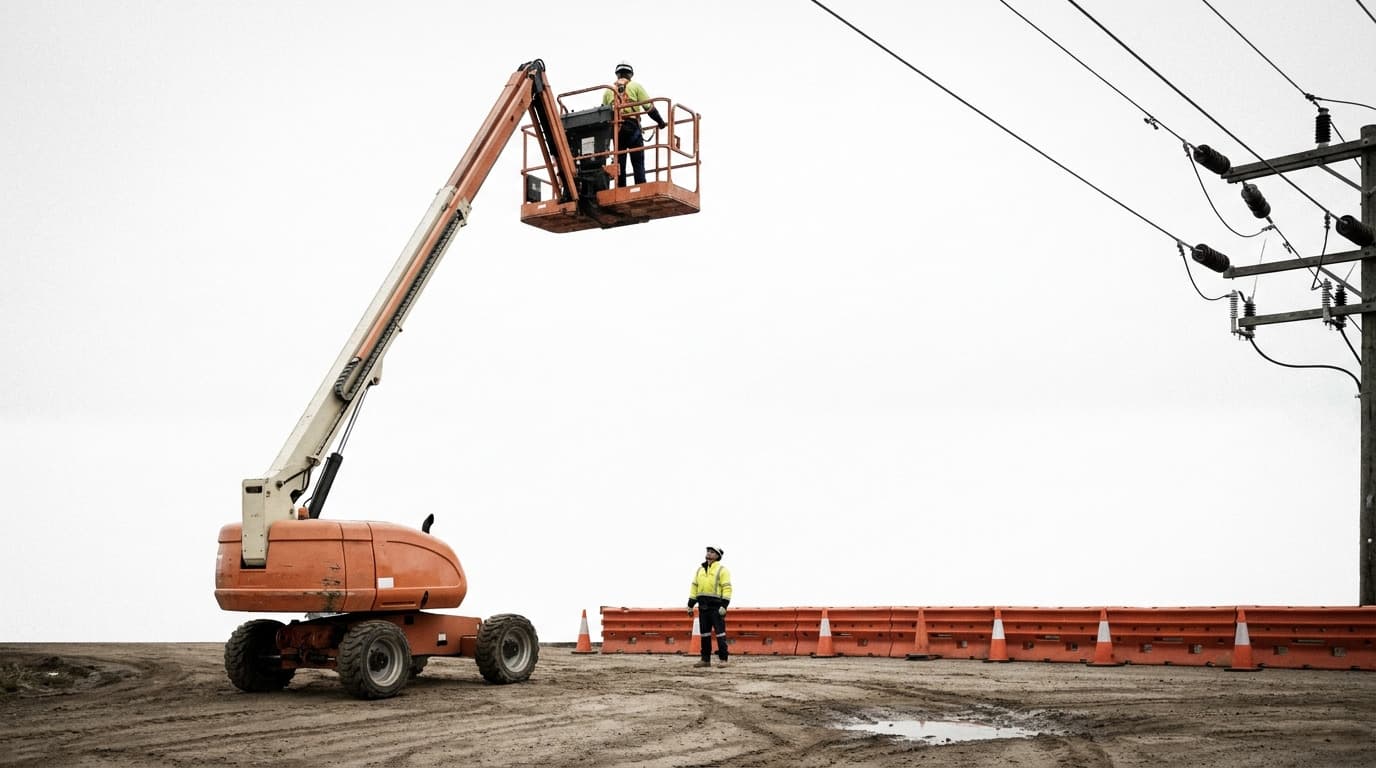
Aerial lifts are involved in a meaningful number of construction fatalities every year, and they cluster into three modes that all trace back to the reach of the arm. The first is tip-over: because your weight is out on a lever, the machine's stability depends entirely on the surface it stands on and the position of the arm. Soft ground, a hole or slope, an unset outrigger, exceeding the boom and basket load limits, or overreaching can put the center of gravity outside the base and roll the whole machine over. The second is ejection: the arm's motion, a bounce over rough terrain, or a sudden stop can throw an untethered worker out of the basket entirely — the hazard the restraint lanyard exists to prevent. The third is electrocution: a boom is a long conductive arm that workers routinely maneuver near overhead power lines, and contact, or even close approach, can energize the whole machine. Every one of these is a consequence of the same thing that makes the boom lift useful — that it reaches out and up, into positions a scissor lift cannot go.
Setting up and operating so it doesn't tip#
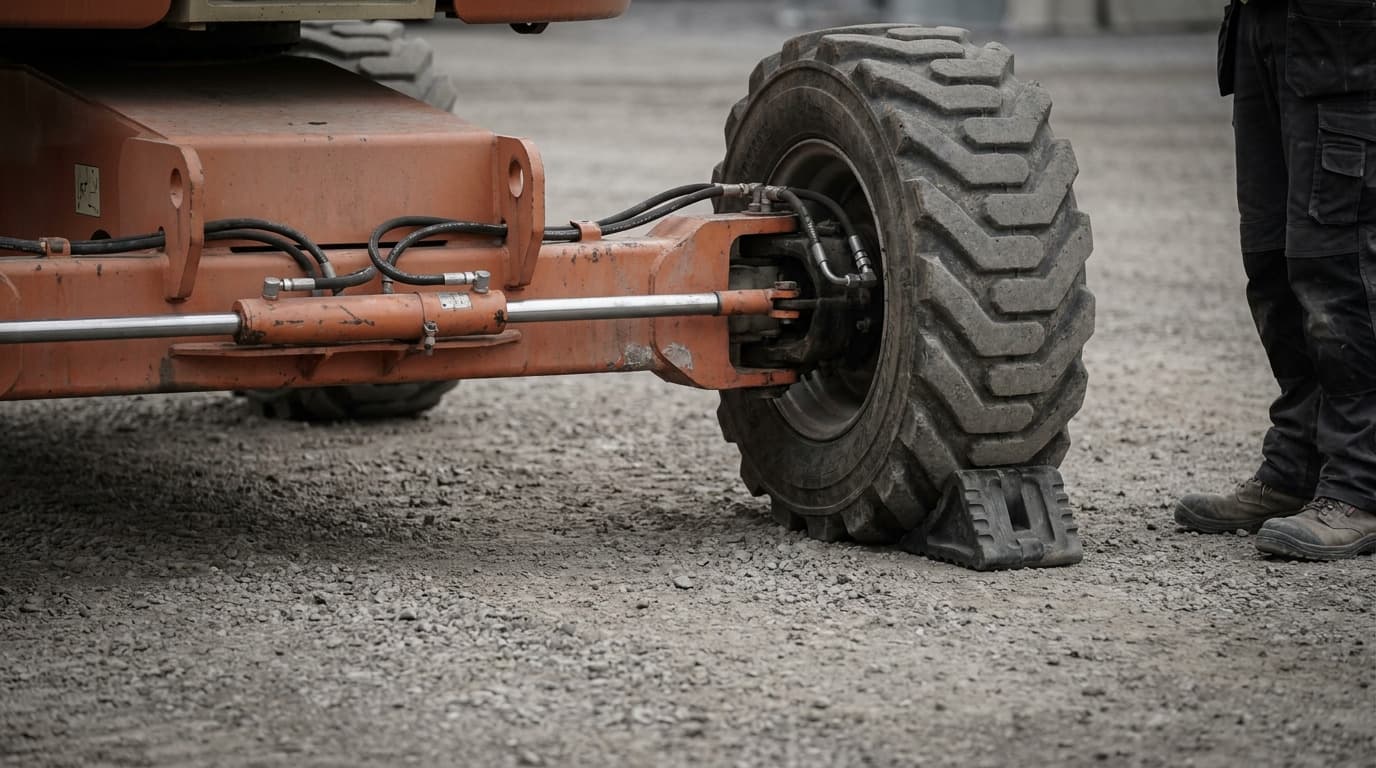
Controlling tip-over is mostly about the setup and the discipline of operation. The machine goes on firm, level ground rated to hold it; where the ground is soft or uneven you use the outriggers, positioned on pads or a solid surface, and you set the brakes. On any incline you chock the wheels if they can be safely installed. You respect the load chart — the boom and basket have manufacturer load limits that account for both weight and how far the arm is extended, and those limits are not to be exceeded. You do not move the lift with the boom elevated and someone in the basket unless the machine is specifically designed for that. And you do not use the basket as a crane, drag the machine sideways with the arm, or reach out beyond the platform to extend your work — every one of those puts your center of gravity or the machine's where it does not belong. The operator has to be trained and, under current consensus standards, familiarized on the specific type and model of lift, because the controls and stability envelope differ from one machine to the next.
Where the duty sits#
Boom lifts are governed by OSHA's aerial lift standard, 1926.453, which applies to the equipment defined as aerial lifts in ANSI A92.2 — extensible and articulating boom platforms, aerial ladders, and vertical towers — and, importantly, does not apply to scissor lifts, which are scaffolds. The core operating rules live in 1926.453(b)(2): a body belt or harness with a lanyard attached to the boom or basket when working from the lift (b)(2)(v); the prohibition on tying off to an adjacent pole, structure, or equipment (b)(2)(iii); the requirement not to exceed manufacturer boom and basket load limits; brakes set, outriggers on pads, wheel chocks on inclines; and no moving the lift with the boom elevated and occupied unless designed for it. A note to the standard clarifies that since 1998 a body belt is not acceptable as fall arrest, though it remains acceptable in a restraint or tethering system. Training is required under 1926.454, and the current ANSI A92 suite (including A92.22 and A92.24) governs operator familiarization on each MEWP. Where an overhead power line is near, minimum approach distances apply and the lift is treated as a conductive object. Where the manufacturer's manual or a site rule sets a specific requirement, that requirement governs.
What can go wrong?#
- A worker in a boom lift isn't tied off and is bounced out of the basket by a hard arm movement.
- Someone clips a six-foot fall-arrest lanyard instead of a short restraint lanyard and is still thrown clear.
- A worker ties off to an adjacent steel beam and is pulled from the basket when the lift moves.
- The boom is maneuvered near an overhead power line and the machine is energized on contact.
- The lift is set on soft or sloped ground without outriggers and tips over.
- The boom and basket load limit is exceeded and the machine goes unstable.
- The lift is driven with the boom elevated and occupied, and it tips.
- Scissor-lift habits are carried onto a boom lift, so nobody ties off at all.
How do we manage this properly?#
- Tie off the entire time on a boom lift — every height, no guardrail exception.
- Use a short restraint lanyard to the basket anchor, not a six-foot fall-arrest lanyard.
- Never anchor to anything outside the lift — not a pole, structure, or the building.
- Keep the boom well clear of overhead power lines — treat the machine as conductive.
- Set up on firm, level ground, use outriggers on pads, set brakes, chock on inclines.
- Respect the load chart — never exceed boom and basket limits or overreach.
- Don't travel with the boom elevated and occupied unless the machine is built for it.
- Make sure the operator is trained and familiarized on this specific type and model.
Before you start#
- Confirm the lift is a boom lift and everyone knows the tie-off rules differ from a scissor lift.
- Confirm you have a harness and a short restraint lanyard for the basket anchor point.
- Confirm the ground is firm and level, or outriggers are set on pads.
- Confirm you've checked for overhead power lines and know the minimum approach distance.
- Confirm the load chart and that your planned work stays inside it.
- Confirm the operator is trained and familiarized on this specific machine.
- Confirm the pre-use inspection was done and all controls and safety devices work.
- Confirm nobody plans to tie off to anything outside the basket.
Talk it over#
- Does everyone here know why a boom lift needs tie-off when a scissor lift with rails may not?
- Are we using short restraint lanyards to the basket, or did someone grab a six-foot fall-arrest lanyard?
- Where are the overhead lines around this work, and how close could the boom get?
- Is the ground under this lift solid enough, and are the outriggers and chocks set where they should be?
The bottom line#
A scissor lift only goes straight up over its own base, but a boom lift carries you out on the end of a long arm — away from the base, where the machine can tip toward a side it isn't standing on, and the arm can jolt or swing hard enough to throw you clean out of the basket, which is why the guardrails that are enough on a scissor lift are not enough here, and you are tied off the entire time. That reach is why OSHA regulates boom lifts as aerial lifts under 1926.453 and scissor lifts as scaffolds, and why the tie-off is mandatory at every height. But the tie-off does a different job than fall arrest: it is restraint to keep you from being catapulted out, which is why it is a short lanyard to the basket's own anchor — never a six-foot fall-arrest lanyard, and never clipped to an adjacent pole or structure. The three ways a boom lift kills — tip-over, ejection, and electrocution — all come from the same reach of the arm, so the controls are firm level ground and outriggers, respecting the load chart, staying clear of overhead power lines, and not traveling elevated and occupied. It all sits in 1926.453 and the ANSI A92 suite, with training under 1926.454. The question to carry is the one the scissor lift never forces you to ask: am I out past the base on an arm that can throw me — and am I tied off to this basket, the whole time, no matter how low I am?
Frequently asked questions about aerial boom lift safety#
How is a boom lift different from a scissor lift?
A scissor lift raises you straight up and down over its own base, so your weight stays inside the machine's footprint; OSHA classifies it as a mobile scaffold, and intact guardrails satisfy the fall protection rules. A boom lift carries you in a basket at the end of an extensible or articulating arm that reaches up and out, away from the base. That reach is the whole difference: your weight ends up on a lever far from the base, the machine's stability depends on where the arm is pointed, and the arm's motion can pitch or throw you. Because of this, OSHA regulates boom lifts under a completely separate standard, the aerial lift standard 1926.453, and requires you to be tied off the entire time. Treating a boom lift like a scissor lift — assuming guardrails are enough and skipping the tie-off — is one of the most dangerous mistakes on a site, because the two machines fail in completely different ways.
Do I really have to tie off on a boom lift even near the ground?
Yes. On an aerial lift the requirement to wear a harness and attach a lanyard to the boom or basket applies whenever you are working from the lift, with no height threshold — it applies even at ground level. This surprises people, because on most other equipment fall protection kicks in only above a certain height. The reason is that the tie-off on a boom lift is not primarily there to arrest a fall from height; it is there to keep you from being bounced or thrown out of the basket when the arm makes a hard movement, and the arm can jolt you out just as easily two feet off the ground as forty. So the height does not matter — what matters is that you are in a basket on a moving arm. The rule is simply to be tied off whenever you are working from the lift, full stop.
Why a short restraint lanyard instead of a normal fall-arrest lanyard?
Because the hazard is being thrown out of the basket, not falling from it, and the two need different equipment. A standard six-foot fall-arrest lanyard is designed to let you fall a short distance and then arrest the fall — but on a boom lift, six feet of slack is enough for a hard arm movement to throw you clear of the basket entirely, leaving you dangling below the lift or striking the structure. A short restraint lanyard, clipped to the manufacturer's anchor point in the basket, keeps you inside the basket in the first place, which is exactly the point. The purpose is to prevent ejection, not to catch you after it. So on a boom lift you want a short lanyard to the basket anchor that holds you in position, not a long fall-arrest lanyard that assumes you are going to fall and just limits how far.
Can I tie off to a building or beam next to me?
No — this is specifically prohibited, and it is one of the most important rules on an aerial lift. It feels safer to clip to a solid steel beam or a sturdy part of the building than to the basket you are standing in, but it is exactly backwards. If the lift moves, drifts, or is bumped and you are anchored to something outside it, you can be pulled out of the basket or wrenched against the fixed point as the machine and the anchor move independently. The basket has an anchor point engineered and rated for that lift, and critically, it moves with you as the machine moves. Your lanyard goes to that manufacturer anchor point in the basket and nowhere else — never the building, never a scaffold, never an adjacent pole, no matter how solid it looks. The whole tie-off system is designed around anchoring to the machine you are riding.
What makes a boom lift tip over?
Tip-over comes from your weight being out on a lever, so anything that moves the center of gravity outside the machine's base can roll it. The common causes are setting up on soft, sloped, or uneven ground without outriggers; failing to set outriggers on pads or a solid surface; exceeding the boom and basket load limits, which account for both weight and how far the arm is extended; overreaching or using the basket to drag or lift a load; and traveling with the boom elevated and someone in the basket on a machine not designed for it. The controls follow directly: firm level ground, outriggers on pads, brakes set, wheel chocks on inclines, and strict respect for the load chart. Because the arm's position changes the stability envelope constantly, the operator has to understand how far the machine can safely reach in each configuration, which is part of why training and familiarization on the specific model matter so much.
What about power lines?
Overhead power lines are one of the three main ways boom lifts kill, because the boom is a long conductive arm that workers routinely maneuver up and out — exactly where overhead lines are. Contact with a line, or even coming within the minimum approach distance, can energize the entire machine and everyone touching it, and the fatality can happen without the boom ever physically touching the wire. The lift has to be treated as a conductive object near any overhead line: identify the lines before you start, know the minimum approach distance that applies, and keep the boom, basket, and any material well outside it. Where lines cannot be avoided, they may need to be de-energized or the work re-planned. The reach that makes a boom lift able to get to high work is the same reach that puts it into power lines, so line awareness is not a side issue on a boom lift — it is central to operating one safely.
Download the aerial boom lift safety toolbox talk PDF#
Get this aerial boom lift safety toolbox talk as a print-ready PDF — available in English, Spanish, Portuguese, and Turkish. Print it, hand it to the crew, and collect signatures on the included attendance sheet.
Download the PDF — free account required. New members get 3 free downloads.
Related toolbox talks#
Sources#
- OSHA, Aerial lifts — 29 CFR 1926.453 (a body belt or harness with a lanyard attached to the boom or basket when working from an aerial lift; boom and basket manufacturer load limits not exceeded; brakes set, outriggers on pads, wheel chocks on inclines; lift not moved with boom elevated and occupied unless designed for it; body belt not acceptable as fall arrest since 1998 but acceptable in a restraint system): https://www.osha.gov/laws-regs/regulations/standardnumber/1926/1926.453
- OSHA, Standard interpretation — Fall protection, training, inspection and design requirements of aerial lifts and scissor lifts/scaffolds (Feb 23, 2000) (1926.453 applies to equipment defined as aerial lifts in ANSI A92.2-1969; scissor lifts are covered by the scaffold provisions instead; the tie-off purpose is to prevent being bounced out of the basket or exposed to a fall by leaning past the rail): https://www.osha.gov/laws-regs/standardinterpretations/2000-02-23-1
- OSHA, Aerial lifts — 29 CFR 1926.453(b)(2)(iii) and training — 29 CFR 1926.454 (prohibition on belting off to an adjacent pole, structure, or equipment while working from an aerial lift; training by a qualified person; ANSI A92 suite governs operator familiarization on each MEWP type and model): https://www.osha.gov/laws-regs/regulations/standardnumber/1926/1926.454
This talk is general awareness guidance for training purposes. It does not replace your employer's aerial lift program, the OSHA aerial lift standard, the ANSI A92 standards, the manufacturer's operating manual, or a qualified operator's training, and it is not legal advice. Where the manufacturer's manual, a site rule, or a qualified person sets a specific requirement, that requirement governs.
Written by FieldSafetyTalk's safety professional — a CSP, ASP, CHST and OSHA Authorized Outreach Trainer with 14+ years of international construction safety experience across federal, heavy civil, and industrial projects.