Correct Usage of Safety Harness
Updated 2026-07-24
In this bundle Fall Protection & Heights
Print-ready PDF
Download this talk as a print-ready PDF, available in 4 languages.
A harness is the only piece of protective equipment on this site designed around the assumption that it will be used exactly once, under forces most workers never think about. A hard hat gets tested every time something small hits it. Gloves prove themselves daily. A harness does nothing at all until the day it has to absorb the arrest of a falling human body — and on that day, how you put it on that morning decides what happens to you. This correct usage of safety harness talk is about the equipment whose only real test is the one you hope never comes.
Here is the distinction that carries this whole talk: with most PPE, wearing it badly means it protects you less. With a harness, wearing it badly changes where the arrest forces go through your body. A loose harness does not simply catch you later — it catches you somewhere else, and the difference between straps sitting on your thighs and straps riding up into your abdomen is the difference between walking away and internal injury. The harness will hold. The question the fit decides is what it holds you by.
Why are body belts prohibited for fall arrest?#
The single most important thing to know about harnesses is why the alternative was banned.
Under 29 CFR 1926.502(d)(16)(iii), personal fall arrest systems must be rigged so an employee cannot free fall more than 6 feet — and critically, under 1926.502(d), the standard states:
Body belts are not acceptable as part of a personal fall arrest system.
That prohibition came into effect on 1 January 1998, and the reason is anatomical. A body belt concentrates the entire arrest force at the waist, across the abdomen and lower spine. The forces involved are not small. Under 1926.502(d)(16)(ii), a personal fall arrest system must limit the maximum arresting force on an employee to 1,800 pounds when used with a body harness. Under 1926.502(d)(16)(i), the limit for a body belt was 900 pounds — half — because the human waist cannot survive more.
A full-body harness distributes that same arrest across the thighs, pelvis, waist, chest, and shoulders, spreading the load over the parts of the body that can take it and keeping the worker upright after the fall.
Body belts remain acceptable for positioning (1926.502(e)) and travel restraint — situations where a fall cannot occur. They are never acceptable where a fall can be arrested.
OSHA harness and fall arrest requirements#
Personal fall arrest system criteria are set by 29 CFR 1926.502(d):
- Attachment point — 1926.502(d)(17). The attachment point of a body harness must be located in the centre of the wearer's back, near shoulder level, or above the head. A sliding back D-ring is permitted.
- Maximum arresting force — 1926.502(d)(16)(ii). The system must limit maximum arresting force on the employee to 1,800 pounds when used with a body harness.
- Free fall limit — 1926.502(d)(16)(iii). The system must be rigged so the employee cannot free fall more than 6 feet, nor contact any lower level.
- Deceleration distance — 1926.502(d)(16)(iv). The system must bring the employee to a complete stop and limit maximum deceleration distance to 3.5 feet.
- Strength — 1926.502(d)(16)(v). The system must have sufficient strength to withstand twice the potential impact energy of an employee free-falling 6 feet, or the free fall distance permitted, whichever is less.
- Anchorages — 1926.502(d)(15). Anchorages must support 5,000 pounds per attached employee, or be designed by a qualified person with a safety factor of at least two.
- Inspection — 1926.502(d)(21). Personal fall arrest systems must be inspected prior to each use for wear, damage, and other deterioration, and defective components removed from service.
- Never on a guardrail — 1926.502(d)(23). Personal fall arrest systems must not be attached to guardrail systems, nor to hoists.
- After a fall — 1926.502(d)(19). Components subjected to impact loading must be immediately removed from service and not used again until inspected and determined undamaged by a competent person.
- Prompt rescue — 1926.502(d)(20). The employer must provide for prompt rescue of employees in the event of a fall, or ensure employees are able to rescue themselves.
- Training — 1926.503. Employees must be trained by a competent person in the correct use and limitations of the equipment.
On USACE and NAVFAC projects, EM 385-1-1 applies and is more prescriptive on inspection intervals and rescue capability.
What goes wrong with harness use?#
Leg straps too loose. The most common fit error. In a fall, loose leg straps allow the body to slide down into the harness, transferring load from the thighs upward into the groin and abdomen. Two fingers under the strap is the working check — no more.
Chest strap in the wrong place. Too low and the shoulder straps can slip off in a fall, allowing the worker to invert. Too high and it can compress the throat. Mid-chest is correct, and it is the strap most often left unfastened entirely.
D-ring out of position. The dorsal D-ring belongs between the shoulder blades. Too low and the worker is thrown forward into a face-down position during arrest; too high and it can strike the back of the head.
Wearing the harness but never connecting it. Workers wear a harness all shift and clip in only occasionally, because tying off feels like a delay for "just one second" at the edge. A harness that is not connected is clothing.
Connecting to the wrong point. Side D-rings are for positioning. Front D-rings are for ladder climbing and rescue. Neither is a fall arrest attachment. Only the dorsal D-ring, or a designated overhead attachment, arrests a fall.
Using equipment that has already arrested a fall. A deployed shock absorber, a stretched lanyard, or webbing that has taken an arrest is finished. Under 1926.502(d)(19), impact-loaded components come out of service immediately.
Damage nobody looked for. Cut or abraded webbing, chemical burns, UV degradation, heat damage from grinding sparks, corroded hardware, illegible labels. These do not announce themselves and are found only by inspection.
Wrong size, or a harness shared between workers. A harness sized for someone else cannot be adjusted into correct fit. Since January 2025, 1926.95(c) explicitly requires PPE selected to properly fit each affected employee.
No rescue plan. Arresting the fall is half the system. Hanging in a harness restricts blood return from the legs, and unconsciousness can follow within minutes.
How do we wear a harness correctly?#
Inspect before every single use. Webbing for cuts, fraying, burns, chemical damage, and discolouration. Stitching for pulled or broken threads. Hardware for cracks, distortion, corrosion, and function. Labels legible. Shock pack indicator not deployed. Anything questionable comes out of service — do not hang it back on the rack.
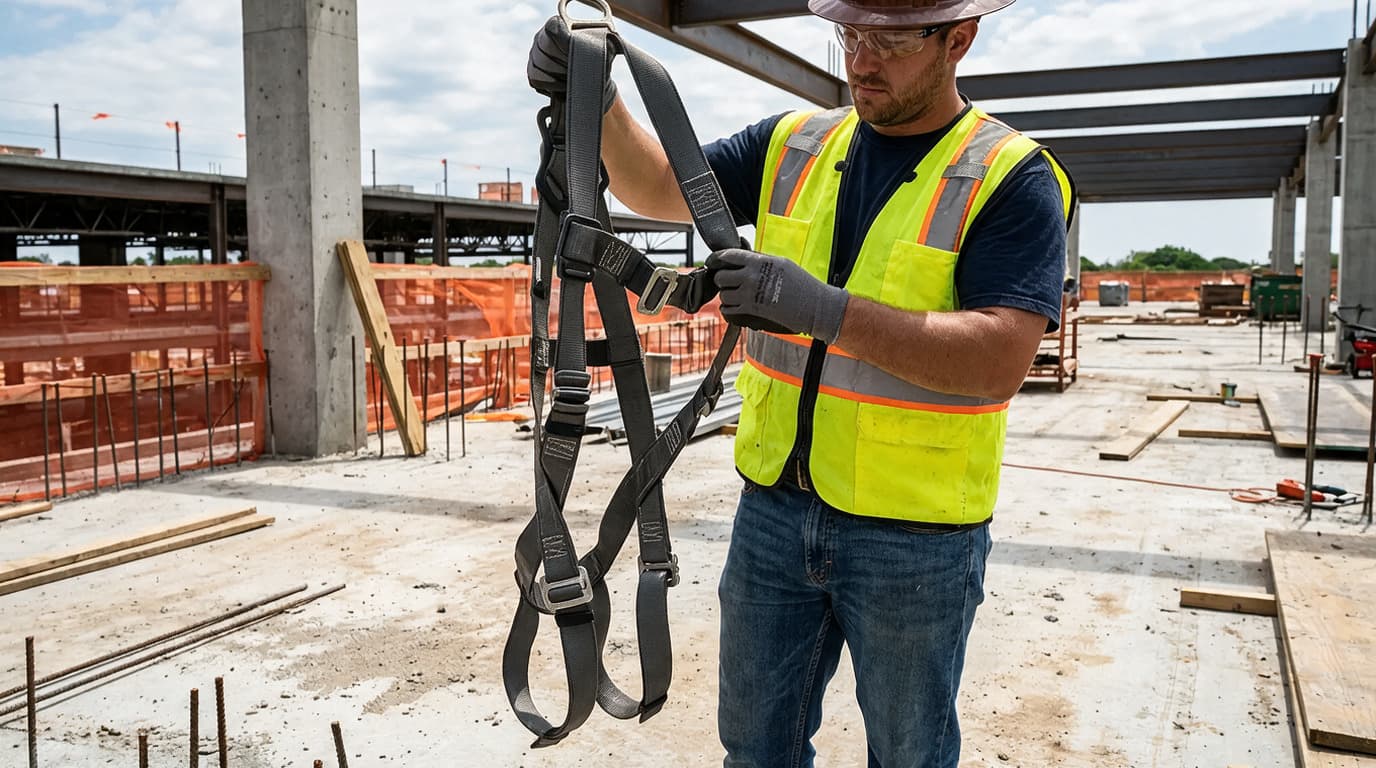
Put it on in a consistent order:
- Hold by the dorsal D-ring and shake so the straps hang free
- Slip the shoulder straps on like a jacket, D-ring centred between the shoulder blades
- Fasten and adjust the leg straps — snug, with room for two fingers, no more
- Fasten the chest strap at mid-chest and adjust so shoulder straps cannot slip outward
- Adjust the torso so the assembly is snug against the body with no slack
- Tuck all loose strap ends into keepers
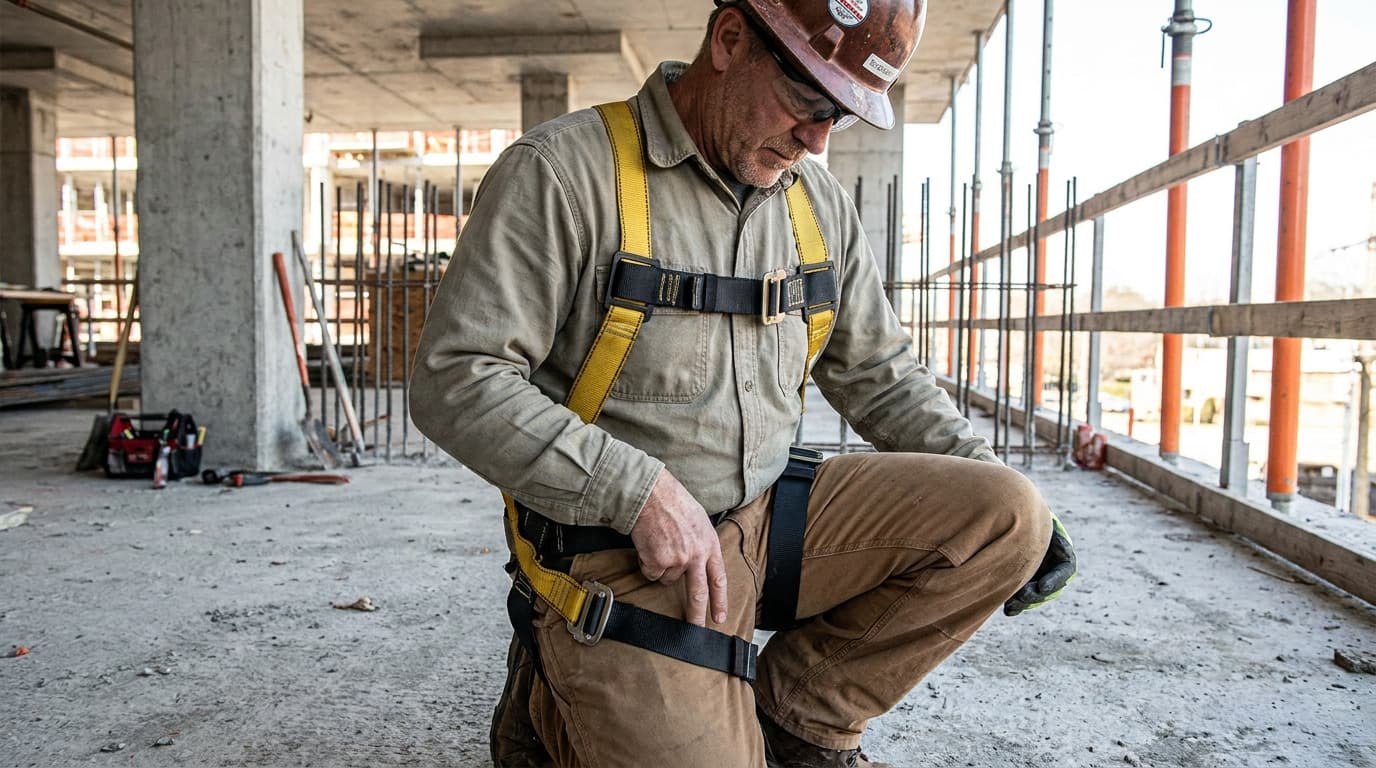
Check the fit before you climb, not at the edge. Squat down. The leg straps should stay in place, not ride up. Reach overhead. The D-ring should stay between the shoulder blades. If the harness moves substantially, it is not adjusted.
Connect to the dorsal D-ring for fall arrest. Side D-rings position you. Front D-rings are for climbing and rescue. Only the dorsal ring — or an approved overhead attachment — is for arresting a fall.
Match the connector to the situation. A leading-edge-rated self-retracting lifeline where the line could cross an edge, because a standard shock pack can be severed. Calculate the fall clearance before connecting — see the Fall Clearance talk.
Never tie off to a guardrail. Under 1926.502(d)(23), personal fall arrest systems must not be attached to guardrail systems. A guardrail is rated for 200 pounds of static force, not the 5,000 pounds an anchorage requires.
Retire anything that has taken a fall. Immediately, permanently, and visibly — cut the webbing if that is what it takes to stop it going back into service.
Confirm the rescue plan before you connect. Who retrieves a suspended worker, with what equipment, in how many minutes. Calling emergency services is not a rescue plan.
Before you start#
- Inspect the full harness: webbing, stitching, hardware, labels, and shock pack indicator.
- Confirm this harness is your size and has not been shared or borrowed without adjustment.
- Put it on in order, and confirm the dorsal D-ring sits centred between your shoulder blades.
- Check leg straps — snug, two fingers of room, no more.
- Confirm the chest strap is fastened at mid-chest and the shoulder straps cannot slip outward.
- Squat and reach overhead to confirm the fit holds under movement.
- Confirm you are connecting to the dorsal D-ring, not a side or front ring.
- Confirm your anchorage supports 5,000 pounds or is engineered, and is not a guardrail.
- Calculate your fall clearance for this position.
- Confirm the rescue plan and who executes it.
Talk it over#
- Put two fingers under your leg strap right now. Is there room for more than that?
- Where is your chest strap sitting — and is it fastened at all?
- If your lanyard had arrested a fall last week, would that harness still be on the rack today?
The bottom line#
A harness works once, under forces you will never feel in training, and how you adjusted it that morning decides where those forces go through your body. Body belts are prohibited for fall arrest because the waist cannot survive the load — a full-body harness spreads it across the thighs, pelvis, chest, and shoulders instead. Inspect before every use, dorsal D-ring between the shoulder blades, leg straps snug to two fingers, chest strap fastened at mid-chest, and connect only to the dorsal ring on a real anchorage. Anything that has arrested a fall never goes back into service.
Frequently asked questions about safety harnesses#
Why are body belts prohibited for fall arrest?
Because a body belt concentrates the entire arrest force at the waist, across the abdomen and lower spine, causing severe internal injury. 29 CFR 1926.502(d) states that body belts are not acceptable as part of a personal fall arrest system, effective 1 January 1998. Body belts remain acceptable only for positioning and travel restraint, where a fall cannot occur.
Where should the D-ring sit on a harness?
Under 29 CFR 1926.502(d)(17), the attachment point of a body harness must be in the centre of the wearer's back near shoulder level, or above the head. Too low and the worker is thrown face-down during arrest; too high and it can strike the back of the head.
How tight should harness leg straps be?
Snug enough that you can fit two fingers between the strap and your leg — and no more. Loose leg straps let the body slide down into the harness during arrest, transferring load from the thighs into the groin and abdomen. This is the most common fit error.
What is the maximum arresting force allowed?
Under 29 CFR 1926.502(d)(16)(ii), a personal fall arrest system used with a body harness must limit the maximum arresting force on the employee to 1,800 pounds. The system must also limit free fall to 6 feet and deceleration distance to 3.5 feet.
Can I keep using a harness after it has arrested a fall?
No. Under 29 CFR 1926.502(d)(19), components subjected to impact loading must be immediately removed from service and not used again until a competent person inspects them and determines they are undamaged. In practice, a deployed shock absorber or stretched lanyard is retired permanently.
Can I attach my lanyard to a guardrail?
No. 29 CFR 1926.502(d)(23) states that personal fall arrest systems must not be attached to guardrail systems. A guardrail is designed for 200 pounds of static force, while an anchorage must support 5,000 pounds per attached worker under 1926.502(d)(15).
Download the safety harness toolbox talk PDF#
Get this safety harness toolbox talk as a print-ready PDF — available in English, Spanish, Portuguese, and Turkish. Print it, hand it to the crew, and collect signatures on the included attendance sheet.
Download the PDF — free account required. New members get 3 free downloads.
Related toolbox talks#
- How to Inspect a Harness
- Anchor Point Selection
- Fall Clearance Awareness
- Fall Rescue & Suspension Trauma
Sources#
- OSHA, 29 CFR 1926.502 — Fall protection systems criteria and practices: https://www.osha.gov/laws-regs/regulations/standardnumber/1926/1926.502
- OSHA, 29 CFR 1926.503 — Training requirements: https://www.osha.gov/laws-regs/regulations/standardnumber/1926/1926.503
- OSHA, 29 CFR 1926.95 — Criteria for personal protective equipment: https://www.osha.gov/laws-regs/regulations/standardnumber/1926/1926.95
- OSHA, 1926 Subpart M App C — Personal Fall Arrest Systems: https://www.osha.gov/laws-regs/regulations/standardnumber/1926/1926SubpartMAppC