Working Safely in Cold Weather
Updated 2026-11-09
In this bundle Health & Environmental Exposure
Print-ready PDF
Download this talk as a print-ready PDF, available in 4 languages.
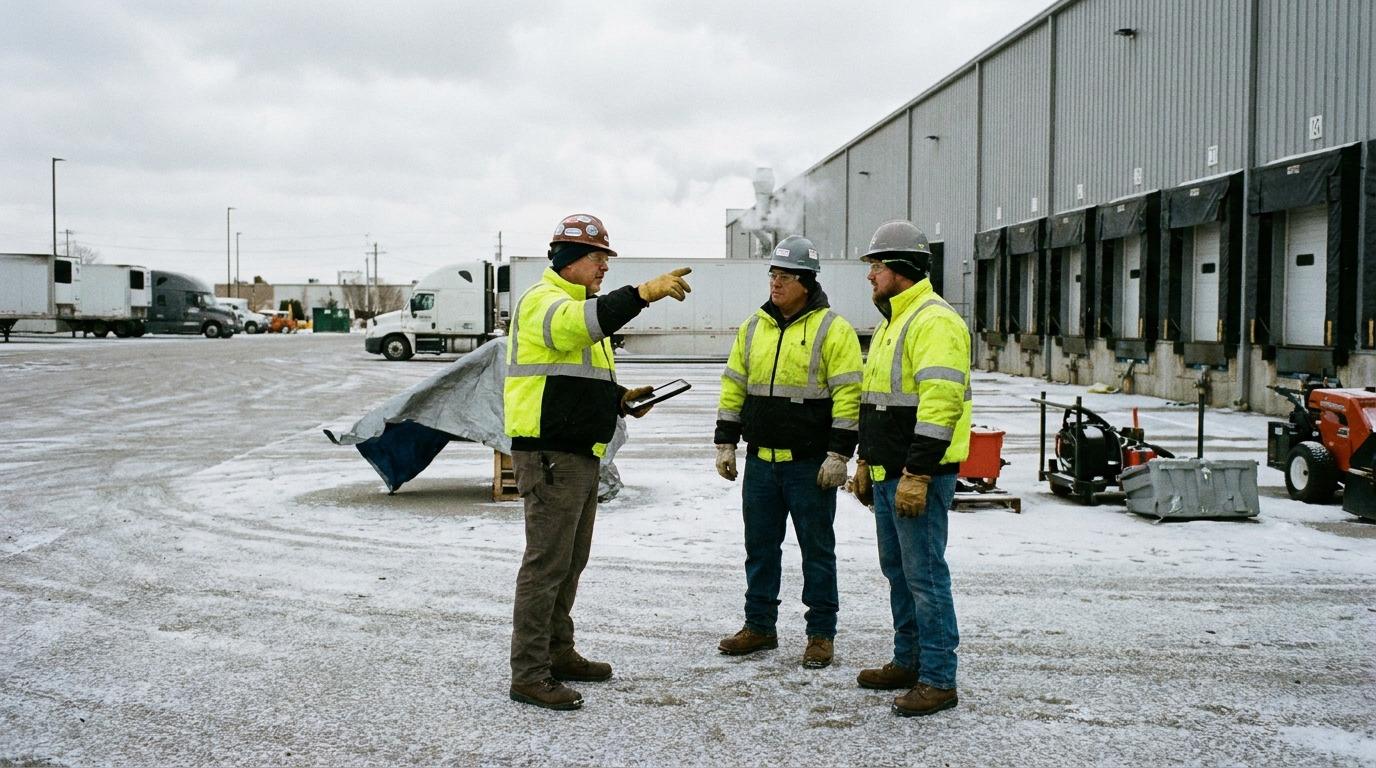
Cold weather is the only hazard on the job that mails you a notice. The trench does not tell you it will collapse on Thursday; the forecast tells you Thursday will be 12 degrees with a 25-mile-an-hour wind, and it tells you on Monday. This Working Safely in Cold Weather Toolbox Talk (Safety Talk / Tailgate Talk) is about what a crew does with that notice: how the wind chill number becomes tomorrow's schedule, break pattern, clothing, shelter, and heat, and why the plan for a cold day is made the night before and not at the gate with the wind already blowing. This is the general industry version, for yards, docks, utility and maintenance crews, delivery and field service, and anyone whose shift happens outdoors or in an unheated building; the construction version covers heaters under 1926.154, icy scaffolds, and the rest of the jobsite rules.
Where the boundary of this talk sits#
The cold stress talk owns the body: how heat leaves it, hypothermia, frostbite, trench foot, and the first aid for each. The winter slips talk owns ice underfoot. The winter driving talk owns the road. The portable heater and carbon monoxide talks own the heater itself and the gas it makes. All are linked. This talk owns the cold-weather workday as a plan: reading the forecast and the wind chill chart, deciding what gets done and when, setting the work and warm-up rhythm, dressing for the number, putting shelter and heat where the crew can reach them, and knowing what the cold does to the surfaces, tools, and machines the work depends on. The cold stress talk tells you what the cold does to a person. This one tells you how the day is built so it does not get the chance.
The anchor#
Here is the distinction that carries this whole talk: cold is the one hazard a crew can see three days out, so a cold-weather injury is almost never a surprise — it is a forecast that nobody turned into a plan; the wind chill number on tomorrow's forecast is a work order that sets the schedule, the break pattern, the layers, the shelter, and the heat, and a crew that reads it the night before arrives dressed, scheduled, and sheltered for the day it is actually going to get, while a crew that reads it at the gate is already behind the weather.
Read the forecast like a work order#
The number that matters is not the temperature. It is the wind chill — what the air does to exposed skin once the wind is added. The National Weather Service chart puts it in one line: at 0°F with a 15-mile-an-hour wind, the wind chill is -19°F, and exposed skin can freeze in 30 minutes. The chart is shaded in three bands — frostbite in 30 minutes, in 10 minutes, in 5 minutes — and the band your day falls in is the first thing the plan has to know. When the Weather Service issues an Extreme Cold Advisory, the wind chill is potentially hazardous; an Extreme Cold Warning means it is life-threatening. Those are not weather trivia. They are the two lines on a forecast that should change what a crew is scheduled to do.
OSHA says it plainly on its winter weather pages: it has no specific standard for working in cold environments, and employers still "have a duty to protect workers from recognized hazards" under Section 5(a)(1) of the OSH Act. The practical form of that duty is a forecast read the day before, by someone who will act on it. One person on the crew owns the forecast — checks it the evening before and again at the start of the shift, reads the wind chill and not just the high, and tells the supervisor what band the day is in. Everything below follows from that number.
Winter 2026–27 outlook: why "warmer than normal" is not "warm"#
NOAA released its outlook for December 2026 through February 2027 on October 15. It calls for a strong El Niño and favors above-normal temperatures across the Pacific Northwest, northern California, the Midwest, the Mississippi Valley, and much of the East, with above-normal precipitation across the southern tier from the Southwest to the Southeast and up the East Coast. NOAA is careful to add that the outlook "does not project seasonal snowfall accumulations" and says nothing about individual storms. Read it the way the agency means it: a tilt in the odds over three months, not a promise about any Tuesday.
Two things in that outlook matter to a crew. First, a warmer-than-normal winter still has cold snaps, and the cold snap that follows a mild week is the one that catches people in the wrong clothes with the heaters still in the shed. Second, a wetter southern tier means more wet-and-cold days in places that do not plan for winter — and NIOSH notes that near-freezing temperatures are a cold stress factor in regions not used to winter weather. Wet clothing and wind at 35°F takes heat out of a body faster than a dry, still day at 20°F. A Georgia yard crew in a cold rain is a cold-weather crew whether or not anyone there owns a parka.
The work and warm-up rhythm#
Cold is managed in time as much as in clothing. OSHA's recommendations are a schedule, not a speech: "Schedule frequent short breaks in warm dry areas, to allow the body to warm up," "Schedule work during the warmest part of the day," "Use the buddy system (work in pairs)," and "Monitor workers physical condition," especially new workers who are not used to the cold. NIOSH adds the staffing side: rotate in relief workers or add people for long jobs, and limit time outdoors on extremely cold days.
In practice the rhythm follows the wind chill band. In the 30-minute band, the day runs close to normal with a warm break built in every hour or so and the heaviest outdoor work in the warmest hours. In the 10-minute band, outdoor stints shorten, breaks lengthen, face and hands are covered, and the tasks that need bare fingers — small fasteners, electronics, wiring — move indoors or wait. In the 5-minute band, outdoor work is the work that cannot wait, done in pairs, in short stints, with a warm shelter steps away, and nothing else is scheduled outside. The supervisor sets the stints; the buddy watches the face, the hands, and the speech of the person next to them, because a person getting cold is the last to notice it.
| Wind chill band (NWS chart) | Outdoor work | Warm breaks | Move indoors or wait |
|---|---|---|---|
| Frostbite in 30 minutes | Close to normal; heaviest outdoor work in the warmest hours | About every hour | — |
| Frostbite in 10 minutes | Shorter stints; face and hands covered | Longer | Bare-finger tasks: small fasteners, electronics, wiring |
| Frostbite in 5 minutes | Only work that cannot wait, in pairs, short stints | Warm shelter steps away | Everything else |
Dress for the number, not the morning#
The layer rule is the same everywhere: several loose layers, so air is trapped and a layer can come off before you sweat and go back on before you chill. NIOSH's list is short — protect ears, face, hands, and feet; "Boots should be waterproof and insulated"; "Hats reduce body heat escaping from your head"; bring spare socks, gloves, a hat, a jacket, and a blanket; and "Avoid touching cold metal surfaces with bare skin." Wet is the enemy of every layer, so the outer one sheds wind and water, and a dry change of socks and gloves in the truck is part of the kit, not a luxury.
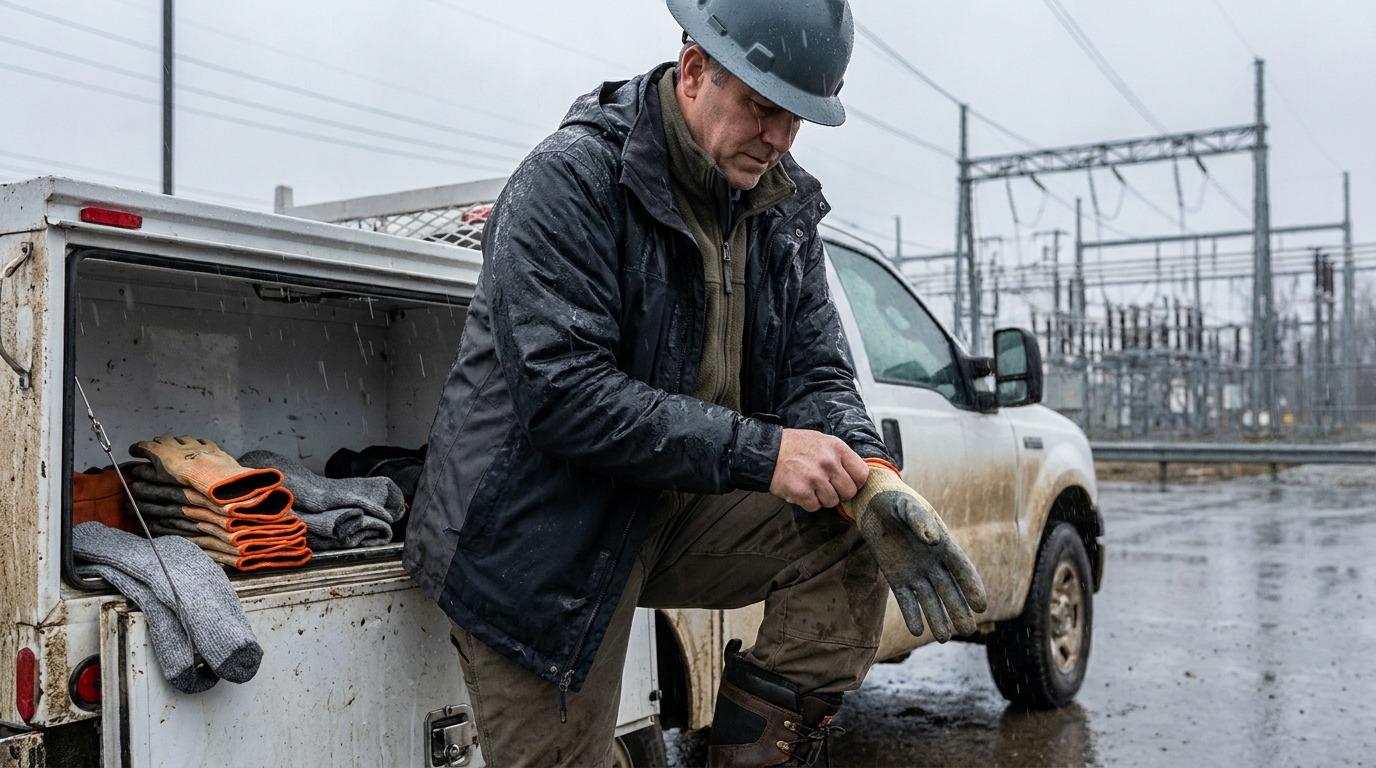
Who pays for it? OSHA's winter weather page answers directly: there is no OSHA requirement for employers to provide ordinary clothing used solely for protection from the weather — winter coats, gloves, parkas, rubber boots — and it points to 1910.132(h)(4). Many employers provide winter gear anyway. What stays on the employer is everything that is protective equipment for a hazard rather than clothing for the weather, and the duty to make sure what people wear fits the number on the forecast.
Shelter, heat, and the gas you cannot smell#
A warm, dry place within a short walk is what makes the warm-up break real. OSHA lists "engineering controls such as radiant heaters" and NIOSH says to "Provide warm areas for use during breaks." A heated break trailer, a running vehicle, or a windbreak with a heater all count, and the planning question is distance: a shelter a five-minute walk away is a shelter nobody uses in a 10-minute frostbite band.
The heat has its own hazard, and winter is when it kills. Carbon monoxide comes from "the incomplete burning of material containing carbon — such as natural gas, gasoline, kerosene, oil, propane, coal, or wood," and the fuel-burning heater or generator moved into a shed, a tent, or a half-closed garage to keep the crew warm is how it reaches people. OSHA's permissible exposure limit is 50 parts per million averaged over 8 hours; its advice is to ventilate, to "Provide personal CO monitors with audible alarms if potential exposure to CO exists," and to "Prohibit the use of gasoline-powered engines or tools in poorly ventilated areas." The warm-up shelter is heated with a vented or electric heater, or it has a CO alarm in it, or it is not heated. Headache, dizziness, and nausea in a warm break room in January are carbon monoxide until proven otherwise.
What the cold does to the work#
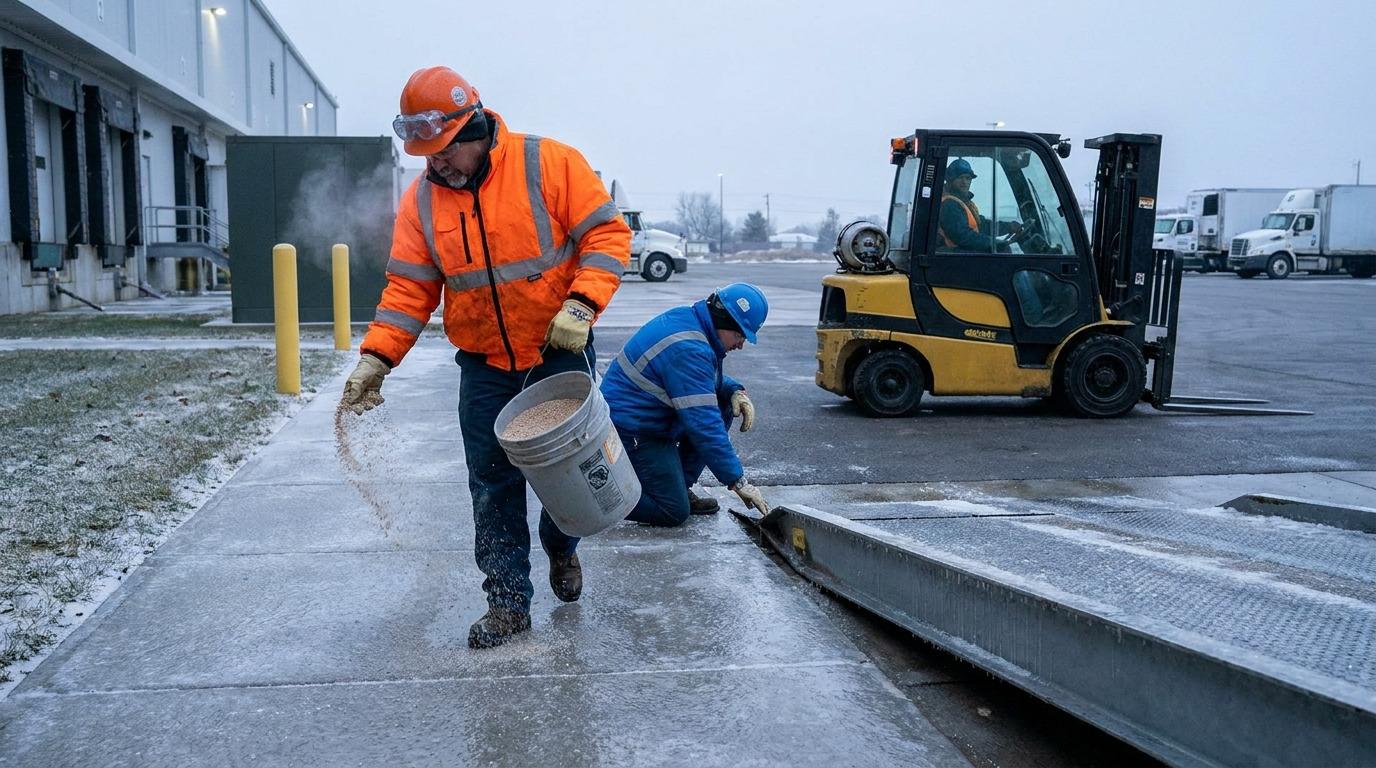
Cold changes the surfaces, the tools, and the machines before it changes the people. Under 1910.22(a)(3), walking-working surfaces are maintained free of hazards "such as sharp or protruding objects, loose boards, corrosion, leaks, spills, snow, and ice," and under (d) they are inspected regularly and hazardous conditions corrected before anyone uses the surface — so the dock, the yard, the stairs, and the path to the shelter are treated before the shift, not after the first fall. Gloved hands drop things and cold hands grip badly, so the task that was easy in October needs a second person or a different tool in January. Batteries lose capacity, hydraulics move slowly until warm, diesel gels, plastics crack, and a cold engine idling to warm the cab in a closed bay is a carbon monoxide problem. Metal takes skin at well below freezing. Snow on a roof or a canopy is a load; ice on a ladder or a platform is a fall; and anyone sent up to clear either one is doing fall-hazard work, not housekeeping.
Where the duty sits#
OSHA cold weather rules: there is no cold-weather standard. Section 5(a)(1) of the OSH Act is the duty OSHA names on its winter pages: a workplace free of recognized hazards, and cold stress is one. 1910.22(a)(3) and (d) put snow and ice on the list of walking-working surface hazards and require inspection and correction before use. 1910.132(h)(4) is where OSHA says ordinary winter clothing is not employer-paid PPE. 1910.1000, Table Z-1 sets the 50 ppm carbon monoxide limit behind every heater decision. The forecast, the schedule, the shelters, and the heat are the employer's and the supervisor's; the layers, the dry socks, the warm drink, and the honest word to the buddy are the worker's.
What can go wrong?#
- Monday's forecast said 10°F with wind on Thursday; nobody read it, and Thursday's crew is in hoodies with the heaters still locked in the shed.
- A new hire from a warm state works the yard in a cold rain in a cotton sweatshirt and never says he is cold until he stops making sense.
- The warm-up trailer is a quarter mile from the dock, so nobody walks to it, and the hourly break becomes a cigarette in the wind.
- A propane heater goes into the closed tool crib to warm it up; three people have headaches by ten and nobody connects the two.
- The forklift ramp has a skin of ice at 6 a.m. that nobody treated because "it's supposed to warm up."
- A worker is sent up on the canopy to knock off snow with no harness, because it is "just snow."
How do we manage this properly?#
Cold weather safety tips for the crew, in the order the day happens:
- One person owns the forecast — read the night before and at the start of the shift, wind chill band named out loud at the huddle.
- Schedule to the band — heavy outdoor work in the warmest hours; shorter stints and longer warm breaks as the band tightens; bare-finger tasks moved inside.
- Buddy up and watch each other — pairs in the 10- and 5-minute bands; face, hands, and speech are the signals.
- Dress for the number — loose layers, wind- and waterproof shell, insulated waterproof boots, hat, spare dry socks and gloves on site.
- Shelter within steps, not minutes — a warm dry place close enough to be used every break, with warm drinks.
- Heat without the gas — vented or electric heat in shelters; CO alarm wherever fuel burns; no gasoline engines in enclosed or poorly ventilated areas.
- Treat surfaces before the shift — snow and ice off the walking-working surfaces per 1910.22, and the path to the shelter first.
- Respect what the cold does to machines — warm-up time, battery and hydraulic checks, no idling in closed bays, no "just snow" on roofs without fall protection.
Before you start#
Check the wind chill, not the temperature, and know which band the day is in. Confirm the work plan matches it: what is outside, for how long, with what breaks, and what has moved indoors or to another day. Walk the path from the work to the shelter and make sure the shelter is warm, dry, close, and safely heated. Look at your own layers and your buddy's: shell, insulation, hat, gloves, boots, and the dry spares. Treat the ice and snow on the walking surfaces before the first person uses them. Know where the warm drinks are and who you tell when you are getting cold.
Talk it over#
- What did tomorrow's wind chill say when you last looked — and who looked?
- Where is the nearest warm, dry place from where you will be working, and how long does it take to walk there?
- Which of tomorrow's tasks need bare fingers, and can they move indoors?
- What heater will be running in which enclosed space, and does that space have a CO alarm?
- Who on this crew has never worked a real winter, and who is watching them?
The bottom line#
Cold is the one hazard that announces itself, so there is no excuse for meeting it unprepared. The wind chill number on tomorrow's forecast is a work order: it sets the schedule, the warm-up rhythm, the layers, the shelter, and the heat. Read it the night before, build the day around the band it puts you in, keep the shelter within steps and the carbon monoxide out of it, treat the ice before the shift, and watch each other's faces and hands. A warmer-than-normal winter still has cold Thursdays; the crew that planned for them is the one that goes home with all ten fingers.
Frequently asked questions about working safely in cold weather#
Is there an OSHA standard for working in the cold?
No. OSHA's winter weather pages say it has no specific standard for cold environments and that employers still have a duty under Section 5(a)(1) of the OSH Act to protect workers from recognized hazards, cold stress included. Specific rules do apply to pieces of the cold-weather day: snow and ice on walking-working surfaces under 1910.22, carbon monoxide under 1910.1000.
What is the wind chill number, and why plan by it instead of the temperature?
Wind chill is what the air does to exposed skin once the wind is added — the rate of heat loss, read as a temperature. At 0°F with a 15 mph wind the wind chill is -19°F and skin can freeze in 30 minutes. The National Weather Service chart marks frostbite bands of 30, 10, and 5 minutes; the band sets the length of outdoor stints and the frequency of warm breaks.
How often should we take warm-up breaks?
OSHA says to schedule frequent short breaks in warm, dry areas and to put the work in the warmest part of the day, without a fixed number. The practical rule follows the band: roughly hourly warm breaks in the 30-minute band, shorter stints and longer breaks in the 10-minute band, and only the work that cannot wait, in pairs and short stints, in the 5-minute band.
Does the company have to buy my winter coat and gloves?
OSHA's winter weather page says there is no OSHA requirement for employers to provide ordinary clothing used solely for protection from the weather, such as winter coats, gloves, parkas, and rubber boots, citing 1910.132(h)(4) — though many employers provide winter gear. Protective equipment for a job hazard is a different matter and stays on the employer.
What does this winter's forecast mean for us?
NOAA's October 15 outlook favors a strong El Niño winter: warmer than normal across the North, Midwest, and East, wetter across the southern tier and the East Coast, with no projection of snowfall or individual storms. For a crew that means cold snaps inside a mild season, and more wet-and-cold days in regions that do not normally plan for winter — both of which hurt most when nobody expected them.
Can we run a propane or kerosene heater in the break tent?
Only if the tent is ventilated and the heater is one made for that use, and it is safer to put a CO alarm in any space where fuel burns. Carbon monoxide comes from incomplete burning of any carbon fuel; OSHA's limit is 50 ppm over 8 hours, and it says to prohibit gasoline-powered engines in poorly ventilated areas and provide CO monitors with alarms where exposure is possible.
Who clears the snow and ice, and when?
Before the shift, on every walking-working surface people will use — that is 1910.22(a)(3) and (d), which list snow and ice as hazards to be kept off and require correction before use. The path to the warm-up shelter is first. Anyone sent onto a roof or canopy to clear snow is doing fall-hazard work and needs fall protection, not just a shovel.
Download the working safely in cold weather toolbox talk PDF#
Download this Working Safely in Cold Weather Toolbox Talk (Safety Talk / Tailgate Talk) as a printable PDF in English, Spanish, Portuguese, and Turkish for your next tailgate meeting, and run it the day the forecast first shows a wind chill below freezing.
Related toolbox talks#
- Cold Stress
- Winter Slips
- Portable Heater Safety
- Winter Driving Safety
- Working Safely in Cold Weather for Construction
Sources#
- OSHA, Winter Weather — Cold Stress (no specific standard for cold environments; employers "have a duty to protect workers from recognized hazards"; wind chill; "Schedule frequent short breaks in warm dry areas"; "Schedule work during the warmest part of the day"; "Use the buddy system (work in pairs)"; "Monitor workers physical condition"; "Provide warm, sweet beverages. Avoid drinks with alcohol"; "Provide engineering controls such as radiant heaters"): https://www.osha.gov/index%2ephp/winter-weather/cold-stress
- OSHA, Winter Weather — Preparedness (Section 5(a)(1); training on winter hazards; no OSHA requirement to provide ordinary weather clothing such as winter coats, gloves, parkas, rubber boots, citing 29 CFR 1910.132(h)(4); monitoring weather and NOAA alerts): https://www.osha.gov/winter-weather/preparedness
- NIOSH, Cold Stress — About Cold and Work ("Schedule cold jobs for warmer months or the warmer part of the day"; "Provide warm areas for use during breaks"; "Monitor workers who are at risk of cold stress"; "Boots should be waterproof and insulated"; "Hats reduce body heat escaping from your head"; "Avoid touching cold metal surfaces with bare skin"; near-freezing temperatures a factor in regions not used to winter): https://cdc.gov/niosh/cold-stress/about
- National Weather Service, Wind Chill Temperature Index brochure (index implemented November 1, 2001; 0°F and 15 mph produce a wind chill of -19°F; shaded bands show frostbite in 30, 10 and 5 minutes; wind chill does not affect inanimate objects; Extreme Cold Advisory — potentially hazardous; Extreme Cold Warning — life threatening): https://www.weather.gov/media/owlie/wind-chill-brochure.pdf
- NOAA, El Niño looms large over U.S. Winter Outlook, October 15, 2026 (December 2026 – February 2027; very strong El Niño; above-normal temperatures favored for northern California, the Pacific Northwest, the Midwest, the Mississippi Valley and much of the East; above-normal precipitation favored for the southern tier and the East Coast; "The outlook does not project seasonal snowfall accumulations"): https://www.noaa.gov/news-release/el-nino-looms-large-over-us-winter-outlook
- OSHA, 29 CFR 1910.22 — General requirements, walking-working surfaces ((a)(3) surfaces maintained free of hazards such as "corrosion, leaks, spills, snow, and ice"; (d)(1) inspected regularly and as necessary; (d)(2) hazardous conditions corrected before use): https://www.law.cornell.edu/cfr/text/29/1910.22
- OSHA Fact Sheet, Carbon Monoxide Poisoning (CO from incomplete burning of natural gas, gasoline, kerosene, oil, propane, coal or wood; "The OSHA PEL for CO is 50 parts per million (ppm)" averaged over 8 hours; ventilation; personal CO monitors with audible alarms; prohibit gasoline-powered engines in poorly ventilated areas): https://www.osha.gov/OshDoc/data_General_Facts/carbonmonoxide-factsheet.pdf
Written by FieldSafetyTalk's safety professional — a CSP, ASP, CHST and OSHA Authorized Outreach Trainer with 14+ years of international construction safety experience across federal, heavy civil, and industrial projects.