Machine Guard Removal
Updated 2026-07-28
In this bundle Tools & Machinery
Print-ready PDF
Download this talk as a print-ready PDF, available in 4 languages.
Every guard that goes missing was removed by somebody with a reason. A blade change, a jam, a bearing, an adjustment, a repair. The removal is almost never the problem — the problem is the interval afterwards, when the guard is on a bench and the machine is back in service and nobody has decided whose job it was to close that gap. This machine guard removal talk is about that interval.
Here is the distinction that carries this whole talk: taking a guard off is not a guarding decision, it is an energy decision. While the guard is on, the machine is protected against the operator's mistake. The moment it comes off, the only thing standing between a person and the moving part is the machine being incapable of starting. That is not a guarding control at all — it is isolation — which is why guard removal belongs in the same conversation as lockout, and not in the same conversation as convenience.
Look for the provision that lets you remove a guard#
It is not there.
Search Subpart I and you will find no clause permitting temporary removal of a guard, no maintenance exemption, no permit, no time limit, no "provided the operator is trained." The standard offers no authorised state in which a guarded machine runs unguarded.
What it offers instead is a condition on the requirement — three words in 1926.300(b)(1):
When power operated tools are designed to accommodate guards, they shall be equipped with such guards when in use.
Those three words are the entire lawful window. The guard must be fitted when the tool is in use. It follows that the only time a guard may legitimately be off is when the tool is not in use — and "not in use" cannot mean "nobody is holding the trigger right now." For a machine sitting on a bench with a guard off, not in use has to mean incapable of being started, because anything less leaves an exposed moving part one accidental contact away from turning.
So the standard does not grant permission to remove a guard. It defines a state — machine not in use — and removal is only lawful inside it. Establishing that state is the job.
Two other provisions close the loop:
1926.300(a) — all hand and power tools and similar equipment, whether furnished by the employer or the employee, shall be maintained in a safe condition. A machine sitting in the stores with its guard in a drawer is not in a safe condition, whoever put it there.
1926.20(b)(2) — the employer's accident prevention responsibilities include frequent and regular inspections of the job sites, materials, and equipment to be made by competent persons designated by the employer. A guard that came off on Tuesday and is still off on Friday is exactly what those inspections exist to catch.
For electrical isolation before work on or near a circuit, 1926.417 governs, and lockout/tagout is covered in its own talk.
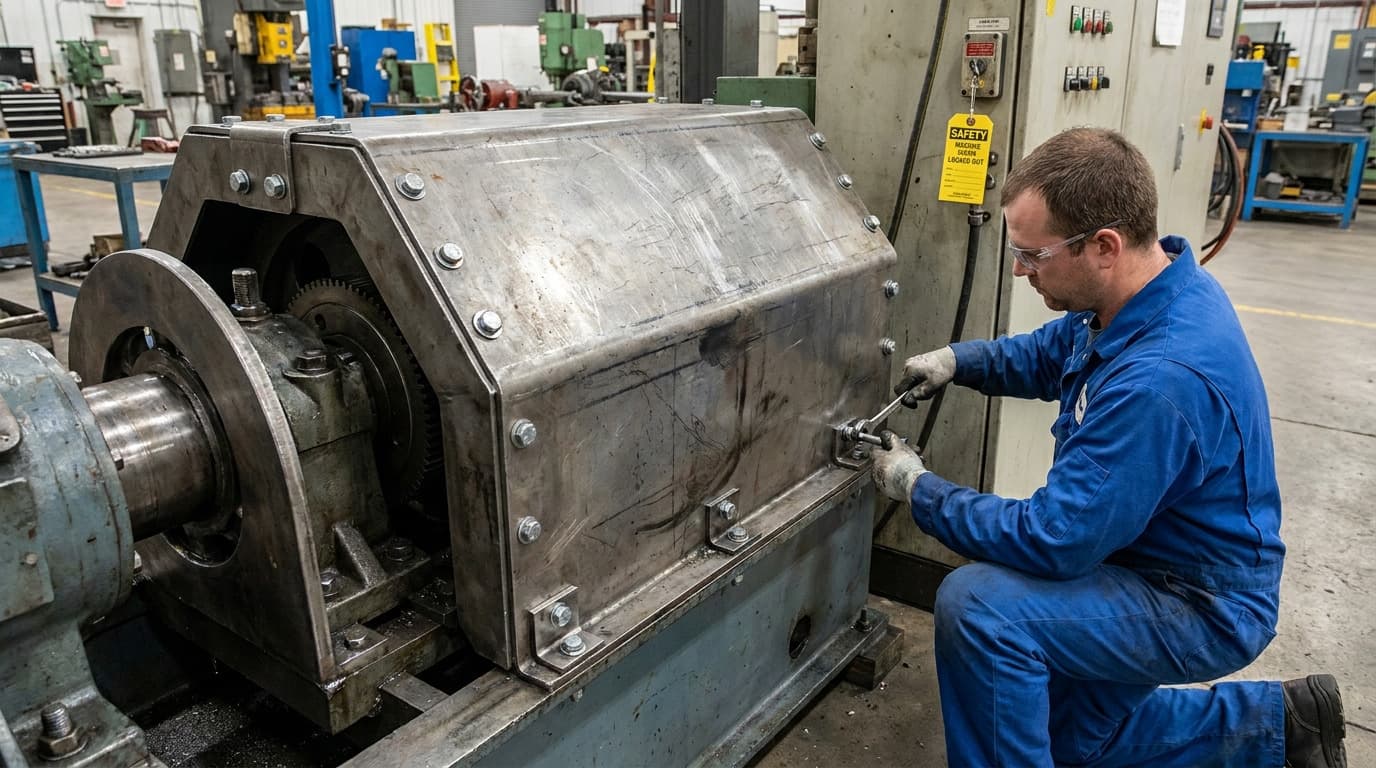
The interval nobody owns#
Draw the sequence out and the gap is obvious:
- The machine needs work.
- Someone removes the guard.
- The work happens.
- Someone refits the guard.
- The machine returns to service.
Steps 2 and 4 are almost always different people, and steps 4 and 5 are almost always in the wrong order. The fitter takes the guard off, gets called to something urgent, and a different crew finds the machine looking usable. Nobody lied, nobody was reckless, and the machine is running unguarded.
The fix is not a rule about guards. It is a rule about ownership: whoever removes a guard owns its replacement, and the machine does not leave their control until the guard is back on, aligned, and fastened with all its fixings. If they have to hand it over, they hand over the machine out of service and tagged, not the machine plus a verbal warning.
Isolate first, every time. Before a guard is removed, the machine is unplugged or isolated so it cannot start — not switched off, not "the operator knows," but incapable of starting.
Tag the machine, not the guard. The guard on a bench tells you nothing. The tag on the machine tells the next person what state it is in.
One guard, one owner, one closing check. Whoever removed it verifies it back on before the tag comes off.
What can go wrong?#
The guard comes off and the machine looks finished. Nothing about a machine sitting there says "the guard is in a drawer."
The removal outlives the shift. The person who took it off goes home; the machine stays.
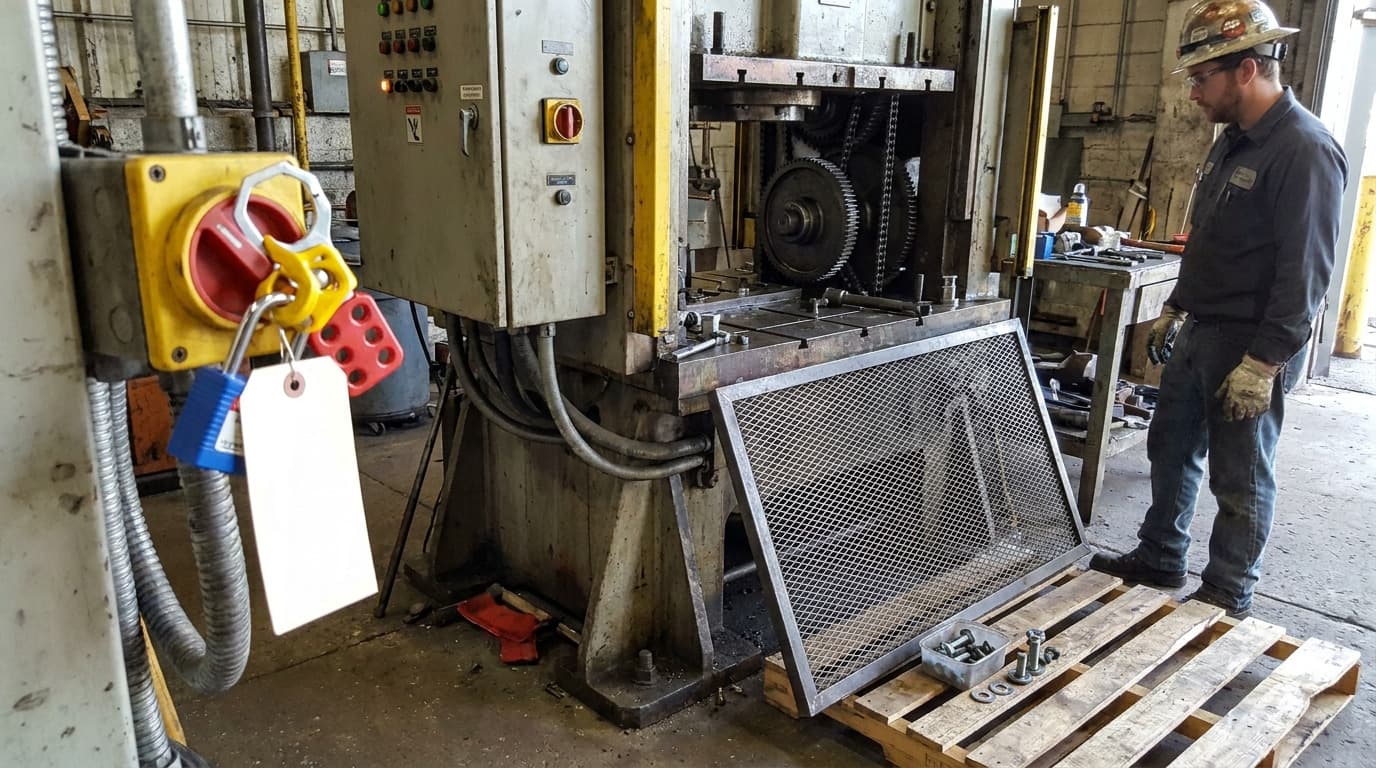
The wrong fixings go back. A guard refitted with two of its four bolts, or with bolts of the wrong grade — and 1926.303(d) requires, for abrasive wheels, that the strength of the fastenings exceed the strength of the guard.
The guard goes back misaligned. Refitted but rubbing, twisted, or no longer covering what it covered, so it fails at the moment it is needed.
The machine is tested "just to check" with the guard off. The most common single-injury scenario in the whole sequence.
A guard is removed to make a difficult job possible — and stays off because the job recurs. That is a tooling problem being solved with an exposure.
Nobody records it. No tag, no log, no handover, and the next inspection is the first time anyone notices.
How do we do this properly?#
Decide the machine is out of service before the first fastener moves. Isolate it, tag it, and treat it as unavailable — not "being worked on."
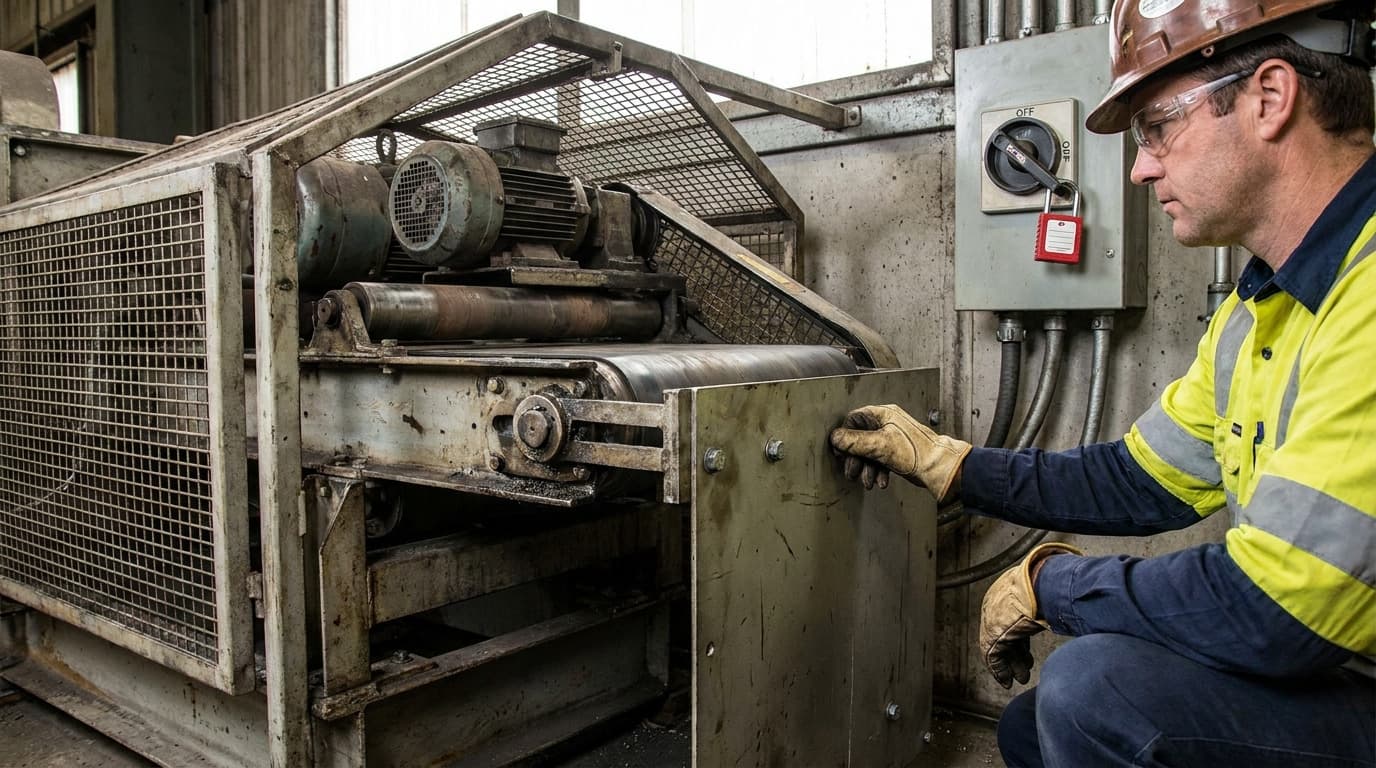
Never remove a guard on a machine that can start. Unplugged or isolated, always, with no exception for "it's only a second."
Own it end to end. The person who removes the guard refits it, checks alignment, replaces every fastener, and only then clears the tag.
Hand over properly if you cannot finish. Machine tagged and out of service, guard with the machine, the next person told directly — not left to notice.
Refit with the right fixings. All of them, correct grade and length, tight, and the guard aligned as designed.
Function-check before release. Guard secure, moving parts covered, nothing rubbing, machine anchored where it should be.
Escalate a recurring removal. If a guard has to come off regularly for a task, that is a signal to change the tool, the guard or the method — not to normalise the removal.
Check for orphan guards at inspection. A guard on a shelf means a machine somewhere is missing one.
Before you start#
- Confirm the machine is isolated and cannot start before any guard fastener is touched.
- Confirm the machine is tagged out of service, and that the tag names who removed the guard.
- Confirm you know where the guard and all its fasteners are being kept.
- Confirm nobody else will use, test or move the machine while it is open.
- Confirm you — not somebody later — will refit the guard, or that a named person has taken the handover.
- Confirm all fasteners are present and correct before the guard goes back.
- Confirm the guard is aligned and secure, and the machine is function-checked before the tag comes off.
Talk it over#
- Is there a guard sitting on a shelf on this site right now? Which machine is it from?
- Who was the last person to take a guard off, and who put it back?
- Which task on this job keeps needing a guard removed — and what would fix that permanently?
- If you had to leave a machine open at the end of the shift, what would you do?
The bottom line#
No provision in Subpart I authorises removing a guard. What 1926.300(b)(1) does is condition the requirement on three words — a tool designed to accommodate guards shall be equipped with them when in use — so the only lawful window for guard-off is when the machine is genuinely not in use, which for an open machine means incapable of being started. That makes guard removal an isolation task before it is a guarding task. 1926.300(a) requires tools to be maintained in a safe condition throughout, and 1926.20(b)(2) puts frequent and regular inspections by competent persons behind it. The practical rule that covers all of it: whoever takes the guard off owns putting it back, the machine stays tagged and isolated until they do, and it goes back with all its fasteners.
Frequently asked questions about machine guard removal#
Does OSHA allow a machine guard to be removed for maintenance?
Subpart I contains no provision authorising removal — no maintenance exemption, no permit and no time limit. 1926.300(b)(1) requires a power-operated tool designed to accommodate guards to be equipped with them when in use, so the guard may only be off when the machine is genuinely not in use. Establishing and maintaining that state is the employer's task.
What does "when in use" mean for a machine with the guard off?
It has to mean more than "nobody is operating it at this moment." A machine with an exposed moving part is one accidental start away from injury, so for practical purposes "not in use" means isolated and incapable of being started — unplugged, locked out, or otherwise unable to run.
Who is responsible for putting the guard back?
The person who removed it. The standard does not name a role, which is exactly why the site rule has to: unassigned responsibility is how guards end up on benches. Whoever removes a guard keeps the machine out of service and tagged until they have refitted it, or hands over the machine — tagged — directly to a named person.
Can a machine be tested with the guard off?
No. Test running is use, and 1926.300(b)(1) requires the guard to be fitted when the tool is in use. "Just to check it runs" is the single most common injury moment in the whole removal sequence, because the machine is live and the protection is on a bench.
What if the guard has to come off regularly for a particular task?
Treat that as a design problem, not a procedure. A guard that must be removed routinely means the tool, the guard or the method does not suit the task — the same conclusion OSHA reached in Letter of Interpretation 2001-12-11-1, where a guard that made a job difficult led to a recommendation to change tools rather than to remove the guard.
Do all the original fasteners have to go back?
Yes. A guard refitted with fewer or wrong fasteners is not the guard that was assessed, and for abrasive wheel machinery 1926.303(d) goes further and requires that the strength of the fastenings exceed the strength of the guard. Two bolts out of four is a failed refit, not a partial one.
How do inspections catch missing guards?
1926.20(b)(2) requires frequent and regular inspections of the job sites, materials, and equipment by competent persons designated by the employer. In practice, the tell is often the guard rather than the machine: a guard found on a shelf, in a drawer or in a toolbox means a machine somewhere is running without one.
Download the machine guard removal toolbox talk PDF#
Get this machine guard removal toolbox talk as a print-ready PDF — available in English, Spanish, Portuguese, and Turkish. Print it, hand it to the crew, and collect signatures on the included attendance sheet.
Download the PDF — free account required. New members get 3 free downloads.
Related toolbox talks#
Sources#
- OSHA, 29 CFR 1926.300 — General requirements (Subpart I, Tools — Hand and Power): https://www.osha.gov/laws-regs/regulations/standardnumber/1926/1926.300
- OSHA, 29 CFR 1926.20 — General safety and health provisions: https://www.osha.gov/laws-regs/regulations/standardnumber/1926/1926.20
- OSHA, Letter of Interpretation, 11 December 2001 — Guarding requirements for a rotary pneumatic angle-drive hand-held tool: https://www.osha.gov/laws-regs/standardinterpretations/2001-12-11-1