Utility Knife and Box Cutter
Updated 2026-08-06
In this bundle Tools & Machinery
Print-ready PDF
Download this talk as a print-ready PDF, available in 4 languages.
The utility knife is probably the most-used tool on any jobsite, and it injures more hands than almost anything else you carry. It opens boxes, scores drywall, trims membrane, strips wire jackets, cuts insulation, and slices banding a hundred times a day, and because it is so ordinary and so simple, it gets none of the respect a saw or a grinder gets. That familiarity is exactly the problem. Nobody gives a toolbox talk before picking up the tool they have used ten thousand times — and that is why the box cutter quietly accounts for a large share of the cut and laceration injuries that dominate hand-injury statistics. This utility knife and box cutter talk is about the specific things that make this small tool so good at cutting the person holding it.
Here is the distinction that carries this whole talk: a utility knife is the one tool that gets more dangerous as it gets duller — a sharp blade slices where you aim it, a dull one tugs, forces you to push harder, then breaks free with all that extra force behind it and goes where you never aimed. This runs against instinct. A dull blade feels safer, because it seems less likely to cut you, so people keep using worn blades far too long. But a dull blade does not cut the material cleanly — it drags and catches, so the worker leans in and pushes harder to force it through, loading the cut with muscle. When the blade finally breaks free of the material, or slips off it, all that stored force is still there, and it drives the blade in whatever direction it escaped — usually toward the hand steadying the work, or the leg behind the cut. A sharp blade needs almost no force, so when it slips there is little behind it. The dull blade is the trap precisely because it feels like the careful choice.
Where the boundary of this talk sits#
Two talks sit right next to this one. The cutting tools talk owns the general safe use of cutting tools across the whole family — saws, snips, shears, chisels, and knives. The hand injuries talk owns the mechanics of how hands get cut, crushed, and pinched, and how those wounds are treated. This talk owns the utility knife and box cutter specifically: the dull-blade trap, the pull-toward-the-body cut, the retracted-blade discipline, and choosing the right blade and knife for the task. Where the question is cutting tools in general or the anatomy of a hand injury, those talks own it; this one owns the small blade in your pocket that you stopped thinking about years ago.
The direction of the cut#
If the dull blade is what puts force behind the slip, the direction of the cut is what decides where that force goes. The single most common way a utility knife wounds someone is being pulled toward the body. It is natural to pull — you get more control and more power pulling a blade toward you than pushing it away — so people draw the knife back toward the hand, the wrist, the thigh, or the stomach. As long as the blade stays in the material, that works. The instant it breaks free, it continues along the same line, straight into whatever part of the body it was heading for. Cutting away from the body is the golden rule of every knife because it changes where a slip ends up: a blade that escapes while moving away from you travels into open air, not into you. The same logic governs the other hand — the one holding the material must never be in the path of the blade, because that is the hand the knife reaches first when it slips.
Let the blade do the work#
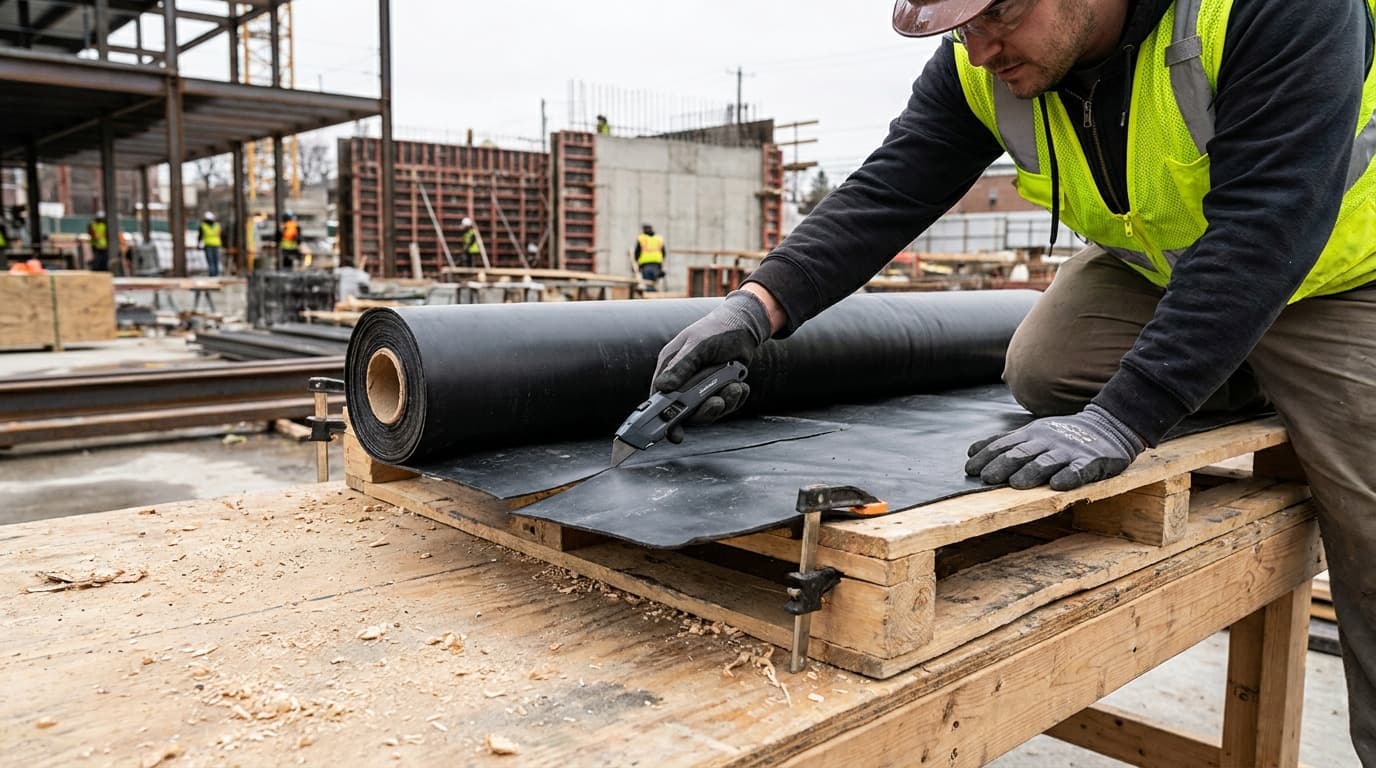
Between the sharp blade and the right direction sits a habit: letting the blade do the cutting instead of forcing it. A utility knife is designed to cut with light, repeated passes, not one deep power stroke. Scoring a line and passing over it two or three times keeps the force low, the blade under control, and the slip harmless if it happens. Trying to cut all the way through thick material in a single hard pull is what loads the tool, and it usually means the wrong tool for the job anyway — a box cutter is not for cutting strapping steel or thick rope or prying anything, and using it that way is how blades snap and hands get hurt. If the blade sticks, the answer is never to force it harder; it is to stop, back off, and figure out why. And the cut belongs on a stable, solid surface with the material secured, not held in mid-air in the other hand where every slip finds flesh.
The blade that should not be out#
More than half of what makes a utility knife dangerous is simply the blade being exposed when it should not be. A blade that is out when you are carrying the knife, reaching into a pocket, setting it down on a bench, or handing it to someone else is a blade waiting to cut without any cutting happening at all. This is the entire logic behind self-retracting and safety knives, where the blade springs back into the handle the moment you release the slide or lift it from the work — the tool defaults to safe instead of defaulting to exposed. Even with a manual knife, the discipline is the same: retract the blade the instant the cut is finished, before you do anything else with your hands. Store the knife retracted, hand it to others handle-first with the blade in, and never drop an open knife into a pocket or a bag. A retracted blade cannot cut anyone, which is why retracting it is the highest-value habit with this tool.
The blade itself, and getting rid of it#
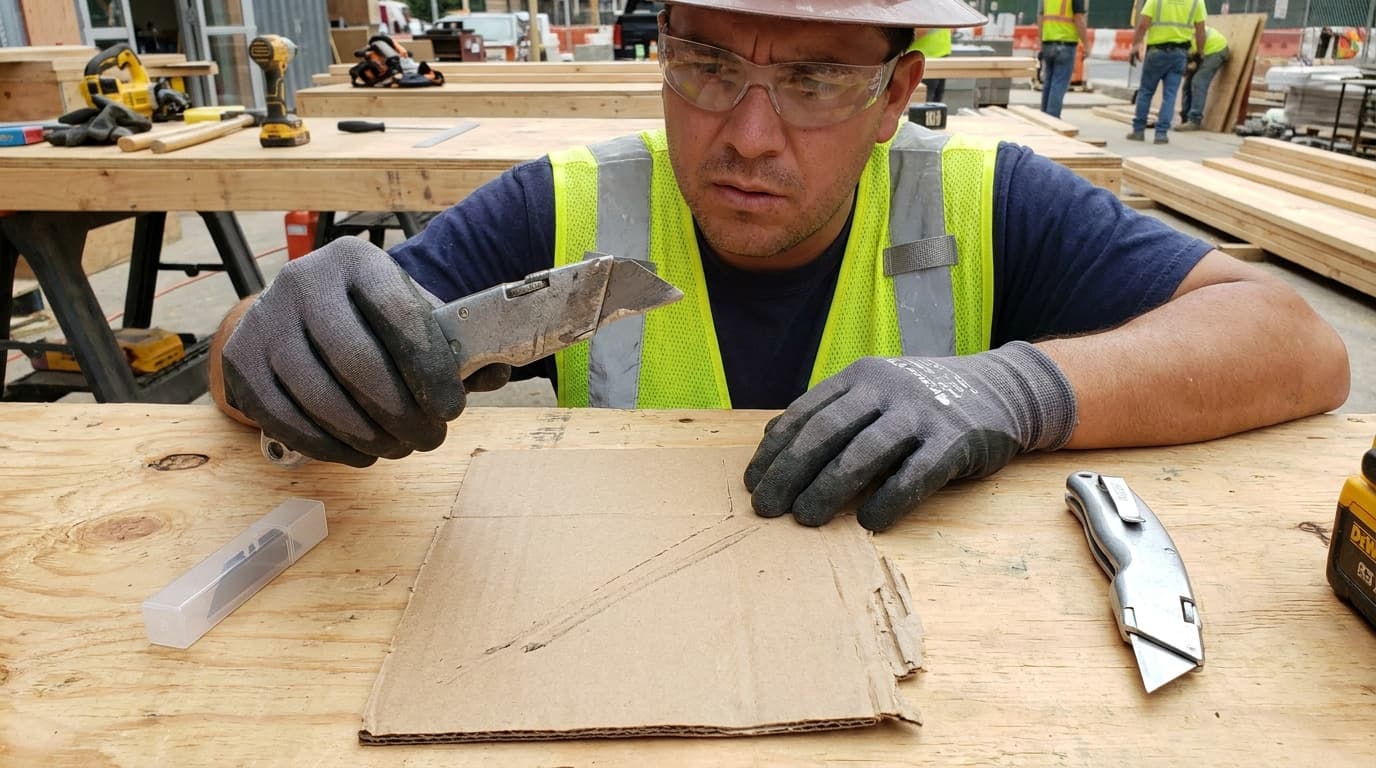
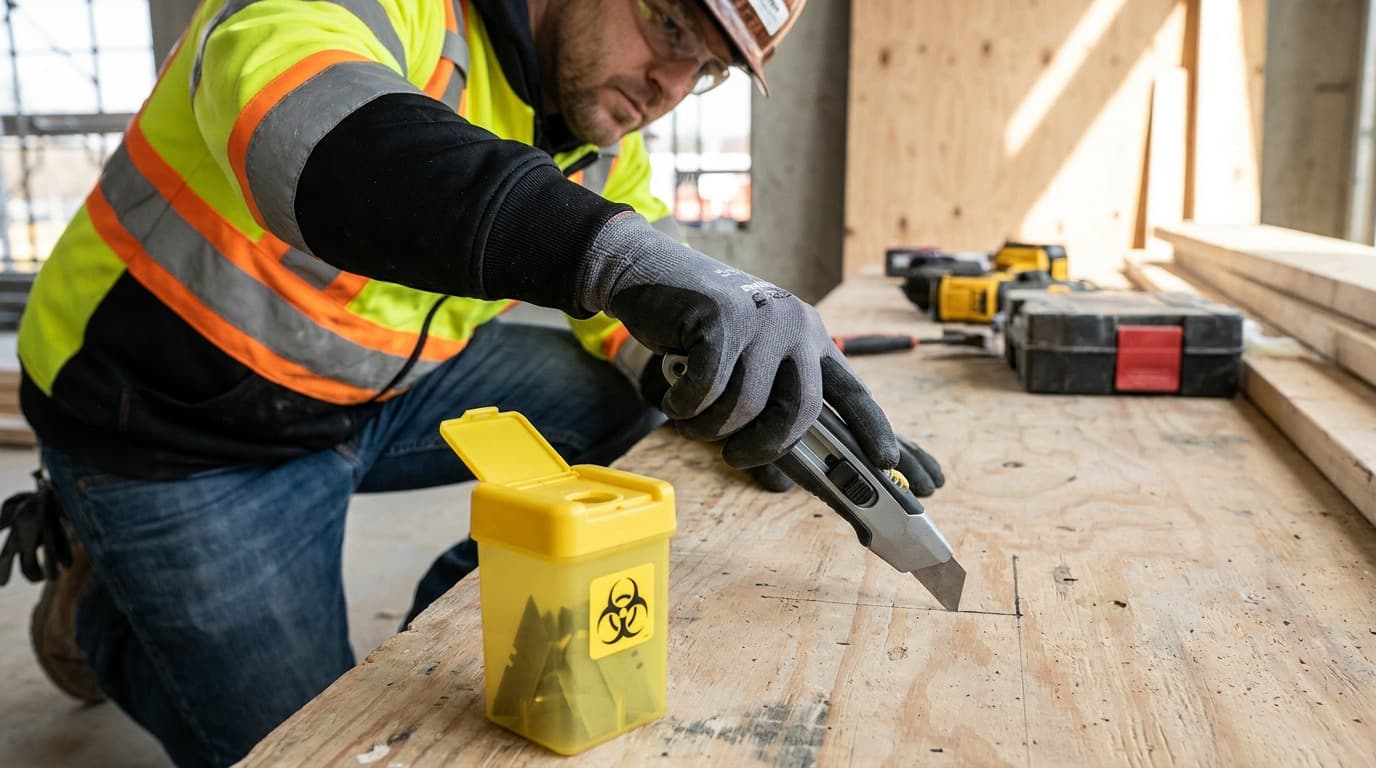
Two more blade facts round out the picture. First, replace blades early and often — a fresh blade is a safe blade, and the cost of a pack of blades is nothing next to the cost of a stitched hand. Change the blade at the first sign of drag, not when it finally quits, because the drag is the dull-blade danger arriving. Second, dispose of used and snapped blades in a puncture-resistant container, never loose in a trash bag where they cut the next person who handles the bag. Snap-off blade knives create a specific version of this: the snapped segments are razor-sharp and easy to leave lying around, and the snap itself can send a fragment flying, which is one more reason for eye protection. And cut-resistant gloves — rated for the cut level of the work — are the last line when everything else fails, but they are a backstop, not a substitute for a sharp blade and the right direction.
Where the duty sits#
There is no OSHA standard written specifically for utility knives, so the requirements come from the general hand-tool rules and the duty to control recognized hazards. 1926.301 requires that employers not issue or permit the use of unsafe hand tools, and 1926.300(a) requires all hand tools to be maintained in a safe condition — a knife with a defective retraction mechanism, a cracked handle, or a blade that will not lock is an unsafe tool under these rules. Personal protective equipment, including cut-resistant gloves and eye protection where needed, runs through 1926.95 and 1926.102. The specific practices — sharp blades, cutting away from the body, retracting the blade, using the right knife — are how an employer meets the duty under the General Duty Clause, Section 5(a)(1) to protect workers from the recognized hazard of laceration, together with the training duty in 1926.21(b)(2). Where a site rule requires self-retracting knives or bans fixed-blade box cutters, that rule governs.
What can go wrong?#
- A dull blade drags, the worker forces it, and it breaks free with force into the hand.
- The knife is pulled toward the body and slips into the wrist, thigh, or stomach.
- The hand holding the material is in the blade's path and gets cut when it slips.
- A blade left extended cuts a hand reaching into a pocket or bag.
- A box cutter is used to pry or to cut something too heavy and the blade snaps.
- A used or snapped blade is thrown loose in the trash and cuts the next handler.
- A stuck blade is forced instead of stopped, and it jumps free.
- The cut is made in mid-air against the holding hand instead of on a solid surface.
How do we manage this properly?#
- Change to a sharp blade at the first sign of drag — a dull blade is the more dangerous one.
- Cut away from your body, never pulling the blade toward you.
- Keep the other hand out of the blade's path, and cut on a stable, secured surface.
- Let the blade do the work — light repeated passes, never one forced power stroke.
- Retract the blade the instant the cut is done; use self-retracting knives where possible.
- Use the right knife and blade for the task — never as a pry bar or for heavy material.
- If a blade sticks, stop — don't force it, back off and find out why.
- Dispose of blades in a puncture-resistant container, and wear cut-resistant gloves.
Before you start#
- Confirm the blade is sharp and undamaged, and change it if it drags.
- Confirm the knife's retraction mechanism works and the handle isn't cracked.
- Confirm you're cutting away from your body and your other hand is clear.
- Confirm the material is on a stable surface, not held in mid-air.
- Confirm the utility knife is the right tool — not a substitute for a saw or pry bar.
- Confirm cut-resistant gloves and eye protection where the task calls for them.
- Confirm there's a puncture-resistant container for used blades nearby.
- Confirm you'll retract the blade the moment each cut is finished.
Talk it over#
- When did you last change your blade — and is it dragging right now?
- Which cuts do you make pulling toward yourself, and could you turn them around?
- Does your knife retract on its own, or is it on you to remember every time?
- Where do used blades go on this site — and is anyone at risk from the bin?
The bottom line#
A utility knife is the one tool that gets more dangerous as it gets duller — a sharp blade slices where you aim it, a dull one tugs, forces you to push harder, then breaks free with all that extra force behind it and goes where you never aimed. The two things that turn a slip into a wound are direction and stored force: cutting toward the body sends the escaping blade into you, and pushing harder to force a dull blade or a stuck cut puts maximum force behind that slip. Fix both — keep a sharp blade, cut away from your body and your other hand, and let the blade do the work with light passes instead of one hard pull. Then remove the hazard when you are not cutting at all: retract the blade the instant the cut is done, use self-retracting knives where you can, and store and pass the knife with the blade in. Use the right knife for the task, never as a pry bar, and get used blades into a puncture-resistant container. There is no OSHA standard just for utility knives — 1926.301 and 1926.300(a) require a safe tool, and the practices meet the 5(a)(1) duty against the recognized hazard of laceration. The question to carry is the one nobody asks about the tool they use most: is my blade sharp, am I cutting away from myself, and is the blade in before I do anything else with my hand?
Frequently asked questions about utility knife and box cutter safety#
Why is a dull blade more dangerous than a sharp one?
Because a dull blade forces you to add the danger yourself. A sharp blade slices cleanly with very little pressure, so it goes where you aim it and there is almost no force behind it if it slips. A dull blade drags and catches instead of cutting, so you lean in and push harder to force it through the material. Now the cut is loaded with muscle, and when the blade finally breaks free or slips off, all that stored force drives it in whatever direction it escaped. The dullness itself does not cut you — the extra force you added to compensate for it does. This is why "the blade felt safe because it was dull" is exactly backwards, and why changing the blade at the first sign of drag is one of the most important habits with this tool.
Why does it matter which direction I cut?
Because the direction of the cut decides where the blade goes when it slips, and it will eventually slip. Pulling a knife toward your body gives more control and power, so it is the natural way to cut — but it points the blade at you, and the instant it breaks free of the material it keeps traveling along that same line into your hand, wrist, thigh, or stomach. Cutting away from your body sends an escaping blade into open air instead of into you. The same rule protects your other hand: the hand steadying the material must be kept out of the blade's path, because it is the closest thing to the blade and the first thing a slip reaches. Direction is the difference between a slip that startles you and one that sends you for stitches.
Are self-retracting knives really worth it?
For most tasks, yes, because they fix the single biggest source of utility-knife injuries: a blade that is exposed when no cutting is happening. A large share of cuts happen not during a cut but while carrying the knife, reaching into a pocket, setting it down, or handing it over with the blade still out. A self-retracting knife pulls the blade back into the handle automatically the moment you release the slide or lift it off the work, so the tool defaults to safe instead of defaulting to exposed. It removes the need to remember, which is exactly the kind of habit that fails when people are busy or distracted. Manual knives can be used safely, but only with strict discipline to retract every single time — and many sites now require self-retracting knives for exactly that reason.
What's the right way to deal with a blade that sticks?
Stop. A stuck blade is a signal, not an obstacle to power through. The instinct is to pull harder to free it, but that loads the cut with force, and when the blade suddenly releases it jumps in the direction you were pulling — often straight toward your body or your other hand. Instead, ease off, back the blade out, and figure out why it stuck: the blade may be dull, the material may be too thick or too tough for the tool, or you may be trying to cut in one pass what needs several. Forcing a stuck blade combines both of the things that cause the worst injuries — maximum stored force and an unpredictable direction — so it is precisely the moment to slow down rather than push.
What knife and blade should I use?
The right one for the task, which usually means a proper utility knife or box cutter with a sharp blade sized for the work, not a substitute. A box cutter is made for thin materials — cardboard, film, membrane, drywall paper — not for cutting strapping steel, thick rope, or anything that needs a saw, and never for prying, which snaps blades and sends fragments flying. Use a fresh blade and change it early. For snap-off blade knives, remember the snapped segments are razor-sharp and the snap can eject a fragment, so protect your eyes and dispose of the pieces safely. Cut-resistant gloves rated for the cut level of the work add a real layer of protection, but they are a backstop for when technique fails, not a license to skip the sharp blade and the safe direction.
Where do used blades go?
Into a dedicated puncture-resistant container, never loose into a trash bag or bin. A used or snapped blade thrown loose stays just as sharp as it ever was, and it becomes an invisible hazard to the next person who handles the bag, compresses the trash, or reaches into the bin — someone who never chose to be near a blade at all. Many sites keep a small sharps-style container at each work area for exactly this. Snap-off knives make this especially important because they generate many small, easy-to-lose razor segments. Getting rid of blades safely is the last step of using the tool safely, and it protects people who are not even part of the task — which is why it belongs in the routine, not left to chance.
Download the utility knife and box cutter toolbox talk PDF#
Get this utility knife and box cutter toolbox talk as a print-ready PDF — available in English, Spanish, Portuguese, and Turkish. Print it, hand it to the crew, and collect signatures on the included attendance sheet.
Download the PDF — free account required. New members get 3 free downloads.
Related toolbox talks#
Sources#
- OSHA, Hand tools — 29 CFR 1926.301 (employers shall not issue or permit the use of unsafe hand tools): https://www.osha.gov/laws-regs/regulations/standardnumber/1926/1926.301
- OSHA, General requirements — 29 CFR 1926.300 (all hand and power tools and similar equipment, whether furnished by the employer or the employee, maintained in a safe condition; PPE provided against flying objects): https://www.osha.gov/laws-regs/regulations/standardnumber/1926/1926.300
- OSHA / Consumer Product Safety Commission data as reported in industry safety training (knives and cutters account for a large share of hand-tool injuries; lacerations dominate hand injuries; retractable-blade knives feature heavily in manual-tool injury data — figures cited qualitatively and attributed, not as a single fixed statistic): https://www.osha.gov/laws-regs/regulations/standardnumber/1926/1926.301
This talk is general awareness guidance for training purposes. It does not replace your employer's tool safety program, the OSHA hand tool standards, the OSH Act General Duty Clause, the tool manufacturer's instructions, or a competent person's duties, and it is not legal advice. Where a site rule sets a specific requirement — such as requiring self-retracting knives — that requirement governs.