Slips, Trips and Falls
Updated 2026-07-23
In this bundle Jobsite Fundamentals & Compliance
Print-ready PDF
Download this talk as a print-ready PDF, available in 4 languages.
Every serious hazard on this site has a procedure wrapped around it. Nobody enters a trench without an inspection, opens a panel without a permit, or ties off without checking the anchor. But the ground you walk on has no procedure at all — and it injures more construction workers than ladders do. This slips, trips and falls talk is about the hazard everyone crosses fifty times a shift without once assessing it.
Here is the distinction that carries this whole talk: falls from height get planned for, because the consequence is obvious and the standard is explicit. Same-level falls get nothing, because the consequence sounds trivial — you tripped, you got up. Except a large share of them do not end that way. A worker who trips while carrying material has no hands free to break the fall. A slip at the top of a stairway is not a same-level fall for long. The hazard is not the height you fall from. It is that nobody looked at the route before walking it.
How dangerous are slips, trips and falls in construction?#
The construction industry carries a disproportionate share of this hazard. Almost half of all work-related fatal falls, slips, and trips in 2021 occurred among construction workers — 46.2 percent (CPWR Data Bulletin, March 2024, from BLS Census of Fatal Occupational Injuries).
The non-fatal picture is where same-level incidents dominate:
- There were 44,000 nonfatal falls, slips, and trips in construction during 2021–2022 (CPWR, March 2024, from BLS Survey of Occupational Injuries and Illnesses).
- Of those, falls to a lower level accounted for 19,400 — meaning roughly 24,600 were same-level falls, or slips and trips without a fall. More than half of the total.
- Floors, walkways, and ground surfaces were the primary source of 13,700 nonfatal injuries in 2021–2022 — more than ladders (11,600), scaffolds and staging (2,500), or roofs (2,800) (CPWR, March 2024).
That last figure is the one worth sitting with. The surface you are standing on right now injures more construction workers than every ladder on every site in the country.
There is also a fatal dimension people underestimate. Falls, slips, and trips killed 412 construction workers in 2022, and while the overwhelming majority were falls to a lower level, the initiating event is frequently a slip or trip at height — on a scaffold platform, at a leading edge, or on a roof (CPWR, March 2024).
OSHA housekeeping and walking surface requirements#
There is no single "slips, trips and falls" standard for construction. The controls sit across housekeeping, storage, illumination, and fall protection provisions:
- Housekeeping — 1926.25(a). During the course of construction, form and scrap lumber with protruding nails, and all other debris, must be kept cleared from work areas, passageways, and stairs, in and around buildings or other structures.
- Combustible scrap — 1926.25(b). Combustible scrap and debris must be removed at regular intervals, and safe means provided to facilitate removal.
- Waste containers — 1926.25(c). Containers must be provided for the collection and separation of waste, trash, oily and used rags, and other refuse.
- Aisles and passageways — 1926.250(a)(3). Aisles and passageways must be kept clear and in good repair, with no obstruction across or in aisles that could create a hazard.
- Illumination — 1926.26. Construction areas, ramps, runways, corridors, offices, shops, and storage areas must be lighted to not less than the minimum illumination intensities while work is in progress.
- Fall protection — 1926.501(b)(1). Where a slip or trip could result in a fall of 6 feet or more to a lower level, guardrails, safety nets, or personal fall arrest are required.
29 CFR 1926.25 is the provision most often cited in this area, and the violations are consistently the same: debris left in walkways, scrap lumber with protruding nails, and combustible waste allowed to accumulate.
On USACE and NAVFAC projects, EM 385-1-1 applies and is more prescriptive on housekeeping and access routes.
What causes slips, trips and falls?#
Slips happen when there is not enough friction between the boot and the surface. Water, mud, ice, oil, hydraulic fluid, concrete slurry, sawdust, and loose gravel all reduce it. So does the wrong footwear — worn tread, or soles never rated for the surface.
Trips happen when a foot meets something unexpected. On construction sites that is a long list:
- Extension cords and air hoses run across walkways
- Rebar, offcuts, banding, and packaging left where people walk
- Changes in level — kerbs, thresholds, formwork edges, transitions between surfaces
- Uneven or broken ground, ruts, and covered holes that shift underfoot
- Materials staged in circulation routes because there was nowhere else
Poor lighting turns manageable hazards into injuries. A cord you would step over in daylight is invisible at dusk, in a stairwell, or inside a partially completed structure.
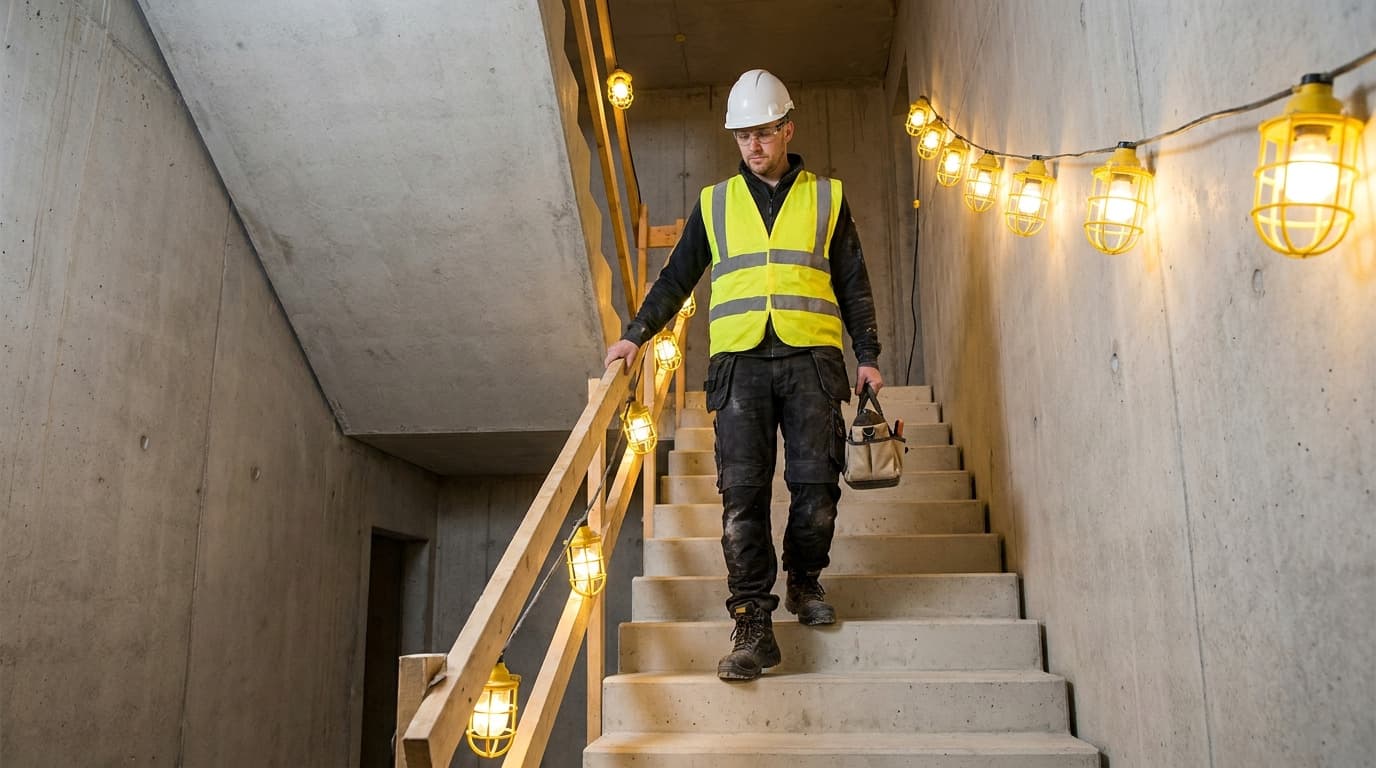
Carrying loads removes your defences. You cannot see your feet, you cannot use your hands to recover balance, and the load's momentum carries you down. This is why the same trip that would be nothing empty-handed becomes a serious injury with a sheet of ply.
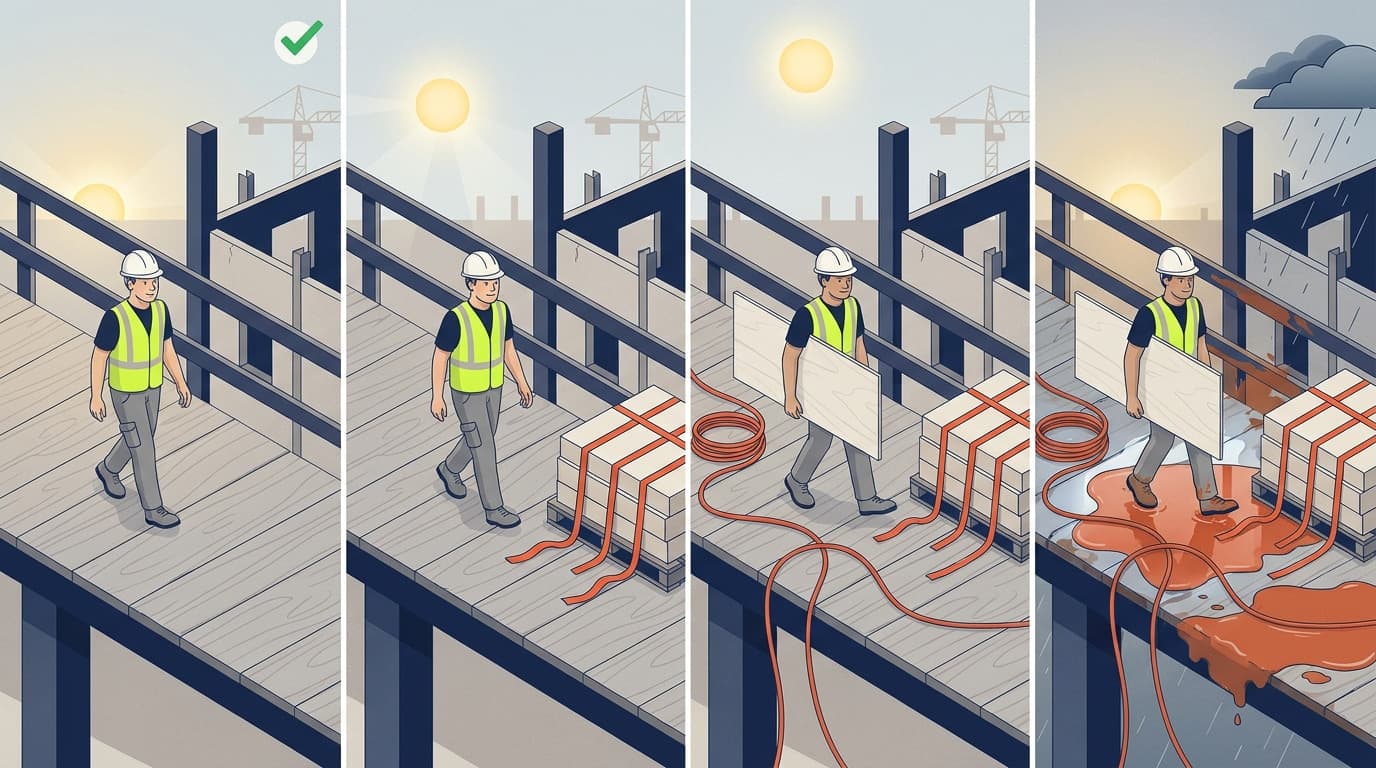
The route changes constantly. A construction site is not a fixed environment. The path that was clear this morning has a delivery on it by ten, a trench across it by noon, and standing water on it after the afternoon rain. Familiarity with the route is exactly what stops people looking at it.
Rushing and distraction. Carrying too much to save a second trip, walking while looking at a phone or a drawing, moving fast at the end of the shift. Most trips involve someone whose attention was legitimately elsewhere.
How do we prevent slips, trips and falls?#
Housekeeping is the primary control, not a tidiness issue. Under 1926.25, debris comes out of walkways continuously — not at the end of the shift, and not when someone complains. Waste containers positioned where the waste is generated, and emptied before they overflow.
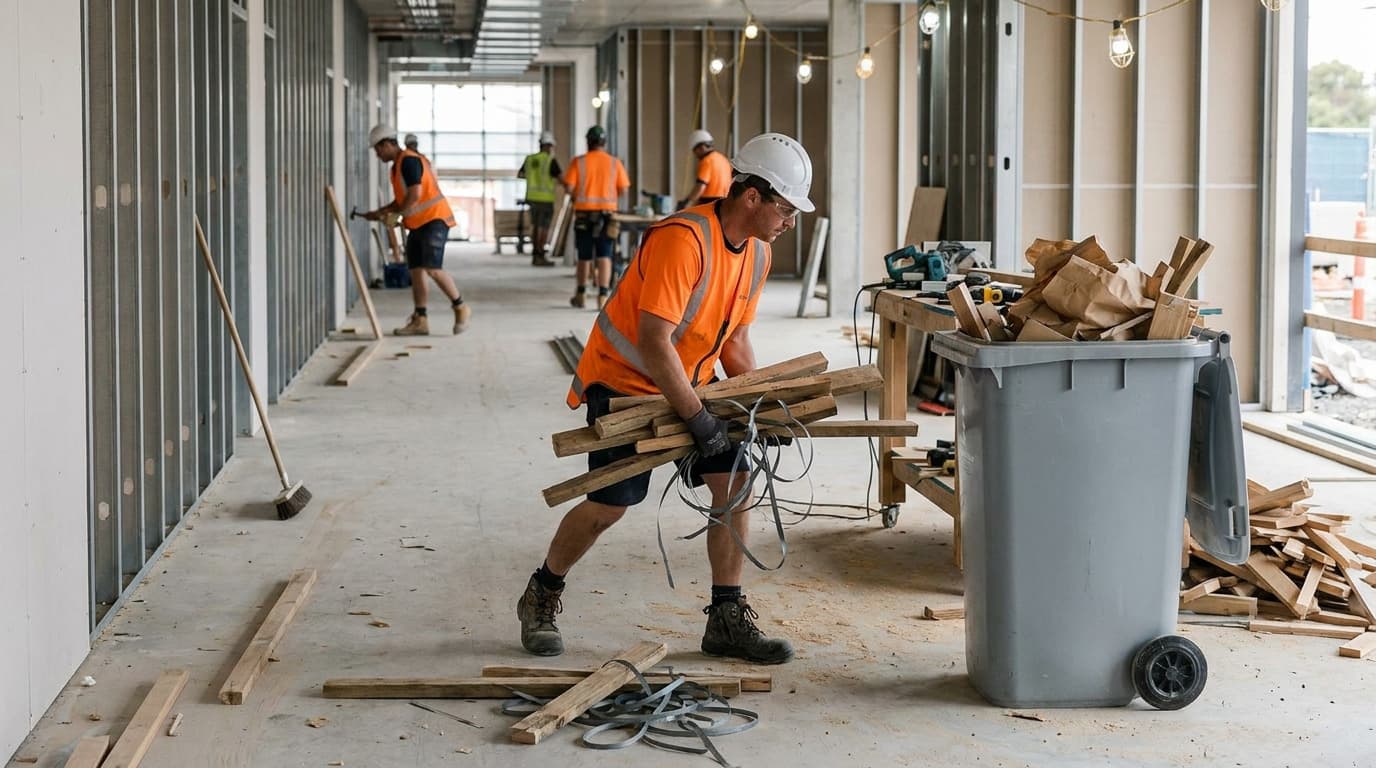
Design the routes. Define pedestrian routes, keep them clear, and light them. Material gets staged out of circulation paths, not in them. If a route has to close, it gets barricaded and an alternative signed.
Get cords and hoses off the ground:
- Run them overhead wherever possible
- Use cable ramps or covers where they must cross a walkway
- Route them along walls rather than diagonally across open areas
- Coil and remove them at the end of the task, not the end of the job
Deal with liquids immediately. Spills cleaned as they happen, not left for later. Ice treated or barricaded. Concrete slurry and mud managed at the source, with boot cleaning where crews move from wet to dry areas.
Light the work and the route. Under 1926.26, both need illumination. Task lighting frequently leaves the walking route dark — check the path, not just the work face.
Match footwear to the surface. Slip-resistant soles in appropriate condition, with tread that is not worn smooth. Boots that fit and are laced properly.
Change how you carry. Loads that let you see your feet, and two trips rather than one when the load blocks your view. Mechanical aids where the load is genuinely too much to carry safely over that route.
Look at the route before you walk it, especially when it is familiar. The 30-second walk-through before moving material is what catches the delivery that arrived while you were working.
Report and fix rather than step over. The trip hazard everybody steps over is the one that eventually catches somebody carrying something. If you cannot fix it, mark it and report it.
Before you start#
- Walk the route you will use today and look at the actual surface, not just the destination.
- Identify liquids, ice, mud, or slurry on any part of that route.
- Check for cords, hoses, and material crossing walkways, and move or protect them.
- Confirm the route is lit, including stairwells, partially enclosed areas, and any part you will use after dark.
- Check your boots — tread condition, fit, and whether the soles suit today's surfaces.
- If you are carrying, confirm you can see your feet and that the load will not block your recovery.
- Identify any point where a slip or trip could result in a fall to a lower level, and confirm fall protection is in place there.
- Note where waste is being generated today and confirm there is a container for it.
Talk it over#
- Walk the route from here to where the material is stacked. What is on that path right now that should not be?
- Has anyone tripped or nearly tripped on this site this week? What was it, and is it still there?
- Where on this site would a slip turn into a fall to a lower level rather than just a fall on the ground?
The bottom line#
Slips and trips are the hazard nobody plans for, and the surfaces we walk on injure more construction workers than ladders do — 13,700 injuries from floors, walkways, and ground surfaces in 2021–2022 alone. The control is unglamorous and effective: clear the walkways continuously under 1926.25, get cords and hoses off the ground, light the route as well as the work, deal with liquids immediately, and look at the path before you walk it, especially the path you have walked a hundred times.
Frequently asked questions about slips, trips and falls#
How common are slips, trips and falls in construction?
There were 44,000 nonfatal falls, slips, and trips in construction during 2021–2022, of which roughly 24,600 were same-level falls or slips and trips without a fall (CPWR Data Bulletin, March 2024, from BLS data). Construction also accounted for 46.2 percent of all work-related fatal falls, slips, and trips in 2021.
What surfaces cause the most injuries?
Floors, walkways, and ground surfaces were the primary source of 13,700 nonfatal construction injuries in 2021–2022 — more than ladders (11,600), scaffolds and staging (2,500), or roofs (2,800) (CPWR, March 2024). The ordinary walking surface injures more workers than any piece of access equipment.
What does OSHA require for construction housekeeping?
Under 29 CFR 1926.25(a), form and scrap lumber with protruding nails and all other debris must be kept cleared from work areas, passageways, and stairs. Combustible scrap must be removed at regular intervals (1926.25(b)), and containers provided for waste collection (1926.25(c)). Aisles and passageways must be kept clear and in good repair under 1926.250(a)(3).
Why are same-level falls treated as less serious than falls from height?
Because the consequence sounds minor, not because it is. A worker carrying material has no hands free to break the fall, and a slip near an edge, a stairway, or a scaffold platform does not stay a same-level fall. The injury severity depends on what the worker is holding and where the slip happens, not on the height itself.
Does OSHA require lighting on walkways?
Yes. Under 29 CFR 1926.26, construction areas, ramps, runways, corridors, offices, shops, and storage areas must be lighted to not less than the minimum illumination intensities while work is in progress. Task lighting frequently leaves the walking route dark — the route needs lighting too.
What should I do about a trip hazard I cannot fix myself?
Mark it so others can see it, then report it so it gets removed. The hazard everybody steps over is the one that eventually catches a worker carrying material who cannot see their feet. Stepping over a hazard repeatedly is how it stays there.
Download the slips, trips and falls toolbox talk PDF#
Get this slips, trips and falls toolbox talk as a print-ready PDF — available in English, Spanish, Portuguese, and Turkish. Print it, hand it to the crew, and collect signatures on the included attendance sheet.
Download the PDF — free account required. New members get 3 free downloads.
Related toolbox talks#
Sources#
- CPWR, Fatal and Nonfatal Falls in the U.S. Construction Industry, 2011–2022, Data Bulletin March 2024: https://www.cpwr.com/wp-content/uploads/DataBulletin-March2024.pdf
- OSHA, 29 CFR 1926.25 — Housekeeping: https://www.osha.gov/laws-regs/regulations/standardnumber/1926
- OSHA, Construction Focus Four: Fall Hazards: https://www.osha.gov/sites/default/files/falls_ig.pdf
- Bureau of Labor Statistics, Survey of Occupational Injuries and Illnesses: https://www.bls.gov/iif/