Safe Usage of Circular Saw
Updated 2026-07-28
In this bundle Tools & Machinery
Print-ready PDF
Download this talk as a print-ready PDF, available in 4 languages.
The circular saw is the tool most people on a site have used since they were young, which is exactly why it keeps cutting people. Familiarity removes the pause. And of all the guards on all the tools on a jobsite, the one on a circular saw is the easiest to defeat — you can do it with a thumb, and there is a version of the job where doing it feels reasonable. This safe usage of circular saw talk is about that guard and about the moment the saw comes back at you.
Here is the distinction that carries this whole talk: the upper guard is fixed and the lower guard moves — and only one of them is a live safety system. The upper guard is a cover that stays where it is. The lower guard has to retract as the blade enters the work and then close again by itself, every single cut, in the fraction of a second between the blade leaving the timber and the saw touching your leg. That closing action is the requirement, and it is the thing that wears out, sticks with sawdust and gets held open by habit.
Two guards, one moving — 1926.304(d)#
All portable, power-driven circular saws shall be equipped with guards above and below the base plate or shoe. The upper guard shall cover the saw to the depth of the teeth, except for the minimum arc required to permit the base to be tilted for bevel cuts. The lower guard shall cover the saw to the depth of the teeth, except for the minimum arc required to allow proper retraction and contact with the work. When the tool is withdrawn from the work, the lower guard shall automatically and instantly return to the covering position.
Three things in there are worth pulling out.
"Automatically and instantly." That is a testable requirement, not a description. Lift the lower guard by its lever and let go: it must snap shut on its own, immediately, with no hesitation and no help. If it drifts, hangs up, needs a nudge, or closes slowly because the return spring is tired and the pivot is packed with resin and dust, the saw fails the standard — even though nothing is broken.
No blade-size threshold. The general industry version of this rule, at 1910.243(a)(1)(i), applies to portable circular saws with a blade diameter greater than 2 inches. The construction rule says all portable, power-driven circular saws. On our sites, the small trim saw is covered exactly like the big framing saw.
The exceptions are geometric, not practical. The guards may be cut back only for the minimum arc needed to tilt for a bevel, and for the minimum arc needed to retract into the work. "The blade was in an awkward place" is not one of the exceptions.
Two general provisions sit behind it. 1926.300(b)(1) — a power-operated tool designed to accommodate guards must be equipped with them when in use, so a saw with the lower guard wired back is unusable rather than merely poor practice. And 1926.300(b)(4) lists power saws among the machines that usually require point-of-operation guarding. 1926.300(a) adds the plainest duty of all: all hand and power tools shall be maintained in a safe condition — which is where a sticking lower guard is caught even before anyone reads (d).
How kickback actually happens#
Kickback is not the saw slipping. It is the blade being stopped or pinched while the motor keeps turning, and the reaction driving the tool backwards along the cut line — toward the operator, in a fraction of a second, faster than a reflex.
The usual causes are geometric and predictable:
- The kerf closes on the blade. The offcut is unsupported, or supported at both ends so the timber sags and pinches the blade in the middle.
- The cut-off piece drops or twists and binds the blade at the end of the cut.
- The blade is buried too deep, exposing far more tooth than needed and increasing the grab.
- The saw is twisted in the cut, or the workpiece moves because it is not held.
- A dull, damaged or wrong-toothed blade is forced through the material.
- Plunge and pocket cuts start with the guard held open and the blade already at full speed.
Blade depth is the setting that quietly does the most work. Set so that the teeth just clear the underside of the material — roughly a tooth's depth below — and you reduce the amount of blade available to grab, the size of the kickback, and the exposure below the workpiece where somebody's hand or the trestle is.
What can go wrong?#
The lower guard is held or wired open. Sometimes for a bevel or a plunge cut, then left that way for the rest of the day.
The guard closes slowly. Nobody defeated anything; the spring is weak and the pivot is full of resin, and the guard just does not make it back before the saw is put down.
The saw is set down before the blade stops. The blade keeps turning for several seconds after the trigger is released — that is exactly the window the lower guard exists to cover.
The cut is unsupported. Material bridged between two trestles, or the offcut left to fall, pinching the blade at the worst moment.
The workpiece is held by hand or by knee. Nothing else is holding it, so the moment the blade binds, the material and the saw both move.
The cord is in the cut path. A cut cord on a saw that is not on a GFCI-protected circuit is an electrical event on top of a mechanical one.
Nobody knows where the blade goes on breakthrough. Cutting over the leg, over the arm, or into a space where someone else is working below.
How do we do this properly?#
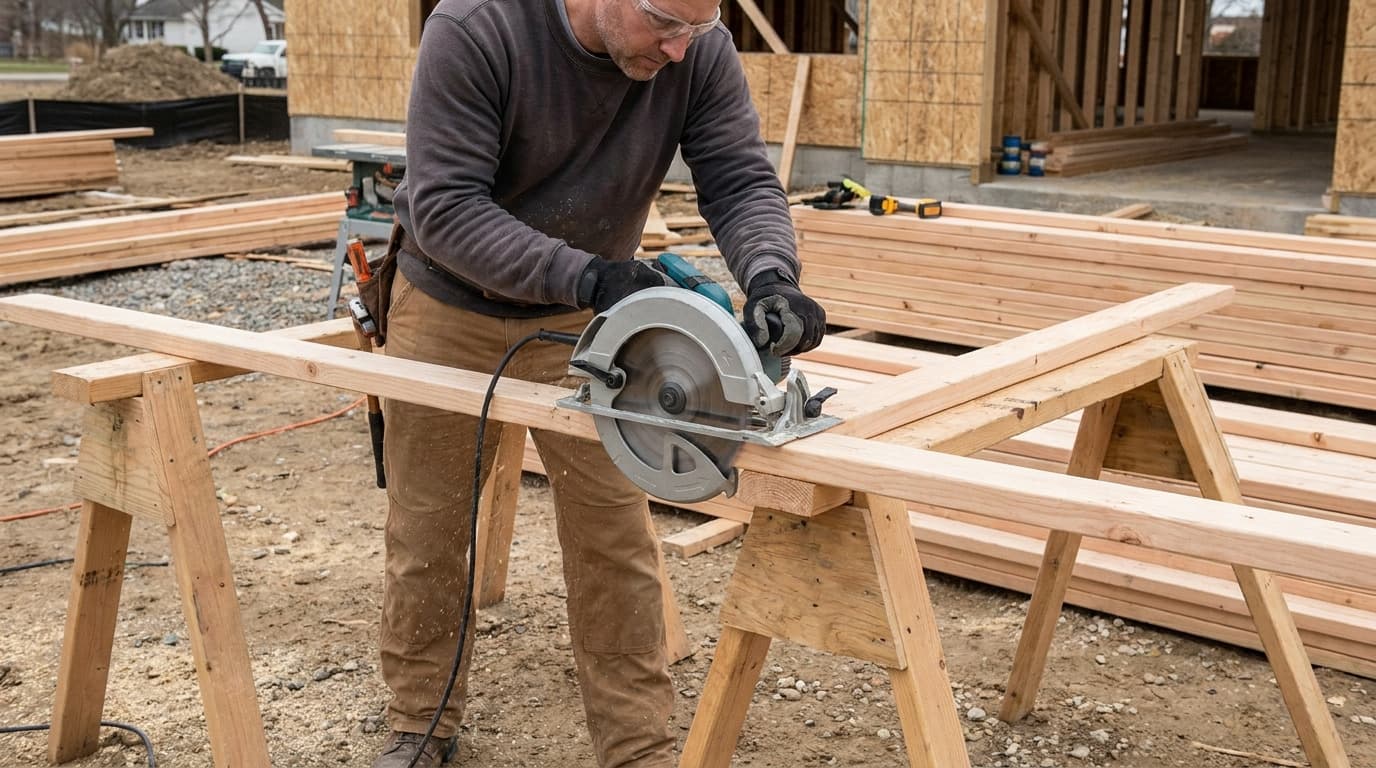
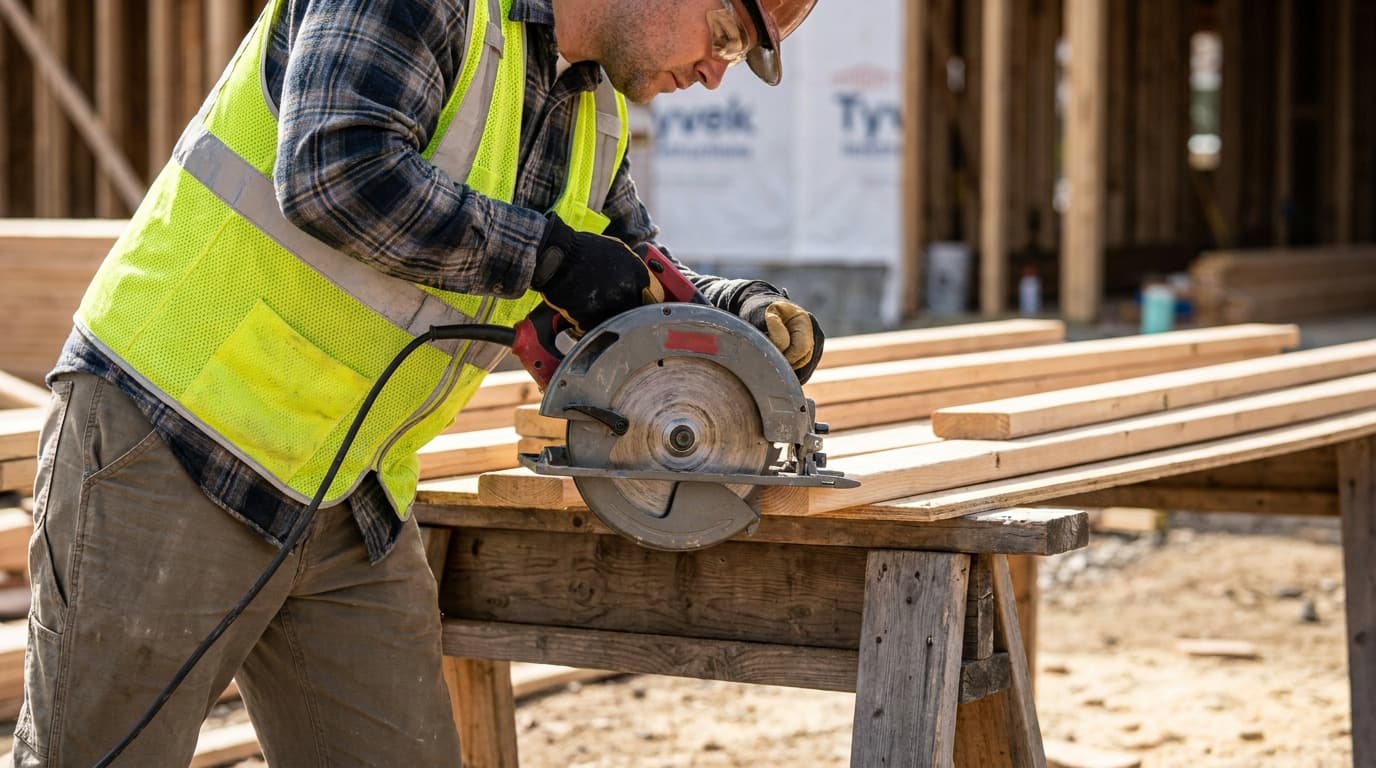
Test the lower guard before every use. Retract it with the lever and release: it must return automatically and instantly. If it does not, the saw goes out of service for cleaning or repair — not into the cut with a note to be careful.
Never tie, wedge or hold the guard open for routine cutting. Use the lever for the start of a plunge cut only, and let the guard close the instant the blade is in the work.
Set the depth. Teeth just clearing the underside of the material. Deeper is not faster; it is more kickback and more exposure.
Support the work properly. Support both sides of the cut so the kerf cannot close, and let the offcut fall free rather than pinching. Clamp the work; never hold it with your free hand or against your body.
Stand out of the line. Position yourself to the side of the blade's line of travel, not behind it, and keep both hands on the saw where the tool has two handles.
Let it reach speed before entering the work, and let it stop before you put it down. Never set a saw down on a coiled cord, on your leg, or on a surface the still-spinning blade can grab.
Check the blade. Correct type for the material, sharp, undamaged, correctly mounted and rotating the right way, with the arbor nut properly tight.
Route the cord behind you and confirm the tool is on a GFCI-protected supply.
Eye protection every cut, hearing protection with sustained use, and never wear loose sleeves or gloves that can be caught.
Before you start#
- Confirm the lower guard returns automatically and instantly when released.
- Confirm the upper guard is present, intact and not cut back beyond the bevel arc.
- Confirm the blade is sharp, correct for the material, and mounted the right way round.
- Confirm the depth is set so the teeth just clear the underside of the work.
- Confirm the work is clamped or supported so the kerf cannot close on the blade.
- Confirm the offcut can fall free without binding or landing on anyone.
- Confirm the cord is behind you, out of the cut path, and on a GFCI-protected circuit.
- Confirm nobody is below or behind the line of the cut.
Talk it over#
- When did you last release the lower guard and actually watch it close?
- Has anyone here had a saw kick back? What was the material doing at that moment?
- Where do we set the blade depth — and why is it usually deeper than it needs to be?
- What is directly beneath the last cut you made today?
The bottom line#
1926.304(d) requires every portable, power-driven circular saw to have guards above and below the base plate or shoe, both covering the blade to the depth of the teeth except for the minimum arcs needed for bevel tilt and for retraction into the work — and requires that when the tool is withdrawn, the lower guard return automatically and instantly to the covering position. Unlike the general industry rule, the construction version has no blade-diameter threshold: it applies to all of them. Behind it, 1926.300(b)(1) makes a saw with a defeated guard unusable rather than merely unwise, and 1926.300(a) requires the tool to be maintained in a safe condition — which a sticky, slow-closing guard is not. The rest is kickback: set the depth so the teeth just clear, support the work so the kerf cannot close, stand out of the line, and let the blade stop before the saw goes down.
Frequently asked questions about circular saw safety#
What guards does OSHA require on a portable circular saw?
1926.304(d) requires guards above and below the base plate or shoe. The upper guard must cover the saw to the depth of the teeth except for the minimum arc allowing the base to be tilted for bevel cuts, and the lower guard must cover the saw to the depth of the teeth except for the minimum arc allowing proper retraction and contact with the work.
What does "automatically and instantly" mean in practice?
It is a test you can perform in two seconds. Retract the lower guard with its lever and release it: it must return to the covering position by itself and immediately, with no assistance and no delay. A guard that drifts closed, hesitates or hangs up on resin and sawdust does not meet 1926.304(d), even though nothing is visibly broken.
Does the rule apply to small circular saws?
In construction, yes — to all of them. The general industry provision at 1910.243(a)(1)(i) applies to portable circular saws with a blade diameter greater than 2 inches, but 1926.304(d) is written for all portable, power-driven circular saws with no size threshold.
Can I tie the lower guard open for a plunge or bevel cut?
No. The guard's retraction lever exists so the guard can be lifted for the start of an unusual cut and then released — not tied, wedged or held open through the work. Under 1926.300(b)(1), a tool designed to accommodate guards must be equipped with them when in use, so a saw running with the lower guard secured open is not usable.
What causes circular saw kickback?
The blade being pinched or stopped while the motor keeps driving. The common mechanisms are the kerf closing on the blade because the material is unsupported or supported at both ends, the offcut dropping or twisting into the blade, excessive blade depth, twisting the saw in the cut, and forcing a dull or unsuitable blade.
How deep should the blade be set?
So the teeth just clear the underside of the material — about one tooth's depth through. That reduces the length of blade available to bind, limits the force of any kickback, and reduces the exposed blade beneath the workpiece where hands, trestles and cords are.
Why does it matter where the saw is put down?
Because the blade keeps turning after the trigger is released. That coast-down period is precisely what the lower guard covers, so a saw set down on a leg, a cord or a surface with a slow-closing guard can still cut. Let the blade come to a stop, and never rely on the trigger being released as the same thing as the blade being stopped.
Download the circular saw toolbox talk PDF#
Get this safe usage of circular saw toolbox talk as a print-ready PDF — available in English, Spanish, Portuguese, and Turkish. Print it, hand it to the crew, and collect signatures on the included attendance sheet.
Download the PDF — free account required. New members get 3 free downloads.
Related toolbox talks#
Sources#
- OSHA, 29 CFR 1926.304 — Woodworking tools: https://www.osha.gov/laws-regs/regulations/standardnumber/1926/1926.304
- OSHA, 29 CFR 1926.300 — General requirements (Subpart I, Tools — Hand and Power): https://www.osha.gov/laws-regs/regulations/standardnumber/1926/1926.300
- OSHA, 29 CFR 1910.243 — Guarding of portable powered tools (general industry): https://www.osha.gov/laws-regs/regulations/standardnumber/1910/1910.243