Contact Lenses & Chemical Splashes
Updated 2026-07-31
In this bundle Jobsite Fundamentals & Compliance
Print-ready PDF
Download this talk as a print-ready PDF, available in 4 languages.
For most of the working lives of anyone on a construction site, the rule was simple: no contact lenses around chemicals. It was on inductions, in chemical hygiene plans and in site rules. It was also, on review of the evidence, wrong — and it has been formally reversed for two decades without most of the industry noticing. This Contact Lenses & Chemical Splashes Toolbox Talk (Safety Talk / Tailgate Talk) sets out what actually applies.
Here is the distinction that carries this whole talk: the ban was withdrawn, but the eye protection requirement never changed — because contact lenses were never protection in the first place. Those two halves get confused constantly. A site that bans lenses is following advice that the evidence did not support. A site that lets someone work in lenses without goggles has made a far worse error. Both mistakes come from treating a corrective device as a safety device.
What NIOSH actually says#
The history matters, because it explains where the old rule came from.
Since the 1978 Standards Completion Program, NIOSH recommended that workers not wear contact lenses during work with chemicals presenting an eye irritation or injury hazard. That recommendation propagated into thousands of company policies, and it is why the belief is so entrenched.
NIOSH then reviewed it. In Current Intelligence Bulletin 59, "Contact Lens Use in a Chemical Environment" — DHHS (NIOSH) Publication 2005-139, June 2005 — it examined professional guidelines, company policies, injury incidents and the available literature, and concluded:
"Injury data are lacking to indicate that contact lens wear should be restricted during work with hazardous chemicals, and thus NIOSH recommends that contact lens wear be permitted provided that the safety guidelines presented in this Current Intelligence Bulletin are followed."
Note the two halves of that sentence. Permitted — and provided the guidelines are followed. It is a conditional permission, not a free pass.
One important exception to check: a number of substance-specific OSHA standards have historically restricted or prohibited contact lens use — including those covering methylene chloride, acrylonitrile, ethylene oxide, 1,2-dibromo-3-chloropropane and methylenedianiline. If you work with a substance that has its own standard, check that standard rather than relying on the general position.
The myths, and what actually happens#
The old rule was supported by beliefs that turned out not to hold up.
"The lens traps chemical against the eye." In practice, a lens does not create a sealed reservoir, and irrigation flushes beneath and around it.
"The lens will fuse or melt to the eye." This does not occur in the way the folklore describes.
"You won't be able to get it out." Irrigation generally dislodges a lens, and in any case removal is not the first action — see below.
What is true, and worth saying plainly:
A lens can retain some material in the eye longer in certain exposures, which is exactly why the response protocol below matters.
A lens can make a bad situation worse if it delays flushing — and historically the ban itself caused that delay, because people believed they had to get the lens out first.
The rule that saves the eye#
If nothing else survives from this talk, make it this.
Flush immediately. Do not delay flushing to remove a contact lens.
Seconds decide outcomes with corrosives. The lens usually comes out during irrigation; if it does not, it can be removed while flushing continues, or afterwards. Water first, lens second, always.
Then:
Hold the eyelids open — the natural reaction is to clamp them shut, which prevents the flush reaching the surface that needs it.
Flush for long enough. OSHA does not set a duration in the general provisions; the widely used consensus benchmark is ANSI/ISEA Z358.1, which specifies 15 minutes of flushing. For strong alkalis in particular, longer is better.
Roll the eye during flushing so the water reaches under the lids.
Get medical attention, and take the safety data sheet with you.
Never rub, and never try to neutralise a chemical in the eye with another chemical.
What the standard requires on site#
1926.50(g) — the construction provision — states that where the eyes or body of any person may be exposed to injurious corrosive materials, suitable facilities for quick drenching or flushing of the eyes and body shall be provided within the work area for immediate emergency use. The general industry equivalent is 1910.151(c), in identical terms.
Two things to notice about that wording.
It is triggered by the hazard, not by the industry or the job title. If injurious corrosive materials are present, the duty applies.
"Within the work area for immediate emergency use" does not specify a distance in the standard. OSHA does not set flow rates, temperature or distances in these sections — ANSI/ISEA Z358.1 is the consensus yardstick generally used, and it is built around a station being reachable within about ten seconds and delivering flushing for 15 minutes. Say clearly that this is a consensus standard rather than an OSHA rule.
One construction-specific number that is in the regulation: 1926.441(a)(6) requires facilities for quick drenching of the eyes and body within 25 feet of battery handling areas.
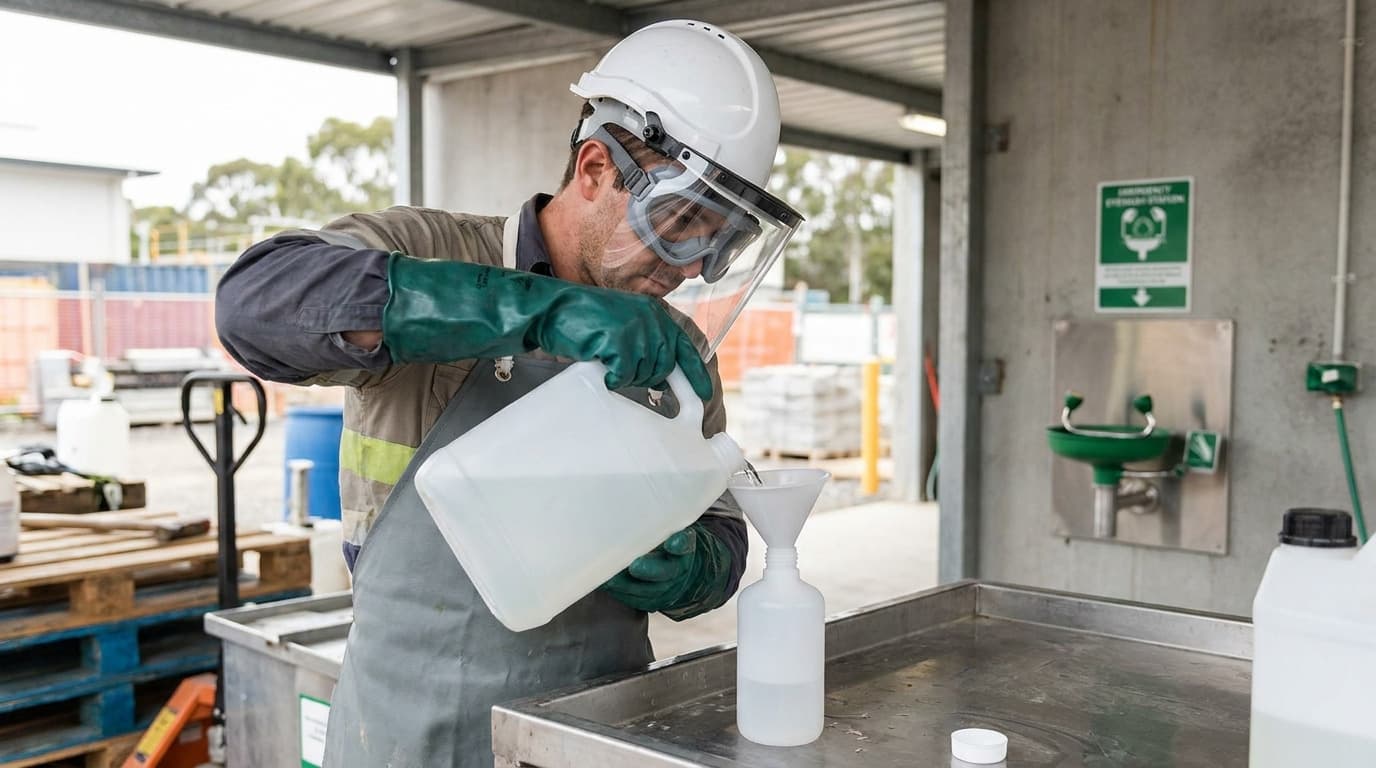
And underpinning all of it, 1926.102 requires eye and face protection where there is a reasonable probability of injury preventable by such equipment.
What has not changed#
Contact lenses are not eye protection. They are a corrective device. They provide no impact protection, no splash protection and no seal.
So the selection rules are exactly what they always were:
Goggles for splash. Safety glasses — even with side shields — are for impact and minor splash. Pouring, mixing, decanting and transferring corrosives need sealed splash goggles, lenses or no lenses.
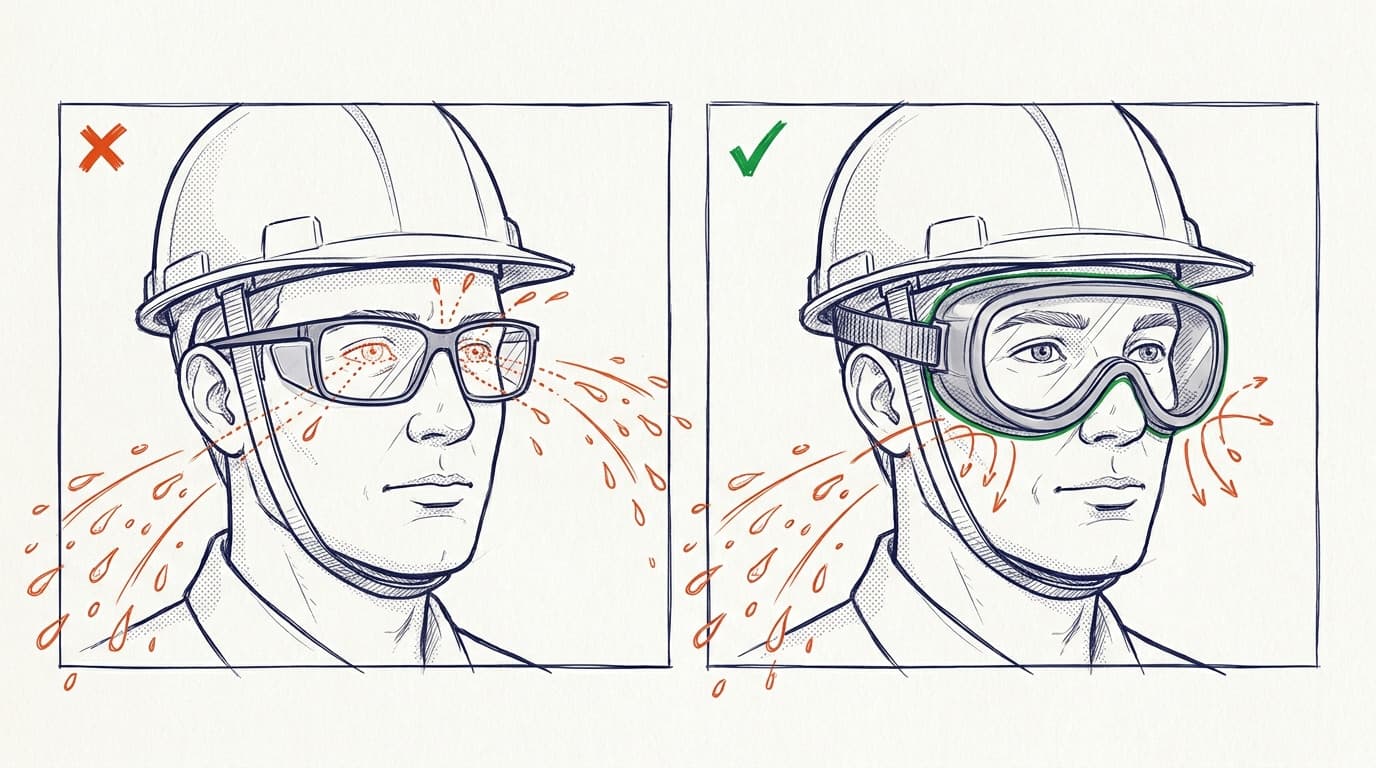
A face shield over goggles for high-volume or high-pressure work. A face shield alone is not primary eye protection.
Prescription safety eyewear, or protection worn over prescription glasses, for those who need correction and are not in lenses.
What can go wrong?#
A site ban that pushes lens wear underground, so nobody declares it and first responders do not know.
Someone spending thirty seconds trying to remove a lens before reaching the eyewash.
Eyewash blocked, unlabelled or unflushed, discovered at the moment of need.
A fifteen-second rinse treated as adequate for an alkali.
Eyelids clamped shut, so the flush never reaches the eye.
Safety glasses used for decanting, with lenses blamed afterwards for an injury caused by the wrong PPE.
Nobody carrying the SDS to the medical facility.
A substance-specific standard ignored, because the general NIOSH position was assumed to cover everything.
How do we manage this properly?#
Replace a blanket ban with the NIOSH position plus enforcement of PPE. Bans have not been supported since 2005, and they cost you information.
Ask people to declare lens wear, and make it unremarkable — supervisors and first aiders should know.
Brief the flushing rule until it is automatic: water first, lens second.
Check eyewash stations on a schedule, including flushing them, and keep the path to them clear.
Match protection to the task, not to the person — goggles for splash work, full stop.
Check the SDS for eye contact guidance before starting, not during the emergency.
Check substance-specific standards for anything with its own rule.
And keep the SDS with the casualty when they go for treatment.
Before you start#
- Confirm whether today's chemicals present a splash hazard, from the SDS.
- Confirm you have the right protection for that hazard — goggles, not glasses, for splash.
- Confirm where the nearest eyewash is and that you could reach it with your eyes shut.
- Confirm it has been flushed and is in service.
- Confirm anyone wearing lenses has said so, and that the crew knows the flush-first rule.
- Confirm whether any substance today has its own standard restricting contact lens use.
- Confirm somebody knows to bring the SDS if anyone needs treatment.
- Confirm nobody is decanting corrosives in safety glasses.
Talk it over#
- Does anyone here wear contact lenses, and does the crew know?
- Where is the nearest eyewash, and when was it last flushed?
- If you got a splash right now, what is the first thing you would do?
- How long would you flush for?
The bottom line#
The ban was withdrawn, but the eye protection requirement never changed — because contact lenses were never protection. NIOSH recommended against lens wear around hazardous chemicals from the 1978 Standards Completion Program, then reversed it in Current Intelligence Bulletin 59 (Publication 2005-139, June 2005): "Injury data are lacking to indicate that contact lens wear should be restricted during work with hazardous chemicals, and thus NIOSH recommends that contact lens wear be permitted provided that the safety guidelines presented in this Current Intelligence Bulletin are followed." Permission is conditional, and substance-specific standards — methylene chloride, acrylonitrile, ethylene oxide, DBCP, methylenedianiline — must be checked separately. The rule that saves the eye: flush immediately and do not delay flushing to remove a lens — water first, lens second, hold the lids open, roll the eye, and use the ANSI/ISEA Z358.1 benchmark of 15 minutes, longer for strong alkalis. 1926.50(g) requires that where eyes may be exposed to injurious corrosive materials, suitable facilities for quick drenching or flushing shall be provided within the work area for immediate emergency use — triggered by the hazard, not the industry — with 1926.441(a)(6) requiring drenching facilities within 25 feet of battery handling areas. And unchanged throughout: goggles for splash work, lenses or no lenses.
Frequently asked questions about contact lenses and chemical splashes#
Can you wear contact lenses around chemicals?
Under the current NIOSH position, generally yes — with conditions. Current Intelligence Bulletin 59 (2005-139, June 2005) concluded that injury data are lacking to indicate that contact lens wear should be restricted during work with hazardous chemicals, and recommended that lens wear be permitted provided the safety guidelines in the bulletin are followed. That reversed a recommendation dating from the 1978 Standards Completion Program. Some substance-specific standards still restrict lens use and must be checked.
Do contact lenses protect the eyes?
No, and this is the point most often confused. Contact lenses are a corrective device, not personal protective equipment. They offer no impact protection, no splash protection and no seal. The eye protection requirement is completely unchanged by the NIOSH position — splash work needs sealed goggles, and safety glasses are not sufficient for pouring, mixing, decanting or transferring corrosives.
Should you remove a contact lens before flushing a chemical splash?
No. Flush immediately and do not delay flushing to remove a lens. With corrosives, seconds determine the outcome. The lens usually comes out during irrigation; if it does not, it can be removed while flushing continues or afterwards. Water first, lens second, always — and hold the eyelids open, because the natural reaction is to clamp them shut, which stops the flush reaching the eye.
How long should you flush an eye?
OSHA does not specify a duration in the general provisions. The consensus benchmark widely used is ANSI/ISEA Z358.1, which specifies 15 minutes of flushing — and longer is better for strong alkalis, which continue to penetrate tissue. Roll the eye during flushing so water reaches beneath the lids, get medical attention, and take the safety data sheet with you.
What does OSHA require for eyewash facilities?
1926.50(g) for construction — and 1910.151(c) in identical terms for general industry — requires that where the eyes or body of any person may be exposed to injurious corrosive materials, suitable facilities for quick drenching or flushing of the eyes and body shall be provided within the work area for immediate emergency use. The duty is triggered by the hazard rather than the industry. OSHA does not set flow, temperature or distance in these sections; ANSI/ISEA Z358.1 is the consensus yardstick.
Is there a required distance to an eyewash station?
Not in the general provisions — OSHA says "within the work area for immediate emergency use" without specifying a distance. The commonly used consensus figure from ANSI/ISEA Z358.1 is a station reachable within about ten seconds. One construction-specific distance does appear in regulation: 1926.441(a)(6) requires quick drenching facilities within 25 feet of battery handling areas.
Should a site ban contact lenses?
A blanket ban is not supported by the current NIOSH position, and it has a practical cost: it drives lens wear underground, so nobody declares it and first aiders do not know who is wearing them. The better arrangement is to permit lens wear under the NIOSH guidelines, ask people to declare it, enforce the correct eye protection regardless, and drill the flush-first rule — while checking any substance-specific standard that applies.
Download the contact lenses and chemical splashes toolbox talk PDF#
Get this contact lenses and chemical splashes toolbox talk as a print-ready PDF — available in English, Spanish, Portuguese, and Turkish. Print it, hand it to the crew, and collect signatures on the included attendance sheet.
Download the PDF — free account required. New members get 3 free downloads.
Related toolbox talks#
Sources#
- NIOSH, Current Intelligence Bulletin 59: Contact Lens Use in a Chemical Environment, DHHS (NIOSH) Publication No. 2005-139: https://www.cdc.gov/niosh/docs/2005-139
- OSHA, 29 CFR 1926.50 — Medical services and first aid: https://www.osha.gov/laws-regs/regulations/standardnumber/1926/1926.50
- OSHA, 29 CFR 1926.102 — Eye and face protection: https://www.osha.gov/laws-regs/regulations/standardnumber/1926/1926.102
This talk summarises published guidance and regulation for training purposes. It is not medical advice. Any chemical exposure to the eye requires medical assessment — flush immediately, seek treatment, and take the safety data sheet with you.
Written by FieldSafetyTalk's safety professional — a CSP, ASP, CHST and OSHA Authorized Outreach Trainer with 14+ years of international construction safety experience across federal, heavy civil, and industrial projects.