Severe Weather
Updated 2026-07-28
In this bundle Health & Environmental Exposure
Print-ready PDF
Download this talk as a print-ready PDF, available in 4 languages.
Severe weather is the only hazard on a construction site that announces itself in advance and still catches people out. The forecast said it. The sky said it. And work carried on, because stopping is a decision somebody has to make and nobody had agreed in advance who that was or what would trigger it. This severe weather talk is about making that decision before the storm rather than during it.
Here is the distinction that carries this whole talk: you do not decide when the weather is dangerous — you decide the threshold, in advance, and the weather decides when it is met. Judgement in the moment is exactly what fails, because the pressure to finish rises as the sky darkens. The only defence is a trigger agreed while everyone is calm, and a named person with the authority to call it.
Lightning: the rule starts with sound#
OSHA and NOAA's guidance for outdoor workers is unusually blunt, and it turns on one point most crews get wrong: if you can hear thunder, you are already within striking distance. Lightning does not need to be overhead, and it does not need to be raining.
The rules that follow from that:
Go indoors when you hear thunder — "When Thunder Roars, Go Indoors." Not when the rain starts, not when it looks close. The first thunder is the trigger.
Wait at least 30 minutes after the last clap of thunder or the last flash of lightning before resuming outdoor work. This is the part that gets shortened, and it is the part that matters — the tail of a storm is dangerous, and the clock restarts with every new rumble.
Take shelter in a substantial building — one with wiring and plumbing — or, if none is accessible, in the nearest hard-topped vehicle with the windows rolled up, remaining there for the same 30 minutes after the last thunder or lightning.
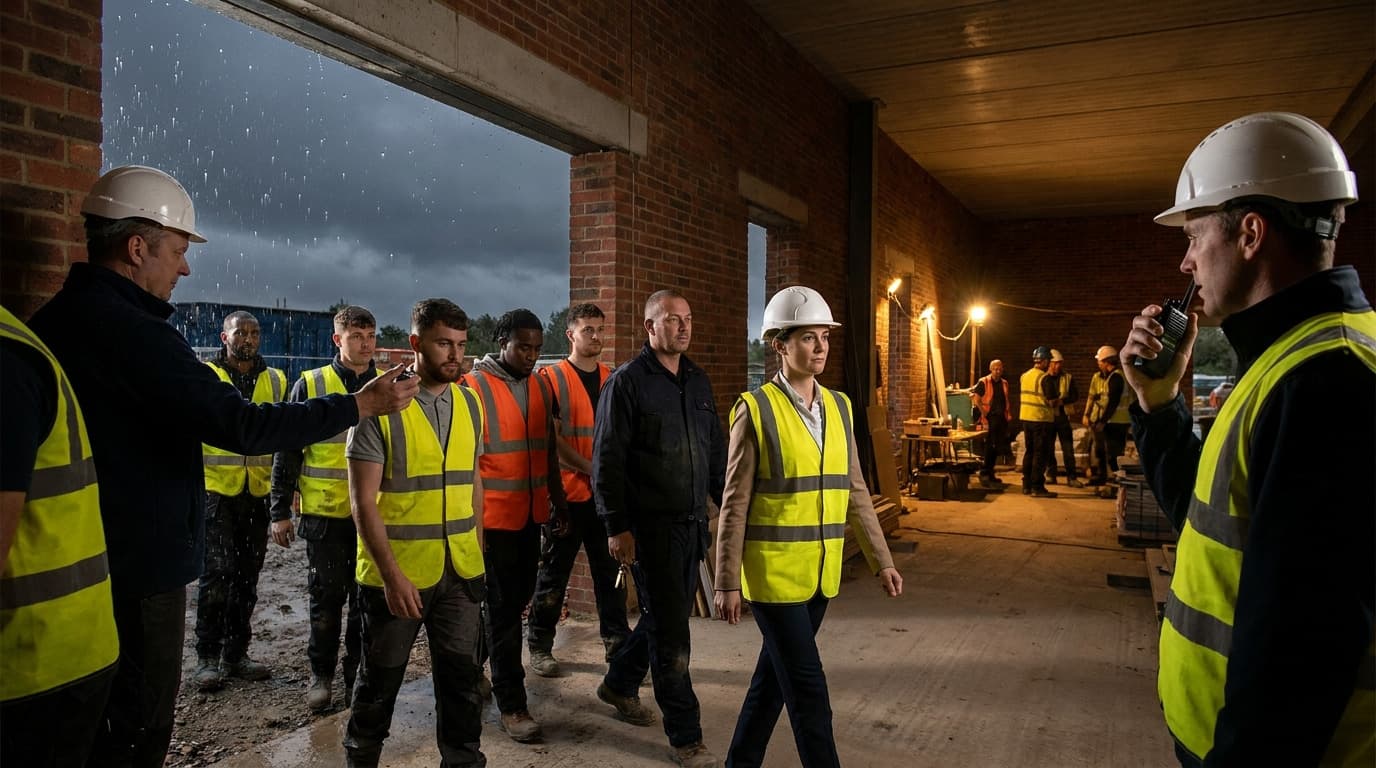
What does not count as shelter: open-sided structures, picnic shelters, bus stops, sheds, tents, dugouts, the open cab of plant, or anything with a fabric or open roof. If it does not fully enclose you in a metal-topped vehicle or a wired-and-plumbed building, treat it as exposed.
Do not use corded phones except in an emergency — cell phones and cordless phones are fine.
The 30-minute figure is a NOAA and National Weather Service recommendation that OSHA references in its joint fact sheet on lightning safety for outdoor workers. It is endorsed best practice rather than a numeric OSHA rule — which is precisely why it needs to be written into your own plan, where it becomes the site rule.
Where the decision lives — 1926.35#
Because there is no severe weather standard, the enforceable structure is built from three places.
The General Duty Clause, Section 5(a)(1) is the citation route: a workplace free from recognised hazards likely to cause death or serious physical harm. Severe weather is a recognised hazard, and the question after an incident is always whether a feasible means of abatement existed and was not used.
1926.35 — Employee emergency action plans is where the detail belongs. A written EAP is the natural home for your suspend and resume thresholds, the shelter locations, how workers are notified, and who makes the call. OSHA's lightning guidance says exactly this: the EAP should inform supervisors and workers to act after hearing thunder or seeing lightning, indicate how workers are notified, and identify the locations and requirements for safe shelters.
1926.21(b)(2) requires employees to be instructed in the recognition and avoidance of unsafe conditions — the basis for actually training the crew on those triggers rather than filing them.
And one equipment-specific stoppage bites directly in storm conditions: 1926.451(f)(12) prohibits work on or from scaffolds during storms or high winds unless a competent person determines it is safe and employees are protected. That one is a standard, not guidance — and the sustained-condition provisions are covered in the extreme weather talk.
Getting people off the site, not just off the tools#
Stopping work is the easy half. The dangerous window is the one after that, when a hundred people move across an open site at the same time.
Where do they go? Shelter capacity is the constraint nobody plans. If the only substantial building holds thirty and the site holds two hundred, the plan fails at the moment it is needed.
How long does it take to get there? Height, depth and distance all cost time — a crew at the top of a structure, in an excavation, or in a lift basket cannot simply walk away.
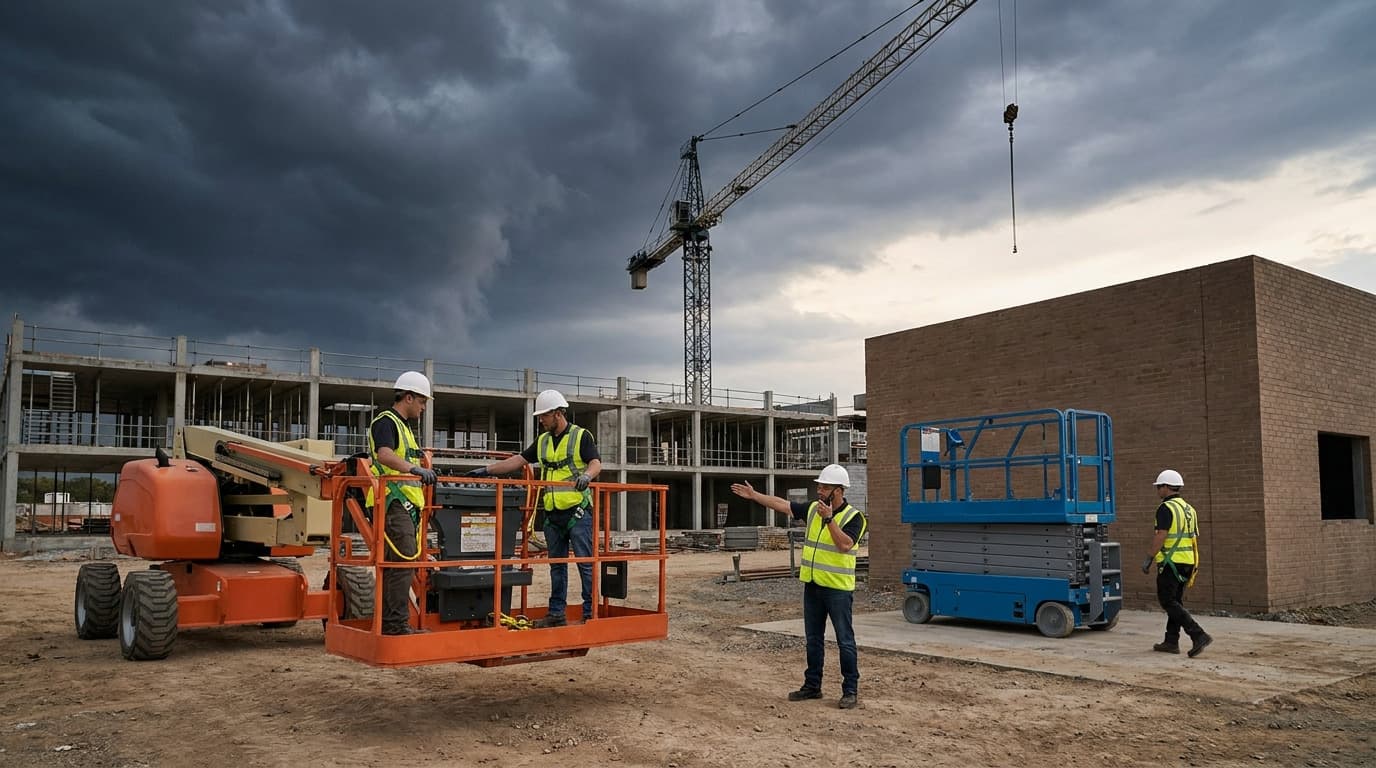
What has to happen first? Loads landed, cranes stowed to manufacturer requirements, lifts brought down, sheet material secured, excavations left safe. That sequence takes longer than the walk, which is why the trigger has to come before the storm arrives.
Who is counted? Subcontractors, delivery drivers, visitors and anyone working alone in a remote part of the site.
Tornado and flash flood add their own logic: for a tornado warning, the lowest floor of a substantial structure, away from windows and away from anything that can be lifted; for flooding, the fact that moving water and flooded ground carry hazards you cannot see — never enter or drive through it.
What can go wrong?#
Work continues through thunder because it is not raining yet. The trigger is the sound, not the rain.
The 30 minutes gets rounded down. Five minutes of quiet is not the storm passing, and any new thunder restarts the clock.
People shelter under or in the wrong thing. A site canopy, a container without a metal roof, a tent, a machine cab, or under a tree — all of which are exposure, not shelter.
Nobody is told. No notification method, so the message reaches whoever happens to be near a supervisor.
Everyone leaves at once, through one route. Congestion, plant moving, poor visibility and people hurrying.
Cranes and lifts are left as they were. Booms not stowed, baskets at height, loads suspended.
Nobody is counted back in. Work resumes and nobody knows if everybody returned — or if anyone is still sheltering.
The resume decision is made by the same pressure that delayed the stop.
How do we manage this properly?#
Write the triggers into the emergency action plan — the suspend threshold, the resume threshold, shelter locations, notification method and the named person who calls it. Then brief them, because a plan nobody has heard of is not a plan.
Use the sound as the trigger. First thunder means stop and move — that is the whole rule, and its simplicity is its strength.
Hold the 30 minutes. After the last thunder or last flash, and restart it if there is another.
Name the shelters and check the capacity. Substantial buildings first; hard-topped vehicles with windows up as the fallback; nothing open-sided, nothing fabric.
Rehearse the getting-there. Time it from the furthest, highest and deepest working position, not from the gate.
Sequence the shutdown. Land loads, stow plant to the manufacturer's requirements, bring lifts down, secure sheet material — all before people leave.
Count out and count back. Including subcontractors, deliveries and visitors.
Watch the forecast as a task, not a habit. Someone owns it, checks it and reports it at the brief.
Before you start#
- Confirm today's forecast and whether storms are expected.
- Confirm what the suspend trigger is, and who has the authority to call it.
- Confirm how everyone on site will be notified — including anyone working alone or remotely.
- Confirm where the shelters are and whether they hold everyone.
- Confirm how long it takes to get down, out and across from the furthest working position.
- Confirm what has to be shut down or secured before people move.
- Confirm the resume rule — at least 30 minutes after the last thunder or lightning.
- Confirm who counts people out and back in.
Talk it over#
- If you heard thunder right now, where would you go — and how long would it take?
- Does that shelter actually hold everyone on this site?
- What would have to be secured before anyone could leave your work area?
- Who tells the crew working on the far side of the site, and how?
The bottom line#
There is no severe weather standard, so the structure is built from the General Duty Clause, from 1926.35 employee emergency action plans, and from 1926.21(b)(2) training — with 1926.451(f)(12) prohibiting scaffold work during storms or high winds unless a competent person determines it is safe. On lightning, the guidance OSHA issues jointly with NOAA is simple: if you can hear thunder, you are within striking distance — go indoors to a substantial building, or to the nearest hard-topped vehicle with the windows rolled up, and wait at least 30 minutes after the last thunder or lightning before resuming. Open-sided structures, tents, sheds, dugouts and machine cabs are not shelter. And the part that decides whether any of it works: the thresholds, the notification method, the shelter locations and the named person who calls it belong in the written plan, agreed before the sky changes.
Frequently asked questions about severe weather#
When should work stop for lightning?
When you hear thunder. OSHA and NOAA's guidance for outdoor workers is that if you can hear thunder, you are already within striking distance of the storm — so the first thunder is the trigger, regardless of whether it is raining or whether the storm looks close.
How long do we wait before going back to work?
At least 30 minutes after the last clap of thunder or the last flash of lightning. If there is further thunder or lightning during that period, the 30 minutes restarts. The figure is a NOAA and National Weather Service recommendation that OSHA references, so it is best practice — which is why it should be written into your own emergency action plan as the site rule.
What counts as safe shelter?
A substantial building with wiring and plumbing. If none is accessible, the fallback is the nearest hard-topped vehicle with the windows rolled up, remaining inside for the same 30 minutes after the last thunder or lightning.
What does not count as shelter?
Open-sided structures, picnic shelters, bus stops, sheds, tents, dugouts, the open cab of plant, and anything with a fabric or open roof. Standing under a tree is among the most dangerous options available. If it does not fully enclose you in a metal-topped vehicle or a wired-and-plumbed building, treat it as exposed.
Does OSHA have a severe weather standard?
No specific one. Enforcement runs through the General Duty Clause, Section 5(a)(1), which requires a workplace free from recognised hazards likely to cause death or serious physical harm. 1926.35 requires employee emergency action plans, which is where suspend and resume thresholds, shelter locations and notification methods belong, and 1926.21(b)(2) requires employees to be instructed in recognising and avoiding unsafe conditions.
What should the emergency action plan say about lightning?
OSHA's guidance is specific: the plan should inform supervisors and workers to act after hearing thunder, seeing lightning or noticing other warning signs of approaching storms; indicate how workers are notified about lightning safety warnings; and identify the locations and requirements for safe shelters.
Can we keep working on a scaffold if a storm is coming?
Not by default. 1926.451(f)(12) prohibits work on or from scaffolds during storms or high winds unless a competent person has determined that it is safe and employees are protected by a personal fall arrest system or wind screens. Metal scaffolds in a lightning storm carry an electrocution risk on top of the wind loading.
Download the severe weather toolbox talk PDF#
Get this severe weather toolbox talk as a print-ready PDF — available in English, Spanish, Portuguese, and Turkish. Print it, hand it to the crew, and collect signatures on the included attendance sheet.
Download the PDF — free account required. New members get 3 free downloads.
Related toolbox talks#
Sources#
- OSHA/NOAA, Lightning Safety When Working Outdoors (Fact Sheet): https://www.osha.gov/sites/default/files/publications/OSHA3863.pdf
- OSHA, 29 CFR 1926.35 — Employee emergency action plans: https://www.osha.gov/laws-regs/regulations/standardnumber/1926/1926.35
- OSHA, 29 CFR 1926.451 — Scaffolds, general requirements: https://www.osha.gov/laws-regs/regulations/standardnumber/1926/1926.451