Ammonia Safety
Updated 2026-08-01
In this bundle Health & Environmental Exposure
Print-ready PDF
Download this talk as a print-ready PDF, available in 4 languages.
Ask any crew which way ammonia goes and you will get the right answer: up. It is lighter than air, it says so on every data sheet, and the instinct that follows is that a leak rises away from you. That instinct has walked people into ammonia clouds. This ammonia safety talk is about the gap between what the gas does and what a release does.
Here is the distinction that carries this whole talk: ammonia is lighter than air, but an ammonia release is not. Almost all the ammonia on an industrial site is stored as a liquid under pressure or refrigeration. When that liquid escapes it flashes — part boils off instantly and the rest is thrown out as a fog of cold liquid droplets. That two-phase cloud of vapour, droplets and chilled air is denser than the air around it, so it spreads sideways along the ground before it ever becomes buoyant. The vapour rises. The release crawls.
Where the boundary of this talk sits#
Cylinder and vessel handling belongs to the compressed gas cylinder talk. Response to a release already on the ground belongs to the chemical spill response talk. Respirator selection and fit belong to the respiratory protection talk. Alkali burns to the skin — and the reason alkalis are sneakier than acids — are owned by the skin hazards talk, which builds that argument on wet cement. This talk owns the release behaviour and the inhalation injury.
The number behind the anchor#
This is not a hedge or a "sometimes." It has been studied and quantified.
Dispersion research on anhydrous ammonia found that the aerosol in a rapid release can carry as much as 80% of the ammonia mass as liquid droplets. More usefully for a tailgate: even when the liquid fraction is as low as 16% of the mass, the cloud stays denser than air throughout its dilution. That is why a two-phase ammonia release is modelled as a dense gas release, despite ammonia's vapour density of about 0.6 against air at 1.
NOAA's CAMEO Chemicals entry puts it in one line: although ammonia is lighter than air, the vapours from a leak will initially hug the ground.
There is a second reason it stays low. Ammonia is extraordinarily thirsty for water — one cubic foot of water will dissolve about 1,300 cubic feet of ammonia vapour — so on a humid day the cloud pulls moisture out of the air, gets heavier and stays down. Emergency responders describe the "upside-down J": vapour released from the top of a tank goes straight up, then at roughly 50 to 75 feet (15 to 23 m) curls over and flattens out as it takes on atmospheric moisture.
What this changes on site: you do not move away from an ammonia release by standing up. You move upwind and uphill, and you treat the low ground as the danger zone.
The pain is the protection#
Ammonia is one of the few industrial gases where the immediate suffering is doing you a favour, and understanding why prevents a serious error.
Ammonia is extremely soluble in water. On the wet lining of your eyes, nose, mouth and throat it dissolves at once and forms ammonium hydroxide, a strong alkali. That is instant, severe, unmistakable pain in the upper airway — and it drives people out of the area within seconds. Most of the dose never reaches the deep lung because most of it never gets past your throat.
Compare that with chlorine, which is only moderately soluble and therefore travels further down while hurting less on the way. Two irritant gases, opposite warning profiles.
The error to avoid is the conclusion that ammonia is therefore the safer gas. It is not. At high concentrations the same alkali attack causes swelling of the airway, laryngospasm, chemical burns to the eyes and skin, and pulmonary oedema. What is true is narrower and more useful: with ammonia, the thing that makes you leave is reliable — so leave. Do not push through it to close a valve.
Liquid ammonia freezes what it touches#
Anhydrous ammonia boils at around −33 °C (−28 °F). Liquid on skin or in an eye causes severe cold injury on top of the caustic burn — two mechanisms in the same contact. Frostbite recognition and first aid are covered in the cold stress talk; what belongs here is that ammonia gives you both at once, and that the caustic component keeps working after the cold has gone.
Non-flammable is not the whole story#
Ammonia is shipped and often described as a non-flammable gas, and for most site purposes it behaves that way. But NIOSH lists a lower explosive limit of 15%, with a flammable range running up to roughly 28% in air.
That range is narrow and high, which is why open-air leaks rarely ignite. In an enclosed plant room, a machinery space or a pit, it is reachable. Ammonia in a confined space is a fire and explosion problem as well as a toxic one, and the presence of oil from compressors makes it worse. Do not let "non-flammable" on a placard end the conversation.
The numbers#
The OSHA permissible exposure limit is 50 ppm as an 8-hour TWA, from 1910.1000 Table Z-1, applied to construction through 1926.55.
The NIOSH IDLH is 300 ppm.
NIOSH recommends 25 ppm as a TWA with a 35 ppm short-term limit, and the ACGIH threshold limit value is the same 25 ppm with a 35 ppm STEL. Both are consensus standards, not OSHA rules.
Worth noting for context: OSHA proposed a 25 ppm TWA in 1989 and did not adopt it — the enforceable federal figure remains 50 ppm, which is twice what NIOSH and ACGIH recommend. If your site works to 25 ppm, that is a deliberate decision to work below the legal line, not a misreading of it.
Where it turns up in construction#
Industrial refrigeration is the big one. Cold stores, food and beverage plants, distribution centres and ice rinks run on ammonia, and construction and maintenance contractors work in and around those systems constantly — in plant rooms, on roof-mounted condensers, in machinery spaces and above ceilings where pipe runs.
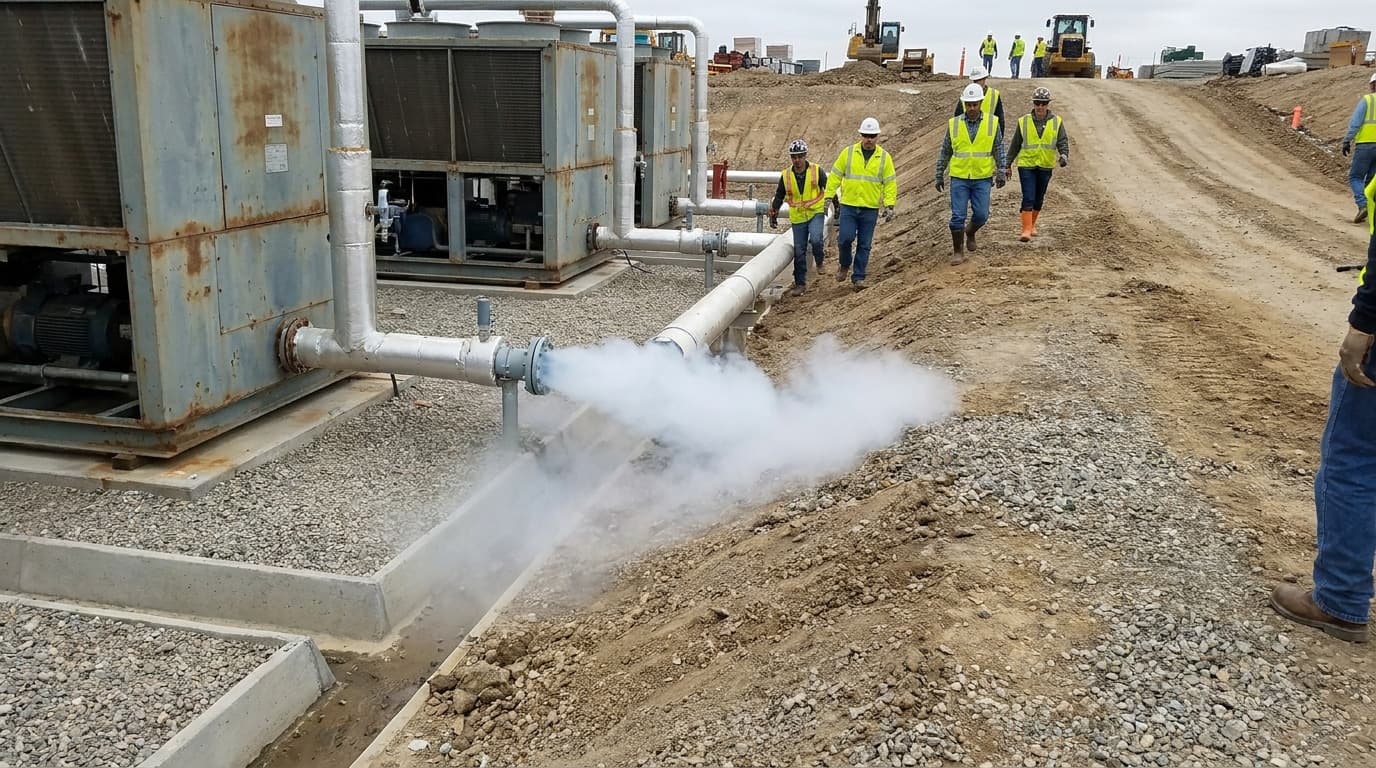
Also: fertiliser and agricultural facilities, NOx control systems at power plants, cleaning products in site accommodation, and accidental generation — mixing ammonia-based cleaner with bleach produces chloramine gas, a different hazard again.
Where the duty sits#
There is no OSHA standard specific to ammonia in construction beyond the exposure limit. Say so plainly.
The PEL applies through 1926.55, which requires engineering and administrative controls first wherever feasible, with PPE where controls are not feasible. 1926.59 brings hazard communication and the SDS. 1926.50(g) requires quick drenching and flushing facilities where employees may be exposed to injurious corrosive materials — for a caustic gas that attacks eyes first, this one is not paperwork.
The provision that matters most for contractors is 1910.119, Process Safety Management. Appendix A lists Ammonia, Anhydrous at a threshold quantity of 10,000 pounds (4,540 kg) and ammonia solutions above 44% by weight at 15,000 pounds (6,800 kg). A mid-sized cold store passes 10,000 lb comfortably. Where the process is covered, 1910.119(h) reaches contractors doing maintenance, repair, turnaround, major renovation or specialty work on or adjacent to it: the host must inform contract employers of known fire, explosion and toxic release hazards and explain the emergency action plan, and the contract employer must train its own people to match. Ask for that briefing before your crew goes into the plant room.
What can go wrong?#
Assuming the cloud rises, and walking or standing your way out of a release instead of going upwind and uphill.
Entering a plant room or machinery space on a reported smell to "have a quick look."
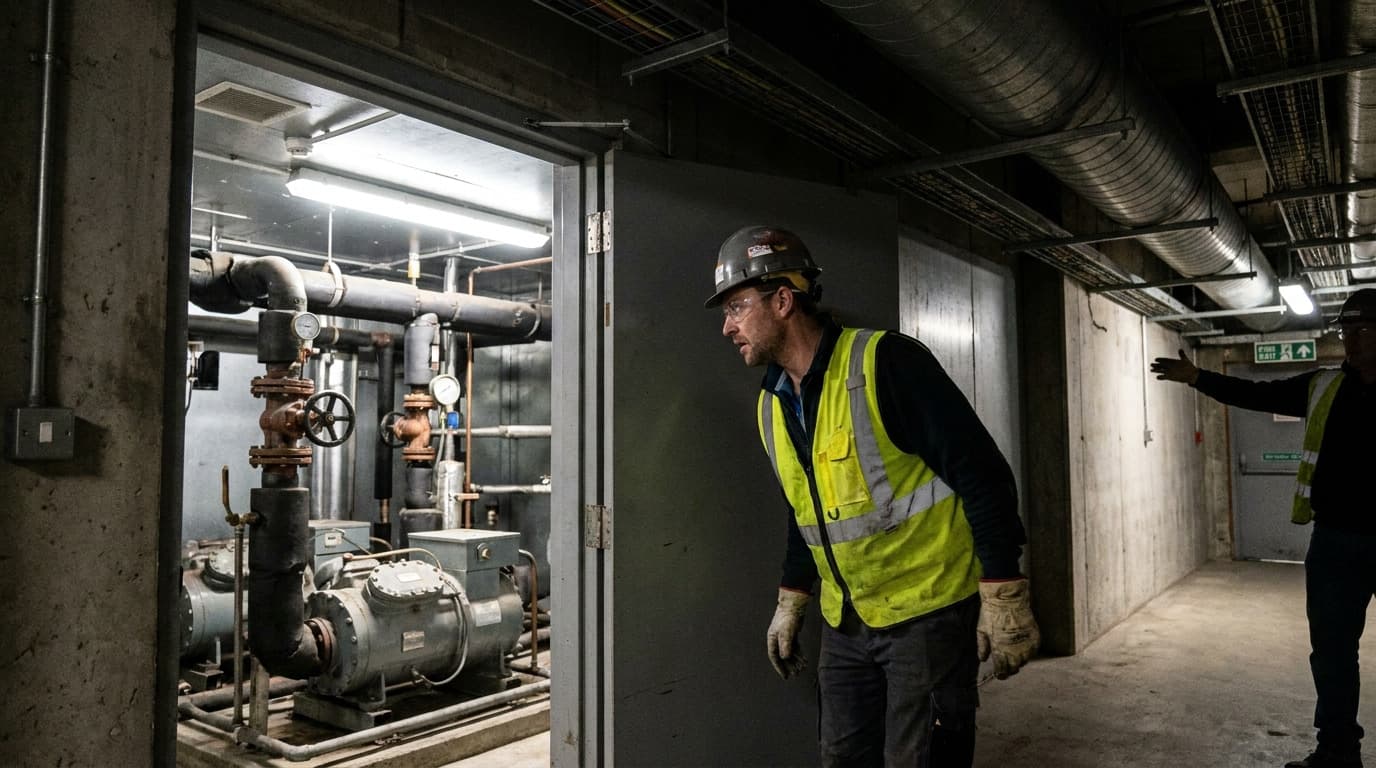
Trying to close a valve through the pain, because the exposure feels survivable for a few more seconds.
Treating an ammonia plant room as a non-flammable space, and doing hot work or ignoring accumulated compressor oil.
Working at a refrigerated facility without asking what the system holds, where the alarms are and what the evacuation route is.
Mixing an ammonia cleaner with bleach in a site cabin or washroom.
Handling liquid ammonia lines without eye and face protection, where a single drop causes a caustic and cold injury together.
Sending somebody back to work after an eye or airway exposure without flushing properly and getting them assessed.
How do we manage this properly?#
Establish the inventory before you mobilise — what form of ammonia, what quantity, where, and whether the process is PSM-covered.
Get the 1910.119(h) briefing and make sure the crew heard it, not just the supervisor.
Read Section 8 of the SDS for whatever is actually in use, including ammonia-based cleaners.
Move upwind and uphill on any release, account for people, and keep everyone out of low ground, pits and trenches near the leak.
Never enter to investigate a smell. Ammonia at a detectable concentration is a reason to leave and report, not to look.
Treat plant rooms and machinery spaces as confined or enclosed work where the atmosphere is tested and mechanical ventilation is running.
Flush eyes and skin immediately and at length using the facilities required by 1926.50(g) — minutes, not seconds, and keep the eyelids held open.
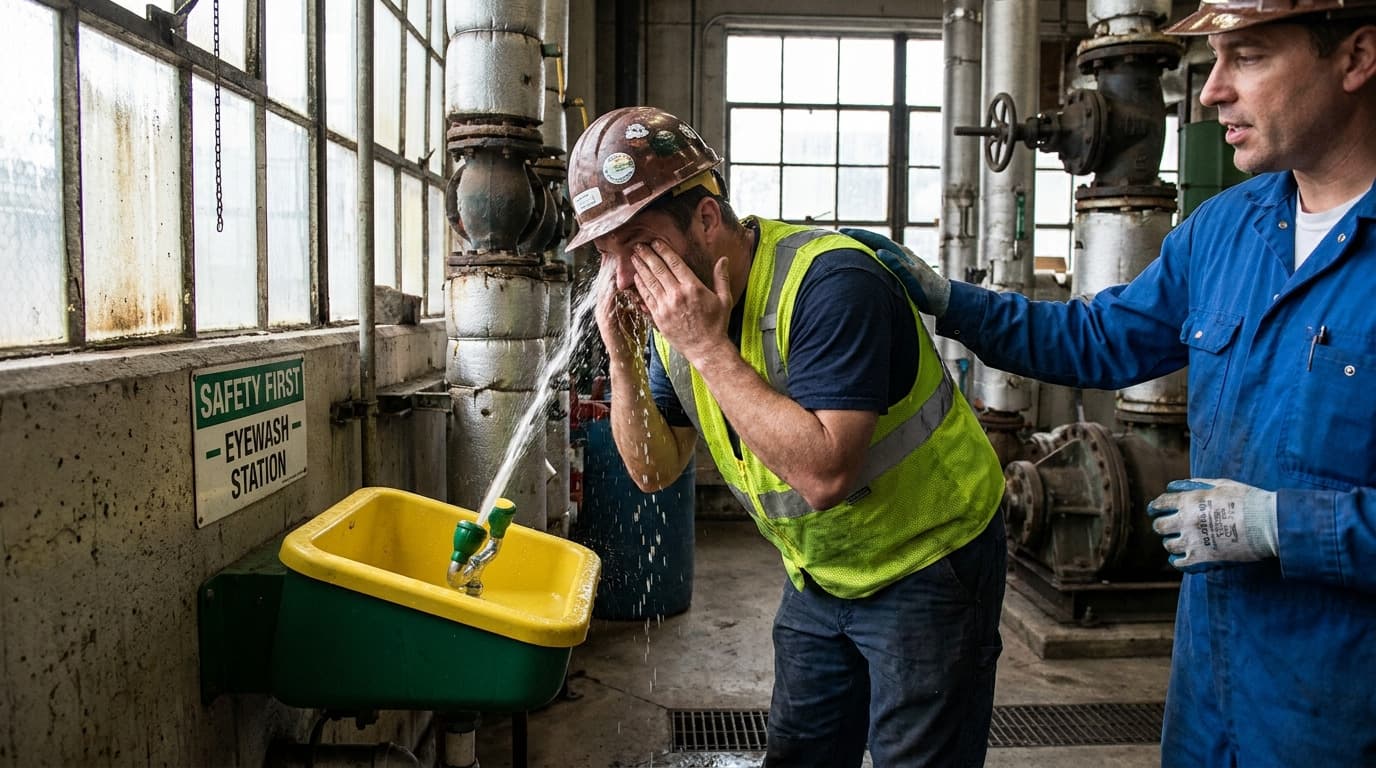
Send every exposure for medical assessment and tell the clinician it was ammonia, so both the caustic and the cold injury are looked for.
Never mix cleaning products, and control what comes onto site.
Before you start#
- Confirm what ammonia is on this site, in what form and in what quantity.
- Confirm whether the process is PSM-covered and whether the 1910.119(h) briefing has been given.
- Confirm you have read Section 8 of the SDS for anything ammonia-based in use.
- Confirm where the alarms, wind indicator and evacuation muster point are.
- Confirm the eyewash and drenching facilities are in the work area and working.
- Confirm any plant room or machinery space is ventilated and the atmosphere tested.
- Confirm nobody on this crew intends to enter on a smell or close a valve through the pain.
- Confirm no ammonia-based cleaner and bleach are stored or used together.
Talk it over#
- If we smelled ammonia at the plant room right now, which way would each of us go?
- Where is the low ground between us and that building?
- Has anyone here ever pushed through a chemical smell to finish a job?
- What ammonia-based products do we have in the cabin, and what else is on that shelf?
The bottom line#
Ammonia is lighter than air, but an ammonia release is not. Stored as a liquid under pressure or refrigeration, it flashes on escape into a two-phase cloud of vapour and cold liquid droplets that is denser than the surrounding air and spreads along the ground. Dispersion studies found droplets can carry as much as 80% of the ammonia mass, and that even at a liquid fraction of only 16% the cloud stays denser than air throughout dilution — which is why a two-phase release is modelled as a dense gas release despite a vapour density of about 0.6. NOAA's CAMEO states plainly that vapours from a leak will initially hug the ground, and because one cubic foot of water dissolves about 1,300 cubic feet of ammonia, humidity keeps the cloud low — the responders' "upside-down J", curling over at roughly 50 to 75 feet (15 to 23 m). So you go upwind and uphill, not upright. On injury: ammonia is extremely water-soluble, forming ammonium hydroxide on contact with the wet upper airway, so the pain is immediate and is what saves you — most of the dose never passes the throat, the opposite of chlorine. That makes the urge to leave reliable, so leave; do not push through it to close a valve. At high concentration it still causes airway swelling, laryngospasm, eye and skin burns and pulmonary oedema, and liquid ammonia boiling at −33 °C (−28 °F) delivers a cold injury and a caustic burn in the same contact. It is commonly called non-flammable but NIOSH lists an LEL of 15% with a range to about 28% — unreachable outdoors, reachable in a plant room. Limits: OSHA PEL 50 ppm 8-hour TWA (1910.1000 Table Z-1 via 1926.55), NIOSH IDLH 300 ppm, with NIOSH and ACGIH both recommending 25 ppm TWA / 35 ppm STEL — consensus, not OSHA. Duties run through 1926.55 (controls before PPE), 1926.59 HazCom, 1926.50(g) quick drenching and flushing, and 1910.119 Appendix A, which lists anhydrous ammonia at 10,000 lb (4,540 kg) and solutions above 44% at 15,000 lb (6,800 kg) — with 1910.119(h) placing duties on contractors working on or adjacent to a covered process, and on the host to brief them.
Frequently asked questions about ammonia#
Ammonia is lighter than air, so won't a leak just rise away from me?
The gas will. A release usually will not, at first. Ammonia is stored as a liquid, and when it escapes it flashes into a two-phase cloud of vapour plus cold liquid droplets that is denser than air and spreads along the ground. Research found the cloud stays denser than air throughout dilution even when only 16% of the mass is liquid. NOAA's CAMEO states that vapours from a leak will initially hug the ground. Go upwind and uphill.
Why does humidity make an ammonia cloud worse?
Because ammonia is intensely hygroscopic — one cubic foot of water dissolves about 1,300 cubic feet of ammonia vapour. On a humid day the cloud takes moisture out of the air, becomes heavier and stays low instead of lifting. Responders call the shape the "upside-down J": vapour goes up from the release, then at around 50 to 75 feet (15 to 23 m) curls over and flattens out.
If ammonia hurts so much, doesn't that make it safer than a gas I cannot feel?
The warning is more reliable, and that is genuinely useful — but the gas is not safe. Ammonia's extreme water solubility means it dissolves in the wet upper airway and forms ammonium hydroxide, causing immediate severe pain that drives people out. Most of the dose stops at the throat. At high concentrations it still causes airway swelling, laryngospasm, burns and pulmonary oedema. Treat the pain as an instruction to leave, not as a measure of how much you can take.
Is ammonia flammable or not?
Both answers appear on site, and the precise version matters. It is usually handled as a non-flammable gas, but NIOSH lists a lower explosive limit of 15% with a flammable range to about 28% in air. Those concentrations are effectively unreachable outdoors, which is why leaks rarely ignite — but they are reachable in an enclosed plant room, machinery space or pit. Treat ammonia in a confined space as a fire risk as well as a toxic one.
What are the exposure limits for ammonia?
The enforceable figure is the OSHA PEL of 50 ppm as an 8-hour TWA (1910.1000 Table Z-1, applied to construction through 1926.55), and the NIOSH IDLH is 300 ppm. Both NIOSH and ACGIH recommend a lower 25 ppm TWA with a 35 ppm short-term limit — these are consensus standards, not OSHA rules. OSHA proposed 25 ppm in 1989 and did not adopt it, so the legal limit is twice the recommended one.
I am a contractor at a cold store. Does process safety management apply to me?
It may well, and you should ask. 1910.119 Appendix A lists anhydrous ammonia at a threshold quantity of 10,000 pounds (4,540 kg) — a quantity a mid-sized refrigeration plant exceeds easily — and ammonia solutions above 44% by weight at 15,000 pounds (6,800 kg). Where a process is covered, 1910.119(h) applies to contractors working on or adjacent to it, and the host must inform you of known fire, explosion and toxic release hazards and explain the emergency plan.
What is the first aid for an ammonia splash to the eye?
Flush immediately and keep flushing, using the quick drenching and flushing facilities required by 1926.50(g), holding the eyelids open — this is a strong alkali and the injury continues while it remains in contact. Then get urgent medical assessment and tell the clinician it was ammonia, because liquid ammonia delivers a cold injury as well as a caustic burn. Do not delay flushing for anything.
Download the ammonia toolbox talk PDF#
Get this ammonia safety toolbox talk as a print-ready PDF — available in English, Spanish, Portuguese, and Turkish. Print it, hand it to the crew, and collect signatures on the included attendance sheet.
Download the PDF — free account required. New members get 3 free downloads.
Related toolbox talks#
Sources#
- NOAA, CAMEO Chemicals — Ammonia Solutions: https://cameochemicals.noaa.gov/chemical/24008
- NIOSH, Documentation for Immediately Dangerous to Life or Health Concentrations — Ammonia: https://www.cdc.gov/niosh/idlh/7664417.html
- OSHA, Appendix A to 1910.119 — List of Highly Hazardous Chemicals, Toxics and Reactives: https://www.osha.gov/laws-regs/regulations/standardnumber/1910/1910.119AppA
This talk is general awareness guidance for training purposes. It does not qualify anyone to handle ammonia, work on refrigeration systems or respond to an ammonia release, all of which require specific training and authorisation. It is not medical advice and nothing in it is a diagnosis; anyone with a suspected ammonia exposure should be assessed by a qualified medical professional, who should be told that ammonia exposure is suspected.