Personal Hygiene
Updated 2026-07-28
In this bundle Health & Environmental Exposure
Working in California? See the Cal/OSHA edition → California (Cal/OSHA)
Print-ready PDF
Download this talk as a print-ready PDF, available in 4 languages.
Sanitation is the part of a site everyone judges and nobody manages. The toilets are somebody else's contract, the water is somebody else's delivery, and the washing station is wherever it ended up on day one. Meanwhile the standard covering all of it is short, numerical and routinely breached without anyone checking. This personal hygiene talk puts the actual numbers on it.
Here is the distinction that carries this whole talk: provided means usable, not present. A toilet that exists but cannot be used is not a facility; a washing station with no soap is not a washing station; water in a container nobody can draw from cleanly is not potable supply. Every requirement in 1926.51 is written about provision, and the practical failures are almost all about condition rather than absence.
The numbers — Table D-1#
1926.51(c)(1) sets the ratios directly:
| Number of employees | Minimum number of facilities |
|---|---|
| 20 or less | 1 |
| 20 or more | 1 toilet seat and 1 urinal per 40 workers |
| 200 or more | 1 toilet seat and 1 urinal per 50 workers |
Read the table carefully, because its bands overlap at exactly 20 — the first row covers "20 or less" and the second "20 or more." In practice, plan against the higher requirement rather than arguing the boundary.
Two further provisions matter as much as the ratio:
(c)(2) — under temporary field conditions, provisions shall be made to assure not less than one toilet facility is available. There is no site too temporary to need one.
(c)(4) — the requirements of paragraph (c) shall not apply to mobile crews having transportation readily available to nearby toilet facilities. That is a real exemption and a narrow one: it needs both a genuinely mobile crew and transport that is actually available, not theoretically available.
"Provided" means sanitary — but not immaculate#
OSHA has answered the question every site eventually asks, and the answer is more precise than either side expects.
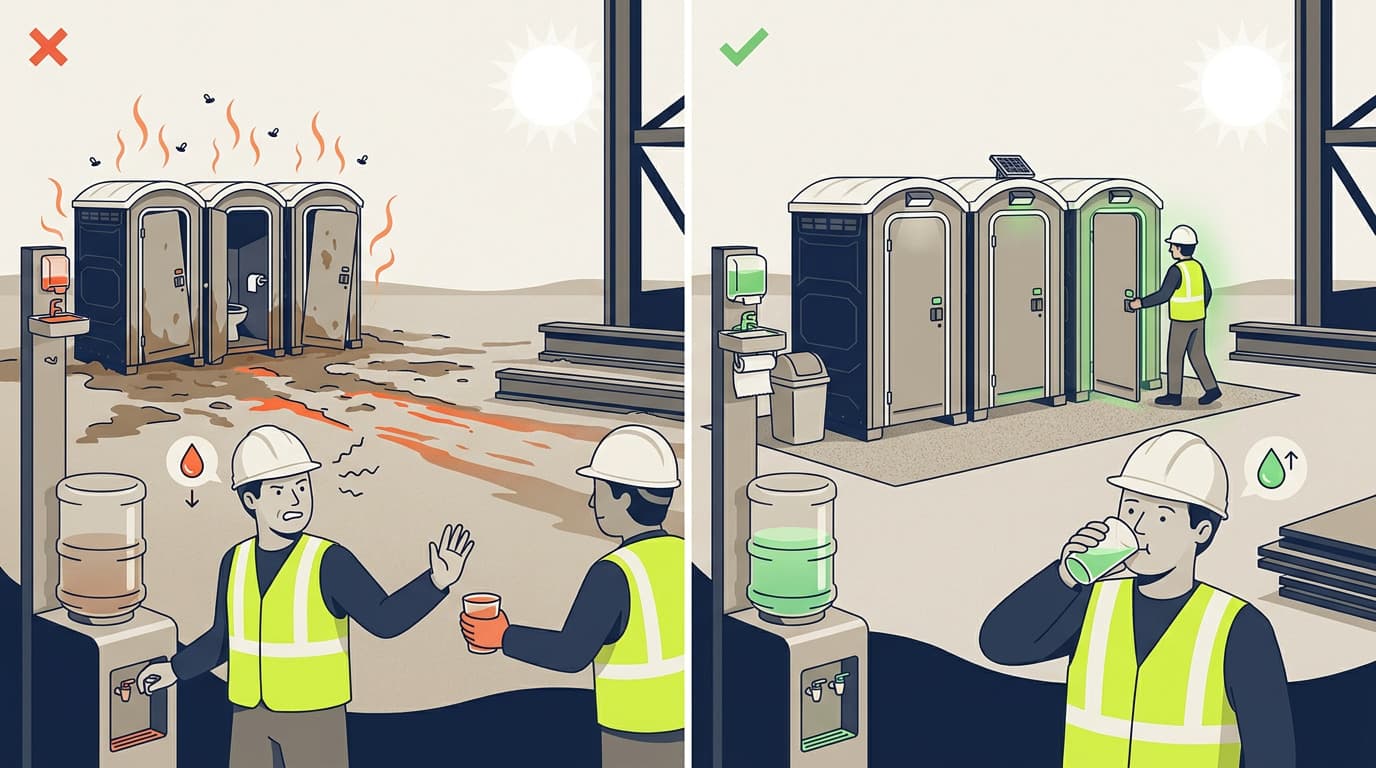
A toilet that is not maintained in a sanitary condition does not satisfy the requirement to be provided. But OSHA also noted that 1926.51(c) does not require toilet facilities to be in immaculate condition to be considered sanitary.
So the test sits between the two. Not spotless — usable. If a unit is in a condition where a reasonable worker would avoid using it, it is not doing the job the standard requires of it, and it does not count toward your Table D-1 numbers. The practical control is servicing frequency, and servicing means emptying waste and cleaning the facility, not just pumping it out.
There is a consequence people miss: workers who avoid site toilets stop drinking water. That is how a sanitation failure becomes a heat illness problem, and it is one of the more direct links between two apparently separate topics.
Washing facilities — a narrower trigger than most assume#
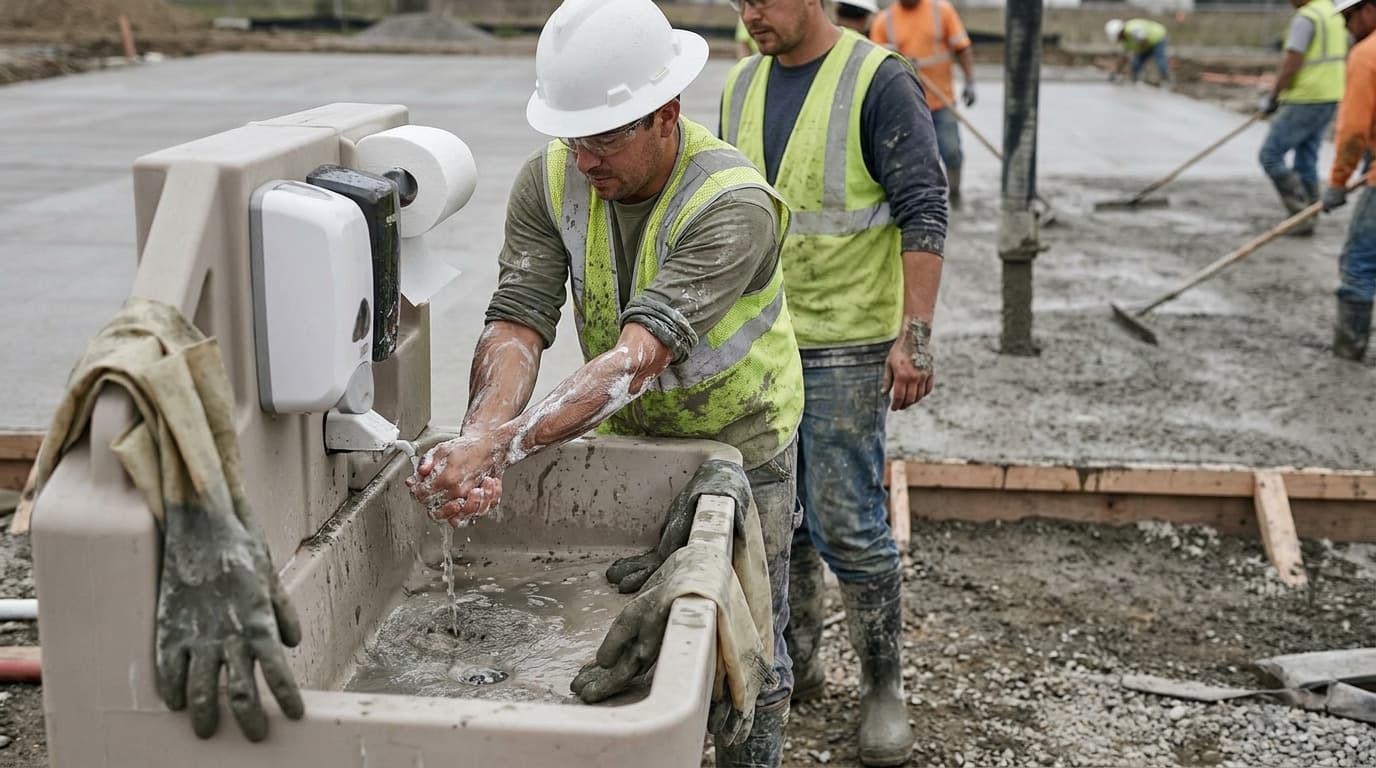
This is the provision most often misquoted. 1926.51(d)(1) requires the employer to provide adequate washing facilities for employees engaged in the application of paints, coating, herbicides, or insecticides, or in other operations where contaminants may be harmful to the employees, located in near proximity to the worksite and so equipped as to enable employees to remove such substances.
Notice what it is written around: contaminants that may be harmful. It is not, on its face, a universal handwashing requirement for every worker on every site — the breadth comes from that final clause, "or in other operations where contaminants may be harmful," which is wide enough to catch most of what construction actually does. Cement, solvents, adhesives, fuels, lead, silica and sewage are all comfortably inside it.
The practical position: if the work puts something harmful on skin, the standard requires facilities close enough to the work to remove it — and that is a much stronger requirement than one sink by the gate.
And soap and a means of drying are what make a washing facility function. Hand sanitiser is not a substitute where the contaminant is cement dust, lead or oil; it does not remove anything.
The rest of 1926.51#
Potable water — (a). An adequate supply, with portable containers capable of being tightly closed and equipped with a tap. Water shall not be dipped from containers. A common drinking cup is prohibited, and where single-service cups are used there must be a sanitary container for the unused and a receptacle for the used.
Non-potable water — (b). Outlets must be identified by signs indicating clearly that the water is unsafe and not to be used for drinking, washing or cooking, and there shall be no cross-connection, open or potential, between potable and non-potable systems.
Food handling — (e). Food service must meet applicable law and be carried out in accordance with sound hygienic principles, with food wholesome, free from spoilage and protected against contamination.
Temporary sleeping quarters — (f). Where provided, they shall be heated, ventilated and lighted.
What can go wrong?#
Units counted, not checked. The right number on paper, several of them unusable.
Servicing lapses over a long weekend or a shutdown. Then a full site returns to facilities that were adequate on Friday.
One washing station at the gate. Nowhere near where the cement, solvent or lead work is happening.
Soap and towels not restocked. The facility exists and does nothing.
Water dipped from an open container, or a shared cup in a crew truck.
Non-potable outlets unsigned. A hose is a hose until somebody drinks from it.
Facilities that some of the workforce will not use. Poor privacy, poor lighting, no sanitary disposal — which in practice excludes people rather than serving them.
People stop drinking to avoid the toilets. Dehydration by design, and heat illness follows.
How do we manage this properly?#
Count against the peak, not the average. Overlapping shifts and multiple crews mean the headcount that matters is the one at the busiest hour.
Put facilities near the work, not near the office. Distance is what determines whether they are used at all — vertically as well as horizontally on a tall structure.
Service on a schedule someone owns, with a check that includes stock levels, not just emptying.
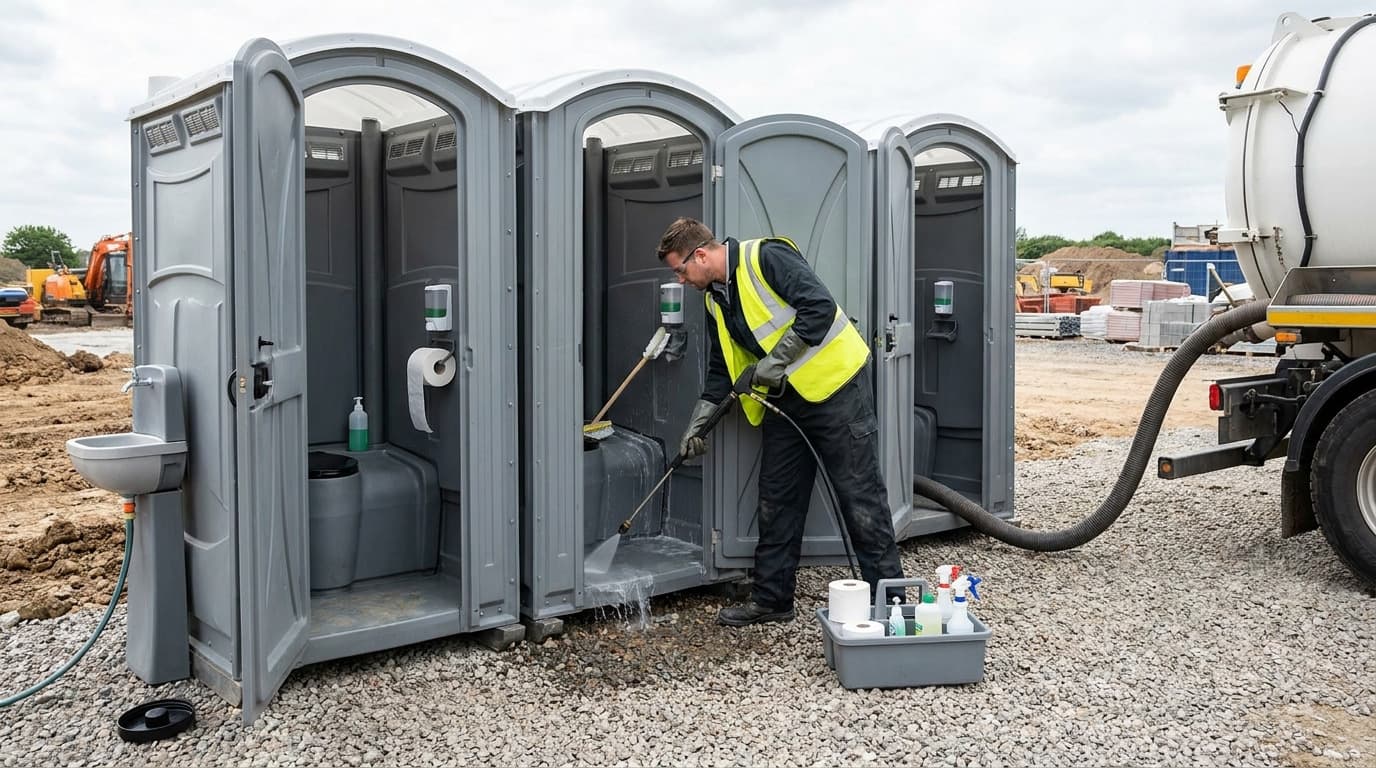
Provide soap and drying, always, and treat hand sanitiser as a supplement rather than a facility.
Put washing facilities where the contaminant is — cement, solvent, lead, silica, sewage — because 1926.51(d) requires near proximity to the worksite.
Keep potable water tapped, covered and cool, with single-service cups and no shared cup.
Sign every non-potable outlet and confirm no cross-connection exists.
Make facilities usable by everyone on the site, including privacy, lighting, hand hygiene and sanitary disposal — a facility half the workforce avoids is a facility that is not really provided.
Before you start#
- Confirm the headcount at peak and what Table D-1 requires for it.
- Confirm every unit counted is actually usable today, not just present.
- Confirm when facilities were last serviced and who owns the schedule.
- Confirm washing facilities are in near proximity to where contaminants are being handled.
- Confirm soap and a means of drying are stocked.
- Confirm potable water has a tap, is covered, and that nobody is dipping or sharing a cup.
- Confirm non-potable outlets are signed and separated from potable supply.
- Confirm whether any crew is genuinely mobile with transport readily available.
Talk it over#
- How far is the nearest toilet from where you are working — and how long does it take to get there and back?
- Would you use it right now?
- Where do you wash your hands before eating, and is there soap?
- Has anyone here drunk less water to avoid a trip to the toilet?
The bottom line#
1926.51(c)(1) Table D-1 sets the ratios: 20 or less — one facility; 20 or more — one toilet seat and one urinal per 40 workers; 200 or more — one toilet seat and one urinal per 50 workers, with (c)(2) requiring not less than one toilet facility under temporary field conditions and (c)(4) exempting mobile crews having transportation readily available to nearby toilet facilities. OSHA's position on condition is precise: an unsanitary toilet does not satisfy the requirement to be provided, but 1926.51(c) does not require toilet facilities to be in immaculate condition to be considered sanitary. (d)(1) requires adequate washing facilities in near proximity to the worksite for employees applying paints, coatings, herbicides or insecticides, or in other operations where contaminants may be harmful — the clause that pulls in cement, solvent, lead and silica work. And (a) requires potable water in closed containers with a tap, not dipped, with no common drinking cup.
Frequently asked questions about sanitation and personal hygiene#
How many toilets does a construction site need?
Table D-1 in 1926.51(c)(1) sets it: 20 employees or less — one facility; 20 or more — one toilet seat and one urinal per 40 workers; 200 or more — one toilet seat and one urinal per 50 workers. Because the bands overlap at exactly 20, the safer approach is to plan against the higher requirement.
Does a dirty portable toilet count towards the minimum?
No. OSHA has confirmed that a toilet not maintained in a sanitary condition does not satisfy the requirement that toilets be provided. It also noted, however, that 1926.51(c) does not require toilet facilities to be in immaculate condition to be considered sanitary — the test is whether the facility is genuinely usable, and servicing means emptying waste and cleaning, not just emptying.
Is there an exemption for small or mobile crews?
For mobile crews, yes. 1926.51(c)(4) provides that the requirements of paragraph (c) shall not apply to mobile crews having transportation readily available to nearby toilet facilities. It requires both conditions — a genuinely mobile crew and transport that is actually available. Under temporary field conditions, (c)(2) still requires that not less than one toilet facility be available.
When are washing facilities required?
1926.51(d)(1) requires adequate washing facilities for employees engaged in the application of paints, coating, herbicides or insecticides, or in other operations where contaminants may be harmful to the employees. That final clause is broad enough to cover cement, solvents, adhesives, fuels, lead, silica and sewage work — and the facilities must be in near proximity to the worksite and equipped to remove those substances.
Is hand sanitiser enough?
Not where the contaminant is a dust, a metal or an oil. Sanitiser does not remove cement, lead or silica from skin — it is a supplement to washing, not a replacement for it. A washing facility needs water, soap and a means of drying to do the job the standard describes.
What are the rules on drinking water?
Under 1926.51(a), an adequate supply of potable water must be provided. Portable containers must be capable of being tightly closed and equipped with a tap, water shall not be dipped from containers, the common drinking cup is prohibited, and where single-service cups are used there must be a sanitary container for unused cups and a receptacle for used ones.
Why does sanitation affect heat illness?
Because people manage their intake around the facilities. If toilets are far away, unpleasant or lack privacy, workers reduce how much they drink — which is a direct route into dehydration and heat illness. Sanitation quality and hydration are the same problem viewed from two ends.
Download the personal hygiene toolbox talk PDF#
Get this personal hygiene toolbox talk as a print-ready PDF — available in English, Spanish, Portuguese, and Turkish. Print it, hand it to the crew, and collect signatures on the included attendance sheet.
Download the PDF — free account required. New members get 3 free downloads.
Related toolbox talks#
Sources#
- OSHA, 29 CFR 1926.51 — Sanitation: https://www.osha.gov/laws-regs/regulations/standardnumber/1926/1926.51
- OSHA, Letter of Interpretation, 17 May 2006 — Whether toilets at a construction jobsite must be in a sanitary condition: https://www.osha.gov/laws-regs/standardinterpretations/2006-05-17-0
- OSHA, Letter of Interpretation, 23 February 2005 — Providing employees with toilet facilities on a construction jobsite: https://www.osha.gov/laws-regs/standardinterpretations/2005-02-23