Bloodborne Pathogens
Updated 2026-07-28
In this bundle Health & Environmental Exposure
Print-ready PDF
Download this talk as a print-ready PDF, available in 4 languages.
Almost every bloodborne pathogens talk in construction cites 29 CFR 1910.1030. It is the standard everyone knows, it is comprehensive, and on a construction site it is the wrong citation. That does not make the hazard smaller — but it does mean the duty comes from somewhere else, and knowing where changes what you actually have to do. This Bloodborne Pathogens Toolbox Talk (Safety Talk / Tailgate Talk) sets that out honestly.
Here is the distinction that carries this whole talk: the exposure does not come from the injury, it comes from the response to it. Nobody catches anything from falling off a ladder. The risk lands on the person who runs over, puts their hands on the wound, holds a dressing without gloves, and picks up the debris afterwards. The people most exposed to bloodborne pathogens on a construction site are the ones who help.
The standard everyone quotes does not apply here#
OSHA has been unusually direct about this, and it said so more than once.
The bloodborne pathogens standard, 29 CFR 1910.1030, does not apply to construction work as defined in 29 CFR 1910.12(b). OSHA stated that in response to numerous inquiries and confirmed it would amend its enforcement instruction — then CPL 2-2.44 — to say so. It does apply to employees performing maintenance activities: making or keeping a structure, fixture or foundation in proper condition in a routine, scheduled or anticipated fashion. Those are general industry activities rather than construction work, and where occupational exposure occurs they are covered by all the provisions of 1910.1030.
So the line runs between construction work and maintenance, not between industries. The same firm can be inside the standard on Tuesday and outside it on Wednesday.
OSHA was equally clear that this is not an exemption from the hazard. In its words, while the Agency announced the standard would not apply to the construction industry, it did not state that the construction industry was free from the hazards of bloodborne pathogens — and the General Duty Clause will not be used to cite for violations of the bloodborne pathogens rule, but for failure to provide a workplace free from bloodborne pathogen hazards.
A note on currency: several of these interpretation letters are held in OSHA's archive and carry a notice that they may no longer represent current policy, and the enforcement instruction they refer to has since been cancelled and revised. The construction/maintenance distinction has been stated consistently across them, but if you are writing a company procedure, verify the current position rather than relying on a talk.
What carries the duty instead#
OSHA named the construction provisions it expects employers to apply:
1926.21(b)(2) — training. The employer must instruct each employee in the recognition and avoidance of unsafe conditions and in the regulations applicable to their work environment. OSHA's own words: under this provision, the employer is required to train designated first aid providers in the hazards of bloodborne pathogens. That is the training duty, and it is not optional.
1926.25 — waste containers. Containers must be provided for the collection and separation of waste, including containers for sharps and other regulated waste which may be generated from rendering medical assistance. A jobsite that treats a used dressing or a contaminated blade like general rubbish is failing this.
1926.28 — personal protective equipment. PPE is required in all operations where there is exposure to hazardous conditions. OSHA specifically lists gloves, gowns, masks, eye protectors and resuscitation equipment as appropriate for rendering first aid or other medical assistance.
Section 5(a)(1) — the General Duty Clause. Applied where appropriate, for failure to provide a workplace free from bloodborne pathogen hazards.
And 1926.50(c) sits behind all of it: in the absence of an infirmary, clinic or hospital in near proximity used for the treatment of injured employees, a person or persons must be adequately trained to render first aid, with adequate supplies readily available.
Who is actually exposed#
The useful definition comes from 1910.1030(b), and it is worth borrowing whatever standard applies to you: occupational exposure means reasonably anticipated skin, eye, mucous membrane or parenteral contact with blood or other potentially infectious materials that may result from the performance of an employee's duties.
Two things follow.
Being trained in first aid does not, by itself, put someone in scope. OSHA has said the standard does not apply automatically to employees because they are trained in first aid, but to those required by the employer to actually administer first aid where occupational exposure may occur. The trigger is the assigned duty, not the certificate.
A designated first aid provider on a construction site is squarely in the exposed group — which is exactly why 1926.21(b)(2) requires them to be trained in these hazards.
Universal precautions, in a jobsite version#
The principle is simple and it removes every judgement call: treat all blood and body fluids as if they are infectious. No assessment of the injured person, no assumptions, no exceptions for people you know.
Gloves before contact — always. The single control that does most of the work. Keep them where the first aid kit is, not in a store.
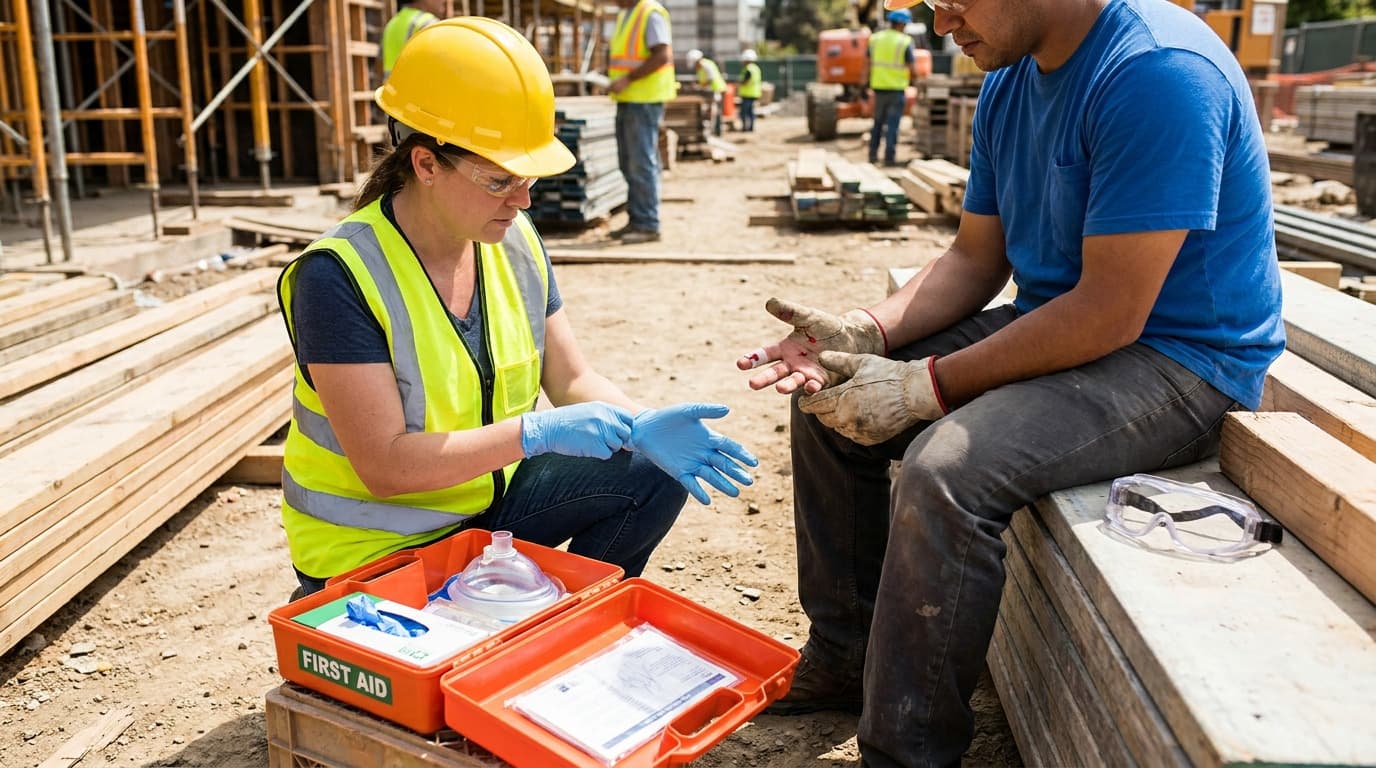
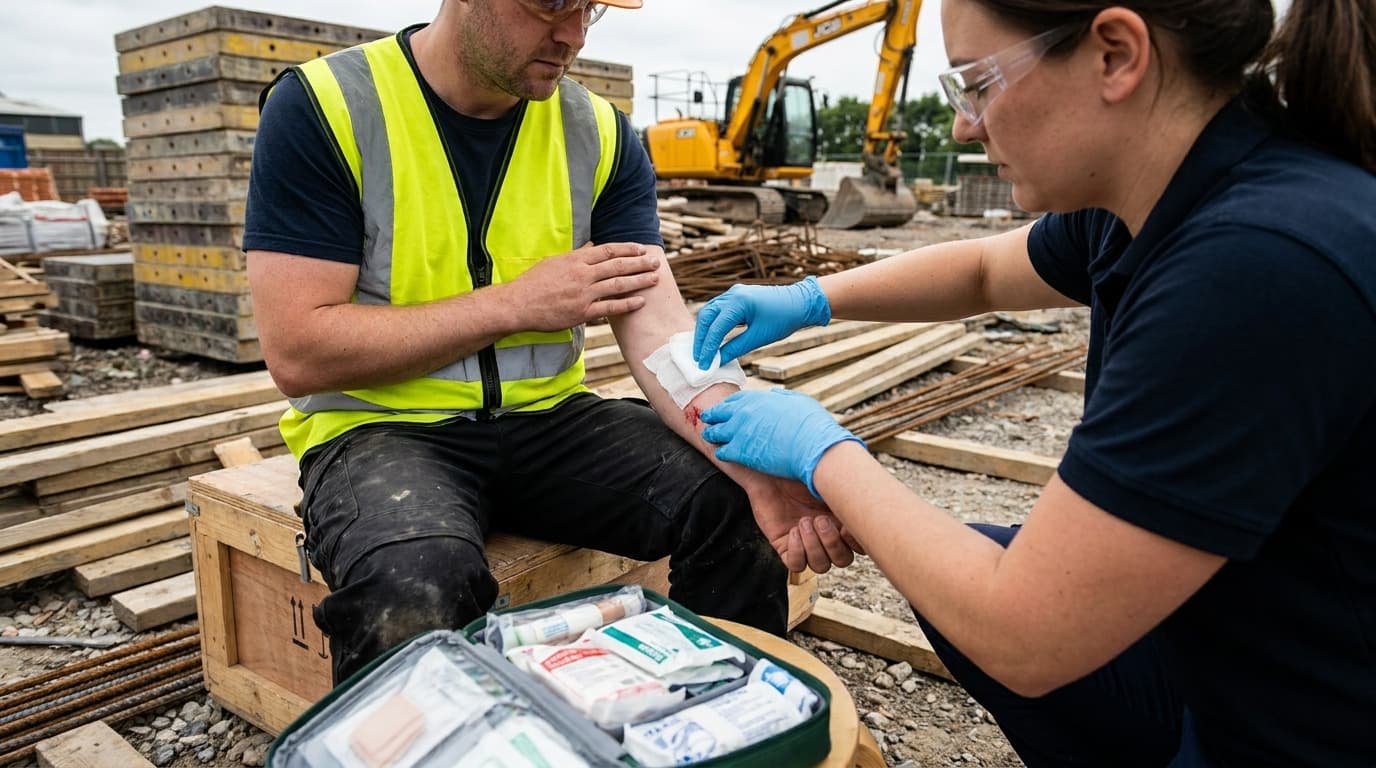
Eye and face protection where blood may splash or spray. Arterial bleeding and airway work both produce it.
Use a barrier device for rescue breathing, and have resuscitation equipment where it can be reached.
Do not pick up sharps by hand. Broken glass, blades, contaminated fixings — use tools, and put them in a proper sharps container, not a bin bag.
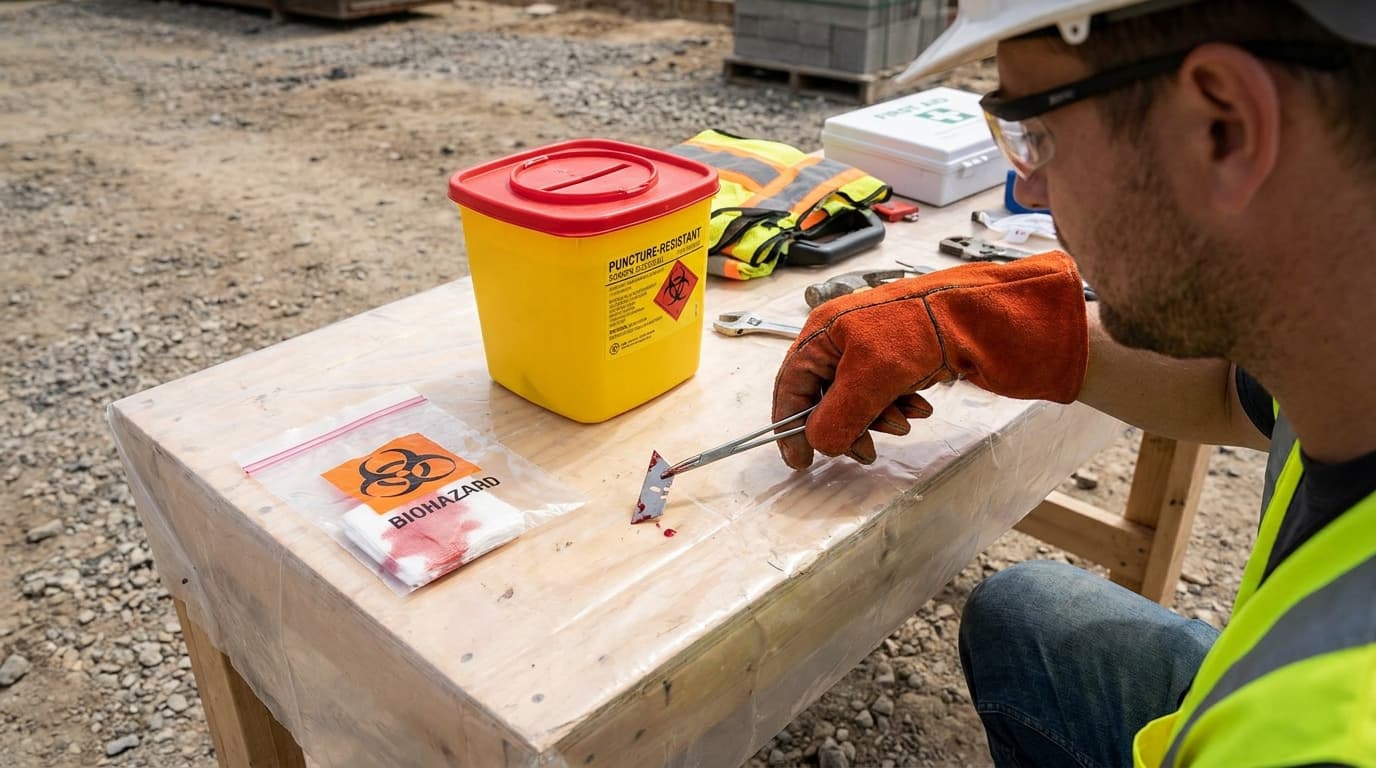
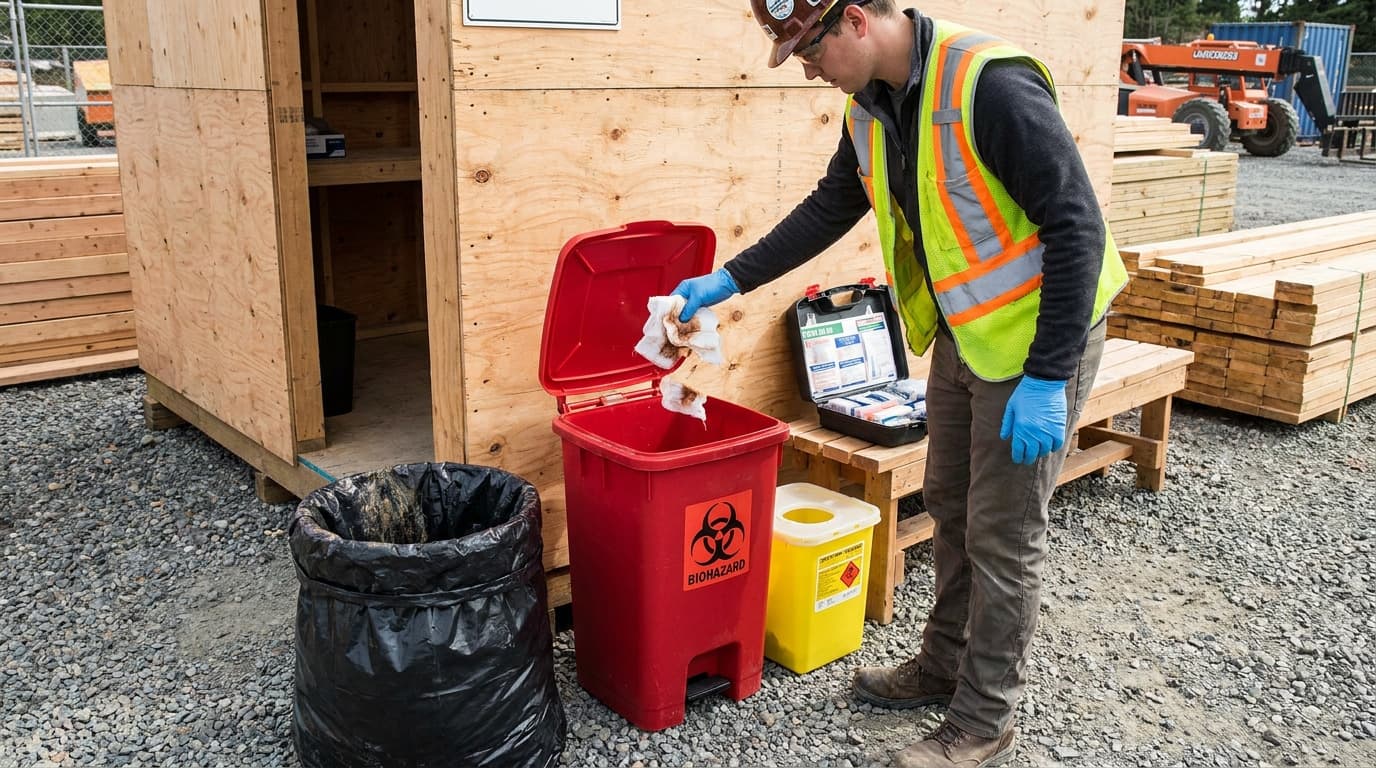
Contain and clean up properly. Contaminated dressings, clothing and materials go into the containers 1926.25 requires, not into general waste.
Cover your own breaks in the skin before you help anyone. Cuts, cracked skin and grazes are entry points.
Wash immediately and thoroughly after any contact — soap and running water, for long enough.
Report every exposure incident, immediately. Needle stick, splash to the eye, blood to broken skin — reporting starts a clock on medical evaluation that only runs if somebody knows.
What can go wrong?#
Someone helps bare-handed. The most common exposure on any site, and it happens because helping is instinctive and gloves are elsewhere.
Gloves are in the office and the accident is on level six.
Sharps go in the bin bag. The next exposure is the person who empties it.
Contaminated clothing is worn on. Or taken home.
Nobody reports it. No exposure incident, no medical evaluation, no record — and the window for post-exposure assessment closes quietly.
"I know him, he's fine." Universal precautions exist precisely because that judgement cannot be made.
Rescue breathing without a barrier.
The kit is empty. Gloves used and never replaced, so the next responder has nothing.
Before you start#
- Confirm who the designated first aid providers are on this site today.
- Confirm they have been trained in the hazards of bloodborne pathogens, not just in first aid technique.
- Confirm where the first aid kit is and that it contains gloves, barrier device and eye protection.
- Confirm gloves are reachable from the work area, not only from the office.
- Confirm there is a sharps container and a route for contaminated waste.
- Confirm everyone knows to treat all blood as infectious, without exception.
- Confirm everyone knows to report any exposure immediately, and to whom.
- Confirm whether today's work is construction or maintenance — it changes which standard applies.
Talk it over#
- If someone opened a hand on that rebar right now, who would go over — and would they have gloves?
- Where is the nearest pair of gloves to where you are standing?
- What happens to a bloodied dressing on this site?
- Has anyone ever helped at an accident bare-handed? What would you do differently?
The bottom line#
29 CFR 1910.1030 does not apply to construction work as defined in 1910.12(b) — OSHA said so directly and amended its enforcement instruction accordingly — but it does apply to maintenance activities, which are general industry work. The hazard is not exempted; the duty is relocated. In construction it runs through 1926.21(b)(2), under which OSHA states the employer is required to train designated first aid providers in the hazards of bloodborne pathogens; 1926.25, requiring containers for waste including sharps generated from rendering medical assistance; 1926.28, requiring gloves, gowns, masks, eye protectors and resuscitation equipment where appropriate; and Section 5(a)(1), applied not for breaching the bloodborne rule but for failing to provide a workplace free from the hazard. The working rule on site is unchanged: treat all blood as infectious, glove up before contact, never handle sharps by hand, and report every exposure immediately.
Frequently asked questions about bloodborne pathogens#
Does OSHA's bloodborne pathogens standard apply to construction?
Not to construction work. OSHA has stated that the bloodborne pathogens standard, 29 CFR 1910.1030, does not apply to construction work as defined in 29 CFR 1910.12(b), and said it would amend its enforcement instruction to state that. It does apply to employees performing maintenance activities — keeping a structure, fixture or foundation in proper condition in a routine, scheduled or anticipated fashion — because those are general industry activities.
So is construction exempt from the hazard?
No, and OSHA addressed that misconception directly: while the Agency announced the standard would not apply to the construction industry, it did not state that the construction industry was free from the hazards of bloodborne pathogens. The General Duty Clause will not be used to cite for violations of the bloodborne pathogens rule, but for failure to provide a workplace free from bloodborne pathogen hazards.
What training is required in construction?
Training of designated first aid providers. OSHA states that under 29 CFR 1926.21(b)(2) — which requires employers to instruct each employee in recognising and avoiding unsafe conditions — the employer is required to train designated first aid providers in the hazards of bloodborne pathogens.
What do we do with contaminated waste and sharps?
Contain them properly. 29 CFR 1926.25 requires containers for the collection and separation of waste, and OSHA has confirmed this includes containers for sharps and other regulated waste which may be generated from rendering medical assistance. Contaminated dressings and sharps do not belong in general site waste.
What PPE should first aid providers have?
29 CFR 1926.28 requires PPE wherever there is exposure to hazardous conditions, and OSHA has listed gloves, gowns, masks, eye protectors and resuscitation equipment as appropriate for rendering first aid or other medical assistance. Gloves and a barrier device are the minimum, and they need to be where the work is.
Does being first aid trained make someone covered?
Not by itself. OSHA has stated that the standard does not apply automatically to employees because they are trained in first aid, but rather to those required by the employer to actually administer first aid in instances where occupational exposure may occur. The trigger is the assigned duty.
What are universal precautions?
Treating all blood and other potentially infectious materials as if they are infectious, regardless of who the person is or what is known about them. It removes the judgement call entirely — gloves before contact, eye protection where splashing is possible, a barrier device for rescue breathing, no bare-handed handling of sharps, and immediate reporting of any exposure.
Download the bloodborne pathogens toolbox talk PDF#
Get this bloodborne pathogens toolbox talk as a print-ready PDF — available in English, Spanish, Portuguese, and Turkish. Print it, hand it to the crew, and collect signatures on the included attendance sheet.
Download the PDF — free account required. New members get 3 free downloads.
Related toolbox talks#
Sources#
- OSHA, Letter of Interpretation, 13 May 1994 — Bloodborne pathogens standard applies to employees performing maintenance activities: https://www.osha.gov/laws-regs/standardinterpretations/1994-05-13
- OSHA, Letter of Interpretation, 23 March 1993 — Construction industry general duty clause, and the bloodborne pathogens standard: https://www.osha.gov/laws-regs/standardinterpretations/1993-03-23
- OSHA, Letter of Interpretation, 26 January 1993 — Bloodborne pathogens standard and the construction industry: https://www.osha.gov/laws-regs/standardinterpretations/1993-01-26
This talk summarises published regulatory interpretations, some of which are held in OSHA's archive and may not represent current policy — verify before writing procedure. It is not medical advice. Any exposure incident requires prompt medical evaluation by a qualified health care professional.
Written by FieldSafetyTalk's safety professional — a CSP, ASP, CHST and OSHA Authorized Outreach Trainer with 14+ years of international construction safety experience across federal, heavy civil, and industrial projects.