Asbestos Awareness
Updated 2026-07-31
In this bundle Health & Environmental Exposure
Working in California? See the Cal/OSHA edition → California (Cal/OSHA)Working in Washington? See the WA DOSH edition → Washington (WA DOSH)
Print-ready PDF
Download this talk as a print-ready PDF, available in 4 languages.
Asbestos is the hazard where the ordinary construction instinct is exactly wrong. Everywhere else, a competent worker looks at a material and decides how to handle it. Here, looking tells you almost nothing — asbestos was mixed into dozens of products that look like their non-asbestos equivalents, and the fibres that cause the harm are far too small to see. This Asbestos Awareness Toolbox Talk (Safety Talk / Tailgate Talk) is about what to assume, what to stop for, and what the standard actually presumes on your behalf.
Here is the distinction that carries this whole talk: the standard presumes against you, and the presumption is written into the definitions. Under 1926.1101, thermal system insulation and surfacing material in buildings constructed no later than 1980 are presumed asbestos-containing material — PACM — unless testing rebuts it. You do not have to prove a material is asbestos before treating it as asbestos. The burden runs the other way.
The numbers, and the one that is missing#
PEL — time-weighted average limit. No employee exposed above 0.1 fibre per cubic centimetre of air as an 8-hour TWA.
Excursion limit. No employee exposed above 1.0 fibre per cubic centimetre averaged over a 30-minute sampling period.
Both of these are PELs. The excursion limit is not a guideline sitting under the main figure — it is a second limit in its own right, and it is the one that catches short, intense tasks that average out to nothing over a shift.
Now the part worth knowing, because it distinguishes asbestos from every other exposure topic in this library: there is no action level. Lead has one at 30 µg/m³. Silica has one at 25 µg/m³. Asbestos has none — and OSHA's stated reason is that the sampling and analytical method is not reliable below the time-weighted average limit of 0.1 f/cc.
That is worth sitting with. The measurement cannot see clearly below the limit, which is precisely why the standard leans so heavily on presumption, classification and work practice rather than on going and taking a reading.
PACM: what is presumed, and where#
Thermal system insulation (TSI) — material applied to pipes, fittings, boilers, breeching, tanks, ducts or other structural components to prevent heat loss or gain. Pipe lagging, boiler insulation, duct wrap.
Surfacing material — sprayed or troweled onto surfaces: fireproofing, acoustic and decorative coatings, textured finishes.
In buildings constructed no later than 1980, both are presumed to contain asbestos. "Asbestos-containing" means more than 1% asbestos.
Beyond the presumed categories, asbestos turns up across a building: floor tiles and the black mastic under them, roofing felt and shingles, asbestos-cement sheet and pipe, gaskets, rope seals, fire doors, textured ceiling coatings, and window putty.
Two practical points follow.
A 1980s or 1990s refurbishment does not clear an older building. New finishes get installed over old materials constantly. The ceiling is new; what is above it may not be.
Building owners hold information you need. The standard assigns owners specific duties to convey information about installed materials, precisely because they are often the only source. Ask before you cut.
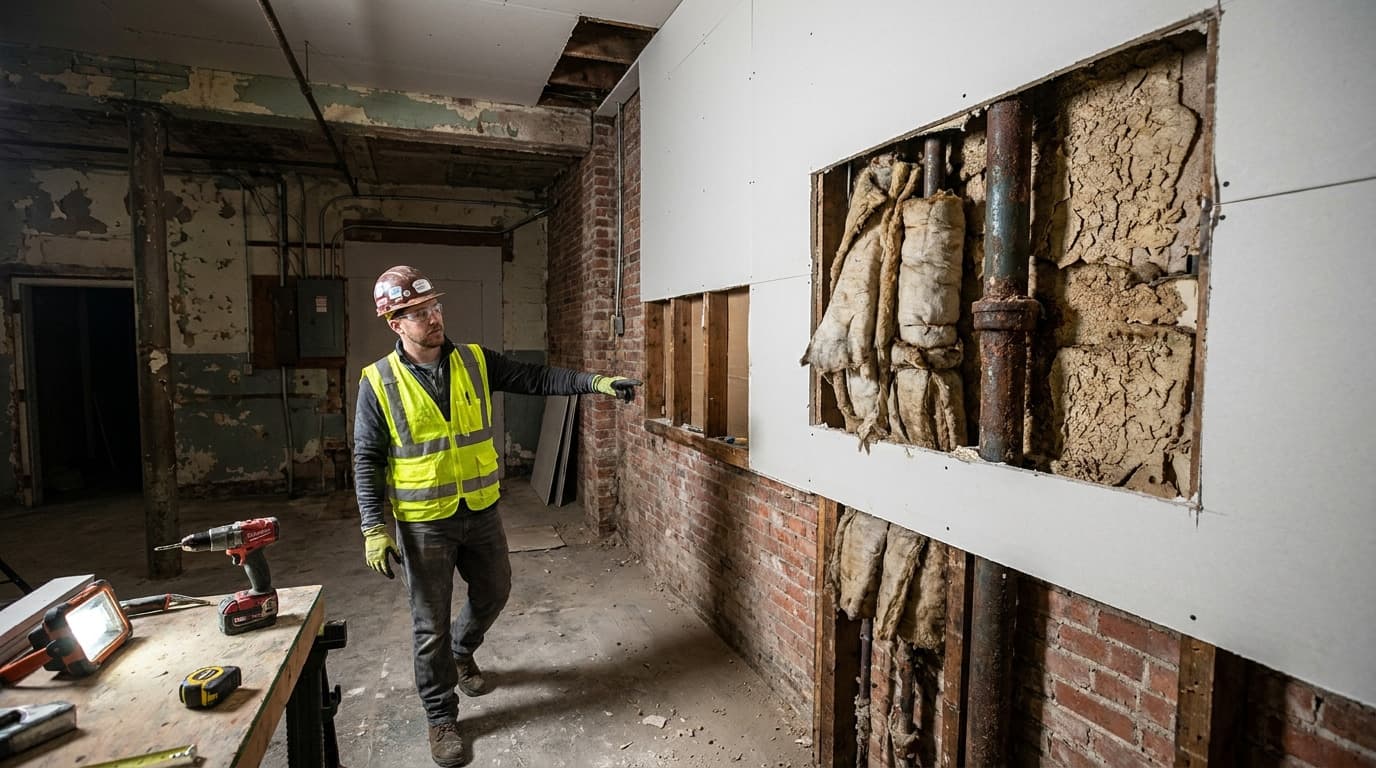
Friable, non-friable, and why "intact" is not "safe"#
This is where people get hurt doing ordinary work.
Friable material readily releases fibres if disturbed. Sprayed-on fireproofing, insulation and sound-proofing are friable and will release airborne fibres readily.
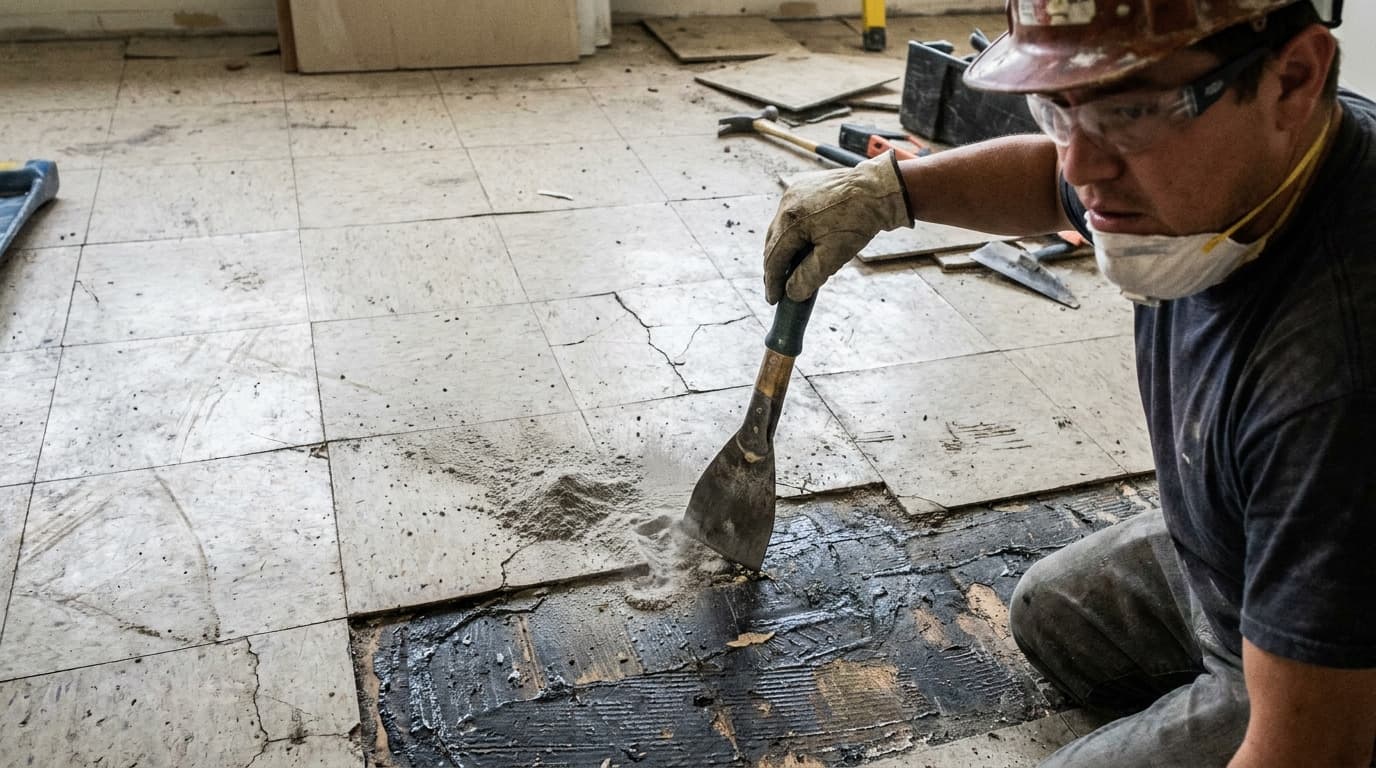
Non-friable material — vinyl-asbestos floor tile, roofing felt — is considered non-friable if intact, and generally does not emit airborne fibres in that state.
Then comes the sentence that matters on site: those materials release fibres when subjected to sanding, sawing and other aggressive operations, and asbestos-cement pipe or sheet can emit airborne fibres if cut or sawed, or if broken.
So non-friable describes a condition, not a property. A floor tile that has sat harmlessly for forty years becomes a fibre source the moment a grinder touches it. Intact is a state you can destroy in one second with a power tool, and most accidental exposures happen exactly that way — during demolition, drilling, chasing, cutting or breaking out, by someone who was not doing asbestos work at all.
The four classes#
The standard sorts work by what is being disturbed, and each class carries different requirements for regulated areas, enclosures, respirators and competent person oversight:
Class I — the most hazardous: removal of TSI and surfacing ACM or PACM.
Class II — removal of other types of ACM: floor tile, roofing, siding, wallboard.
Class III — repair and maintenance operations where ACM or PACM is likely to be disturbed.
Class IV — custodial work: cleaning up asbestos-containing waste and debris.
Note that Class IV is still asbestos work. Sweeping up after somebody else is inside the standard, which is exactly the situation general labourers most often find themselves in without realising it.
Competent person, and what awareness training is not#
The competent person must meet 1926.32(f) — capable of identifying existing asbestos hazards and selecting the appropriate control strategy, with authority to take prompt corrective action — and must additionally be specially trained: for Class I and II, a course meeting the criteria of EPA's Model Accreditation Plan for supervisors; for Class III and IV, a course meeting EPA requirements for maintenance and custodial staff.
Be clear about what this talk is. Awareness training is not a licence to disturb asbestos. It qualifies you to recognise the possibility and stop. Removal is licensed, trained, regulated work, and the correct response to finding suspected asbestos is not to deal with it carefully — it is to leave it alone and report it.
And on multi-employer sites, an employer whose work requires a regulated area must inform other employers of the nature of the work and the requirements attaching to that area. On a busy site, other trades will not know unless they are told.
What can go wrong?#
Drilling or chasing a wall in an older building with no check on what is behind it.
Cutting asbestos-cement sheet or pipe with a power saw, which is one of the most efficient fibre generators there is.
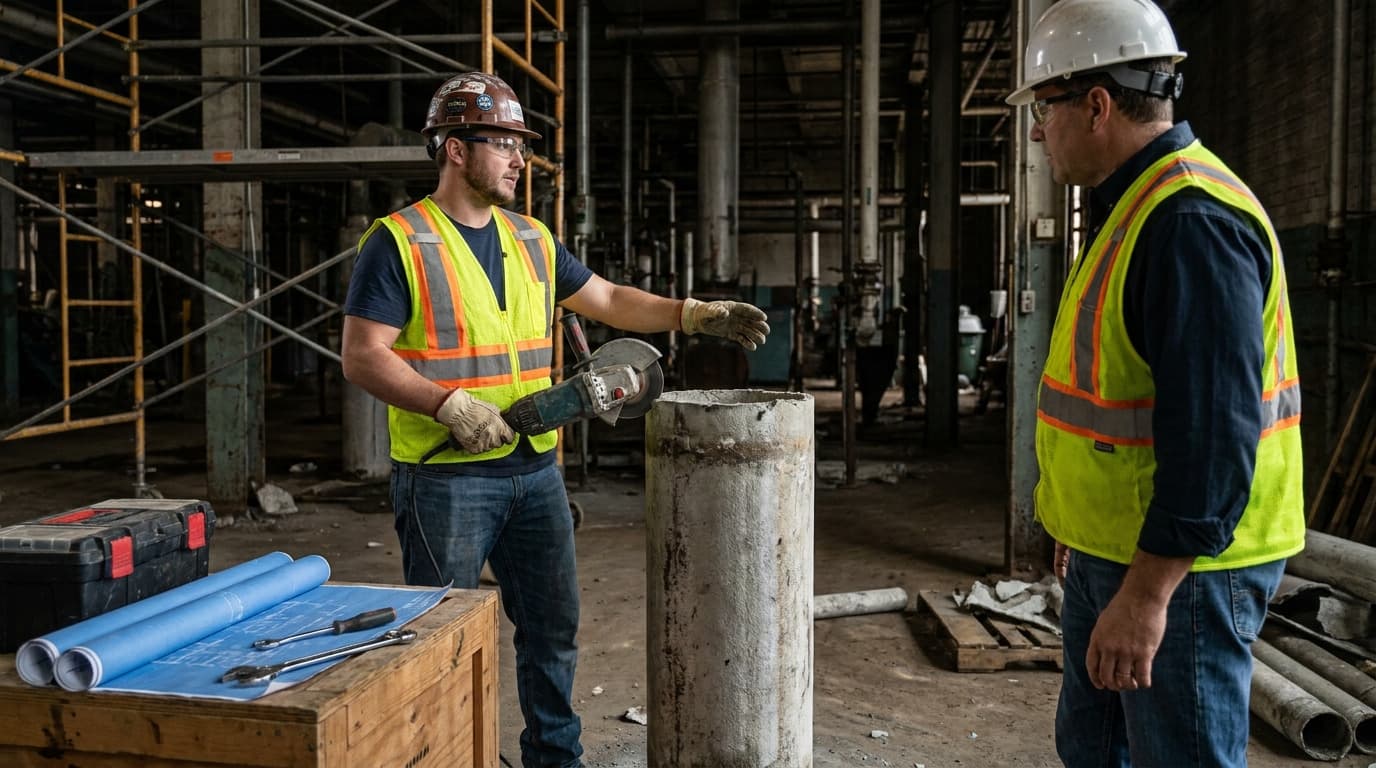
Lifting or grinding old floor tiles and the black mastic beneath them.
Assuming a refurbished building is clear, when only the surface finishes are new.
Sweeping up debris — Class IV work — with no idea it is regulated.
A "small job" treated as too minor to stop for.
Damaged pipe lagging walked past for weeks because it has always looked like that.
Dust carried home on clothing, the same take-home route as lead.
How do we manage this properly?#
Establish the building's age and get the survey information before work starts. Owners hold duties to provide it.
Treat pre-1981 TSI and surfacing material as PACM unless testing has rebutted it.
Stop and report anything suspicious. Nobody on a crew is expected to identify asbestos by eye, and stopping costs almost nothing compared with the alternative.
Never sand, saw, grind, drill or break suspect material. If it is intact, the single most valuable thing you can do is leave it intact.
Never use compressed air to clean up dust, and never dry sweep — HEPA vacuum and wet methods only.
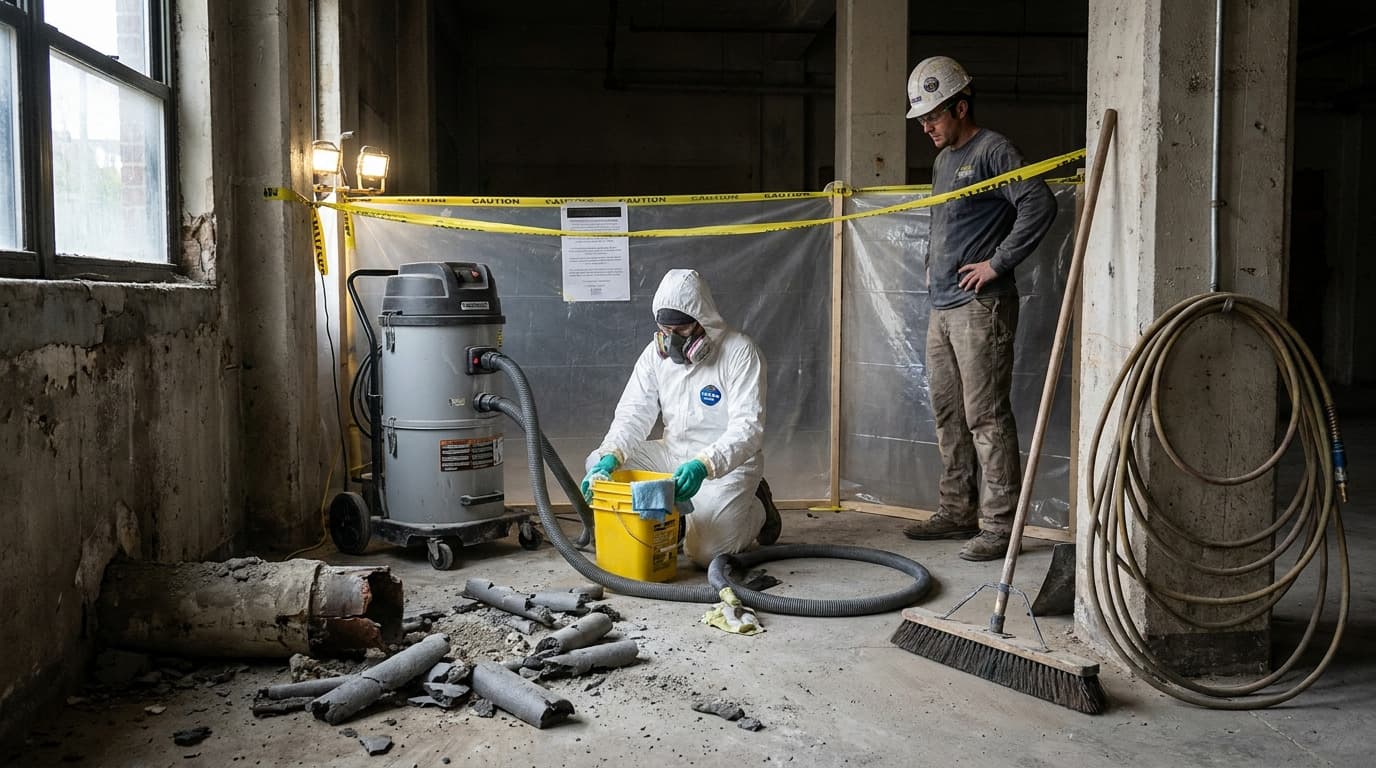
Respect regulated areas and the signage, and expect to be told when one is established near you.
Remember Class IV is asbestos work, and do not let cleanup be handed to whoever is free.
Keep it off your clothes, for the same reason as lead — the exposure follows you home.
And if it has already been disturbed, stop everything and get advice. Continuing while somebody decides is the worst available option.
Before you start#
- Confirm the age of the building and whether pre-1981 applies.
- Confirm whether an asbestos survey exists and whether you have seen it.
- Confirm whether anything you will drill, cut, chase or break out has been checked.
- Confirm what pipe lagging, ceiling coating or floor covering is present in your area.
- Confirm whether any regulated area has been established near where you are working.
- Confirm you know who to report suspected material to, and that stopping is expected.
- Confirm nobody is being asked to clean up debris without knowing what it is.
- Confirm how you will avoid carrying dust home.
Talk it over#
- How old is this building, and has anyone seen a survey?
- What is above the ceiling tiles in this area?
- Who would you tell if you found damaged pipe lagging right now?
- Has anyone here ever cut into something and then wondered what it was?
The bottom line#
The standard presumes against you. Under 1926.1101, thermal system insulation and surfacing material in buildings constructed no later than 1980 are presumed asbestos-containing material (PACM) unless testing rebuts it — you do not have to prove it is asbestos before treating it as asbestos. The limits are 0.1 f/cc as an 8-hour TWA and an excursion limit of 1.0 f/cc over 30 minutes, and both are PELs. There is no action level, because the sampling and analytical method is not reliable below 0.1 f/cc — which is exactly why the standard relies on presumption, classification and work practice instead of readings. Asbestos-containing means more than 1% asbestos, and beyond the presumed categories it appears in floor tile and mastic, roofing, asbestos-cement sheet and pipe, gaskets, rope seals, fire doors, textured coatings and putty. Critically, non-friable is a condition, not a property: vinyl-asbestos tile and roofing felt are non-friable while intact and release fibres when sanded, sawed or broken — and cement sheet or pipe emits fibres if cut or broken. Work is sorted into four classes, and Class IV custodial cleanup is still asbestos work. Finally: awareness training is not a licence to disturb it. It qualifies you to recognise the possibility and stop.
Frequently asked questions about asbestos awareness#
What is PACM and which materials are presumed?
Presumed Asbestos-Containing Material. Under 1926.1101, thermal system insulation — material on pipes, fittings, boilers, breeching, tanks, ducts or other structural components to prevent heat loss or gain — and surfacing material such as sprayed or troweled fireproofing and acoustic coatings are presumed to contain asbestos in buildings constructed no later than 1980, unless testing rebuts the presumption.
What are the exposure limits?
0.1 fibre per cubic centimetre of air as an 8-hour time-weighted average, and an excursion limit of 1.0 f/cc averaged over a 30-minute sampling period. Both are PELs — the excursion limit is a limit in its own right, not a guideline, and it is the one that catches short intense tasks that would average out to nothing across a full shift.
Why is there no action level for asbestos?
Because the measurement cannot reliably see below the limit. OSHA's stated reason is that the sampling and analytical method is not reliable below the time-weighted average limit of 0.1 f/cc. That is why the standard leans on presumption, work classification and prescribed work practices rather than on taking a reading and deciding from it — a genuine difference from lead and silica, which both have action levels.
If a material is intact, is it safe to work around?
Around, often yes. Into, no. Non-friable describes a condition, not a property: vinyl-asbestos floor tile and roofing felt are non-friable while intact and generally do not emit fibres, but they release them when subjected to sanding, sawing and other aggressive operations — and asbestos-cement pipe or sheet emits fibres if cut, sawed or broken. Intact is a state a power tool can destroy in one second.
What are the four classes of asbestos work?
Class I — removal of TSI and surfacing ACM or PACM, the most hazardous. Class II — removal of other ACM such as floor tile, roofing, siding and wallboard. Class III — repair and maintenance where ACM or PACM is likely to be disturbed. Class IV — custodial cleanup of asbestos-containing waste and debris. Each triggers different requirements, and Class IV is still asbestos work.
Does awareness training let me remove asbestos?
No. Awareness training qualifies you to recognise the possibility and stop — nothing more. Removal is licensed, trained and regulated work performed under a competent person who meets 1926.32(f) and holds specific accredited training. The correct response to suspected asbestos is not to handle it carefully; it is to leave it alone and report it.
The building was refurbished in the 1990s — is it clear?
Not necessarily, and this is a common and costly assumption. New finishes are routinely installed over older materials, so the ceiling, floor covering or boxing may be recent while what sits behind or above it is not. Establish the original construction date, obtain the survey information the building owner holds duties to provide, and check before drilling, cutting or breaking out.
Download the asbestos awareness toolbox talk PDF#
Get this asbestos awareness toolbox talk as a print-ready PDF — available in English, Spanish, Portuguese, and Turkish. Print it, hand it to the crew, and collect signatures on the included attendance sheet.
Download the PDF — free account required. New members get 3 free downloads.
Related toolbox talks#
Sources#
- OSHA, 29 CFR 1926.1101 — Asbestos: https://www.osha.gov/laws-regs/regulations/standardnumber/1926/1926.1101
- OSHA, Significant Changes in the Asbestos Standard for Construction: https://www.osha.gov/training/library/asbestos/construction
- OSHA, 1926.1101 App H — Substance Technical Information for Asbestos: https://www.osha.gov/laws-regs/regulations/standardnumber/1926/1926.1101AppH
This talk is awareness-level guidance only. It does not qualify anyone to disturb, handle, remove or dispose of asbestos-containing material, all of which is licensed and regulated work. Suspected asbestos must be left undisturbed and reported. Anyone concerned about a past exposure should speak to a physician.
Written by FieldSafetyTalk's safety professional — a CSP, ASP, CHST and OSHA Authorized Outreach Trainer with 14+ years of international construction safety experience across federal, heavy civil, and industrial projects.