Hydration
Updated 2026-08-06
In this bundle Health & Environmental Exposure
Print-ready PDF
Download this talk as a print-ready PDF, available in 4 languages.
Everyone on a crew knows to drink water when it is hot. The problem is not knowing that — it is the timing, and the belief that your body will tell you when you need it. This hydration talk is about why that belief is wrong, why the way most people drink on a jobsite leaves them behind all day, and why the fix is not simply "drink more."
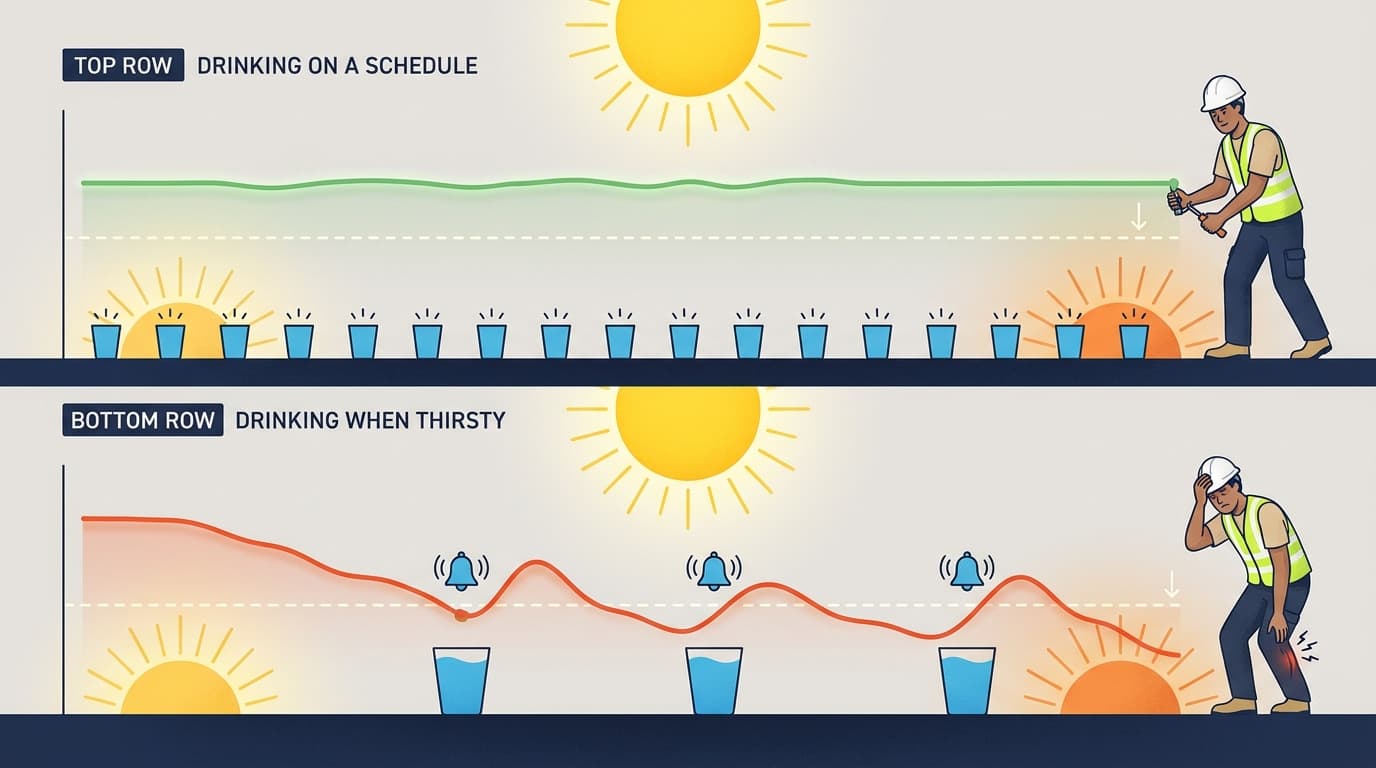
Here is the distinction that carries this whole talk: your body asks for water too late to protect you — thirst is the alarm going off after the damage has already started. By the time you feel thirsty, you are already measurably dehydrated, and on a hot shift you never catch up by drinking only when thirst tells you to — you spend the whole day a step behind. That is why hydration is not something you do in response to a feeling; it is something you do on a schedule, before the feeling arrives. And there is a second half most people miss: more is not always better. Hydration is a balance, not a maximum. Drinking large amounts of plain water over a long, sweaty shift can dilute the body's salts to a dangerous level, which is its own life-threatening problem. So the real skill is drinking steadily and replacing what you sweat out — not chugging, not waiting, and not drowning the problem in plain water.
Where the boundary of this talk sits#
The heat stress talk owns the body overheating — heat exhaustion, heat stroke, and cooling down. The sun and UV talk owns the sun's radiation. The cold stress talk owns the cold. This talk owns hydration itself — fluid and electrolyte balance as its own system: how much to drink, when, what, and the fact that both too little and too much are dangerous. Dehydration is closely tied to heat, but it is not only a heat problem — you can dehydrate in the cold and in dry air too — so it earns its own talk. Where the question is the body overheating or the sun's rays, those talks own it; this one owns the water and salts going in and out.
Thirst is a lagging indicator#
The single most important fact about hydration is that thirst does not show up on time. It is a lagging indicator — by the time you feel it, fluid loss is already underway and your performance and safety have already started to slip. OSHA's own heat guidance says it plainly: thirst cannot be relied on as a guide to how much water you need. This matters on a jobsite because the natural rhythm — work until you notice you are thirsty, then go get a drink — guarantees you are always drinking to catch up rather than to stay ahead. On a hot day with heavy sweating, that gap never closes, and a worker who is even mildly dehydrated is more likely to make an error, move slower, and slide toward heat illness.
The replacement for thirst is a schedule. OSHA and NIOSH both recommend drinking about one cup (8 ounces) of cool water every 15 to 20 minutes while working in the heat — roughly a quart an hour — whether or not you feel thirsty. The point of the interval is to take thirst out of the decision entirely: you drink because it is time, not because you finally noticed. Small, frequent amounts work better than occasionally gulping a large volume, because the body absorbs a steady trickle better than a flood.
Water alone is not always enough — and can be too much#
Here is where hydration gets more interesting than "drink water," and where the second insight lives. When you sweat, you lose more than water — you lose electrolytes, the salts like sodium and potassium your body needs to function. For short jobs, cool water is enough. But for work lasting two hours or more, or any job with heavy sweating, water alone does not replace what you have lost: OSHA's guidance is to add electrolyte-containing fluids, because water cannot replace electrolytes and a substantial loss of them causes muscle cramps and worse. Scheduled meal breaks help too, since food replaces salts.
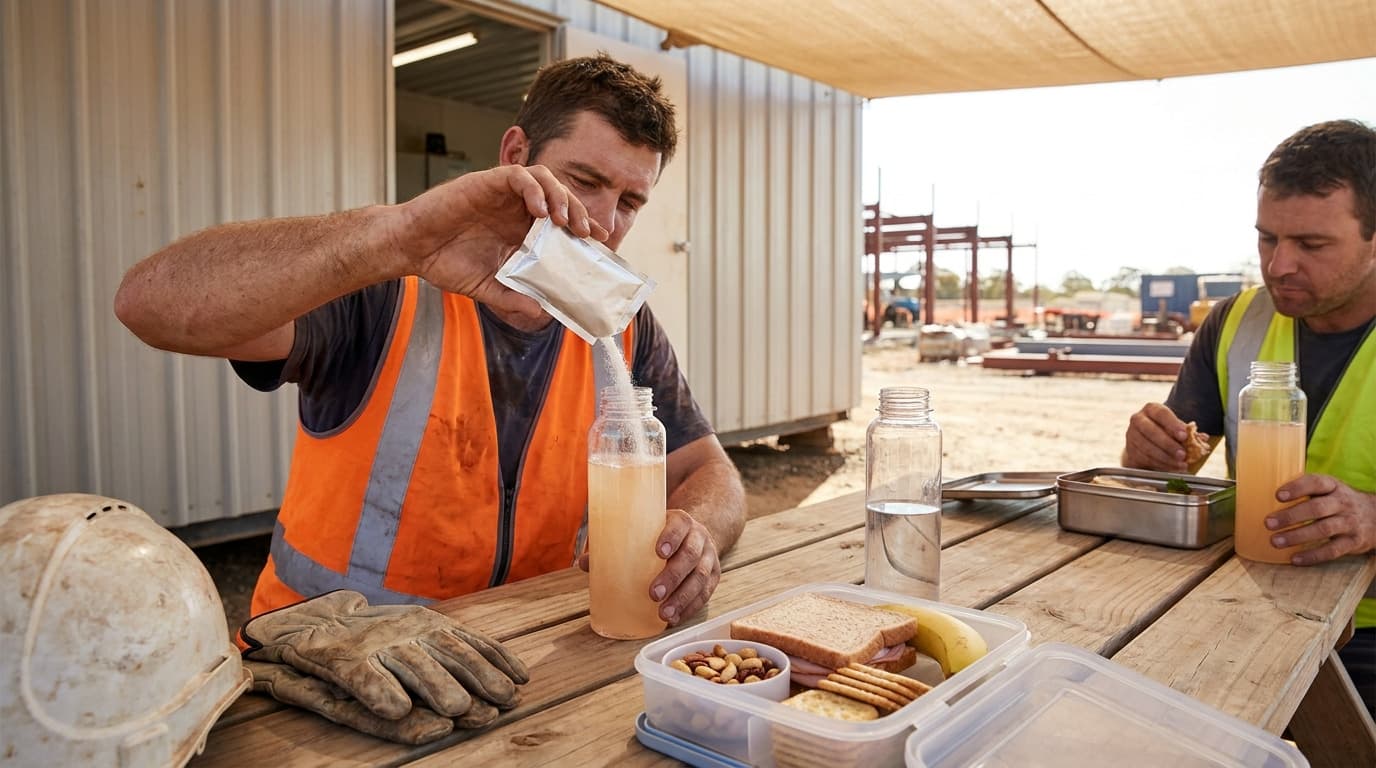
And then the counterintuitive part: you can drink too much plain water. Flooding your body with water while sweating out salts, and never replacing the salts, can dilute your blood sodium to a dangerous level — a condition called hyponatremia, or water intoxication, which is life-threatening and can look like heat illness. This is the real reason electrolytes matter: they protect you from both sides — dehydration and over-hydration. The practical guardrails are simple: do not exceed roughly 48 ounces (about 1.5 quarts) per hour; on long or heavy-sweat jobs, use balanced electrolyte drinks or pair water with salted snacks and meals; skip salt tablets unless a doctor directs them; and avoid energy drinks, high-caffeine drinks, and alcohol, all of which work against you. Hydration is a balance you hold through the shift, not a number you try to maximize.
Reading your own hydration#
You do not need a lab to tell whether you are keeping up. The most practical self-check on a jobsite is urine color: pale, like light lemonade, means you are well hydrated; dark, like apple juice, means you are behind and need to catch up. Alongside that, learn the early signs of dehydration so you catch it before it becomes heat illness — thirst (already late), dry mouth, headache, dizziness or lightheadedness, fatigue, dark urine, and muscle cramps. Cramps in particular are a signal that electrolytes, not just water, are running low. The habit worth building is checking these on yourself and looking out for them in the crew, because a dehydrated worker often does not notice the slide themselves — someone else spots the confusion, the stumble, or the stopped sweating first.
Where the duty sits#
Hydration sits inside the employer's duty to protect workers from heat, and it has both a specific water rule and the general duty behind it.
There is no numbered "hydration standard," but OSHA construction sanitation rules, 1926.51, require the employer to provide potable drinking water, accessible and in adequate supply. Beyond that, protection from heat-related illness — of which dehydration is the entry point — runs through the General Duty Clause, Section 5(a)(1), since heat is a recognized hazard. The practical framework is OSHA's Water. Rest. Shade. campaign and the joint OSHA-NIOSH heat guidance: cool water available and drunk on a schedule, rest breaks, and shade to cool down. OSHA has been strengthening its heat-illness enforcement, so expect the expectations here to be firm and, on some sites, formalized in a written heat-illness-prevention plan. On federal contract work, EM 385-1-1 carries heat and hydration provisions. Where a state heat rule or a contract sets specific requirements — scheduled water, mandatory breaks, acclimatization — those govern.
What can go wrong?#
- A worker drinks only when thirsty and spends the whole shift a step behind on fluids.
- Heavy sweating over a long shift is replaced with plain water only, and electrolytes run low.
- Muscle cramps set in because salts, not just water, were never replaced.
- A worker over-drinks plain water and slides toward hyponatremia, which looks like heat illness.
- Salt tablets, energy drinks, or a beer at lunch make dehydration worse.
- Water is available but far from the work, so no one drinks on a useful schedule.
- Early signs — headache, dizziness, dark urine — are dismissed until heat illness takes hold.
- A dehydrated worker does not notice their own decline, and no one is watching for it.
How do we manage this properly?#
- Drink on a schedule — about a cup every 15 to 20 minutes in the heat — not when thirsty.
- Treat thirst as already late, a signal you are behind, not a starting gun.
- For jobs over two hours or with heavy sweat, add electrolytes — drinks or salted food.
- Do not over-drink plain water — cap it around 48 oz/hour; balance water with salts.
- Skip salt tablets unless a doctor directs, and avoid energy drinks and alcohol.
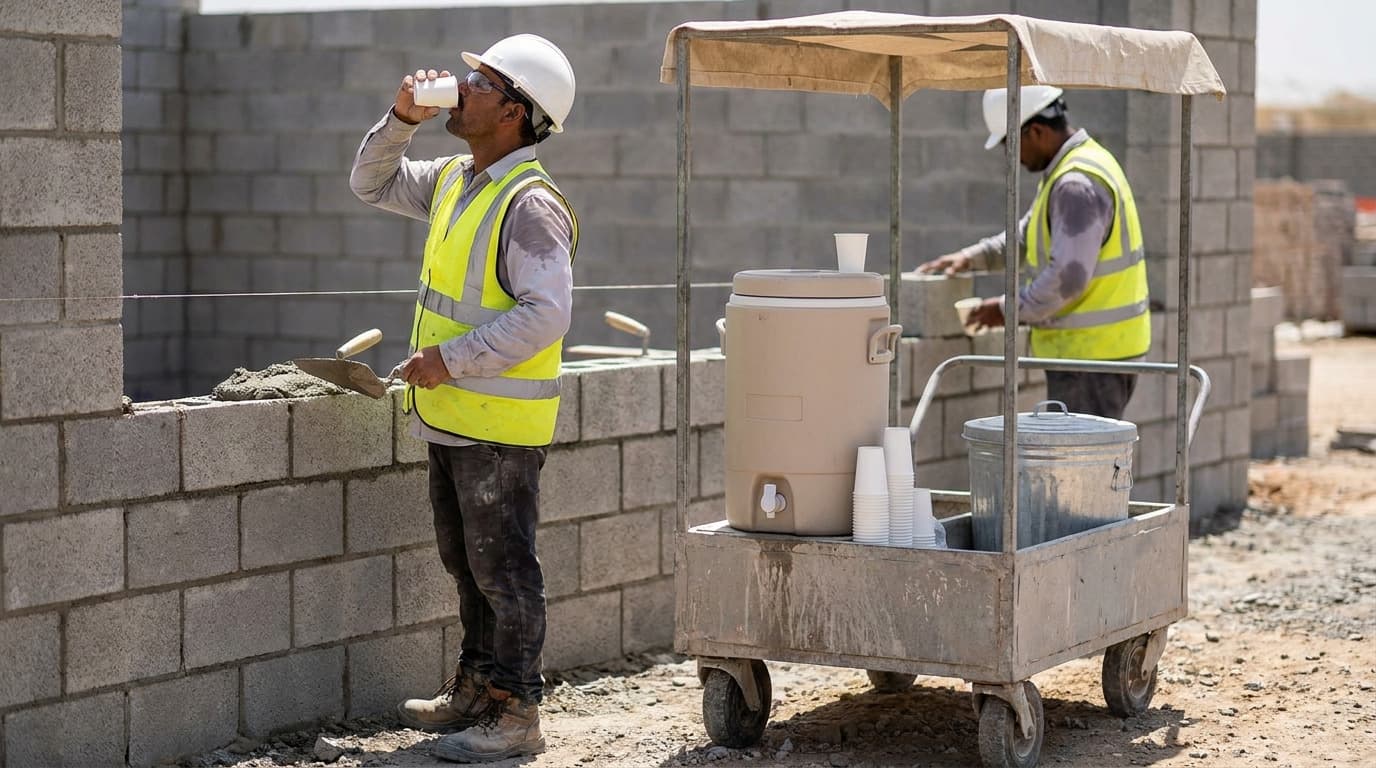
- Keep cool water close to the work so drinking on schedule is easy.
- Use the urine-color check and know the early signs — headache, dizziness, cramps, dark urine.
- Watch the crew, not just yourself — a dehydrated worker often misses their own decline.
Before you start#
- Confirm cool potable water is available, close to the work, and in adequate supply.
- Confirm there is a plan to drink on a schedule, not just when thirsty.
- Confirm electrolyte drinks or salted snacks are available for long or heavy-sweat jobs.
- Confirm there is shade or a cool area for rest breaks.
- Confirm the crew knows the early signs of dehydration and to watch each other.
- Confirm no one is relying on energy drinks, salt tablets, or alcohol for hydration.
- Confirm the day's heat is accounted for in the work-rest schedule.
- On federal work, confirm the EM 385-1-1 heat and hydration provisions are in place.
Talk it over#
- Are you drinking on a schedule today, or waiting until you feel thirsty?
- On a long sweaty job, where are your electrolytes coming from — a drink, or salted food?
- Where is the water right now, and is it close enough that you'll actually drink on time?
- What color check did you do this morning — are you starting the day already behind?
The bottom line#
Your body asks for water too late to protect you — thirst is the alarm going off after the damage has already started. By the time you feel it you are already dehydrated, and drinking only when thirsty leaves you a step behind all day. So hydration is done on a schedule, not in response to a feeling: about a cup of cool water every 15 to 20 minutes in the heat, whether or not you feel thirsty, because OSHA is explicit that thirst cannot be relied on. The second half is the one people miss: more is not always better. When you sweat you lose electrolytes, so for jobs over two hours or with heavy sweat you must add electrolyte fluids or salted food — water alone cannot replace salts — and at the same time you must not over-drink plain water, which can dilute your blood sodium into life-threatening hyponatremia. Hydration is a balance: drink steadily, cap it around 48 oz/hour, replace salts, and skip salt tablets, energy drinks, and alcohol. Read yourself with the urine-color check and the early signs — headache, dizziness, dark urine, cramps — and watch the crew, because a dehydrated worker often misses their own slide. The duty runs through potable-water rules (1926.51) and the General Duty Clause 5(a)(1), framed by OSHA's Water. Rest. Shade. The test for any hot day is one question: am I drinking because it's time and replacing what I sweat out — or waiting for thirst and drowning it in plain water?
Frequently asked questions about hydration#
Why can't I just drink when I'm thirsty?
Because thirst is a lagging indicator — by the time you feel it, you are already measurably dehydrated and your safety and performance have started to slip. OSHA's heat guidance states plainly that thirst cannot be relied on as a guide to how much water you need. On a hot shift, drinking only when thirsty means you spend the whole day catching up rather than staying ahead. Drinking on a schedule takes thirst out of the decision so you never fall behind.
How much water should I actually drink?
OSHA and NIOSH recommend about one cup (8 ounces) of cool water every 15 to 20 minutes while working in the heat — roughly a quart an hour — whether or not you feel thirsty. Small, frequent amounts are better than occasionally gulping a large volume, because the body absorbs a steady intake better. Just as important, do not exceed about 48 ounces per hour, since over-drinking plain water carries its own danger.
When do I need electrolytes, not just water?
For short jobs, cool water is enough. For work lasting two hours or more, or any job with heavy sweating, you need electrolytes too, because sweat carries out salts like sodium and potassium that water cannot replace. Losing too much of them causes muscle cramps and worse. Use balanced electrolyte drinks or pair water with salted snacks and regular meals. Cramps are a specific signal that salts, not just water, are running low.
Can I drink too much water?
Yes. Drinking large amounts of plain water while sweating out salts, and never replacing the salts, can dilute your blood sodium to a dangerous level — a condition called hyponatremia, or water intoxication, which is life-threatening and can look like heat illness. This is why electrolytes matter on long, sweaty jobs: they protect you from both dehydration and over-hydration. Keep intake to roughly 48 ounces per hour and balance water with salts.
How can I tell if I'm dehydrated?
The most practical jobsite check is urine color: pale, like light lemonade, means you are well hydrated; dark, like apple juice, means you are behind. Learn the early signs too — dry mouth, headache, dizziness or lightheadedness, fatigue, dark urine, and muscle cramps — and treat them as a cue to catch up before heat illness sets in. Because a dehydrated worker often does not notice their own decline, watching each other matters as much as watching yourself.
What should I avoid drinking on a hot job?
Avoid energy drinks and high-caffeine drinks, which can strain the body and work against hydration, and alcohol, which worsens dehydration — including the day before heavy heat exposure. Skip salt tablets unless a physician specifically directs them; balanced meals and electrolyte drinks replace salts more safely. Stick to cool water on a schedule, with electrolyte fluids added for long or heavy-sweat work.
Download the hydration toolbox talk PDF#
Get this hydration toolbox talk as a print-ready PDF — available in English, Spanish, Portuguese, and Turkish. Print it, hand it to the crew, and collect signatures on the included attendance sheet.
Download the PDF — free account required. New members get 3 free downloads.
Related toolbox talks#
Sources#
- OSHA, Heat — Water. Rest. Shade. (cool water, drink frequently not just when thirsty, electrolytes for jobs over two hours): https://www.osha.gov/heat-exposure/water-rest-shade
- OSHA, Heat Stress Guide (thirst cannot be relied on; water every 15–20 minutes in hot environments): https://www.osha.gov/emergency-preparedness/guides/heat-stress
- CDC/NIOSH, Keeping Workers Hydrated and Cool (1 cup every 15–20 minutes; drink before thirst; electrolyte loss from sweat): https://www.cdc.gov/niosh/bulletin/2011/heat2.html
This talk is general awareness guidance for training purposes. It does not replace your employer's heat-illness-prevention or health program, the OSHA sanitation and heat requirements, the OSH Act General Duty Clause, applicable state heat rules, individual medical advice, or a competent person's duties, and it is not medical or legal advice. Individual fluid needs vary; workers with medical conditions should follow their physician's guidance.