Pinch Points
Updated 2026-07-24
In this bundle Manual Handling & Body Mechanics
Print-ready PDF
Download this talk as a print-ready PDF, available in 4 languages.
A pinch point does not need a motor. It does not need speed, horsepower, or a machine of any kind. It needs two surfaces and something closing them — and on most jobsites the thing closing them is gravity, a swinging load, a panel going down, a pipe rolling, or a door. This pinch points talk is about the gap that shuts, and about why the instruction everybody gives — keep your hands clear — is the weakest control available.
Here is the distinction that carries this whole talk. Caught-in and caught-between hazards that kill are about mass: trench walls, equipment against a fixed object, a vehicle and a wall. Those are covered elsewhere. This talk is about the ones that do not kill you — the ones that take a finger, a fingertip, a nail bed, a tendon. They happen at the point of work, in the last few inches, to hands that were doing the job correctly right up until the moment the gap closed.
OSHA's word for it#
Worth knowing, because the regulator's term is more precise than ours and it explains the mechanism.
29 CFR 1926.300(b) — the construction guarding provision — requires that one or more methods of machine guarding shall be provided to protect the operator and other employees in the machine area from hazards such as those created by point of operation, ingoing nip points, rotating parts, flying chips and sparks. Examples given are barrier guards, two-hand tripping devices, and electronic safety devices. General industry carries identical language at 1910.212(a)(1).
Ingoing. Not "closing." Not "pinching." Ingoing — because at a nip point, two surfaces that come together are also drawing material in, and a nip point does not wait for your hand to arrive. It takes it. Rollers, belts and pulleys, chain and sprocket, gears, conveyor drums, a rotating shaft against a fixed guard: each is a mechanism that grips whatever touches its surface and feeds it into the gap.
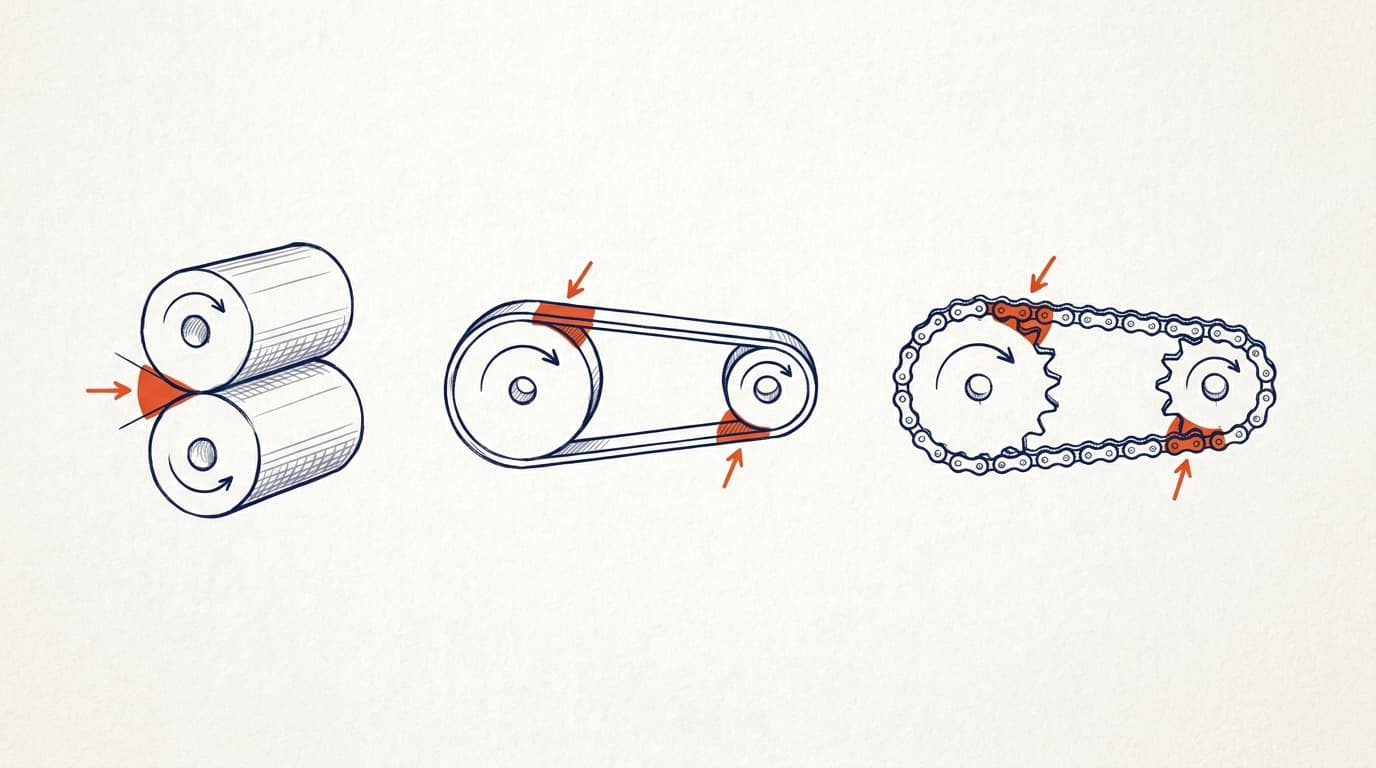
That is why "keep your hands clear" fails as a control. It assumes the hazard stays where it is. An ingoing nip point reaches for you, and it does it at machine speed against a human reaction time of roughly a quarter of a second at best — which is far longer than the gap needs.
The requirement is impossibility, not care#
Here is the part of the standard most people have never read.
Where a machine's point of operation exposes an employee to injury, it must be guarded, and the guarding device must conform to any applicable standard — or, in the absence of an applicable specific standard, must be so designed and constructed as to prevent the operator from having any part of his body in the danger zone during the operating cycle (1910.212(a)(3)(ii), with the same language carried in the construction rule).
Read what that asks for. Not discourage. Not warn. Prevent. The regulation's answer to the point of operation is a physical arrangement in which the body part cannot be in the danger zone at all while the machine is running. Attention is not the control. Geometry is.
Two more provisions follow from it that get overlooked:
- 1910.212(a)(2) — guards shall be affixed to the machine where possible, secured elsewhere if not, and the guard shall be such that it does not offer an accident hazard in itself. A guard with a sharp edge, a trap, or a pinch of its own has failed.
- 1910.212(a)(3)(iii) — special hand tools for placing and removing material must allow easy handling without the operator putting a hand in the danger zone, and such tools shall not be used in lieu of the guards required by this section. A push stick is an addition to a guard, never a substitute for one.
The pinch points with no machine attached#
If the talk stopped at machine guarding it would miss most of what actually happens on a construction site. These are the ones that take fingers:
- Loads being set down. Anything landing on blocking, dunnage, a stack, or the deck — with a hand steadying it.
- Materials being stacked or destacked. Sheet goods, block, pipe, precast, drywall. The gap between the piece and the pile.
- Doors, gates, hatches, and access panels — including wind catching them.
- Rolling stock. Pipe, drums, reels, and anything cylindrical on anything sloped.
- Tailgates, ramps, and outriggers.
- Formwork, panels, and shoring being positioned or struck.
- Scaffold components during assembly, especially clamps and couplers.
- Chain, rigging, and slings taking up — hands on the sling as the load comes on.
- Hinged and folding equipment. Toolboxes, aerial platform gates, folding legs, tailboards.
- Vehicle doors on a slope or in wind.
None of these has a guard. All of them have a moment when a gap closes and a hand is near it.
What can go wrong#
Steadying by hand. The single most common mechanism. The load, panel, or pipe is guided or stabilised with a hand that is between it and something else.
Reaching in while it is running. Clearing a jam, adjusting a workpiece, retrieving an offcut. The operating cycle has not stopped.
A guard removed and not replaced. Taken off for a repair, a blade change, or to reach something, and the machine goes back into service without it.
A guard defeated because it is inconvenient. Tied back, wedged, bypassed, or an interlock overridden.
Gloves near rotating parts. The glove is caught and the hand follows — which is why some tasks require bare hands, as the hand injury talk covers.
Loose clothing, cuffs, lanyards, wristbands, and jewellery near anything turning.
Two people, one load, no communication. One person moves, the other's hand is still on it.
Hands under a load "just for a second" while blocking is positioned.
Fingers in the seam. Between a sheet and the stack, a coupler and a tube, a panel and the frame.
Stored energy. Springs, hydraulics, and suspended loads that close a gap when released, long after the power is off.
Reaction-time thinking. The belief that you will pull your hand out in time. You will not — that is the entire reason the standard demands a guard rather than vigilance.
How do we control pinch points?#
Guard first, and check the guard actually prevents access. The test in 1910.212(a)(3)(ii) is whether a body part can be in the danger zone during the operating cycle. If it can, the guard is decorative.
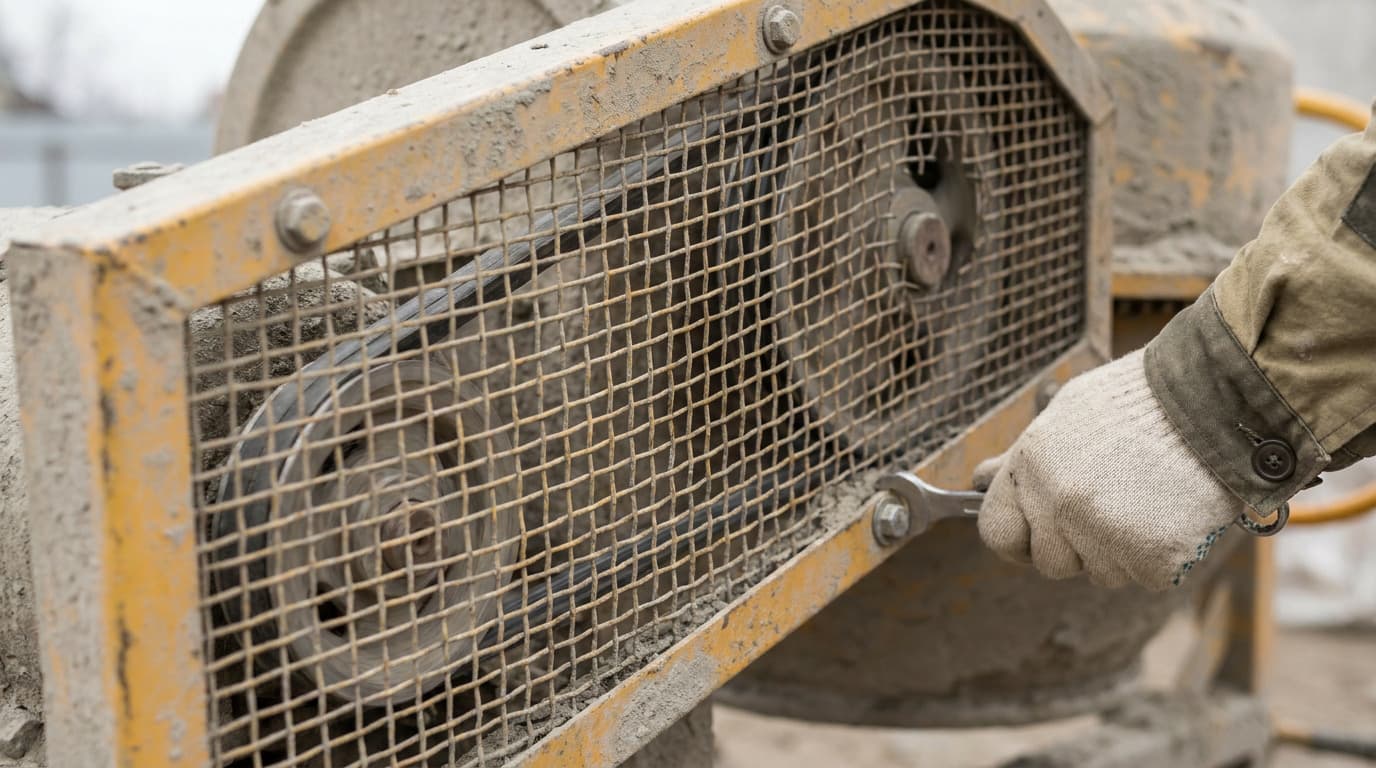
Never remove a guard without a plan to restore it, and never return a machine to service without one. If a guard has to come off, the machine is out of service until it goes back on.
De-energise and isolate before reaching in. A jam, an adjustment, or a blade change is a stop-the-machine task, not a quick-hands task. Account for stored energy — springs, hydraulics, and gravity hold energy after the power is off.
Use a tool, not a hand. A push stick, a bar, a hook, a magnet, a clamp, or a jig. Remember that under 1910.212(a)(3)(iii) these are additions to guards, not replacements.
Never place a hand between two things when one of them can move. Say it that plainly. That single sentence covers the majority of what happens on site.
Guide loads from outside the pinch. Use a taglines, a hook, or the far end of the material — never the seam.
Block and crib rather than hold. If something has to be supported while it is positioned, support it with material, not with a person.
Agree the call on two-person moves. One voice, agreed signal, nobody moves until everybody is clear.
Keep gloves, sleeves, cords, and jewellery away from rotating parts, and check whether the task requires no gloves at all.
Look at where your hands will be if the thing moves unexpectedly — before you touch it, not after.
On USACE and NAVFAC projects, EM 385-1-1 applies and carries its own machine guarding and hazardous energy requirements.
Before you start#
- Identify every gap on this task that can close — machine and non-machine.
- Confirm all guards are in place, secure, and actually prevent access to the danger zone.
- Confirm no guard has been tied back, wedged, or interlocked out.
- Confirm the machine will be stopped and isolated before anyone reaches in.
- Identify stored energy — springs, hydraulics, suspended or propped loads.
- Confirm you have a tool for placing and removing material rather than using a hand.
- Plan how loads will be steadied without a hand in the seam.
- Confirm blocking or cribbing is ready before anything is set down.
- On two-person moves, agree who calls it and what the signal is.
- Check gloves, sleeves, and jewellery against any rotating parts on this task.
Talk it over#
- Point at the gap on this task that could close on a hand. What is going to close it, and what is stopping it?
- The last time you steadied something by hand — where exactly was your hand, and what was on the other side of it?
- If a guard came off this machine for a repair, who puts it back and how would anyone know it was missing?
The bottom line#
OSHA's term for this hazard is ingoing nip point — and ingoing is the word that matters, because these mechanisms do not wait for a hand to arrive, they draw it in faster than anyone can react. 1926.300(b) requires guarding against point of operation and ingoing nip points, and 1910.212(a)(3)(ii) sets the standard for how well: the guard must be designed and constructed to prevent any part of the body from being in the danger zone during the operating cycle. Not discourage — prevent. And remember that most pinch injuries on a construction site involve no machine at all: a load being set down, a sheet coming off a stack, a panel, a door, a rolling pipe. So guard it, isolate it before you reach in, use a tool instead of a hand, block instead of holding — and never put a hand between two things when one of them can move.
Frequently asked questions about pinch points#
What is an ingoing nip point?
It is OSHA's term for the location where two surfaces come together in a way that draws material inward — between two rotating rollers, between a belt and a pulley, between chain and sprocket, or between a rotating part and a fixed surface. 29 CFR 1926.300(b) and 1910.212(a)(1) both require machine guarding against hazards created by point of operation, ingoing nip points, rotating parts, and flying chips and sparks.
Why is "keep your hands clear" not enough?
Because an ingoing nip point does not stay where it is — it grips whatever touches it and feeds it into the gap, at machine speed. Human reaction time is around a quarter of a second at best, which is far longer than the closing gap requires. That is why the standard requires a guard rather than caution, and why 1910.212(a)(3)(ii) demands that guarding prevent the body from being in the danger zone rather than merely discourage it.
What does OSHA require of a machine guard?
Under 1910.212(a)(3)(ii), where no more specific standard applies, the guarding device must be so designed and constructed as to prevent the operator from having any part of his body in the danger zone during the operating cycle. Under 1910.212(a)(2), guards must be affixed to the machine where possible, secured elsewhere if not, and must not offer an accident hazard in themselves.
Can a push stick or special tool replace a guard?
No. 1910.212(a)(3)(iii) provides that special hand tools for placing and removing material must permit easy handling without the operator placing a hand in the danger zone — but such tools shall not be used in lieu of the guards required by the section. They are an addition to guarding, never a substitute.
Do most pinch point injuries involve machinery?
Not on a construction site. A pinch point requires only two surfaces and something closing them, and on site that is usually a load being set down, material coming off a stack, formwork or panels being positioned, rigging taking up, a rolling pipe, or a door in the wind. None of those has a guard, which is why hand placement and blocking matter as much as machine guarding does.
What is stored energy and why does it matter here?
Energy held in a system after the power is switched off — compressed or extended springs, pressurised hydraulic and pneumatic circuits, suspended loads, and anything propped or held against gravity. These can close a gap without the machine running, which is why isolating the power alone is not sufficient before reaching into a danger zone.
Should gloves be worn around pinch points?
It depends on the hazard. Gloves help against sharp edges and abrasion, but around rotating machinery they can be caught and pull the hand in, turning a contact into an amputation. Check the equipment's requirements — for some tasks the correct answer is no gloves, and keeping cuffs, cords, and jewellery clear matters more than glove selection.
Download the pinch points toolbox talk PDF#
Get this pinch points toolbox talk as a print-ready PDF — available in English, Spanish, Portuguese, and Turkish. Print it, hand it to the crew, and collect signatures on the included attendance sheet.
Download the PDF — free account required. New members get 3 free downloads.
Related toolbox talks#
Sources#
- OSHA, 29 CFR 1926.300 — General requirements (hand and power tools): https://www.osha.gov/laws-regs/regulations/standardnumber/1926/1926.300
- OSHA, 29 CFR 1910.212 — General requirements for all machines: https://www.osha.gov/laws-regs/regulations/standardnumber/1910/1910.212
- OSHA, Machine Guarding eTool — General Requirements: https://www.osha.gov/etools/machine-guarding/introduction/general-requirements