Working Near Overhead Power Lines
Updated 2026-07-28
In this bundle Electrical Safety
Working in California? See the Cal/OSHA edition → California (Cal/OSHA)
Print-ready PDF
Download this talk as a print-ready PDF, available in 4 languages.
Everybody on site knows there is a number for power lines, and almost everybody names a different one. They are all right, which is the problem. The clearance you owe an overhead line is not a property of the line — it is a property of what you are standing on, sitting in, or carrying. This working near overhead power lines talk walks the numbers that actually apply to us, and the one that is far smaller than anyone expects.
Here is the distinction that carries this whole talk: the wire does not know what the rule says. A 7,200-volt distribution line will reach for an aluminium ladder from the same distance whether the standard governing you says 3 feet, 10 feet or 20 feet. The clearances below are legal minimums written for particular equipment under particular conditions. They are the floor of what is lawful, not a description of where the hazard stops.
One wire, four different legal distances#
Look at what the construction standards actually require of four different things near the same line:
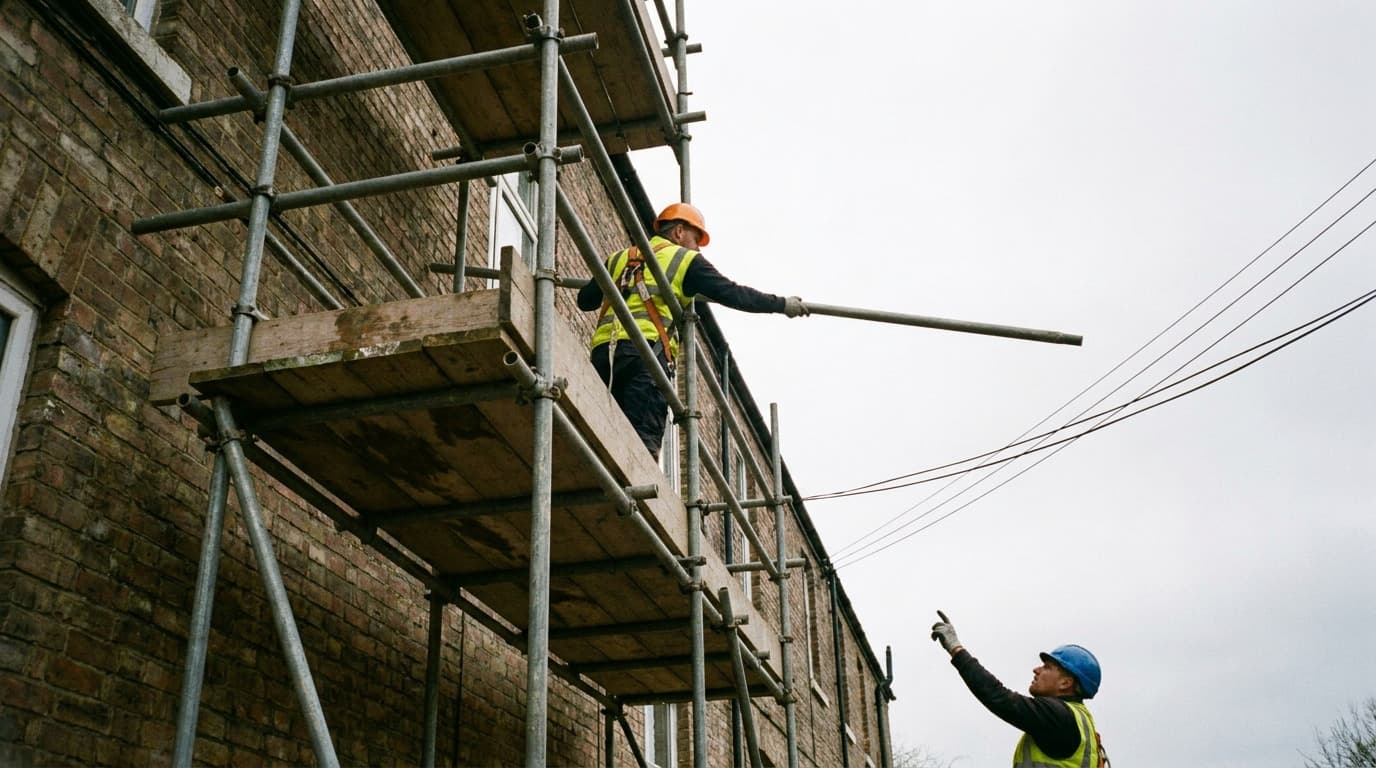
- A scaffold — 1926.451(f)(6). Scaffolds may not be erected, used, dismantled, altered or moved so that they, or any conductive material handled on them, come closer to exposed energized lines than: 3 feet (0.9 m) for insulated lines under 300 volts; 10 feet (3.05 m) for insulated lines from 300 volts to 50 kV; 10 feet (3.05 m) for uninsulated lines under 50 kV; and above 50 kV, 10 feet plus 0.4 inch (1.0 cm) for each 1 kV over 50 kV.
- Mechanized equipment — 1926.600(a)(6). For lines rated 50 kV or below, 10 feet (3.05 m) between the line and any part of the equipment or load. Over 50 kV: 10 feet plus 0.4 inch per kV over 50 kV, or twice the length of the line insulator, but never less than 10 feet.
- That same equipment in transit — with no load and the boom lowered — drops to a minimum of 4 feet (1.22 m) for voltages under 50 kV, 10 feet (3.05 m) from 50 kV up to and including 345 kV, and 16 feet (4.88 m) up to and including 750 kV.
- A crane or derrick under Subpart CC carries its own, larger figures under 1926.1408 — covered in the crane lifting talk, not repeated here.
Four sets of numbers, one wire. And notice the direction they run: the closer the work gets to a person's own hands, the smaller the legal distance becomes. A scaffold three feet from a service drop is lawful. A pipe carried on that scaffold three feet from the same wire is also lawful. Neither is safe in any ordinary sense of the word.
The scaffold rule includes something worth reading twice: it applies to the scaffold and to any conductive material handled on it. The clearance is owed by the tip of the length of conduit you just picked up, not by the plank you are standing on.
The 3-foot figure, and the correction OSHA had to print#
Three feet is the closest lawful approach to an energized line anywhere in the construction standards, and it is so easy to misread that OSHA's own publication got it wrong. An article in the Fall/Winter 2000 Job Safety & Health Quarterly stated the minimum for an insulated line under 300 volts as two feet. A reader wrote in. In Letter of Interpretation 2001-07-18, OSHA confirmed the table requires three feet and said plainly that the article was in error.
Take two things from that. First, the number is 3 feet — 0.9 m — for insulated lines under 300 volts only, and 10 feet for everything else at low voltage. Second, if the agency's own magazine can publish the wrong clearance, the number somebody recites on site is worth checking against the standard before anyone bets a life on it.
The condition attached to 3 feet does the real work: insulated, and under 300 volts. Both parts have to be established, and neither is established by looking up from the ground. Weathered grey covering on a distribution conductor is not insulation — it is a weather coating, and it is not rated to be touched.
"Any overhead wire shall be considered to be an energized line"#
1926.600(a)(6)(vi) states it as a default: any overhead wire is to be considered an energized line unless and until the person owning the line or the electrical utility authorities indicate that it is not an energized line and it has been visibly grounded. The burden runs the right way round. Nobody on this crew, and no supervisor, gets to reclassify a wire by looking at it.
Two more provisions belong with it:
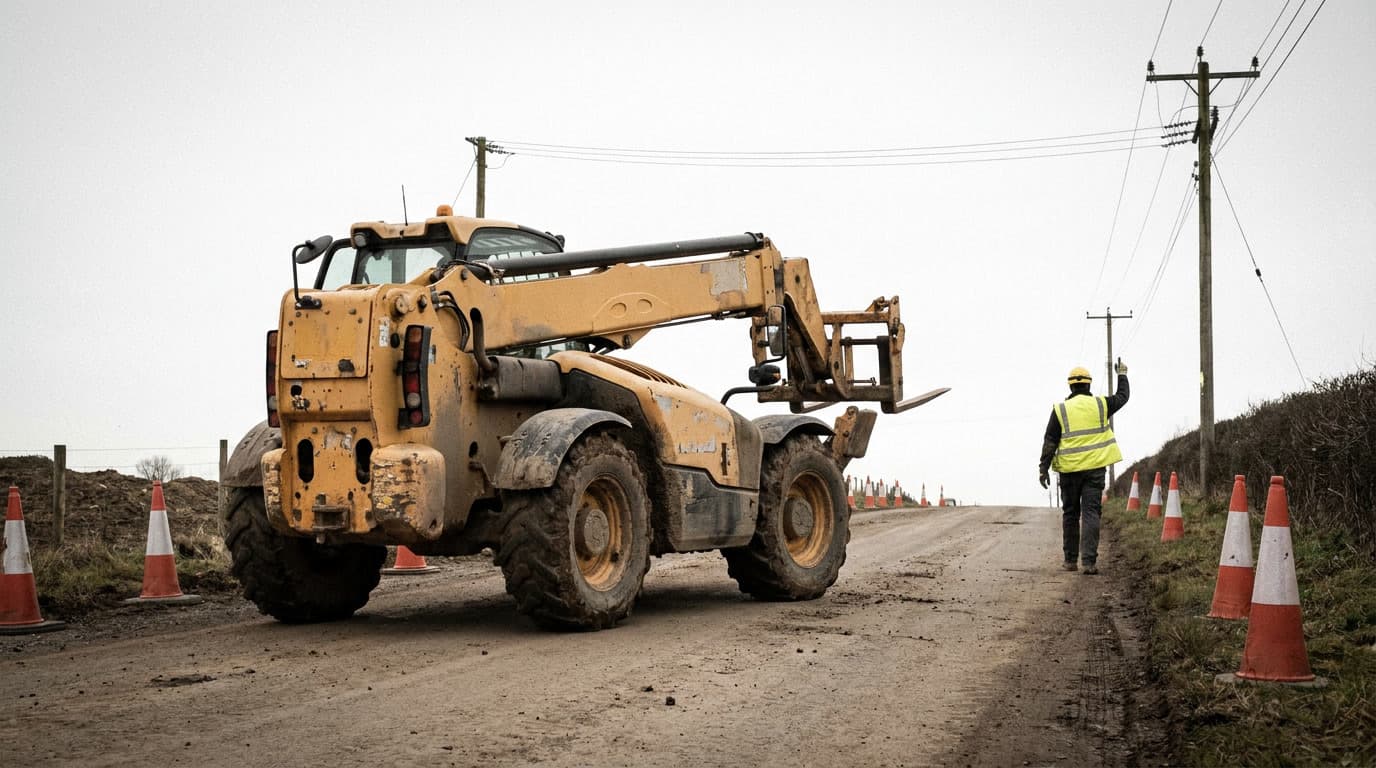
- 1926.600(a)(6)(iv) requires a designated person to observe clearance and give timely warning for any operation where the operator cannot reliably judge the distance visually. That is a job, not a favour. The spotter watches the gap and nothing else.
- 1926.600(a)(6)(v) permits cage-type boom guards, insulating links and proximity warning devices — and then says their use does not alter any other requirement. A proximity alarm buys you nothing in clearance. It is a backup for a distance you were already maintaining.
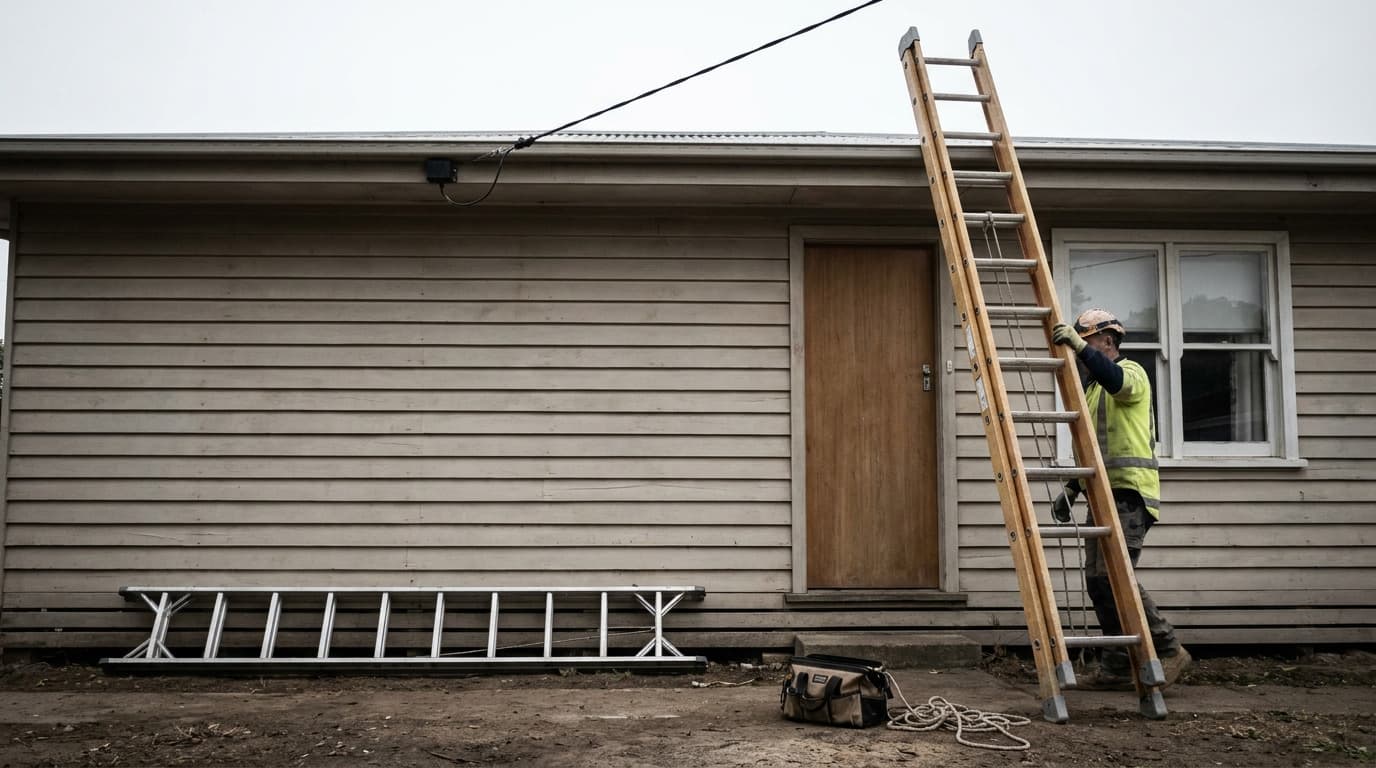
Ladders get the same treatment from a different direction. 1926.1053(b)(12) prohibits portable ladders with conductive side rails where the employee or the ladder could contact exposed energized electrical equipment. There is no clearance table there — the aluminium ladder simply does not belong near the line.
What can go wrong?#
The load swings. Clearance is measured to the nearest point of the equipment, line or load, and a load on a tag line moves. The gap that existed at the pick is not the gap at the set.
Material becomes the conductor. Scaffold tube, conduit, rebar, gutters, aluminium siding, a metal tape measure. The person is not near the line; the thing in their hands is.
Nobody establishes the voltage. Without a confirmed voltage the low numbers are unusable, because every one of them is conditional on knowing what the line is.
The wire is assumed dead because it looks old. Sagging, dirty, weathered conductors carry full voltage. So do lines that were "supposed to be" de-energized last week.
Ground conditions do the killing. When equipment contacts a line, the current spreads through the earth around it. The instinct to jump down and run is the instinct that kills — step potential across two feet on the ground can be lethal.
The crew moves the machine. Most contacts happen while travelling, backing, raising a bed or repositioning — not during the lift everyone planned.
How do we work near lines safely?#
Find the lines before the equipment arrives. Survey the route as well as the work area. Mark them on the plan, and identify what will be raised, carried or swung anywhere near them.
Ask the utility, in writing. De-energize and visibly ground where you can. Where you cannot, get the voltage confirmed so the correct distance can be applied, and ask about line covers.
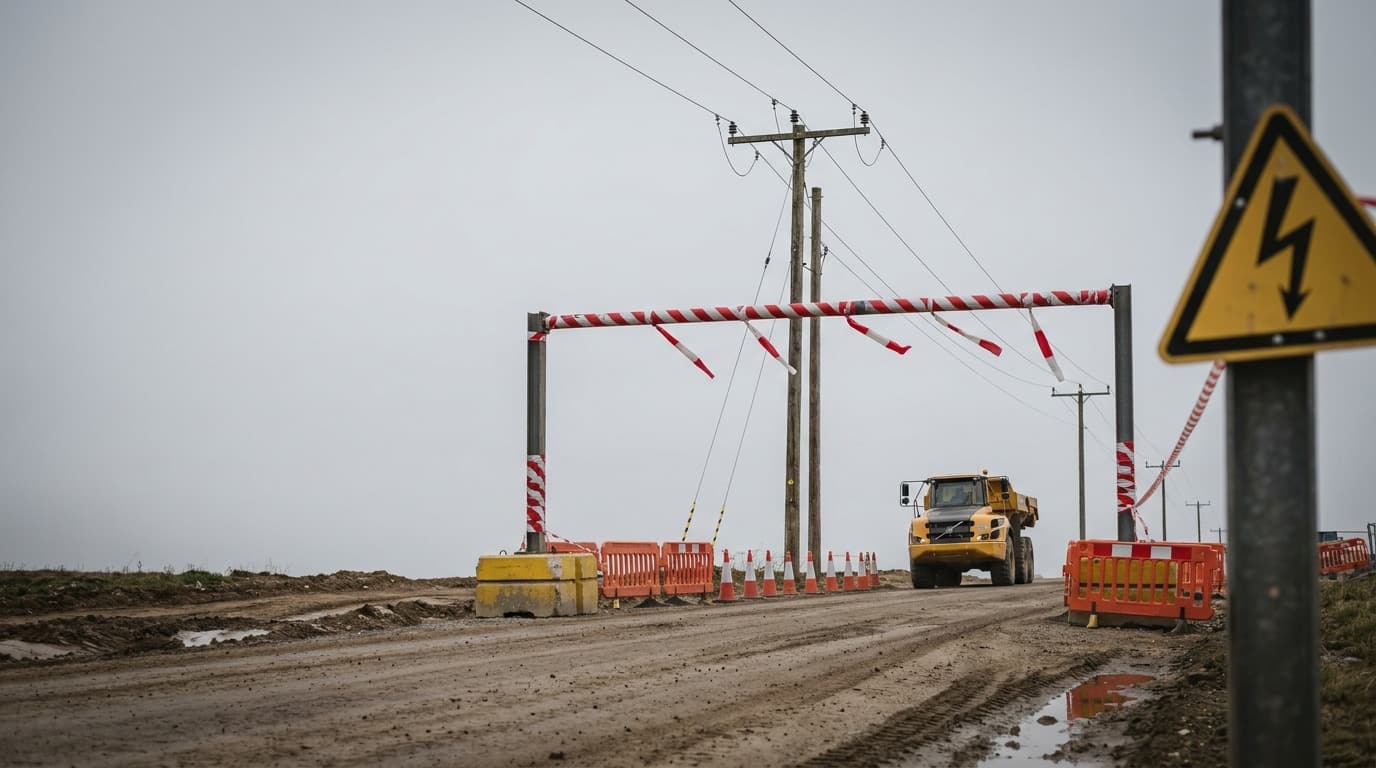
Set a physical limit, not a mental one. Barricades, goalposts on the access route, and a marked exclusion zone on the ground. A number in a briefing is not a control; a barrier is.
Post a dedicated spotter whenever the operator cannot judge the clearance — with no other task, and with the authority to stop the movement.
Lower and stow before travelling, and treat the in-transit figures as the absolute floor rather than a target.
Brief the contact drill. If equipment contacts a line: stay in the cab, warn everyone else away, call the utility. Only leave if there is fire — and then jump clear without touching machine and ground at once, landing with both feet together, and shuffle away in small steps without lifting either foot clear of the ground.
Use non-conductive tools and materials where the work genuinely has to happen near lines — fibreglass ladders, non-conductive poles, shorter lengths.
Before you start#
- Confirm every overhead line on the work area and on the access route, and who owns it.
- Confirm the voltage, or apply the largest applicable distance until you have it.
- Confirm which standard governs your equipment today — scaffold, mechanized equipment, or crane — and the number that goes with it.
- Confirm the clearance is measured from the longest thing you will handle, not from your body.
- Confirm the spotter is named, positioned and doing nothing else.
- Confirm the crew knows what to do — and what not to do — if contact happens.
Talk it over#
- Which lines cross our access route, and at what height?
- What is the longest conductive item anyone will carry today?
- Who confirmed the voltage of the line at the north boundary, and how?
- If a machine touched a line right now, what would you do in the first ten seconds?
The bottom line#
There is no single power line number. 1926.451(f)(6) allows a scaffold 3 feet (0.9 m) from an insulated line under 300 volts and 10 feet (3.05 m) from everything else at low voltage. 1926.600(a)(6) requires 10 feet (3.05 m) for mechanized equipment at 50 kV or below, adds 0.4 inch per kV above that, and drops to 4 feet (1.22 m) in transit with no load and the boom down. Cranes carry the larger Subpart CC distances. All of them are legal minimums, and all of them assume the voltage is known. Until the owner or the utility says otherwise, 1926.600(a)(6)(vi) makes every overhead wire an energized line — which is the only sentence in this talk you actually need to remember.
Frequently asked questions about working near overhead power lines#
How far do I have to stay from an overhead power line on a construction site?
It depends on what is near the line. Under 1926.600(a)(6), mechanized equipment must keep 10 feet (3.05 m) from lines rated 50 kV or below, and 10 feet plus 0.4 inch for each 1 kV over 50 kV — or twice the length of the line insulator — above that. Under 1926.451(f)(6), scaffolds must keep 10 feet from uninsulated lines below 50 kV, but only 3 feet (0.9 m) from insulated lines under 300 volts. Cranes and derricks work to the larger distances in Subpart CC.
Is 10 feet always enough?
No. Ten feet is the figure for lines at 50 kV or below. Above that the required distance grows with voltage, and for cranes it is larger from the start. Ten feet is also a legal minimum measured to the nearest point of equipment, line or load — it assumes nothing swings, sags or is carried out past you.
Does the clearance apply to what I am carrying?
Yes, explicitly for scaffolds. 1926.451(f)(6) covers the scaffold or any conductive material handled on it, and the equipment rules measure to any part of the equipment or the load. The tip of a length of conduit is the point that matters, not your shoulder.
Can I assume a line is de-energized?
No. 1926.600(a)(6)(vi) provides that any overhead wire is to be considered an energized line unless and until the person owning the line or the electrical utility authorities indicate that it is not energized, and it has been visibly grounded. Age, appearance and sag tell you nothing.
Does a covering on the wire make it safe to work close to?
No. The 3-foot figure applies only to lines that are genuinely insulated and under 300 volts. Most overhead distribution conductors are bare or carry a weather covering that is not rated as insulation and is not intended to be contacted. If the line has not been identified and its voltage confirmed, the 3-foot distance does not apply to it.
Do proximity warning devices change the required distance?
No. 1926.600(a)(6)(v) allows cage-type boom guards, insulating links and proximity warning devices, but states that using them does not alter the requirements of any other regulation — even where such a device is itself required by law. They are a backstop for a clearance you are already maintaining.
What should I do if equipment contacts a power line?
Stay where you are and keep everyone else away — the ground around the machine may be energized. Warn others off, and have someone call the utility. Only leave the machine if there is fire or another immediate threat; if you must, jump clear without touching the machine and the ground at the same time, land with your feet together, and shuffle away in small steps keeping both feet in contact with the ground.
Download the overhead power lines toolbox talk PDF#
Get this working near overhead power lines toolbox talk as a print-ready PDF — available in English, Spanish, Portuguese, and Turkish. Print it, hand it to the crew, and collect signatures on the included attendance sheet.
Download the PDF — free account required. New members get 3 free downloads.
Related toolbox talks#
Sources#
- OSHA, 29 CFR 1926.600 — Equipment: https://www.osha.gov/laws-regs/regulations/standardnumber/1926/1926.600
- OSHA, Letter of Interpretation, 18 July 2001 — Minimum approach distances to insulated power lines: https://www.osha.gov/laws-regs/standardinterpretations/2001-07-18
- OSHA, 29 CFR 1926.451 — General requirements (scaffolds): https://www.osha.gov/laws-regs/regulations/standardnumber/1926/1926.451
- OSHA, 29 CFR 1926.1053 — Ladders: https://www.osha.gov/laws-regs/regulations/standardnumber/1926/1926.1053