Shift Handover
Updated 2026-08-06
In this bundle Jobsite Fundamentals & Compliance
Print-ready PDF
Download this talk as a print-ready PDF, available in 4 languages.
A shift handover looks like the most routine moment of the day. One crew is tired and leaving, another is fresh and arriving, and in between there is a short conversation about what happened. Because it is so ordinary, it gets treated as a formality — a few sentences in passing, sometimes just a note left on a desk. But the handover is the one moment when responsibility for a live, half-finished worksite passes from people who know its current state to people who do not, and everything the outgoing crew knows and does not say vanishes with them when they leave. This shift handover talk is about why a handover is not the casual conversation it looks like, and why the information that dies at shift change is the information that hurts the next shift.
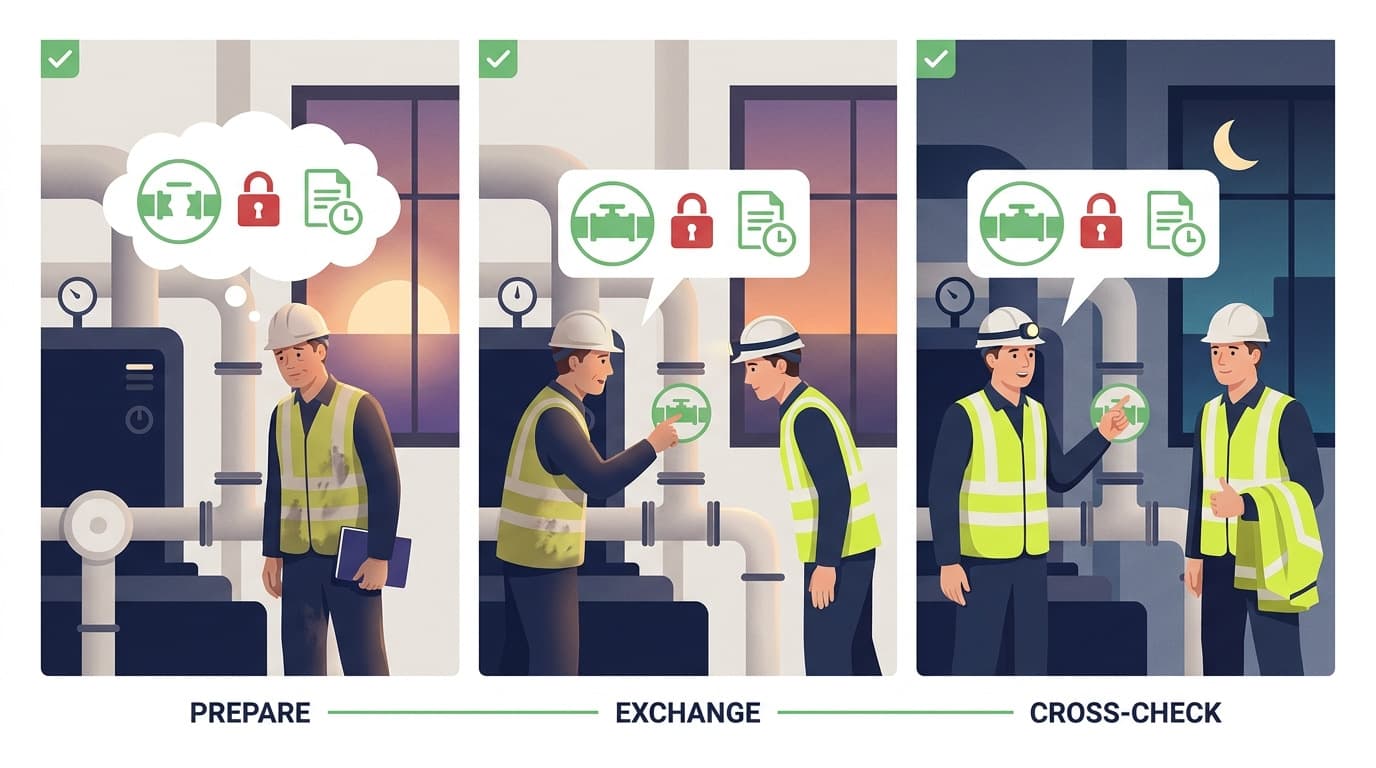
Here is the distinction that carries this whole talk: a handover is not a conversation, it is three phases — and most sites only ever do the middle one. Human-factors guidance defines a proper handover as three distinct stages: a period of preparation by the outgoing personnel, in which they assemble what the incoming crew needs to know; the handover itself, where outgoing and incoming personnel communicate face-to-face to exchange task-relevant information; and cross-checking by the incoming personnel, who confirm they have understood as they assume responsibility for the task. Most sites do only the middle phase — a quick verbal summary — with no real preparation before it and no confirmation after it. The preparation phase is where the outgoing crew figures out what actually matters to say; the cross-check phase is where the incoming crew proves they received it. Skip those two, and the handover becomes a monologue that nobody confirmed anyone understood.
Where the boundary of this talk sits#
The fatigue management talk owns the tiredness that makes the outgoing crew want to rush off. The hazard communication talk owns chemical information. The situational awareness talk owns noticing hazards in the moment. This talk owns the transfer itself — the structured passing of task-relevant information from the shift that is leaving to the shift that is arriving, and what has to happen for that transfer to actually land. Where the question is a specific hazard or the fatigue behind a mistake, that is those talks; this one owns the moment the site changes hands.
The incoming shift acts on what it wasn't told as if it were safe#
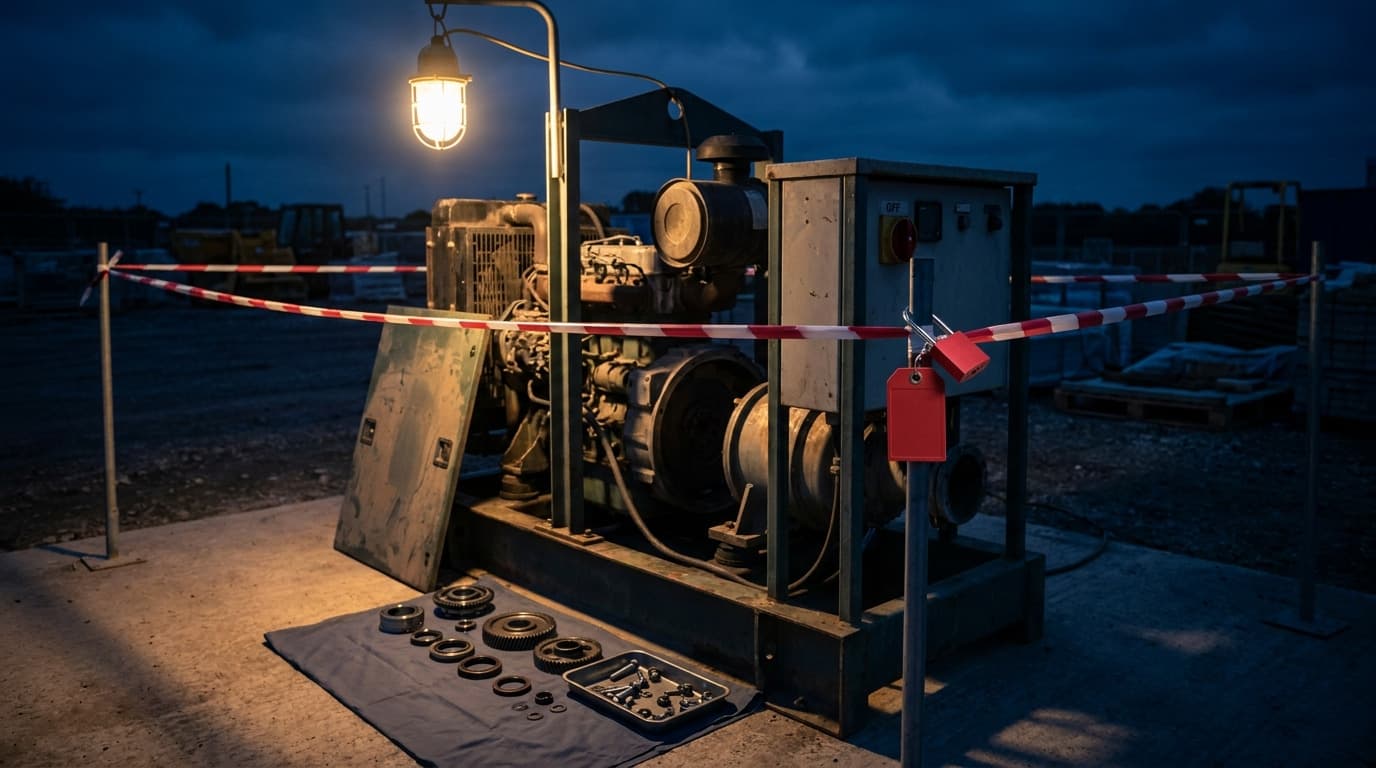
This is the mechanism that makes a bad handover deadly, and it is not obvious. When the outgoing crew fails to mention something — a valve that was removed, a guard that was taken off, a machine left mid-repair, a permit still open — the incoming crew does not know there is a gap. They fill it with the most natural assumption in the world: that nothing has changed, that the site is in its normal state, that the thing they are about to do is the ordinary thing it always is. So they act normally — and the normal action, given the hidden change, is the wrong one. The gap in a handover is never neutral. The incoming shift does not treat unspoken information as a question mark; they treat it as "all clear." That is why a handover has to actively surface what changed, not just describe what is normal. What went unsaid is precisely what the next shift will walk into blind.
What Piper Alpha teaches#
The most-cited example of this is the Piper Alpha disaster in 1988, which killed 167 people, and the inquiry that followed it found that a failure to transmit information at shift handover was one of the contributing factors. A pressure safety valve had been removed for maintenance and replaced with a blind flange, and the work was not finished. That fact was not communicated to the incoming shift. Not knowing the valve was gone, the incoming crew took an action that was entirely normal by their understanding of the plant's state — and that action, given the change they had not been told about, initiated the disaster. The inquiry also found that there were no written procedures for how shift handover should be conducted or what it should include. The lesson is not that one crew was careless; it is that the handover had no structure to force the critical fact across the gap, so it stayed on the shift that knew it and never reached the shift that needed it.
Preparation: decide what actually matters before you speak#
The first phase is the one people skip most, and it is where handover quality is decided. Good preparation is not "remember to mention things"; it is deciding, before the incoming crew arrives, what they specifically need to know to work safely — and that is shaped by who they are. An experienced worker returning from yesterday needs less than someone who has been off for two weeks or is new to the task. The categories that matter most are consistent: equipment status — what is running, isolated, or under maintenance; the status of any permits, and any work in progress or suspended; abnormal conditions or events during the shift; and the actions pending for the incoming crew. Preparation means having those ready and ordered by importance, so the most critical items are not buried under routine chatter or lost because the outgoing crew was in a hurry to leave.
The handover: face-to-face, two-way, unrushed#
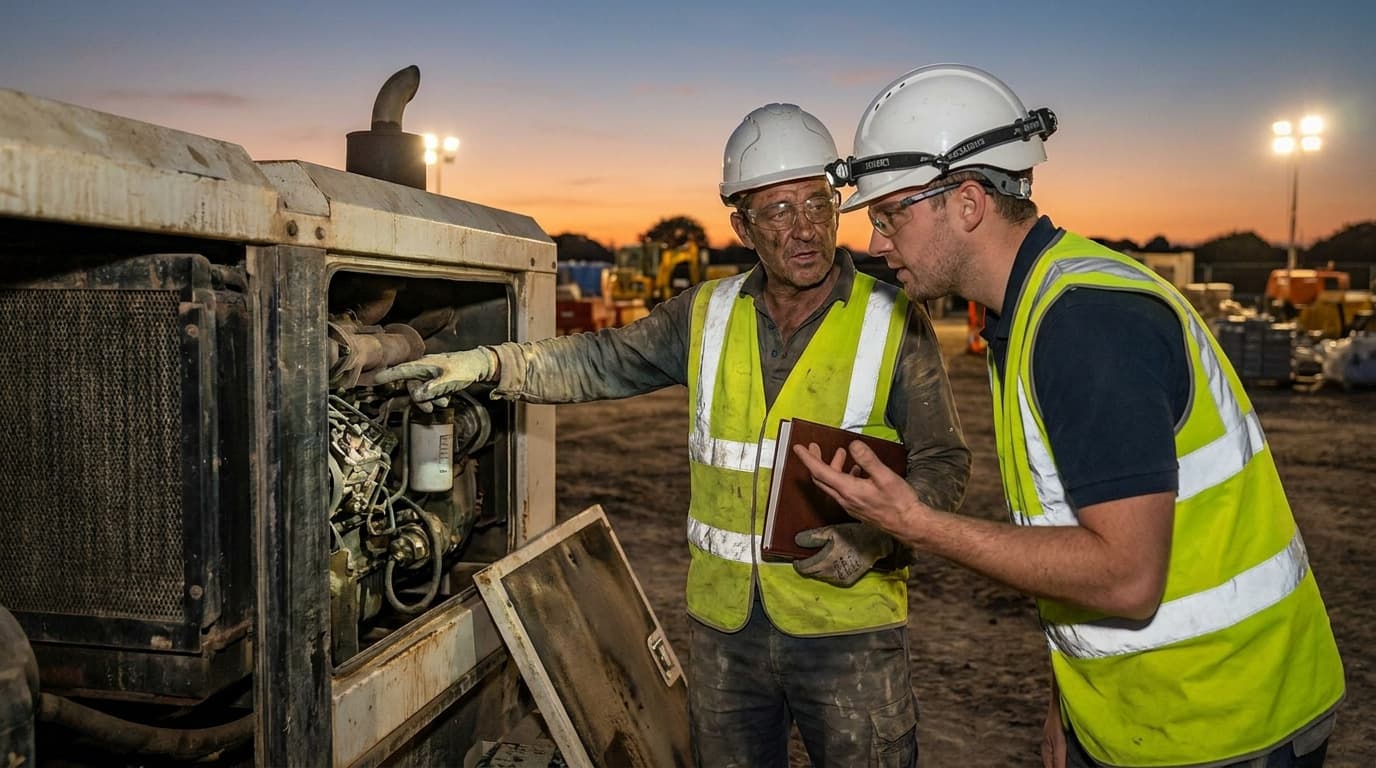
The exchange itself has a few features that guidance is firm about, because each one closes a specific failure mode. It should be face-to-face, ideally at the work location where the outgoing crew can point to the actual equipment and conditions, not a note left on a desk. It should be two-way, with both parties taking joint responsibility for the communication succeeding — not a monologue the incoming crew passively receives. It should use both verbal and written means, so the spoken emphasis and the written record reinforce each other. And it should be treated as high priority and not rushed — given as much time as it needs, in an environment without distractions. A handover squeezed into thirty seconds while one crew has its coats on is a handover designed to lose information. The tiredness of the outgoing shift is real, but the fix is to give the handover time and structure, not to speed it up.
The cross-check: the incoming shift proves it received the message#
The third phase is the one that turns a transmission into a communication, and it is almost always missing. Cross-checking means the incoming personnel confirm they have understood what they were told, as they take on responsibility — reading it back, asking about anything unclear, confirming who owns each pending action. This is what catches the misheard or half-heard item while the outgoing crew is still standing there to correct it. Without it, the outgoing crew leaves believing the message landed and the incoming crew starts work believing they have the full picture, and neither knows there is a gap between the two until something goes wrong. A handover is not finished when the outgoing crew stops talking; it is finished when the incoming crew has confirmed, in their own words, that they hold the information they need.
Where the duty sits#
There is no OSHA standard specifically on shift handover, and it is honest to say so rather than dress the practice up as a citation. The evidence base is human-factors guidance from the UK Health and Safety Executive, which defines the three-phase process and the principles above, developed in large part from investigations like Piper Alpha. In the US framework, handover sits under the general duties: 1926.21(b)(2) requires instructing employees in the recognition and avoidance of unsafe conditions, and the General Duty Clause, Section 5(a)(1) covers recognized hazards — and an unstructured handover that predictably loses safety-critical information is a recognized hazard. Where a permit-to-work system is in place, the permit's own rules govern continuity across shifts: an open permit and the work under it must be reviewed at handover before the outgoing crew leaves. Where a site or a permit system sets a specific handover procedure, that governs.
What can go wrong?#
- A valve, guard, or isolation is removed and not communicated, and the next shift acts as if it's still there.
- An open permit is not reviewed at handover and the incoming crew starts unsafe work under it.
- The handover is a rushed monologue with no confirmation the incoming crew understood.
- Only the middle phase happens — no preparation, no cross-check.
- A note left on a desk substitutes for a face-to-face exchange, and detail is lost.
- The most critical item is buried under routine chatter and never lands.
- The incoming crew is new or returning from absence and needed more, but got the standard rushed version.
- Machine left mid-repair is started by the next shift who didn't know it was incomplete.
How do we manage this properly?#
- Treat the handover as three phases — prepare, exchange, cross-check — not one conversation.
- Prepare first: decide what the incoming crew must know, ordered by importance.
- Cover the categories: equipment status, permits, work in progress, abnormal events, pending actions.
- Hold it face-to-face, ideally at the work location, using verbal and written together.
- Make it two-way — both crews responsible for the message landing, not a monologue.
- Cross-check: have the incoming crew confirm understanding in their own words.
- Actively surface what changed, not just what's normal — the gap is where danger hides.
- Give it time and priority — don't let the outgoing shift's fatigue rush it.
Before you start#
- Confirm the outgoing crew prepared what the incoming crew needs to know.
- Confirm equipment status — running, isolated, under maintenance — was communicated.
- Confirm every open permit was physically reviewed at handover.
- Confirm any work left in progress or suspended was flagged.
- Confirm abnormal events or changes during the shift were surfaced.
- Confirm the incoming crew confirmed understanding, not just listened.
- Confirm pending actions have a clear owner on the new shift.
- Confirm anything left mid-task is marked so the next shift can't assume it's done.
Talk it over#
- On this site, does the handover have a preparation phase and a cross-check — or just the middle?
- What's the one thing from this shift the next crew would be in danger not knowing?
- Has anyone here ever started work on something a previous shift left changed without telling you?
- How would you confirm the incoming crew actually understood, not just heard?
The bottom line#
A handover is not a conversation, it is three phases — and most sites only ever do the middle one. The human-factors definition is preparation by the outgoing crew, a face-to-face exchange of task-relevant information, and cross-checking by the incoming crew as they take responsibility — and skipping the first and third phases turns the handover into an unconfirmed monologue. The reason the phases matter is the mechanism underneath: the incoming shift acts on what it wasn't told as if it were safe, filling any gap with the assumption that nothing changed, which is exactly what makes an unspoken removed valve or open permit deadly. Piper Alpha is the archetype — a safety valve replaced by a blind flange, not communicated between shifts, and an incoming crew that took a normal action which, given the hidden change, initiated a disaster that killed 167 people, with no written handover procedure in place to force the fact across. So prepare (decide what matters before you speak, ordered by importance, covering equipment status, permits, work in progress, abnormal events, and pending actions); exchange face-to-face, two-way, unrushed, verbal and written together; and cross-check so the incoming crew proves it received the message. There is no OSHA handover standard — the base is HSE human-factors guidance under 1926.21(b)(2) and 5(a)(1) — but the test is one question: at the last handover here, did the outgoing crew prepare, and did the incoming crew confirm — or did everyone just do the middle phase and hope?
Frequently asked questions about shift handover#
What are the three phases of a handover?
Preparation, the handover exchange, and cross-checking. In preparation, the outgoing crew assembles what the incoming crew needs to know before they arrive. In the handover, the two crews communicate face-to-face to exchange task-relevant information. In cross-checking, the incoming crew confirms they have understood as they take on responsibility for the task. This is the definition human-factors guidance uses, and the reason it matters is that most sites do only the middle phase — a quick verbal summary — with no preparation to decide what actually matters and no confirmation that the message landed. The first and third phases are what make the middle one reliable.
Why is it so dangerous when something isn't communicated?
Because the incoming shift does not treat missing information as a question — they treat it as "all clear." When something changed during the previous shift and nobody says so, the incoming crew assumes the site is in its normal state and acts accordingly, and the normal action is often exactly the wrong one given the hidden change. The gap is never neutral; it gets filled with the assumption that nothing changed. That is why a handover has to actively surface what changed rather than just describe what is normal — the unspoken change is precisely what the next shift walks into blind.
What does Piper Alpha teach about handover?
The 1988 Piper Alpha disaster killed 167 people, and the inquiry found that a failure to transmit information at shift handover was one of the contributing factors. A pressure safety valve had been removed for maintenance and replaced with a blind flange, and this was not communicated to the incoming shift. Not knowing the valve was gone, the incoming crew took an action that was normal by their understanding of the plant and that initiated the disaster. The inquiry also found there were no written procedures for how handover should be conducted. It is the archetype of how a critical fact can stay on the shift that knows it and never reach the shift that needs it.
Why does the handover have to be face-to-face?
Because a face-to-face exchange, ideally at the work location, lets the outgoing crew point to the actual equipment and conditions and lets the incoming crew ask questions and confirm understanding in real time. A note left on a desk is one-way and cannot catch a misunderstanding — the writer is gone. Guidance is firm that the handover should be face-to-face with both parties taking joint responsibility for the communication succeeding, supported by both verbal and written means so the spoken emphasis and the written record reinforce each other. The written log is valuable, but as a support to the conversation, not a replacement for it.
What information should a handover always cover?
The categories that matter most are equipment status — what is running, isolated, or under maintenance; the status of any permits and any work in progress or suspended; abnormal conditions or events during the shift; and the actions pending for the incoming crew. Every open permit in particular should be physically reviewed at handover before the outgoing crew leaves, because an open permit represents work that is not finished and may have left the plant in a non-standard state. Preparing these categories in advance, ordered by importance, is what keeps the critical item from being buried under routine chatter.
Is shift handover covered by OSHA?
There is no OSHA standard specifically on shift handover, and it is more honest to say that than to cite a rule that does not exist. The evidence base is human-factors guidance from the UK Health and Safety Executive, developed from investigations like Piper Alpha. In the US framework it sits under general duties — instructing employees in recognizing and avoiding unsafe conditions, and the General Duty Clause for recognized hazards, which an unstructured handover that predictably loses safety-critical information can be. Where a permit-to-work system is in use, its own rules require permits to be reviewed at shift change, and any site handover procedure governs on top of that.
Download the shift handover toolbox talk PDF#
Get this shift handover toolbox talk as a print-ready PDF — available in English, Spanish, Portuguese, and Turkish. Print it, hand it to the crew, and collect signatures on the included attendance sheet.
Download the PDF — free account required. New members get 3 free downloads.
Related toolbox talks#
Sources#
- UK Health and Safety Executive, Human factors: Shift handover (three-phase definition — preparation, handover, cross-check; face-to-face, two-way, verbal and written; treated as high priority and not rushed): https://www.hse.gov.uk/humanfactors/topics/shift-handover.htm
- UK Health and Safety Executive / Cullen Report, Piper Alpha (failure of information transmission at shift handover a contributing factor; a pressure safety valve removed and replaced by a blind flange was not communicated between shifts; no written handover procedures existed): https://www.hse.gov.uk/humanfactors/topics/shift-handover.htm
- OSHA, Training requirements — 29 CFR 1926.21(b)(2) (employer must instruct each employee in the recognition and avoidance of unsafe conditions — the general duty under which handover practice sits in the US): https://www.osha.gov/laws-regs/regulations/standardnumber/1926/1926.21
This talk is general awareness guidance for training purposes. It does not replace your employer's shift handover or permit-to-work procedures, applicable human-factors guidance, the OSH Act General Duty Clause, or a competent person's duties, and it is not legal advice. Where a site handover procedure or permit system sets a specific requirement, that requirement governs.