Acid Handling
Updated 2026-08-01
In this bundle Health & Environmental Exposure
Print-ready PDF
Download this talk as a print-ready PDF, available in 4 languages.
Crews rank acids by how frightening they sound. Sulphuric is the one everyone respects, because it eats through cloth and smokes on contact. The tub of brick cleaner sitting by the scaffold gets carried one-handed. That ranking is upside down, and the reason is chemistry rather than concentration. This Acid Handling Toolbox Talk (Safety Talk / Tailgate Talk) is about why the acid you are least worried about may be the one that kills somebody.
Here is the distinction that carries this whole talk: with acids, strength and danger are not the same thing — and the acid most likely to kill a worker on a construction site is chemically one of the weakest. A strong acid dissociates immediately, attacks the surface it touches and hurts at once, which is why people wash it off. Hydrofluoric acid is a weak acid: it does not fully dissociate, so it crosses the skin as an intact molecule before it does anything at all. It hurts later, deeper, and by then the damage is not on your skin — it is in your bones and your bloodstream.
Where the boundary of this talk sits#
Eyewash and drenching provision, and the flushing protocol itself, are owned by the contact lenses and chemical splashes talk. Sulphuric acid in flooded lead-acid batteries, and the 25-foot drenching rule at 1926.441(a)(6), belong to the battery charging station talk. Response to a spill already on the ground belongs to the chemical spill response talk. The alkali side — why bases are sneakier than acids on skin, built on wet cement — belongs to the skin hazards talk. This talk owns the acids themselves: which one is actually the most dangerous, and how they behave when you mix, store and pour them.
The weak acid that kills#
Hydrofluoric acid is unlike every other acid on a construction site, and the difference is worth understanding properly because it changes the first aid.
Strong acids — sulphuric, hydrochloric, nitric, phosphoric — dissociate completely and immediately. They attack the tissue at the surface, and the pain is instantaneous. That pain is the reason most acid splashes end with a wash and a plaster.
Hydrofluoric acid is a weak acid, meaning it only partly dissociates. So a large fraction of it stays as an intact, uncharged molecule — and in that form it penetrates the skin before it dissociates. Once it is deep in the tissue, it releases fluoride ions, and the fluoride is the real weapon. Fluoride has a powerful affinity for calcium and magnesium. It strips them out of cells, tissue and bone, forming insoluble salts, causing progressive tissue destruction and decalcification of bone that continues for days if untreated.
Then it goes systemic. Enough absorbed fluoride causes hypocalcaemia, hypomagnesaemia and hyperkalaemia, and those in turn cause cardiac dysrhythmias and cardiac arrest. People do not die of an HF burn because of the burn. They die of the electrolyte collapse behind it.
The numbers that matter most. NIOSH states that for concentrations below 20%, and for 20–50%, redness, pain and serious injury may be delayed for as long as 24 hours — and are often reported only after significant tissue injury has already occurred. Only above 50% is there immediate pain. And published safety guidance records deaths from concentrated HF burns involving as little as 2.5% of body surface area — roughly the palm and fingers of one hand.
So the dilute product is the dangerous one for exactly the reason people assume it is safe: it does not hurt.
Where hydrofluoric acid is on a construction site#
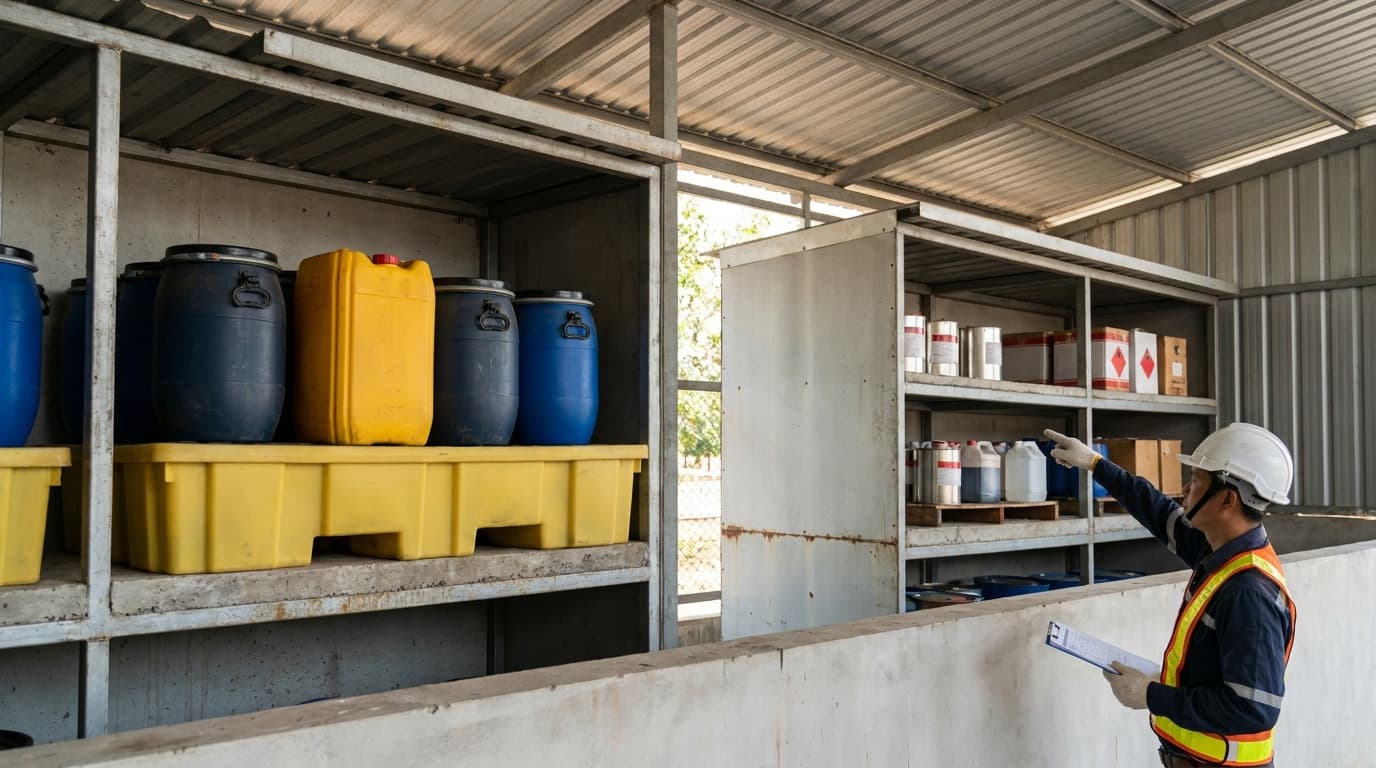
Almost nobody meets it in a bottle labelled "hydrofluoric acid." It arrives inside products.
Masonry and brick cleaners are the big one — many proprietary brick-washing and efflorescence removers contain hydrofluoric acid or ammonium bifluoride, which does the same thing. Also rust removers, aluminium brighteners, alloy wheel cleaners, glass etching compounds and some concrete surface treatments.
The practical instruction is simple. Read Section 3 of the safety data sheet for anything you are about to use on brick, stone, concrete or metal, and look specifically for fluoride. If it is there, that product needs calcium gluconate gel available on site before the work starts, a plan for immediate medical assessment, and nobody using it alone.
What the strong acids do instead#
Not safe — just differently dangerous, and more honestly so.
Sulphuric, hydrochloric, nitric and phosphoric acids attack on contact and announce themselves. Concentrated sulphuric acid is also a powerful dehydrating agent: it strips water out of organic material, which is why it chars cotton, paper and wood on contact and why a splash on a sleeve keeps working through the fabric.
One practical detail crews consistently get wrong: sulphuric acid penetrates ordinary nitrile gloves in about five minutes. The disposable blue glove from the box on the van is a contact barrier for seconds, not protection. Acid work needs neoprene, butyl or thick PVC gloves chosen against the actual product, plus goggles and a face shield — under 1926.95 the employer selects PPE for the hazard, and under 1926.59 the SDS tells you what that hazard is.
Water first, always#
This is the oldest rule in the book and most crews can recite it without knowing the mechanism, which is why it gets broken under time pressure.
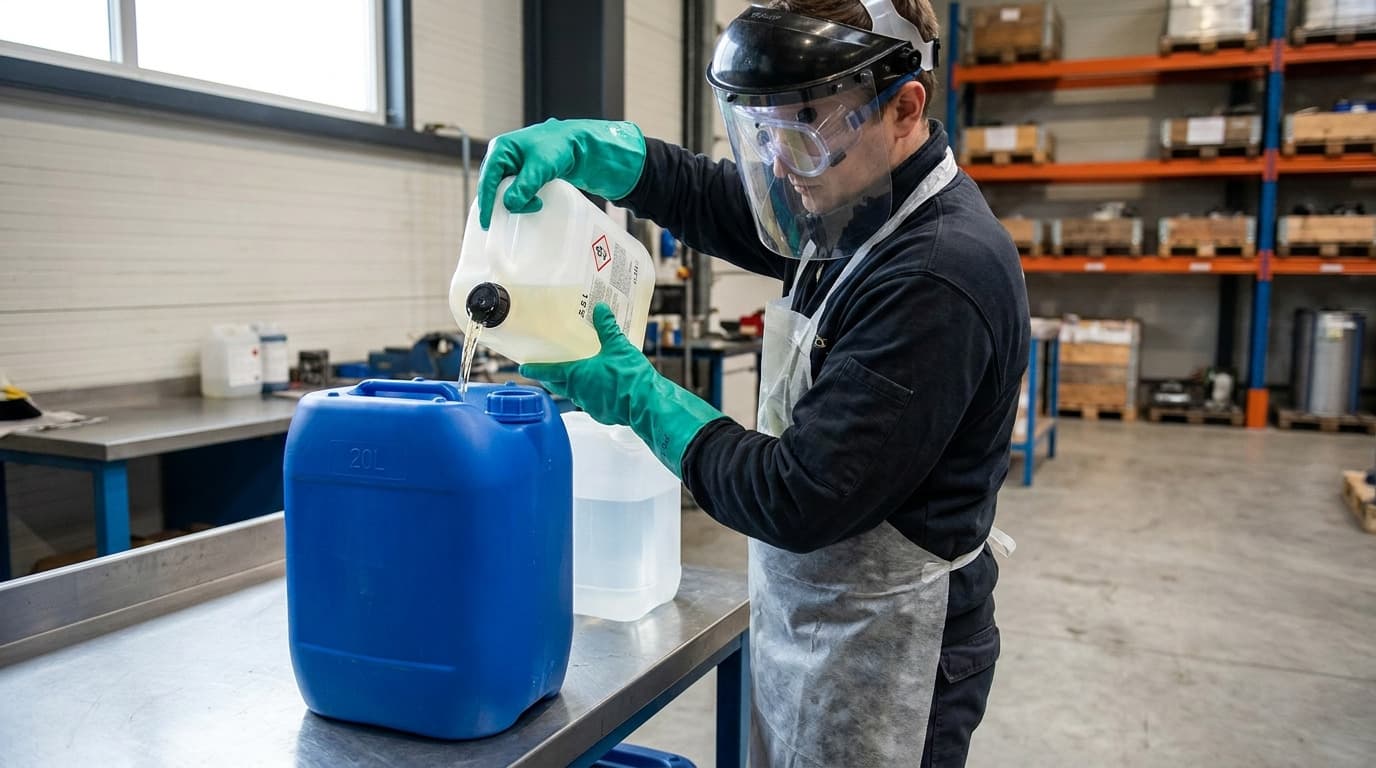
Always add acid to water. Never add water to acid.
Here is why. Diluting concentrated acid is strongly exothermic — it releases a lot of heat, enough to take the mixture past the boiling point of water. Two physical facts then decide what happens to that heat.
Concentrated acid is denser than water. Pour water into acid and the water sits on top, so all of that heat is dumped into a thin layer at the surface — which flashes to steam and throws boiling concentrated acid out of the container and into your face.
Pour acid into water and the acid sinks and mixes, and the heat is spread through the whole volume of water, which has a high heat capacity and absorbs it. Same reaction, same heat, completely different outcome.
Add it slowly, in small amounts, into cold water — never hot — and never in a glass container that has been standing in the sun.
Acids react with everything else on site#
Three reactions worth knowing by heart.
Acid plus most metals gives hydrogen gas, which is flammable and explosive. That is why you open metal acid containers with non-sparking tools and why a leaking acid container inside a steel cabinet or a skip is a fire risk as well as a burn risk.
Acid plus bleach gives chlorine gas. Sodium hypochlorite and any acidic cleaner in the same bucket, drain or plant room produces a toxic gas release indoors; the chlorine talk covers what that does to a person.
Nitric acid plus hydrochloric acid gives off toxic nitrogen oxides, and nitric acid is an oxidiser that will react with organics.
The general rule behind all three: acids are segregated from bases, from oxidisers, from metals and from combustibles, and they are never decanted into an unlabelled bottle, because the next person to pick it up will not know what they are mixing.
Where the duty sits#
There is no OSHA "acid standard." Say that plainly.
Exposure limits are set substance by substance, applied to construction through 1926.55, Gases, vapors, fumes, dusts, and mists, which also fixes the order: engineering and administrative controls first wherever feasible, with PPE where controls are not feasible. The specific number for the specific product is in Section 8 of its safety data sheet, which reaches you through 1926.59, hazard communication. 1926.95 covers PPE selection, and 1926.21(b)(2) requires the employer to instruct each employee in recognising and avoiding these hazards. Where nothing specific reaches the hazard, Section 5(a)(1) of the OSH Act still requires a workplace free of recognised hazards.
Quick drenching and flushing facilities are required by 1926.50(g) where employees may be exposed to injurious corrosive materials, and the specific 25-foot rule for battery areas sits at 1926.441(a)(6) — both are covered in the talks named above. What belongs here is only this: have them, know where they are, and use them without hesitating.
What can go wrong?#
Treating brick or masonry cleaner as mild because it is dilute and does not sting.
Missing fluoride on the safety data sheet because nobody read Section 3 before opening the tub.
Sending somebody home after an HF splash because it did not hurt — the pain may be up to 24 hours away.
Pouring water into concentrated acid, and taking boiling acid in the face.
Diluting into a hot or sun-warmed container, or mixing too fast.
Wearing disposable nitrile gloves for acid work, which sulphuric penetrates in about five minutes.
Mixing an acidic cleaner with bleach in a bucket, a drain or a plant room.
Decanting acid into an unlabelled bottle, so the next person has no idea what is in their hand.
How do we manage this properly?#
Read Section 3 of the SDS before you open anything, and look specifically for fluoride in masonry cleaners, rust removers and metal brighteners.
If it contains fluoride, stock calcium gluconate gel on site before the work starts, brief the crew on it, and make sure nobody uses the product alone.
Substitute where you can — a fluoride-free masonry cleaner or a mechanical method removes the worst of this hazard entirely.
Buy and decant the smallest practical quantity and concentration, and never into an unlabelled container.
Dilute acid into cold water, slowly, in small amounts — never water into acid, never hot water.
Select gloves against the actual product, not by what is in the van: neoprene, butyl or thick PVC, plus goggles and a face shield.
Segregate acids from bases, oxidisers, metals and combustibles in storage, with secondary containment.
Use non-sparking tools on metal acid containers, because acid and metal make hydrogen.
Treat every acid contact as medical, flush immediately and at length, take the SDS with the casualty, and tell the clinician if fluoride is involved.
Before you start#
- Confirm which acid or acidic product you are using and that you have read Sections 3 and 8 of its SDS.
- Confirm whether it contains fluoride, and if so that calcium gluconate gel is on site.
- Confirm a fluoride-free or mechanical alternative has been considered.
- Confirm the gloves you have match the product, not just the job.
- Confirm goggles and a face shield are available for any decanting or dilution.
- Confirm the drenching and eyewash facilities are in the work area and working.
- Confirm you are diluting into cold water and never the other way round.
- Confirm nothing acidic is stored beside bleach, bases, oxidisers or metal.
Talk it over#
- What acidic products are in our store right now, and has anyone read the labels?
- Has anyone here used a brick or masonry cleaner without knowing what was in it?
- If somebody splashed their forearm and said it did not hurt, what would we do?
- Where would we dilute acid on this site, and what would we pour into what?
The bottom line#
With acids, strength and danger are not the same thing — the acid most likely to kill a worker on a construction site is chemically one of the weakest. Strong acids like sulphuric, hydrochloric, nitric and phosphoric dissociate immediately, attack the surface and hurt at once, which is why they get washed off. Hydrofluoric acid is a weak acid, only partly dissociating, so it penetrates the skin as an intact molecule before dissociating, then releases fluoride ions that strip calcium and magnesium from cells, tissue and bone — causing progressive destruction and bone decalcification that continues for days, then hypocalcaemia, hypomagnesaemia and hyperkalaemia, leading to cardiac dysrhythmias and cardiac arrest. NIOSH states that at concentrations below 20% and at 20–50%, pain and serious injury may be delayed up to 24 hours and are often reported only after significant tissue injury has occurred; only above 50% is pain immediate. Deaths have been recorded from concentrated HF burns involving as little as 2.5% of body surface area. On site it arrives inside masonry and brick cleaners, rust removers, aluminium brighteners, wheel cleaners and glass etches — so read Section 3 of the SDS and look for fluoride, and stock calcium gluconate gel before the work starts. On the strong acids: concentrated sulphuric is a dehydrating agent that chars cotton, paper and wood, and it penetrates ordinary nitrile gloves in about five minutes — use neoprene, butyl or thick PVC with goggles and a face shield. Always add acid to water, never water to acid: dilution is strongly exothermic and can pass the boiling point of water, and because acid is denser than water, water poured on top releases all that heat in a thin surface layer that flashes to steam and throws boiling acid out of the container; acid poured into water sinks, mixes, and spreads the heat through a large thermal mass. Acid plus most metals makes hydrogen — use non-sparking tools; acid plus bleach makes chlorine gas; nitric plus hydrochloric gives off nitrogen oxides. Segregate acids from bases, oxidisers, metals and combustibles, and never decant into an unlabelled bottle. There is no OSHA acid standard: limits are substance by substance through 1926.55, which requires controls before PPE, with 1926.59 delivering the SDS, 1926.95 covering PPE and 1926.21(b)(2) requiring instruction.
Frequently asked questions about acid handling#
Which acid on a construction site is the most dangerous?
Usually hydrofluoric acid, and it is chemically one of the weakest. Because it is a weak acid it only partly dissociates, so it crosses the skin intact before releasing fluoride ions deep in the tissue, where they bind calcium and magnesium, destroy tissue and bone and can cause fatal cardiac dysrhythmias. It reaches sites inside ordinary products — masonry and brick cleaners, rust removers, metal brighteners — rather than in a bottle with its own name on it.
Why would a burn that does not hurt be worse than one that does?
Because the pain is what makes people act. NIOSH states that with hydrofluoric acid below 20%, and at 20–50%, pain and serious injury may be delayed for as long as 24 hours, and are often reported only after significant tissue injury has occurred. The casualty feels fine, washes their hands, finishes the shift and goes home while fluoride continues destroying tissue. Only above 50% concentration is the pain immediate.
What should be on site before we use a fluoride-containing product?
Calcium gluconate gel, and a crew that knows it is there and what it is for — calcium binds the fluoride and limits both tissue destruction and systemic absorption. Alongside it: working drenching and eyewash facilities, the SDS to hand, a plan to get somebody to medical assessment immediately, and a rule that nobody uses the product alone. Also consider whether a fluoride-free alternative would do the job.
Why must acid go into water and never water into acid?
Because dilution is strongly exothermic and can drive the mixture past the boiling point of water. Concentrated acid is denser than water, so water poured into acid floats on top and all the heat is released in that thin surface layer, which flashes to steam and ejects boiling acid from the container. Acid poured into water sinks and mixes, spreading the heat through a large volume with a high heat capacity. Add slowly, in small amounts, into cold water.
Are the disposable gloves in the van good enough for acid work?
No. Sulphuric acid penetrates ordinary nitrile gloves in about five minutes, and disposable gloves are a contact barrier for seconds rather than protection for a task. Select the glove against the specific product — commonly neoprene, butyl or thick PVC — and add goggles and a face shield for any decanting, dilution or overhead work. 1926.95 puts the selection duty on the employer and 1926.59 provides the information to make it.
What must never be stored or mixed with acid?
Bases, oxidisers, metals and combustibles, all separated with secondary containment. Three reactions to know: acid plus most metals gives flammable hydrogen gas, which is why non-sparking tools are used on metal acid containers; acid plus bleach gives chlorine gas; and nitric plus hydrochloric acid gives off toxic nitrogen oxides. Never decant acid into an unlabelled bottle — the next person will not know what they are mixing.
Is there an OSHA standard for acids?
There is no OSHA acid standard. Exposure limits are set substance by substance and applied to construction through 1926.55, which also requires engineering and administrative controls first wherever feasible, with PPE where controls are not feasible. The figure for your specific product is in Section 8 of its safety data sheet, provided under 1926.59. 1926.95 covers PPE and 1926.21(b)(2) requires instruction in recognising and avoiding the hazard.
Download the acid handling toolbox talk PDF#
Get this acid handling toolbox talk as a print-ready PDF — available in English, Spanish, Portuguese, and Turkish. Print it, hand it to the crew, and collect signatures on the included attendance sheet.
Download the PDF — free account required. New members get 3 free downloads.
Related toolbox talks#
- Contact Lenses & Chemical Splashes
- Skin Hazards
- Chemical Spill Response
- Battery Charging Station Safety
Sources#
- NIOSH, Hydrogen Fluoride / Hydrofluoric Acid: Systemic Agent — Emergency Response Safety and Health Database: https://www.cdc.gov/niosh/ershdb/emergencyresponsecard_29750030.html
- ATSDR, Medical Management Guidelines for Hydrogen Fluoride: https://wwwn.cdc.gov/TSP/MMG/MMGDetails.aspx?mmgid=1142&toxid=250
- OSHA, 29 CFR 1926.55 — Gases, vapors, fumes, dusts, and mists: https://www.osha.gov/laws-regs/regulations/standardnumber/1926/1926.55
This talk is general awareness guidance for training purposes. It does not qualify anyone to handle concentrated acids or hydrofluoric acid products, which require specific training, authorisation and prepared first aid. It is not medical advice and nothing in it is a diagnosis; anyone with a suspected acid exposure should be assessed by a qualified medical professional, who should be told which product was involved and whether it contains fluoride.
Written by FieldSafetyTalk's safety professional — a CSP, ASP, CHST and OSHA Authorized Outreach Trainer with 14+ years of international construction safety experience across federal, heavy civil, and industrial projects.