Lightning Safety
Updated 2026-08-06
In this bundle Health & Environmental Exposure
Print-ready PDF
Download this talk as a print-ready PDF, available in 4 languages.
Lightning does not feel like a jobsite hazard the way a fall or a trench does, because most of the time the storm is somewhere else — a rumble on the horizon, a dark sky an hour off. That distance is exactly what makes it dangerous. Crews keep working because the rain has not started, the strike seems far away, and the task is almost done. This Lightning Safety Toolbox Talk (Safety Talk / Tailgate Talk) is about why "almost done" is the wrong thing to be thinking when you hear thunder, and about a single fact that should decide every lightning call on the site.
Here is the distinction that carries this whole talk: there is no safe place outside in a thunderstorm — so lightning safety is not about what to do outdoors, it is about not being outdoors. Every other weather hazard you manage in place: you drink water for heat, you layer up for cold, you tie down materials for wind. Lightning is the exception. NOAA is unambiguous about it — nowhere outside is safe when a thunderstorm is in the area. There is no posture, no piece of PPE, no spot on the site that protects you from a strike. The only real protection is a substantial building or a hard-topped vehicle. That changes the entire nature of the job: with lightning, the control is not mitigation, it is evacuation, and the only question that matters is whether everyone can get inside in time.
Where the boundary of this talk sits#
The severe weather and extreme weather talks own storms broadly — the wind, the rain, the general "what to do when weather turns" planning. The heat stress and cold stress talks own temperature. The safe-driving-in-rain talk owns the road. This talk owns lightning specifically — the fact that there is no safe place outdoors, the decision rule for when to stop and when it is safe to resume, and where to shelter. Where the question is general storm planning, wind, temperature, or driving, those talks own it; this one owns the strike and the single rule that keeps people from being under it.
Any thunder means you are already in range#
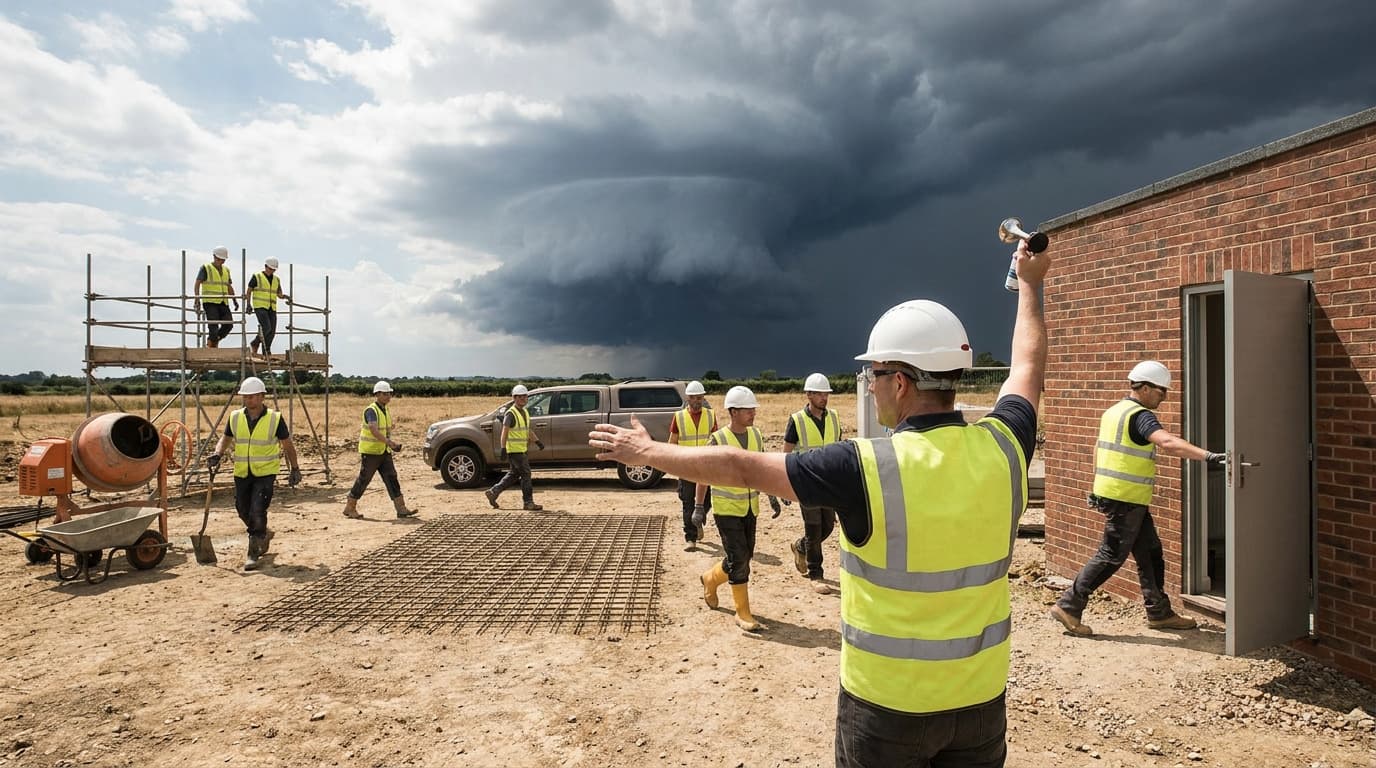
The reason people misjudge lightning is that they wait for the storm to feel close. But the physics does not cooperate with that instinct. Any thunder you can hear means lightning is within striking distance — thunder is caused by lightning, so if you hear it, the strike zone already reaches you. Lightning regularly strikes far from the rain, out of a sky that still looks clear overhead — the "bolt from the blue" that lands miles ahead of the visible storm. So the rule that actually protects you is not a judgment call about how close the storm looks. It is simpler and stricter: when thunder roars, go indoors. If you hear thunder, even a distant rumble, that is the signal to stop and get to shelter — not a signal to watch the sky and decide.
There is a more precise version, the 30-30 rule, which is worth knowing: if the time between seeing the flash and hearing the thunder is 30 seconds or less, the storm is within about six miles and you must seek shelter immediately. But under pressure, on a noisy site, "when thunder roars, go indoors" is the rule to reach for, because it does not require anyone to count, judge distance, or talk themselves into one more task. Both rules point to the same action: the first thunder is the trigger to stop.
The two ways lightning kills workers#
Look at how lightning fatalities actually happen and a clear pattern emerges — and it is not people standing in the open during the worst of a storm. It is two specific timing failures, one at each end of the storm.
The first is leaving too late. Workers get caught outside because they did not act quickly enough — they kept working through the first rumbles, finishing a pour, a lift, a section of roof, and the storm arrived faster than they expected. This is why there is a companion rule to "when thunder roars": do not begin a task you cannot quickly stop if a storm is approaching. If you are about to start something you cannot walk away from in a hurry — a concrete pour, a critical lift, work at height you cannot leave fast — and the sky is building, that is a reason to wait, not to rush to beat the weather.
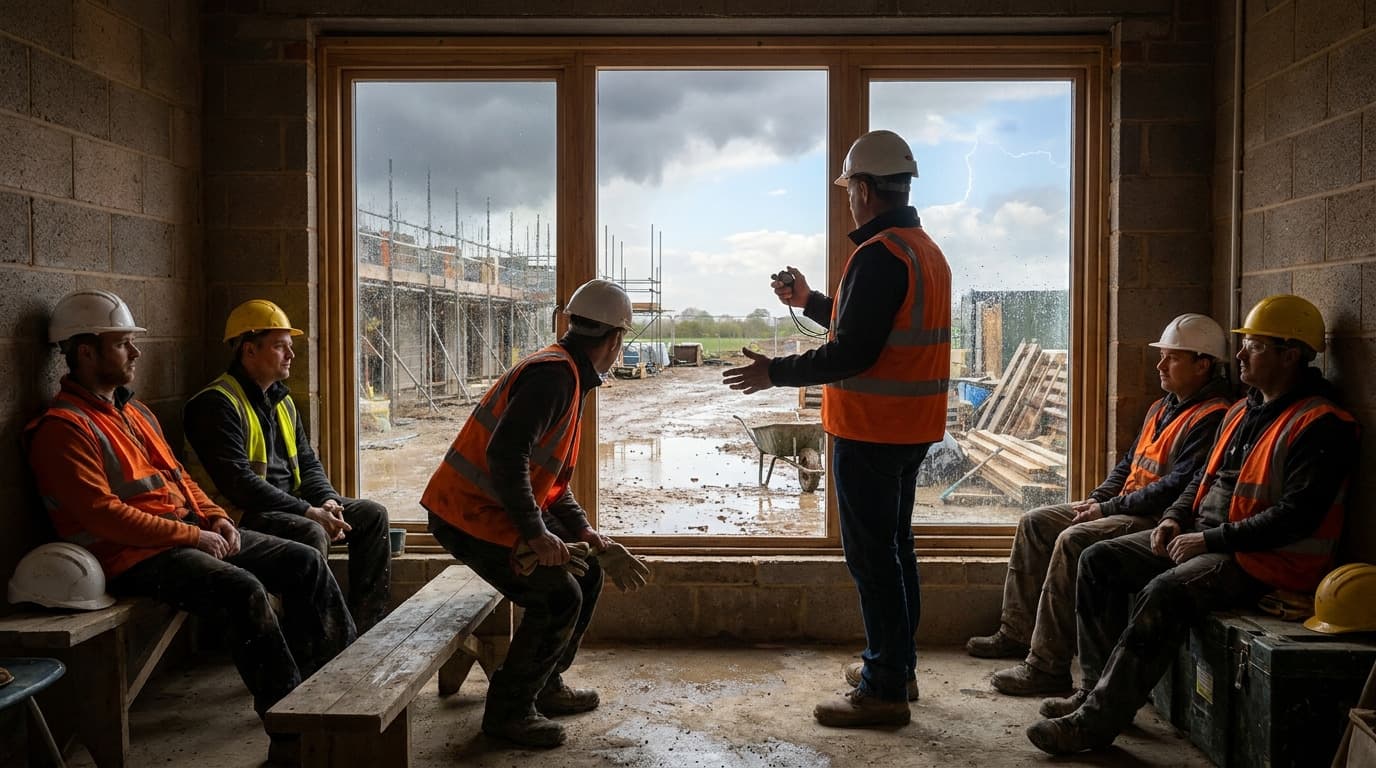
The second is coming back too soon. After the rain passes and the sky brightens, it feels safe, and people go back out. But the storm is still producing strikes from trailing clouds, and the "bolt from the blue" lands on the crew that returned early. This is why the resume rule is strict and specific: wait a full 30 minutes after the last thunder or the last flash — and reset the clock every single time you hear thunder or see lightning again. The most common fatal mistake on the resume side is counting from the last close strike instead of the last strike of any kind. If you hear one more distant rumble at minute 25, the clock goes back to zero. Thirty minutes of quiet, every time, before anyone goes back out.
Where to shelter, and where not to#
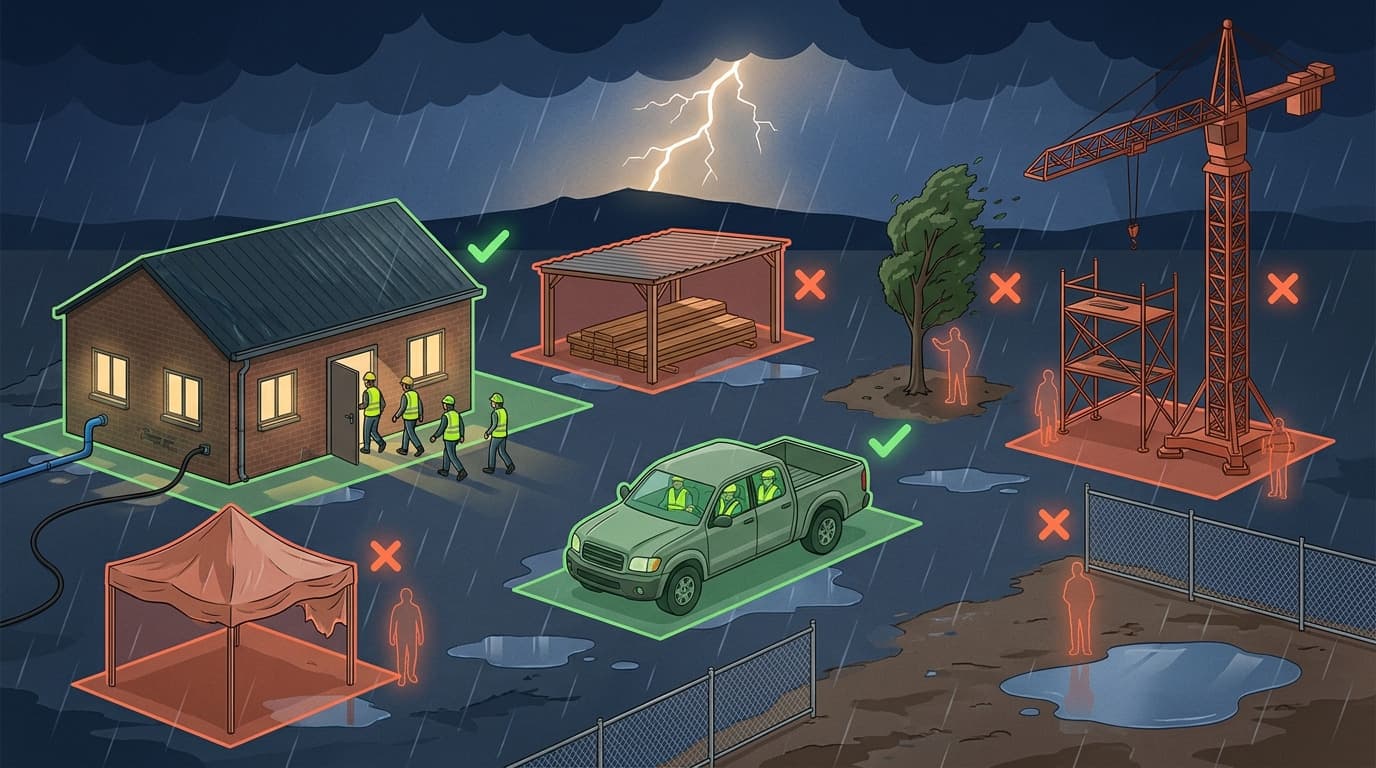
If there is no safe place outside, then knowing what actually counts as inside matters. A safe shelter is a substantial, fully enclosed building with wiring and plumbing — the wiring and plumbing give the current a path to ground that is not you. If no building is reachable, a hard-topped vehicle with the windows rolled up is the next best option; it is the metal shell, not the tires, that protects you. What does not protect you is just as important: open-sided structures, tents, sheds, pavilions, dugouts, and bus shelters offer no protection at all. Out in the open, the danger is being the tallest thing or being next to it — so stay away from isolated tall trees, poles, towers, cranes, and scaffolding, get out of open fields, and get away from water and from metal fences and pipes, which can carry a strike's current a long distance. Never lie flat on the ground; lightning travels through the ground and lying down only increases your contact with it. Inside, keep off corded phones and away from plumbing and wiring during the storm — the same paths that protect the building can carry current if you are touching them.
Where the duty sits#
Lightning is one of several weather hazards with no dedicated OSHA standard, and it works the same way the others do.
There is no numbered "lightning standard." OSHA addresses lightning under the General Duty Clause, Section 5(a)(1) of the OSH Act, which requires employers to keep the workplace free of recognized hazards likely to cause death or serious harm — and lightning is unambiguously a recognized hazard for outdoor work. The practical framework comes from the joint OSHA-NOAA Lightning Safety Fact Sheet (OSHA 3863), which sets the expectation for a written plan, weather monitoring, and training. That written plan is the Emergency Action Plan under 1910.38 / 1926.35, which is where a site records its suspend and resume thresholds, its shelter locations, and how the warning gets communicated. Training to recognize and avoid the hazard falls under 1926.21. The 30-30 rule itself is a NOAA / NWS recommendation that OSHA references — endorsed best practice, not a numbered OSHA figure. One equipment-specific rule bites directly in lightning weather: 1926.451(f)(12) prohibits scaffold work during storms or high winds unless a competent person determines it is safe. On federal contract work, EM 385-1-1 carries its own severe-weather and lightning provisions. Where a contract or a site plan sets a stricter threshold, that threshold governs.
What can go wrong?#
- A crew keeps working through the first thunder to finish a task, and the storm arrives faster than expected.
- Someone judges the storm is "still far away" while lightning is already within striking distance.
- A task that cannot be stopped quickly — a pour, a lift — is started with a storm building.
- Workers shelter under a tent, open shed, or pavilion that offers no protection.
- The crew goes back out as soon as the rain stops, into strikes from trailing clouds.
- The 30-minute clock is counted from the last close strike instead of the last strike of any kind.
- Workers stand near or under isolated tall trees, poles, cranes, or scaffolding.
- Someone lies flat on the ground, increasing contact with ground current.
How do we manage this properly?#
- Treat any thunder as the trigger — if you hear it, lightning is already in range; stop and shelter.
- Use the rule that works under pressure: when thunder roars, go indoors.
- Do not start a task you cannot quickly stop if a storm is approaching.
- Shelter in a substantial building or, failing that, a hard-topped vehicle — never a tent, shed, or open structure.
- Wait a full 30 minutes after the last thunder or flash, and reset the clock every time either happens again.
- Out in the open, get away from tall objects, water, and metal, and never lie flat.
- Know the site's shelter locations and warning signal before work starts, and how long shelter takes to reach.
- Follow the site Emergency Action Plan thresholds; on federal work, the EM 385-1-1 provisions.
Before you start#
- Confirm the day's NOAA/NWS forecast has been checked for thunderstorm risk.
- Confirm everyone knows the site's shelter locations and how long they take to reach.
- Confirm the warning signal for "stop and shelter" is known to the whole crew.
- Confirm the suspend and resume thresholds are set in the Emergency Action Plan.
- Confirm no one is about to start a task that cannot be stopped quickly with a storm building.
- Confirm the resume rule is understood — 30 minutes from the last thunder or flash, clock resets.
- Confirm shelters are real (substantial building or hard-topped vehicle), not tents or open structures.
- On federal work, confirm the EM 385-1-1 lightning and severe-weather provisions are in place.
Talk it over#
- If thunder started right now, where would each of us go, and how long would it take to get there?
- Is anyone planning a task today that we could not stop quickly if a storm rolled in?
- What is our signal that means stop and shelter — and does everyone on the crew know it?
- Have you ever gone back out too soon after a storm? What made it feel safe when it wasn't?
The bottom line#
There is no safe place outside in a thunderstorm, so lightning safety is not about what to do outdoors — it is about not being outdoors. Unlike heat, cold, or wind, which you manage in place, lightning has only one real control: get to a substantial building or a hard-topped vehicle, because NOAA is clear that nowhere outside is safe when a storm is in the area. The trigger is simple and strict: any thunder means lightning is already within striking distance — thunder is caused by lightning — and strikes land miles from the rain out of clear sky, so the rule to reach for under pressure is "when thunder roars, go indoors," with the 30-30 rule (shelter if flash-to-thunder is 30 seconds or less) as the more precise version. Lightning kills workers in two timing failures: leaving too late — working through the first rumbles to finish a task, which is why you never start something you cannot quickly stop with a storm building — and coming back too soon — returning when the rain passes into strikes from trailing clouds, which is why you wait a full 30 minutes after the last thunder or flash and reset the clock every time either happens again. Shelter means a real building or a hard-topped vehicle, never a tent, shed, or pavilion; in the open, get away from tall objects, water, and metal, and never lie flat. The duty runs through the General Duty Clause 5(a)(1) and the OSHA-NOAA Fact Sheet, recorded in the site Emergency Action Plan, because there is no numbered lightning standard. The test for any storm is one question: can everyone hear the thunder, and is everyone already moving inside — or is someone still trying to finish?
Frequently asked questions about lightning safety#
If the storm looks far away, is it safe to keep working?
No. Any thunder you can hear means lightning is already within striking distance, because thunder is caused by lightning. Strikes regularly land miles ahead of the rain, out of a sky that still looks clear overhead — the "bolt from the blue." That is why the rule is not a judgment about how close the storm looks but a simple trigger: when thunder roars, go indoors. The first thunder is the signal to stop, not a signal to watch and decide.
What is the 30-30 rule?
The 30-30 rule has two halves. The first: if the time between seeing a lightning flash and hearing the thunder is 30 seconds or less, the storm is within about six miles and you must seek shelter immediately. The second: wait 30 minutes after the last thunder or flash before resuming outdoor work. It is a NOAA/NWS recommendation that OSHA references, not a numbered OSHA standard. Under pressure, "when thunder roars, go indoors" is the simpler version of the same rule.
How long do we really have to wait before going back out?
A full 30 minutes after the last thunder you hear or the last flash you see — and the clock resets every single time either happens again. The most common fatal mistake is counting from the last close strike instead of the last strike of any kind, so if you hear one more distant rumble at minute 25, you start the 30 minutes over. Coming back too soon, into strikes from trailing clouds, is one of the two main ways lightning kills workers.
What counts as safe shelter?
A substantial, fully enclosed building with wiring and plumbing is best — the wiring and plumbing give the current a path to ground that is not you. If no building is reachable, a hard-topped vehicle with the windows rolled up is the next best option; it is the metal shell, not the tires, that protects you. Tents, open sheds, pavilions, dugouts, and bus shelters offer no protection at all and should never be used as lightning shelter.
What should I do if I'm caught outside with no shelter?
Get away from anything tall and anything that conducts. Stay away from isolated tall trees, poles, towers, cranes, and scaffolding; get out of open fields so you are not the tallest object; and get away from water and from metal fences and pipes, which can carry a strike's current a long distance. Never lie flat on the ground, because lightning travels through the ground and lying down increases your contact with it. Keep moving toward real shelter.
Is there an OSHA standard for lightning?
There is no numbered lightning standard. OSHA addresses lightning under the General Duty Clause, Section 5(a)(1), which requires a workplace free of recognized hazards, and lightning is unambiguously recognized. The practical framework is the joint OSHA-NOAA Lightning Safety Fact Sheet, which calls for a written Emergency Action Plan (1910.38 / 1926.35) with suspend and resume thresholds, weather monitoring, and training (1926.21). Employers can be and are cited under the General Duty Clause when a feasible lightning precaution was not taken.
Download the lightning safety toolbox talk PDF#
Get this lightning safety toolbox talk as a print-ready PDF — available in English, Spanish, Portuguese, and Turkish. Print it, hand it to the crew, and collect signatures on the included attendance sheet.
Download the PDF — free account required. New members get 3 free downloads.
Related toolbox talks#
Sources#
- OSHA / NOAA, Lightning Safety When Working Outdoors (Fact Sheet OSHA 3863) — nowhere outside is safe; when thunder roars, go indoors; shelter and resume guidance: https://www.osha.gov/sites/default/files/publications/OSHA3863.pdf
- OSHA, Lightning — Preparedness (General Duty Clause application; EAP; weather monitoring): https://www.osha.gov/lightning
- National Weather Service, Lightning Safety (30-30 rule; no safe place outside; shelter guidance): https://www.weather.gov/safety/lightning
This talk is general awareness guidance for training purposes. It does not replace your employer's severe-weather or emergency action plan, the OSHA-NOAA lightning guidance, the OSH Act General Duty Clause, or a competent person's duties, and it is not legal advice. Where a site plan or contract sets a stricter threshold, that threshold governs.
Written by FieldSafetyTalk's safety professional — a CSP, ASP, CHST and OSHA Authorized Outreach Trainer with 14+ years of international construction safety experience across federal, heavy civil, and industrial projects.