Wire Rope Inspection
Updated 2026-08-06
In this bundle Rigging & Lifting
Print-ready PDF
Download this talk as a print-ready PDF, available in 4 languages.
Wire rope fails differently from almost everything else on a crane. When it goes, there is no warning stroke, no partial function, no limp-home — the load is in the air one moment and coming down the next, and everyone under it is in the fall zone. That is why the inspection of it is written into federal law in unusual detail, with specific, measurable criteria rather than "inspect and use good judgment." This Wire Rope Inspection Toolbox Talk (Safety Talk / Tailgate Talk) is about what those criteria actually are, and about a distinction inside them that most crews have never been shown.
Here is the distinction that carries this whole talk: the standard does not sort wire rope deficiencies into "bad" and "fine." It sorts them into three categories, and the category decides whether anyone gets to make a judgment call at all. For some deficiencies a competent person weighs whether it is a hazard. For others there is no weighing — the rope is out until it is replaced or severed. Knowing which category a defect falls into is the difference between a decision you are allowed to make and one that has already been made for you by the regulation. Get that backwards and you either pull good rope for no reason or, far worse, run condemned rope because it "looked okay."
Where the boundary of this talk sits#
The crane and lifting talk owns crane operation, setup and the lift itself. The rigging inspections talk owns slings, hardware and the periodic inspection record — and it deliberately did not import the numeric broken-wire numbers, because those live in a different standard. This talk owns exactly that gap: the inspection of the wire rope on cranes and hoists under Subpart CC, the three deficiency categories, and the measurable removal-from-service criteria. Wire rope slings — synthetic and steel rigging between the hook and the load — are inspected under the sling standard and its own removal criteria; this talk is about the rope on the machine, not the rope in the rigging, and it says so where the two could be confused.
The three shift-inspection categories#
Before each shift the equipment is used, 1926.1413(a) requires a competent person to visually inspect the running and standing wire ropes likely to be used, looking for "apparent deficiencies." The standard then lists those deficiencies in three named categories — and the category is not cosmetic. It sets what happens next.
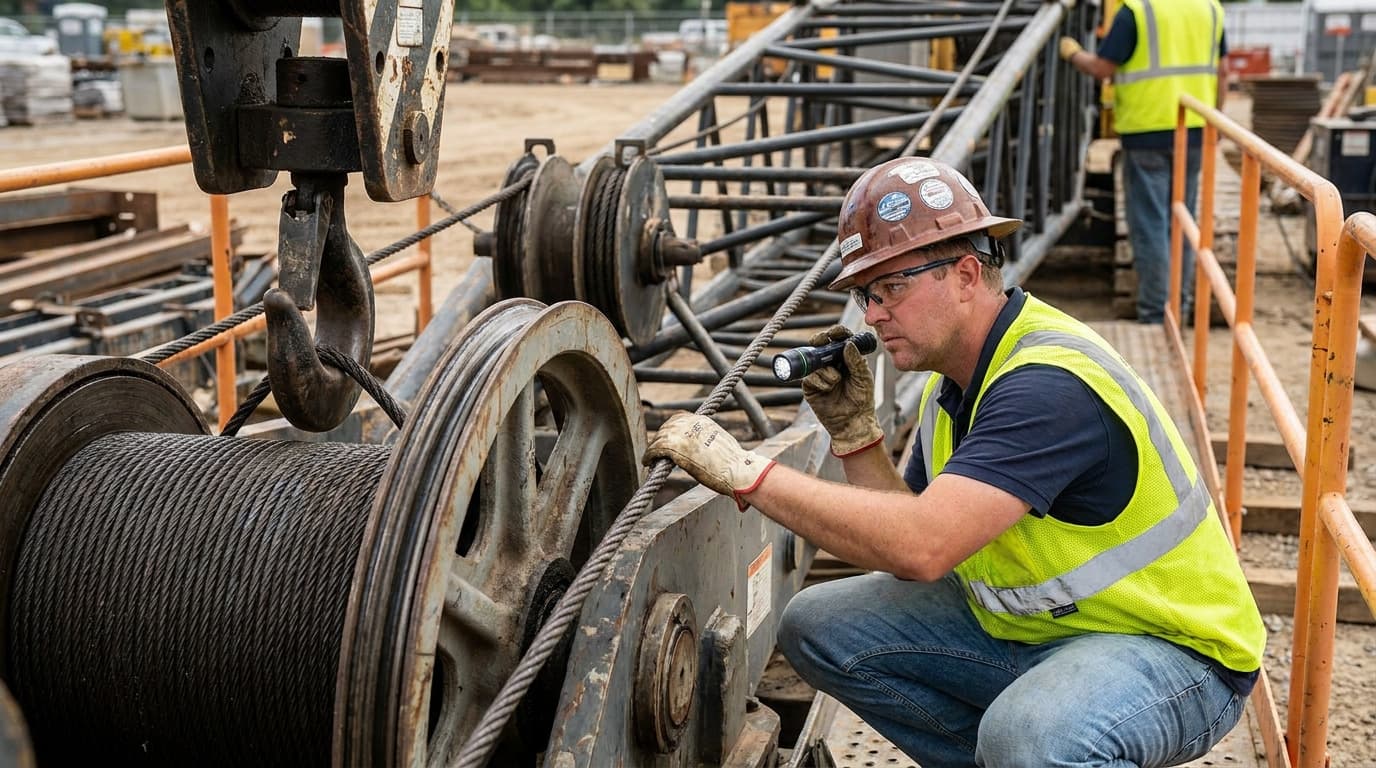
Category I is damage to the rope's structure and its connections: significant distortion such as kinking, crushing, unstranding, birdcaging, signs of core failure or steel core protrusion between the outer strands; significant corrosion; electric arc or heat damage from a source other than a power line; improperly applied end connections; and corroded, cracked, bent or worn end connections. For a Category I deficiency, the competent person makes a determination — is this a safety hazard or not? If it is, the rope is out until replaced or, if the damage is localized, severed. This is the category where judgment is explicitly part of the process.
Category II is where the numbers live, and this is the part most crews half-remember and get wrong. A rope is in Category II when it shows visible broken wires at these thresholds: in running ropes, six randomly distributed broken wires in one rope lay, or three broken wires in one strand in one rope lay — a rope lay being the length along the rope in which one strand makes a complete revolution around it. Rotation-resistant ropes have tighter numbers (two broken wires in six rope diameters, or four in thirty). Pendants and standing ropes have their own. Category II also includes a diameter reduction of more than 5% from nominal. When a Category II deficiency is found, the rope is out until the employer meets the wire rope manufacturer's established removal-from-service criterion (or a different one the manufacturer approved in writing), or replaces it, or severs the localized damage.
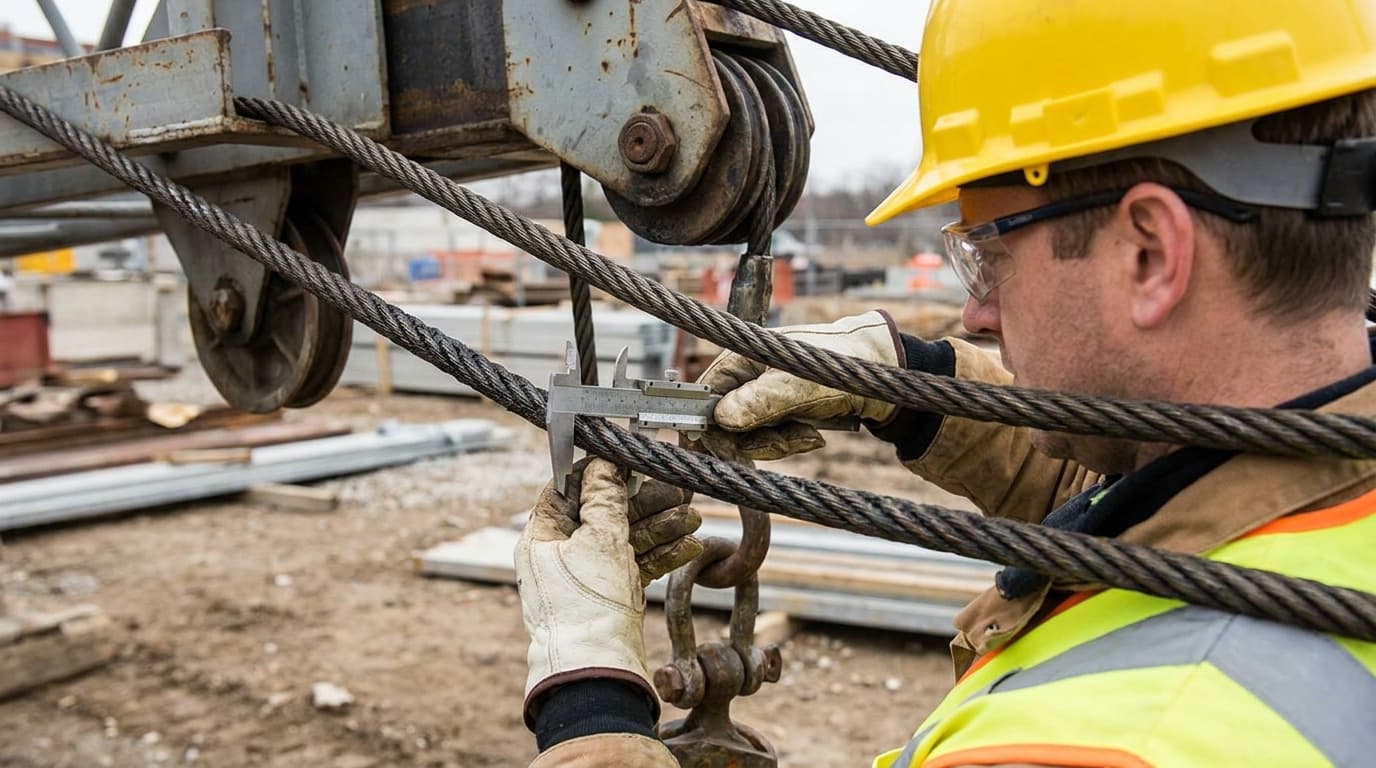
Category III is the most serious, and the consequence is the harshest: no judgment call at all. A Category III deficiency is core protrusion or distortion indicating core failure in rotation-resistant rope, prior electrical contact with a power line, or a broken strand. When one of these is found, the rope is out until it is replaced — or, for a localized deficiency other than power-line contact, severed. There is no "is this a hazard?" step. And repair of wire rope that contacted an energized power line is prohibited outright — that rope never goes back in service under any criterion.
Why one broken strand beats six broken wires#
Put Category II and Category III side by side and you find the fact most crews have backwards. Six broken wires in a rope lay is a Category II deficiency — measured, weighed against the manufacturer's criterion. One broken strand is a Category III deficiency — no weighing, the rope is out. A strand is a bundle of wires; a broken strand means a whole bundle has failed, and the rope has lost a chunk of its structure in one place rather than scattered wear across it. That is why the regulation treats a single broken strand more harshly than six broken individual wires: the failure is concentrated, not distributed, and concentrated failure is what parts a rope under load.
This is the practical value of knowing the categories. A worker who only knows "count the broken wires" will keep counting on a rope with a broken strand, decide it is under six, and keep it in service — running condemned rope while doing exactly what they were taught. The categories are not trivia. They are the difference between a rope that gets weighed and a rope that is simply finished.
The three inspection intervals do different jobs#
The shift inspection is one of three, and they are not the same inspection repeated. The shift inspection (before each shift) is the competent person's visual pass for apparent deficiencies. The monthly inspection runs the same observation but must be documented, and must include any deficiency the annual inspection flagged for monitoring. The annual (comprehensive) inspection is done by a qualified person — a higher bar than the competent person — and it is the thorough one: the entire length of the rope, including the sections normally hidden during shift and monthly checks, the reverse bends, and the rope passing over sheaves. The annual inspection is where a deficiency that is "not a hazard yet, but watch it" gets written down so the monthly inspections track it.
Two details are worth holding onto. The annual can slip past twelve months only in narrow feasibility exceptions, and even then no more than an additional six months for running ropes. And 1926.1413(d) quietly bans rope lubricants of a type that hinder inspection — because a rope you cannot see is a rope you cannot inspect, and a dressing that hides broken wires defeats the entire regime.
Where the duty sits#
The wire rope inspection duties are specific and they belong to Subpart CC, Cranes and Derricks in Construction.
1926.1413(a) sets the shift inspection, the three deficiency categories and the removal-from-service consequences; 1926.1413(b) the documented monthly inspection; 1926.1413(c) the annual comprehensive inspection by a qualified person. 1926.1417(f)(1) requires that a rope removed from service be tagged out — the equipment or the hoist — until the rope is repaired or replaced, so a condemned rope cannot quietly stay in use. The documentation requirements route through 1926.1412. And the manufacturer's removal-from-service criterion referenced throughout is where the precise numeric limits for a specific rope live — the standard points to it deliberately, because a rope's construction determines its real limits.
For wire rope slings rather than crane rope, the criteria live elsewhere — the sling standard and ASME B30.9 — and are different numbers (ten broken wires in a lay, or five in one strand, for a sling). Do not apply crane-rope numbers to a sling or vice versa. On federal contract work, EM 385-1-1 carries its own inspection and tag-out requirements for wire rope and lifting equipment, generally at least as strict as the OSHA baseline; where the contract sets a tighter criterion, it governs.
What can go wrong?#
- A worker counts broken wires but does not know a broken strand is an automatic removal, and runs a Category III rope.
- Category I damage — a kink, birdcaging, a crushed section — is seen but treated as cosmetic, with no hazard determination made.
- A rope that touched a power line is cleaned up and returned to service, which the standard prohibits absolutely.
- The shift inspection is done, but the monthly documented inspection and the annual comprehensive one are skipped.
- A dressing or lubricant that hides broken wires is applied, defeating every inspection after it.
- Sling removal criteria are applied to crane rope, or crane-rope criteria to a sling, and a bad rope passes.
- A condemned rope is left in service because the equipment was never tagged out.
How do we manage this properly?#
- Learn the three categories, not just the wire count: structure damage (I), broken-wire numbers and diameter loss (II), broken strand / core failure / power-line contact (III).
- Treat a broken strand and any core failure as automatic removal — there is no counting and no judgment call.
- Never return a rope that contacted a power line to service; repair is prohibited outright.
- Run all three inspections: the shift visual, the documented monthly, and the annual comprehensive by a qualified person.
- Check the rope's hidden sections — reverse bends, over sheaves, at terminal ends — where failures concentrate.
- Use the manufacturer's removal criterion for the specific rope; do not guess a universal number.
- Keep inspection-hindering lubricants off the rope, so the next inspector can actually see it.
- Tag out the equipment or hoist the moment a rope is condemned, so it cannot be used before repair or replacement.
Before you start#
- Confirm the shift inspection has been done by a competent person before this shift's lifts.
- Confirm whoever inspected knows the three categories, especially that a broken strand is automatic removal.
- Confirm no rope in service has had power-line contact.
- Confirm the monthly documented inspection and the annual comprehensive inspection are current.
- Confirm the rope's hidden and high-stress sections were actually looked at, not just the accessible run.
- Confirm no inspection-hindering lubricant has been applied.
- Confirm any condemned rope has its equipment or hoist tagged out.
- On federal work, confirm the EM 385-1-1 inspection and documentation requirements are met.
Talk it over#
- On the rope we are using today, when was the last documented inspection — and by whom?
- If you found one broken strand on a rope, what would you do, and does the standard agree?
- Where on this rope are the reverse bends and the sheave contacts — the places wires break first?
- Has any rope on this site ever been near a power line, and if so, where is it now?
The bottom line#
Wire rope does not warn you before it parts, which is why OSHA writes its inspection in measurable criteria and sorts every deficiency into three categories that decide whether anyone gets to make a judgment call. Under 1926.1413(a), a competent person inspects the running and standing ropes before each shift. Category I — kinking, crushing, birdcaging, core protrusion, significant corrosion, heat or arc damage, bad end connections — triggers a hazard determination by the competent person. Category II is where the numbers sit: six randomly distributed broken wires in one rope lay, or three in one strand, for running rope, plus a diameter reduction over 5%, and it sends the rope out until the manufacturer's removal criterion is met, it is replaced, or the localized damage is severed. Category III — a broken strand, core failure in rotation-resistant rope, or prior power-line contact — is the harshest: no judgment call, replace or sever, and a rope that touched an energized power line can never be repaired. The fact most crews have backwards: one broken strand (Category III) is treated more severely than six broken wires (Category II), because a broken strand is concentrated failure, not scattered wear. Run all three intervals — the shift visual, the documented monthly, and the annual comprehensive by a qualified person covering the hidden sections, reverse bends and sheave contacts — keep inspection-hindering lubricants off the rope, and tag out (per 1926.1417(f)(1)) any equipment whose rope is condemned. Crane-rope numbers are not sling numbers; do not cross them. The test for any rope going up today is one question: would the person inspecting it know that a single broken strand means it is already out?
Frequently asked questions about wire rope inspection#
How many broken wires mean a crane rope is out of service?
For running ropes under 1926.1413, the Category II threshold is six randomly distributed broken wires in one rope lay, or three broken wires in one strand in one rope lay. Rotation-resistant ropes, pendants and standing ropes have their own separate numbers. But counting wires is not the whole picture — a single broken strand or a core failure is a Category III deficiency and removes the rope regardless of the wire count.
Why is one broken strand worse than six broken wires?
Because a strand is a whole bundle of wires, so a broken strand means the rope has lost a concentrated chunk of its structure in one place, rather than scattered wear across it. Concentrated failure is what parts a rope under load, which is why the standard puts a broken strand in Category III (automatic removal) and six broken wires in Category II (measured against the manufacturer's criterion).
What happens if a rope touches a power line?
It is removed from service and it can never be repaired — repair of wire rope that contacted an energized power line is prohibited outright under 1926.1413. Prior power-line contact is a Category III deficiency, and unlike other localized deficiencies it cannot even be corrected by severing. The rope is finished.
What is a rope lay?
A rope lay is the length along the wire rope in which one strand makes one complete revolution around the rope. The broken-wire criteria are counted within one rope lay, so knowing how to measure a lay is what makes the count meaningful — six broken wires spread over three lays is a different condition from six in a single lay.
How often does wire rope have to be inspected?
Three intervals, doing different jobs. A shift inspection by a competent person before each shift; a monthly inspection that must be documented; and an annual comprehensive inspection by a qualified person covering the entire length including normally hidden sections. The shift check catches the obvious; the annual catches what the shift check cannot see.
Can we use crane-rope broken-wire numbers for a sling?
No. Wire rope slings are inspected under the sling standard and ASME B30.9, with different removal criteria — ten broken wires in a lay, or five in one strand. Applying crane-rope numbers to a sling, or sling numbers to crane rope, can pass a rope that should be out. Use the criteria for the item you are actually inspecting.
Can we put a dressing on the rope to protect it?
Not one that hinders inspection. 1926.1413(d) prohibits rope lubricants of a type that hinder inspection, because a rope you cannot see clearly is a rope you cannot inspect — and a coating that hides broken wires defeats every check that follows. Use only dressings that leave the rope inspectable.
Download the wire rope inspection toolbox talk PDF#
Get this wire rope inspection toolbox talk as a print-ready PDF — available in English, Spanish, Portuguese, and Turkish. Print it, hand it to the crew, and collect signatures on the included attendance sheet.
Download the PDF — free account required. New members get 3 free downloads.
Related toolbox talks#
Sources#
- OSHA, 29 CFR 1926.1413 — Wire rope—inspection: https://www.ecfr.gov/current/title-29/subtitle-B/chapter-XVII/part-1926/subpart-CC/section-1926.1413
- OSHA, Cranes and Derricks in Construction: Wire Rope — Inspection (OSHA 3635): https://www.osha.gov/sites/default/files/publications/osha3635.pdf
- OSHA, 29 CFR 1926.1417 — Operation (tag-out at (f)(1)): https://www.ecfr.gov/current/title-29/subtitle-B/chapter-XVII/part-1926/subpart-CC/section-1926.1417
This talk is general awareness guidance for training purposes. It does not replace your employer's crane and rigging program, the wire rope manufacturer's removal-from-service criteria, or a competent or qualified person's inspection duties, and it is not legal advice. Where the manufacturer's criterion or a contract sets a specific limit, that limit governs.
Written by FieldSafetyTalk's safety professional — a CSP, ASP, CHST and OSHA Authorized Outreach Trainer with 14+ years of international construction safety experience across federal, heavy civil, and industrial projects.