Winter Slips
Updated 2026-08-06
In this bundle Health & Environmental Exposure
Print-ready PDF
Download this talk as a print-ready PDF, available in 4 languages.
A wet floor tells you it is wet. It shines, it darkens, you see the spill and you step around it. Winter takes that warning away. The surface that drops a worker in January is usually the one that looked fine — dry-looking pavement that is actually glazed, a patch of refrozen melt in the shade, a dusting of snow hiding the ice underneath. This Winter Slips Toolbox Talk (Safety Talk / Tailgate Talk) is about why that missing warning changes how you manage the hazard, and why winter makes the same fall both more likely to happen and more likely to hurt.
Here is the distinction that carries this whole talk: ice does not announce itself the way a wet floor does — the most dangerous surface in winter is the one that looks dry, so winter slip safety is about treating the surface before you can see the hazard, not reacting when you feel it. A wet spill is a visible hazard you avoid. Black ice is an invisible one you cannot — by the time your foot tells you it is there, you are already going down. That flips the whole approach. You cannot rely on spotting ice and stepping around it, because the worst of it is the ice you never saw. What protects you is treating the walking surfaces before the shift on the assumption that ice is there — salt, sand, clear the snow, mark the bad spots — and walking as if any surface could be slick, rather than trusting your eyes to warn you in time.
Where the boundary of this talk sits#
The cold stress talk owns what the cold does to your body — hypothermia, frostbite, the thermal injuries. The slips, trips and falls talk owns same-level falls in general. The winter driving talk owns the truck on the icy road. This talk owns the winter walking-working surface specifically — ice and snow underfoot, why it is invisible, and how to treat it and walk on it. Where the question is staying warm, that is cold stress; where it is a wet floor indoors or clutter in a walkway, that is slips and trips; this one owns the frozen surface you have to cross to do the work.
Why winter makes the same slip worse#
There are two reasons a winter slip is more dangerous than a summer one, and both are about the cold acting on your body at the same moment the ice acts on your feet.
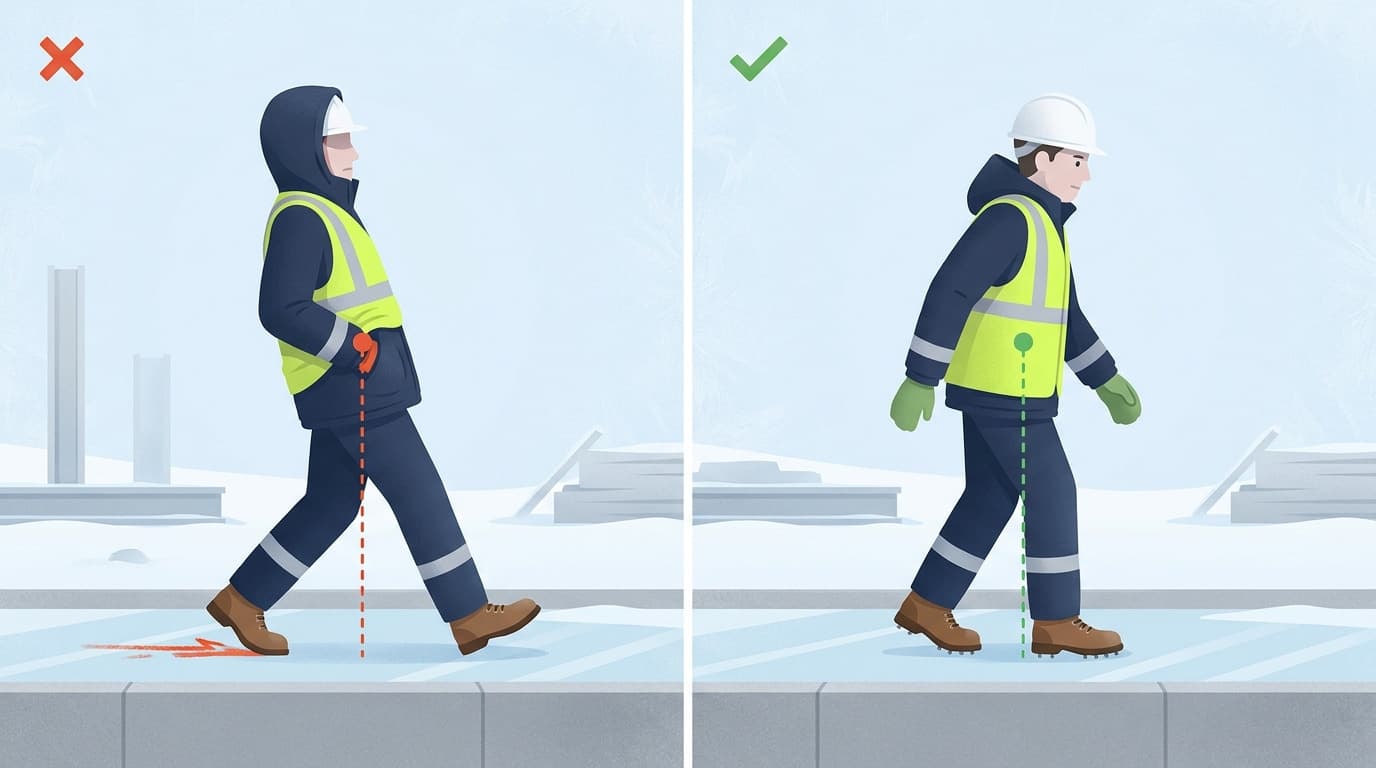
The first is that you are more likely to slip. Cold stiffens muscles and slows reaction time, so the small recovery that saves you on a normal surface — the quick correcting step — is slower and weaker. Gloves make it harder to catch a rail. A hood or a pulled-up collar narrows your vision so you see less of the ground ahead. And the strongest factor of all is behavioural: people hurry in the cold, heads down, hands in pockets, rushing to get inside — which is exactly the posture most likely to turn a slick patch into a fall. Hands in pockets is the quiet killer here, because it removes your ability to catch yourself entirely.
The second is that the fall hurts more. You land on a surface frozen hard as concrete, wearing bulky clothing that restricts how you move but does little to cushion an impact. Cold, stiff bodies absorb impact worse. The same slip that is a bruise in summer is a fractured wrist or hip, or a head strike, in winter. So winter raises both halves of the risk at once — the chance of falling and the cost of the fall — which is why a surface you might walk across casually in July deserves real caution in January.
Treating the surface before you can see the hazard#
If the worst ice is invisible, the work has to be done in advance, not in reaction.
Clear and treat before the shift and through the day. Snow gets removed from walkways, stairs, ramps and work platforms; ice gets broken up and treated with salt, sand, or an ice-melt product. This is not a one-time morning task — melt and refreeze is a daily cycle, so a surface cleared at 7 a.m. can be glazed again by mid-afternoon as temperatures drop, and shaded spots and north faces stay frozen long after the sun has cleared everything else. Re-treat as conditions change.
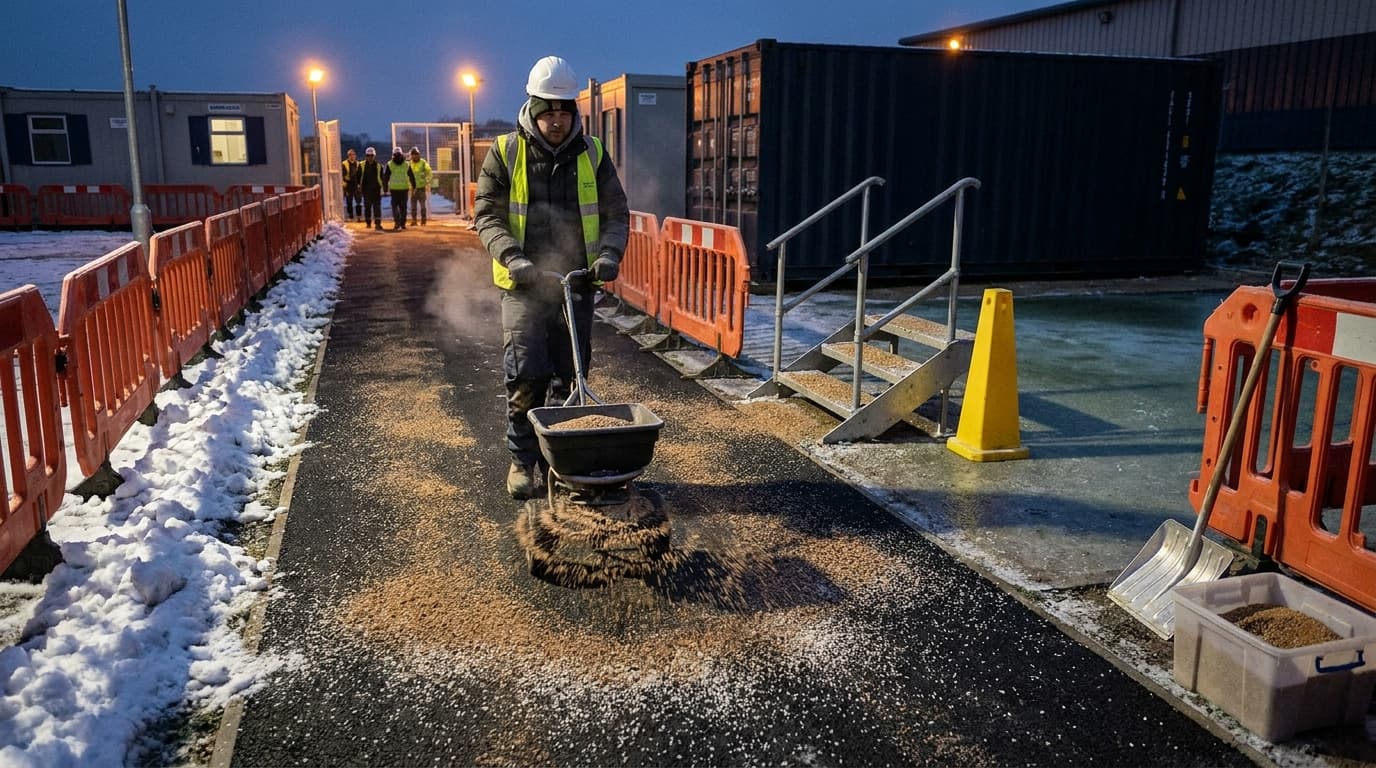
Mark and light what you cannot fix immediately. Where a slick spot cannot be cleared right away, it gets marked and, if possible, barricaded so people route around it — the same logic as guarding any hazard you cannot correct on the spot. Winter's short days mean a lot of walking happens in the dark, so lighting on paths, stairs and entrances matters more, not less.
Route people onto treated paths. Designate and maintain the walkways that are cleared, and keep people on them, rather than letting everyone pick their own line across an untreated lot. Handholds — rails on stairs and ramps, something to grab at transitions — turn a slip into a stumble instead of a fall.
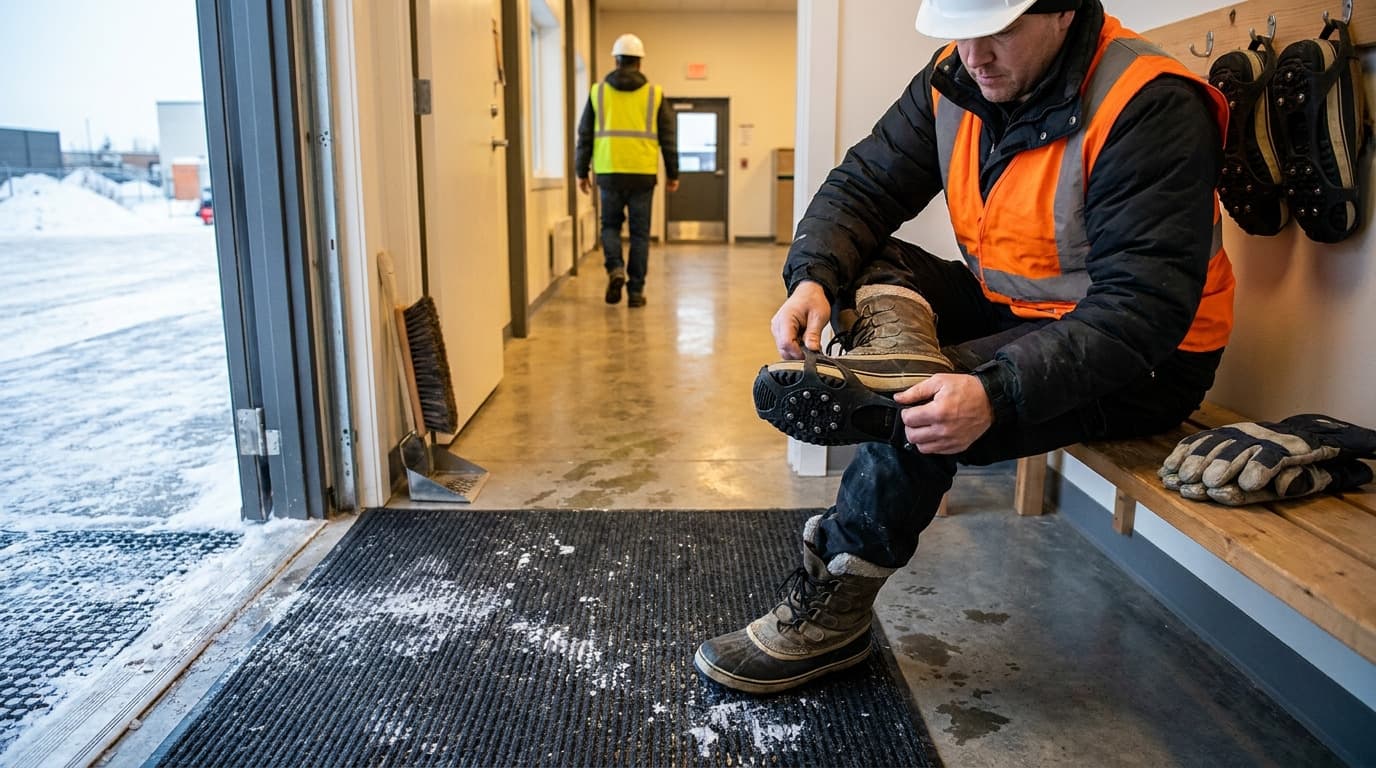
Watch the entrances. The most dangerous few feet are often the doorway: snow tracked inside melts into a puddle, then the floor by the door refreezes or stays wet and slick, and people are transitioning from ice to smooth floor right where they relax. Mats, and keeping that zone dry, matter.
What you can do on your own feet#
The surface is the employer's to treat, but how you move across it is yours.
Footwear with real traction is the first line — winter-rated boots with a soft, deep-tread sole, and slip-on ice cleats where conditions call for them (with the caveat that cleats have to come off before you walk onto smooth indoor floors or metal, where they slide). Walk the way you would on ice even when you think the surface is clear: short flat steps, feet a little wider, weight over your front foot, slow at corners and transitions — sometimes called walking like a penguin, and it works because it keeps your centre of gravity over the foot that is down. Keep your hands out of your pockets so you can balance and catch yourself; carry loads that let you keep at least one hand free and your view of the ground clear. Use the handholds, get in and out of vehicles and equipment facing the steps with three points of contact, and give yourself time so you are not hurrying across the worst of it.
Where the duty sits#
Winter surfaces run on the same framework as the rest of the weather group: there is no OSHA standard written specifically for ice and snow in construction, so the duty runs through the General Duty Clause, Section 5(a)(1) — a slippery frozen walkway is a recognized hazard the employer must address. Around it sit the standards that do apply: construction housekeeping at 1926.25 requires work areas, passageways and stairs to be kept clear of debris, which in winter includes keeping paths usable; and the general-industry walking-working-surfaces standard, 1910.22(a)(3), is the one OSHA standard that names snow and ice directly, requiring surfaces be kept free of hazards "such as ... snow, and ice" — it governs general-industry workplaces rather than construction, but it is the clearest statement of the expectation. (In shipyard work, 1915.81 goes further still, requiring the employer to eliminate slippery conditions such as snow and ice, or restrict workers to cleared paths, or provide slip-resistant footwear.) On federal contract work, EM 385-1-1 carries housekeeping and walking-surface provisions. Where a site plan or contract sets a specific snow-and-ice program, that governs.
What can go wrong?#
- A worker trusts a dry-looking surface that is actually glazed with black ice.
- A path cleared in the morning refreezes by afternoon and nobody re-treats it.
- Someone hurries across an untreated lot with hands in their pockets.
- A shaded spot or north-facing ramp stays iced long after everything else has thawed.
- A slip on frozen ground becomes a fracture or head strike, not a bruise.
- Ice cleats are worn onto a smooth indoor floor or metal surface and slide.
- Snow tracked into a doorway melts, then refreezes or leaves the entrance slick.
- Short winter daylight leaves a walkway or stairway too dark to see the ice.
How do we manage this properly?#
- Treat surfaces as if ice is there — clear and salt/sand before the shift, not after a fall.
- Re-treat through the day, because melt and refreeze is a daily cycle; watch shade and north faces.
- Mark and barricade slick spots you cannot clear immediately; light paths and stairs.
- Route people onto designated, treated walkways with handholds.
- Wear traction footwear / ice cleats, and take cleats off before smooth indoor floors.
- Walk like a penguin — short flat steps, weight forward, slow at transitions.
- Hands out of pockets, one hand free, three points of contact on vehicles and steps.
- Keep entrances dry and matted where ice meets smooth floor.
Before you start#
- Confirm walkways, stairs, ramps and platforms are cleared and treated for the shift.
- Confirm someone is responsible for re-treating as melt-and-refreeze changes conditions.
- Confirm slick spots that cannot be cleared are marked, barricaded, and lit.
- Confirm designated treated paths are established and everyone knows them.
- Confirm workers have winter-rated footwear and ice cleats where needed.
- Confirm the crew knows to take cleats off before smooth indoor floors and metal.
- Confirm entrances have mats and are kept dry where ice meets smooth floor.
- On federal work, confirm the EM 385-1-1 housekeeping and walking-surface provisions apply.
Talk it over#
- Where on this site is the ice you can't see — the shaded spots, the north faces, the low corners?
- What did we clear this morning that could be refrozen by the time we walk back across it?
- Who's re-treating the paths as it melts and refreezes through the day?
- Do you have traction on your boots, and are your hands free enough to catch yourself?
The bottom line#
Ice does not announce itself the way a wet floor does — the most dangerous surface in winter is the one that looks dry, so winter slip safety is about treating the surface before you can see the hazard, not reacting when you feel it. Black ice, refrozen melt, and snow-hidden ice give no warning, so you cannot rely on spotting them and stepping around; what protects you is treating the walking surfaces in advance on the assumption ice is there, and walking as if any surface could be slick. Winter also makes the same slip worse on both ends: cold stiffens muscles and slows the recovery step, gloves and hoods and hurrying make a fall more likely, and landing on frozen ground makes it more injurious — a summer bruise becomes a winter fracture. The work is clearing and treating before the shift and re-treating through the day (melt and refreeze is a daily cycle; shade and north faces stay frozen), marking and lighting what you cannot fix, routing people onto treated paths with handholds, and watching the doorways where ice meets smooth floor. On your own feet: traction footwear, walk like a penguin, and hands out of your pockets. The duty runs through the General Duty Clause 5(a)(1) — there is no construction ice-and-snow standard — with housekeeping (1926.25) and the walking-working-surfaces standard (1910.22(a)(3), the one that names snow and ice) around it. The test for any winter morning is one question: have we treated the surfaces as if the ice is already there — or are we counting on seeing it in time?
Frequently asked questions about winter slips#
Why is black ice so dangerous?
Because it gives no warning. A wet floor shines and darkens, so you see it and step around it; black ice looks like clear, dry pavement, so by the time your foot tells you it is there you are already falling. That is why you cannot manage winter ice by spotting it and avoiding it — the most dangerous ice is the ice you never see. The protection is to treat the surfaces in advance on the assumption ice is present and to walk as if any surface could be slick.
Why is a slip on ice worse than a normal slip?
Two reasons, both from the cold. First, you are more likely to slip: cold stiffens muscles and slows the quick recovery step that saves you on a normal surface, gloves make it harder to catch a rail, hoods narrow your vision, and people hurry in the cold with their hands in their pockets. Second, the fall hurts more: you land on ground frozen hard as concrete, in bulky clothing that restricts movement but does not cushion, and a cold stiff body absorbs impact poorly — so a summer bruise becomes a winter fracture or head strike.
What's the right way to walk on ice?
Short, flat, deliberate steps with your feet a little wider than normal and your weight over your front foot — often called walking like a penguin, because keeping your centre of gravity over the foot that is down is exactly what stops the slip. Slow down at corners, transitions, and getting in and out of vehicles. Keep your hands out of your pockets so you can balance and catch yourself, and use handrails wherever they exist. Give yourself enough time that you are not rushing across the worst of it.
Do ice cleats always help?
They help a great deal on ice and packed snow, but they have an important limit: cleats slide on smooth indoor floors, tile, and metal surfaces like truck steps and deck plates, and they have to come off before you walk onto those. So the right approach is winter-rated boots with good tread as the baseline, cleats added for icy outdoor conditions, and a habit of removing them at the door. Cleats worn onto a smooth floor can cause the exact fall you were trying to prevent.
Why do we have to keep re-treating the same paths?
Because melt and refreeze is a daily cycle. A walkway cleared and salted at 7 a.m. can be glazed again by mid-afternoon as the sun goes off it and temperatures drop, and shaded spots and north-facing ramps stay frozen long after open areas have thawed. Ice treatment is not a one-time morning job; it has to be re-checked and re-applied as conditions change through the day, with particular attention to the spots the sun never reaches.
Does OSHA have a standard for ice and snow?
Not one written specifically for ice and snow in construction. The duty runs through the General Duty Clause, Section 5(a)(1), because a slippery frozen walkway is a recognized hazard the employer must address. Construction housekeeping (1926.25) requires passageways and stairs to be kept clear, and the general-industry walking-working-surfaces standard, 1910.22(a)(3), is the one OSHA standard that names snow and ice directly — requiring surfaces be kept free of them — though it governs general industry rather than construction. In shipyard work, 1915.81 goes further and requires eliminating slippery conditions such as snow and ice.
Download the winter slips toolbox talk PDF#
Get this winter slips toolbox talk as a print-ready PDF — available in English, Spanish, Portuguese, and Turkish. Print it, hand it to the crew, and collect signatures on the included attendance sheet.
Download the PDF — free account required. New members get 3 free downloads.
Related toolbox talks#
Sources#
- OSHA, Walking-Working Surfaces — 1910.22 (surfaces maintained free of hazards such as snow and ice): https://www.osha.gov/laws-regs/regulations/standardnumber/1910/1910.22
- OSHA, Housekeeping — 1926.25 (construction; debris cleared from work areas, passageways, and stairs): https://www.osha.gov/laws-regs/regulations/standardnumber/1926/1926.25
- OSHA, Winter Weather — Preventing Slips on Snow and Ice (clear snow/ice, treat with salt/sand, wear traction footwear): https://www.osha.gov/winter-weather/hazards-precautions
This talk is general awareness guidance for training purposes. It does not replace your employer's housekeeping or winter-weather program, the OSHA walking-working-surface and housekeeping standards, the OSH Act General Duty Clause, or a competent person's duties, and it is not legal advice. Where a site plan or contract sets a stricter snow-and-ice requirement, that requirement governs.
Written by FieldSafetyTalk's safety professional — a CSP, ASP, CHST and OSHA Authorized Outreach Trainer with 14+ years of international construction safety experience across federal, heavy civil, and industrial projects.