Manual Pallet Jack Safety
Updated 2026-07-24
In this bundle Manual Handling & Body Mechanics
Print-ready PDF
Download this talk as a print-ready PDF, available in 4 languages.
Nobody ever certified you on this machine. There was no card, no evaluation, no refresher every three years — and that is not an oversight on your employer's part. A manual pallet jack sits outside the standard that requires all of that. It is also, loaded, one of the heaviest things that moves on this site under human power, and it has no brakes. This Manual Pallet Jack Safety Toolbox Talk (Safety Talk / Tailgate Talk) is about a machine that is regulated less than the forklift beside it and stops considerably worse.
Here is the distinction that carries this whole talk: the pallet jack exists to remove a hazard. It takes a load nobody should lift and puts it on wheels. What it does not do is make the load lighter. It converts a lifting problem into a momentum problem, and momentum is the one that is not covered by any of the tools we use to measure manual handling.
Why nobody had to train you on it#
This is a scope question, and the words matter.
29 CFR 1910.178(a)(1) — the powered industrial truck standard — states that it contains safety requirements relating to the fire protection, design, maintenance, and use of fork trucks, tractors, platform lift trucks, motorized hand trucks, and other specialized industrial trucks powered by electric motors or internal combustion engines.
A manual pallet jack is powered by a person. It has no electric motor and no engine. It therefore falls outside 1910.178 entirely — which means the operator training, evaluation, certification, and three-year re-evaluation requirements in 1910.178(l) do not attach to it. Put an electric drive on the same machine and every one of those obligations switches on. Take the motor off and they switch off.
That absence is not permission. On a construction site, 1926.21(b)(2) requires the employer to instruct each employee in the recognition and avoidance of unsafe conditions and the regulations applicable to their work environment. 1926.20(b)(2) requires frequent and regular inspections of equipment by competent persons. And the General Duty Clause, Section 5(a)(1), applies to any recognised hazard with a feasible control. The duty to train on this machine exists. It just does not come with a card.
The practical consequence is the one worth saying out loud: this is the piece of equipment on site most likely to be operated by someone who has never been shown how.
The brake it does not have#
Look at the machine. Find the brake.
A manual pallet jack has a hydraulic pump to raise the forks and, on most models, a lever to lower them. It has steering through the tiller. It has no braking system at all. What stops it is friction, the floor, the operator's body, or whatever it runs into.
Now put a load on it. Manual pallet jacks are commonly rated by their manufacturers at around 2,000 to 2,500 kg (4,400 to 5,500 lb) — more than a small car, moving at walking pace, three or four inches off the ground, steered by one person walking backwards. Check the capacity plate on the machine you are using; that is the number that governs, not the general figure.
Three consequences follow directly:
- On any slope, the load is in charge. Even a shallow ramp or a slab that drains gives a loaded jack more force than a person can hold back. Gravity does not care about the capacity rating.
- It cannot be stopped quickly in a straight line. If someone steps into the path, the options are turn or collide.
- The operator is the softest thing in the system. Pulling a loaded jack while walking backwards puts the operator between the load and whatever is behind them — a wall, a rack, a doorway, a stack of material.
The hazard it swaps in#
This connects directly to what the lifting talk covers. The NIOSH Revised Lifting Equation gives us a defensible number for a two-handed lift — but it applies to lifting. It does not cover pushing, pulling, or carrying. So the moment you put the load on a pallet jack, you have moved the task out of the one assessment tool that produces a number.
That does not mean the exposure disappeared. Pushing and pulling loads generates force through the shoulders, arms, and lower back, and the forces that matter are the ones at the start of the movement — breaking a stationary load into motion takes substantially more effort than keeping it rolling. Which is why the injuries cluster around starting, stopping, and cornering rather than the straight-line push.
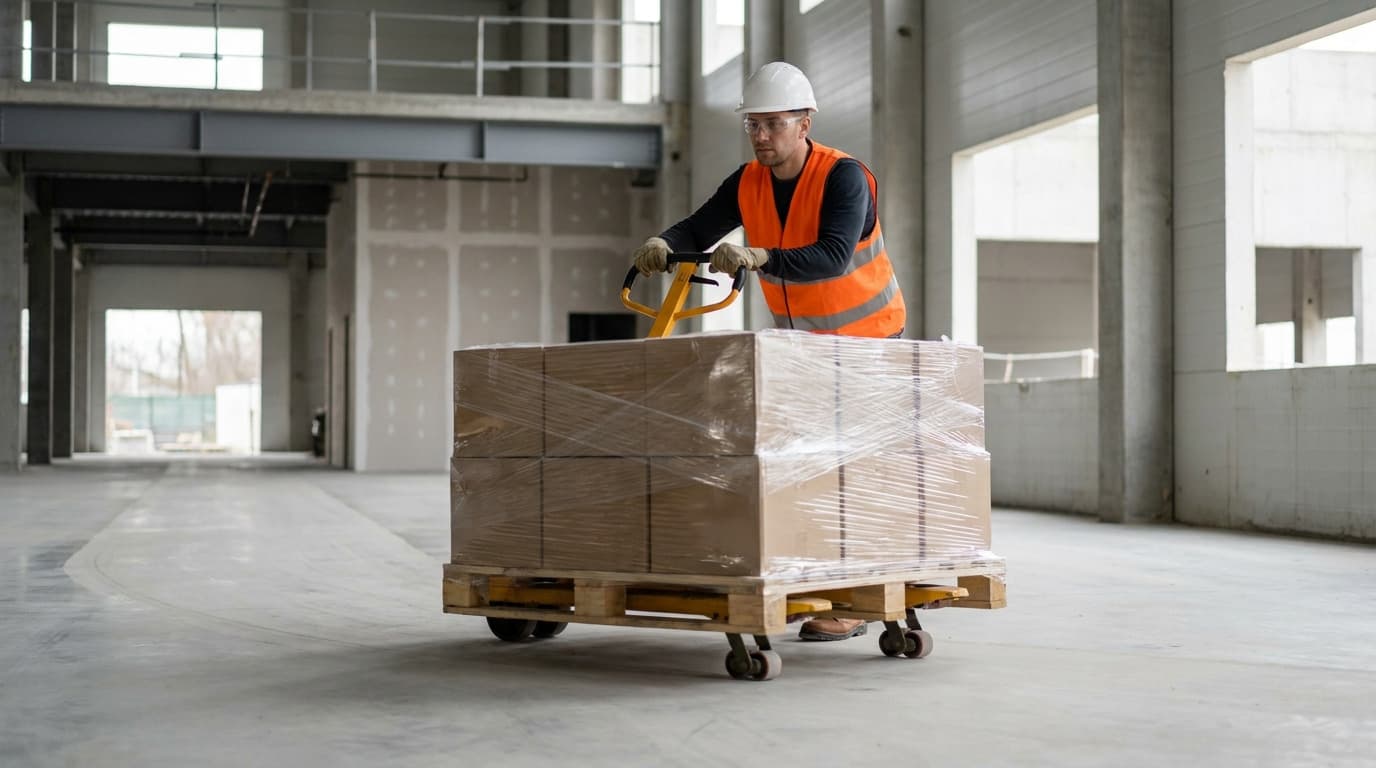
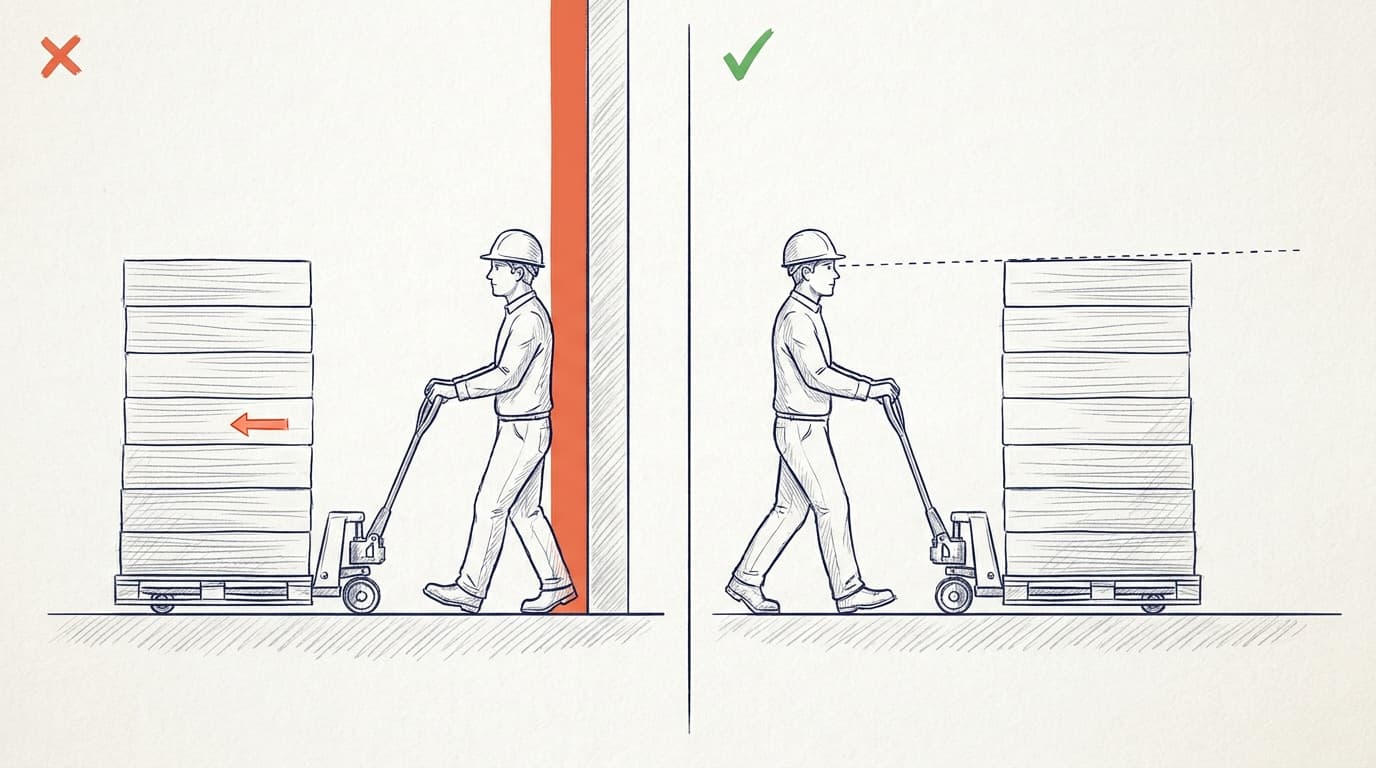
Push rather than pull, wherever the route allows. Pushing lets you use body weight and keeps the load in front of you where you can see it and where it cannot pin you. Pulling puts the load behind your line of travel and puts you in front of it.
What can go wrong#
Walking backwards. The dominant pattern. The operator cannot see the route, and the load follows into whatever they back into.
Feet and ankles under the wheels. The load wheels run at ankle height, carry most of the weight, and are small enough to concentrate it. Steel-toe boots do not protect the metatarsals or the ankle.
Ramps, thresholds, and slab drainage. A loaded jack accelerating downhill is not recoverable by hand.
Cracks, expansion joints, cable ramps, and debris. Small wheels stop dead on obstructions the operator would step over without noticing.
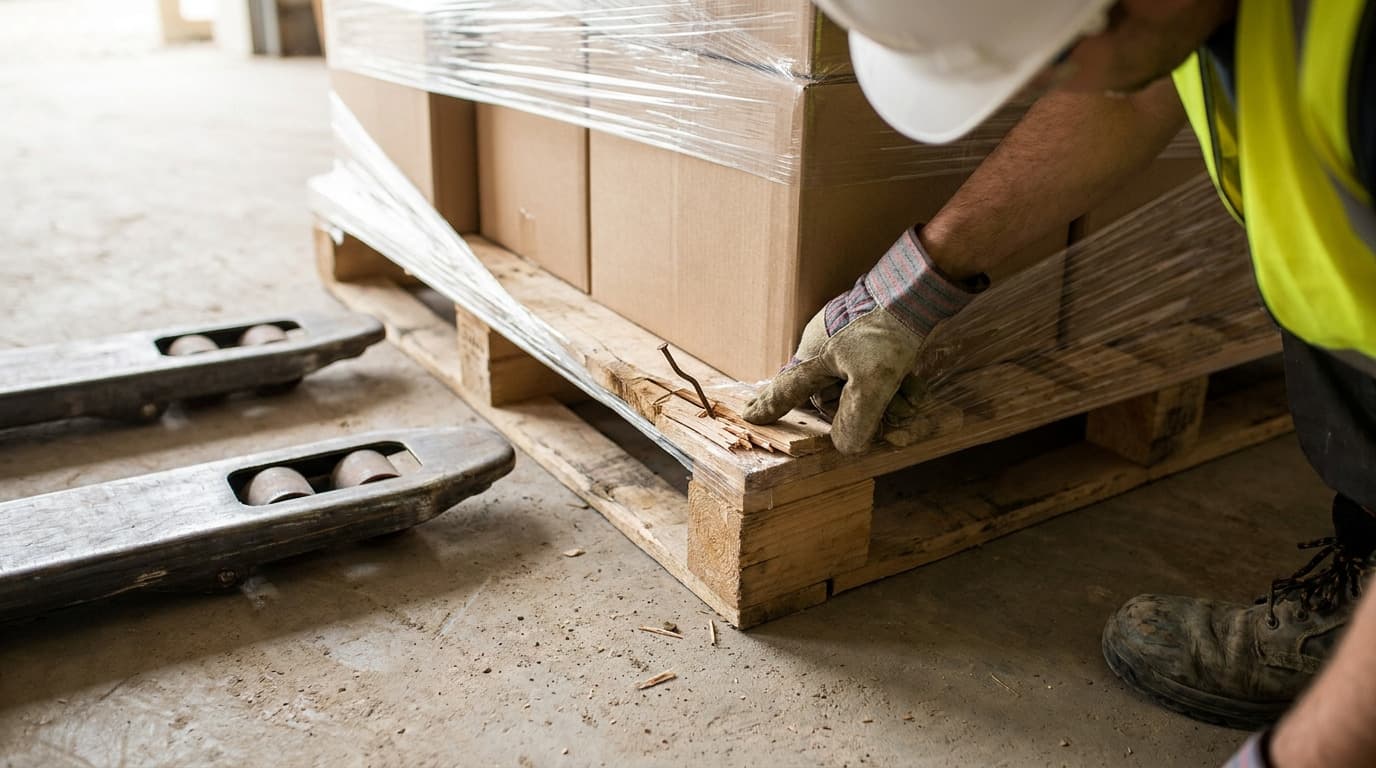
The pallet itself. Broken boards, protruding nails, previously repaired pallets, and loads whose weight sits over one corner. Forks entering a damaged pallet can drop the load.
Overloading. The capacity plate is on the machine and nobody reads it. Over capacity, the hydraulics may still lift it and the machine may still roll — right up until steering or stopping is required.
Unstable or top-heavy loads that shift when the jack starts, stops, or turns.
Uncontrolled lowering. Dropping the forks quickly with an unstable load, or lowering onto feet.
Parking it anywhere. Left in a walkway with forks raised, it becomes a trip hazard at shin height and an obstruction for everyone else.
Two people, one jack, no plan — one pulling, one steering, neither in control.
Using it as a step, a seat, or a scooter. Common, and the reason a machine with no brakes ends up carrying a person down a slope.
How do we control it?#
Train people on it even though no certificate exists. Under 1926.21(b)(2) instruction in hazard recognition is required regardless of whether a certification standard applies. Show new starters the machine, the capacity plate, the lowering lever, and the route.
Read the capacity plate and respect it. The number on the machine beats any rule of thumb.
Push, do not pull, wherever the route allows it. Load in front, body weight behind it, eyes on the path.
Plan the route before you break the load into motion. Doorways, thresholds, floor joints, slopes, blind corners, and where you will set it down.
Refuse the slope. If the route has a ramp or a graded slab, use a different route, a powered machine, or a second person — not more grip.
Keep feet clear and out from under. Stand to the side of the tiller rather than in line with the wheels, and never place a foot under a load being lowered.
Start slowly and deliberately. The peak force is at the moment the load breaks into motion, so ease it rather than jerking it.
Check the pallet before the forks go in. Broken stringers, split boards, protruding fasteners, and load position over the deck.
Sound off at blind corners and slow to walking pace where people cross.
Lower fully and park out of the walkway. Forks down, out of the traffic route, not blocking an exit.
Inspect it. 1926.20(b)(2) requires regular inspection by a competent person — wheels, forks, tiller, and hydraulic function, including whether it holds the load and lowers under control.
On USACE and NAVFAC projects, EM 385-1-1 applies and carries its own material handling requirements — check them rather than assuming the absence of a 1910.178 duty means there is nothing to comply with.
Before you start#
- Read the capacity plate on this machine and confirm the load is within it.
- Walk the route before you move the load: thresholds, joints, slopes, blind corners, and the set-down point.
- Confirm there is no slope on the route, or arrange a different means.
- Check the pallet for broken boards, protruding nails, and load position.
- Confirm you can push rather than pull for most of the route.
- Confirm feet — yours and everyone else's — are clear of the wheel path.
- Confirm the load is stable and will not shift when you start or corner.
- Confirm you can see over or around the load, or arrange a spotter.
- Confirm where it will be parked, forks down and out of the walkway.
- Check the jack itself: wheels, tiller, and whether the hydraulics hold and lower under control.
Talk it over#
- Find the brake on this machine. What actually stops it once it is rolling?
- What is the steepest part of the route between here and where this load is going?
- If you are pulling this backwards and someone opens that door, what happens?
The bottom line#
A manual pallet jack is not a powered industrial truck. 29 CFR 1910.178(a)(1) covers trucks powered by electric motors or internal combustion engines, so a hand-operated jack falls outside it and none of the operator certification requirements apply — which is exactly why so many people are using one with no training at all. The duty still exists under 1926.21(b)(2), 1926.20(b)(2), and the General Duty Clause. And the machine itself has no brakes under a load that is commonly rated at 2,000 to 2,500 kg. So read the capacity plate, walk the route first, push instead of pulling, refuse slopes rather than muscling them, keep your feet out of the wheel path, and park it with the forks down and out of the way.
Frequently asked questions about manual pallet jacks#
Does OSHA require certification to use a manual pallet jack?
No. 29 CFR 1910.178(a)(1) applies to fork trucks, tractors, platform lift trucks, motorized hand trucks, and other specialized industrial trucks powered by electric motors or internal combustion engines. A manual pallet jack has neither, so it falls outside the standard and the operator training and certification requirements in 1910.178(l) do not apply to it.
So no training is required at all?
Training is still required — just not under that standard. On construction sites 29 CFR 1926.21(b)(2) requires the employer to instruct each employee in the recognition and avoidance of unsafe conditions applicable to their work environment, and the General Duty Clause, Section 5(a)(1) of the OSH Act, applies to recognised hazards with feasible controls. The obligation exists; it simply does not produce a certificate.
Is a powered pallet jack different?
Completely. A powered or electric pallet jack — what OSHA calls a motorized hand truck — is a powered industrial truck under 1910.178, and the full operator training, evaluation, and periodic re-evaluation requirements of 1910.178(l) apply. The same machine with a motor is a different regulatory object.
How much can a manual pallet jack carry?
Read the capacity plate on the specific machine, because that is what governs. As a general indication, manufacturers commonly rate manual pallet jacks in the region of 2,000 to 2,500 kg (4,400 to 5,500 lb). Exceeding it does not necessarily prevent the machine from lifting or rolling — the consequences show up when you need to steer or stop.
Do manual pallet jacks have brakes?
No. A standard manual pallet jack has a hydraulic pump to raise the forks and a lever to lower them, but no braking system. Once a loaded jack is in motion, it is stopped by friction, by the operator, or by whatever it strikes. This is why slopes and ramps are the highest-risk part of any route.
Should I push or pull a pallet jack?
Push wherever the route allows. Pushing lets you use body weight, keeps the load in front of you where it is visible, and keeps you out of the space between the load and any obstruction. Pulling places the load behind your direction of travel and puts you between it and whatever you are backing towards.
Does the NIOSH lifting equation cover pushing a pallet jack?
No. The Revised NIOSH Lifting Equation assesses two-handed lifting tasks and does not cover pushing, pulling, or carrying. Moving a load onto a pallet jack removes the lifting hazard but moves the task outside that assessment tool, so the pushing and pulling forces have to be managed through route design, load limits, and technique rather than by calculating a weight limit.
Download the manual pallet jack toolbox talk PDF#
Get this manual pallet jack toolbox talk as a print-ready PDF — available in English, Spanish, Portuguese, and Turkish. Print it, hand it to the crew, and collect signatures on the included attendance sheet.
Download the PDF — free account required. New members get 3 free downloads.
Related toolbox talks#
Sources#
- OSHA, 29 CFR 1910.178 — Powered industrial trucks: https://www.osha.gov/laws-regs/regulations/standardnumber/1910/1910.178
- OSHA, 29 CFR 1926.21 — Safety training and education: https://www.osha.gov/laws-regs/regulations/standardnumber/1926/1926.21
- OSHA, 29 CFR 1926.20 — General safety and health provisions: https://www.osha.gov/laws-regs/regulations/standardnumber/1926/1926.20
- NIOSH, Applications Manual for the Revised NIOSH Lifting Equation, DHHS (NIOSH) Publication No. 94-110, 1994
Written by FieldSafetyTalk's safety professional — a CSP, ASP, CHST and OSHA Authorized Outreach Trainer with 14+ years of international construction safety experience across federal, heavy civil, and industrial projects.